
August 7, 2026
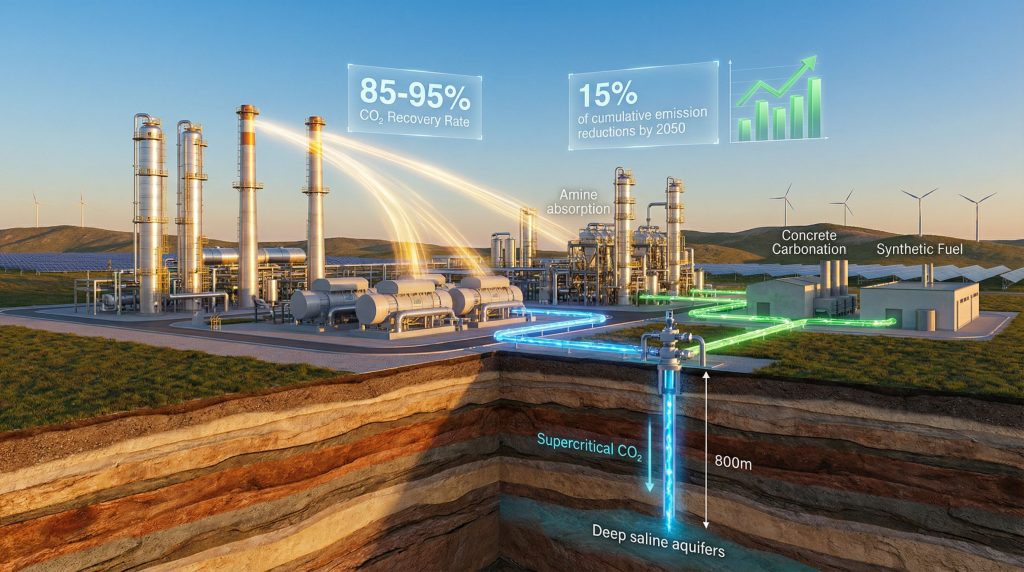
Carbon capture utilisation and storage technologies have emerged as critical infrastructure for addressing the fundamental challenge of industrial process emissions that cannot be eliminated through conventional electrification and decarbonisation or renewable energy adoption. While renewable technologies effectively address electricity sector emissions, approximately 40% of global industrial emissions originate from chemical processes inherent to manufacturing operations, requiring engineered solutions that can intercept, redirect, and permanently sequester carbon dioxide at its source.
Understanding the Integrated CCUS Framework
The carbon capture utilisation and storage approach represents a multi-stage technological system designed to address emissions across three distinct phases: industrial capture, transport infrastructure, and permanent storage or productive utilisation. This integrated framework acknowledges that certain manufacturing processes generate carbon dioxide as an unavoidable chemical byproduct, independent of energy sources powering the facility.
Modern capture systems operate through three primary methodologies, each optimised for different industrial applications and emission characteristics. Post-combustion capture systems utilise amine-based absorption units to process exhaust streams after fuel burning, achieving 85-95% CO₂ recovery rates from mixed flue gases whilst maintaining retrofitability to existing power plants and industrial facilities.
Pre-combustion capture integration employs fuel gasification to convert carbon sources into hydrogen and concentrated CO₂ streams, enabling simultaneous low-carbon hydrogen production. This methodology proves particularly effective for integrated gasification combined cycle plants where fuel transformation occurs before combustion.
Oxy-fuel combustion technology generates concentrated CO₂ streams through pure oxygen combustion, eliminating nitrogen dilution and simplifying downstream processing requirements. However, this approach requires dedicated air separation units for oxygen production, increasing capital requirements.
Transport infrastructure represents the connecting element between capture and storage, requiring compression of captured carbon dioxide to supercritical states exceeding 31°C and 74 bar pressure for efficient movement through high-pressure pipeline networks, specialised shipping vessels, or road and rail transport systems for smaller volumes.
Storage pathways divide into geological sequestration and industrial utilisation applications. Geological storage operates through injection into deep saline aquifers exceeding 800 metres depth, depleted oil and gas reservoirs, or coal seams with methane co-production potential. Industrial utilisation transforms captured CO₂ into chemical feedstocks for methanol and synthetic fuel production, concrete carbonation processes, or enhanced agricultural applications.
When big ASX news breaks, our subscribers know first
Industrial Decarbonisation Through CCUS Integration
Carbon capture utilisation and storage technologies address fundamental process emission sources that remain technically challenging to eliminate through alternative decarbonisation pathways. Steel manufacturing generates process emissions from coking coal utilisation and limestone calcination that serve dual functions as thermal energy sources and chemical reducing agents, representing emissions separate from energy-related combustion.
Cement production exemplifies the technical necessity for CCUS deployment, as limestone calcination generates unavoidable process CO₂ representing 60% of cement industry emissions. This stoichiometric chemistry occurs during thermal decomposition where calcium carbonate releases CO₂ as a chemical byproduct, independent of fuel sources powering the facility.
Recent policy developments demonstrate governmental recognition of CCUS importance for industrial decarbonisation. India's February 2026 budget allocated ₹20,000 crore over five years to support carbon capture utilisation and storage deployment across power, steel, cement, refineries, and chemicals sectors. According to Manish Dabkara, Chairman and Managing Director of EKI Energy Services and President of the Carbon Markets Association of India, this allocation represents a significant transition from climate intent to execution by prioritising CCUS deployment across hard-to-abate sectors and laying groundwork for industrial decarbonisation at scale.
Steel manufacturing integration enables 60-80% emission reduction potential when combined with hydrogen-based direct reduction processes, addressing both combustion and process emission sources. Coal-fired power plant retrofits achieve 85-90% emission reductions through post-combustion capture systems, extending asset lifecycles whilst supporting grid stability during renewable energy transitions.
Chemical and petrochemical applications target steam cracking and reforming process emissions whilst enabling integration with circular carbon economy initiatives. Natural gas combined cycle integration provides flexible backup power for renewable-heavy grids whilst achieving near-zero emissions through capture system deployment.
Furthermore, biomass energy with carbon capture and storage creates net-negative emission electricity generation by combining renewable biomass combustion with permanent CO₂ sequestration, effectively removing atmospheric carbon whilst generating electricity.
Economic Framework Driving CCUS Investment
The economic viability of carbon capture utilisation and storage depends on rapidly evolving cost structures and revenue generation mechanisms that create multiple value streams for project developers. Current total CCUS chain costs range from $50-200 per tonne CO₂, with industry projections targeting $30-100 per tonne by 2030 through technology learning curves and deployment scale effects.
| Technology Component | Current Cost Range (USD/tonne CO₂) | 2030 Target Range |
|---|---|---|
| Post-Combustion Capture | $40-120 | $25-60 |
| Pre-Combustion Capture | $30-80 | $20-50 |
| Transport (Pipeline) | $2-15 | $2-10 |
| Geological Storage | $5-25 | $3-15 |
| Total CCUS Chain | $50-200 | $30-100 |
Revenue generation occurs through multiple mechanisms creating diversified project economics. Carbon credit monetisation operates across voluntary markets with pricing ranges of $10-100 per tonne CO₂ and compliance markets offering premiums for verified storage with potential Article 6 international transfer opportunities under Paris Agreement frameworks.
Enhanced oil recovery economics provide immediate revenue offsets, generating 0.2-0.5 barrels additional oil per tonne CO₂ injected. At oil prices of $60-80 per barrel, this creates revenue offsets of $20-40 per tonne CO₂, improving project economics whilst achieving permanent storage through geological trapping mechanisms.
Industrial product value creation offers premium revenue streams through CO₂ utilisation pathways:
• CO₂-derived methanol: $300-500 per tonne
• Synthetic aviation fuels: $800-1,200 per tonne
• Concrete carbonation: $10-30 per tonne CO₂ utilised
Anujesh Dwivedi, Partner at Deloitte India, characterises budget proposals as signalling a sharper push to mobilise capital and localise supply chains for energy transition challenges, with the ₹20,000 crore five-year CCUS outlay expected to accelerate decarbonisation and help protect export competitiveness amid Carbon Border Adjustment Mechanism implementation.
Learning curve effects drive cost reductions of 10-15% per doubling of capacity, whilst standardisation and modularisation reduce capital costs by 20-30% through shared infrastructure development spreading transport and storage costs across multiple industrial users.
Priority Industries for CCUS Implementation
Global carbon capture utilisation and storage potential concentrates across specific industrial sectors based on emission volumes, technical feasibility, and economic viability. Power generation represents 40% of global CCUS potential, encompassing 2-4 GtCO₂ per year from coal-fired plants, 1-2 GtCO₂ per year from natural gas facilities, and 0.5-1 GtCO₂ per year from biomass integration opportunities.
Iron and steel manufacturing accounts for 15% of global potential with 1.5-2 GtCO₂ per year addressable emissions from integrated steel mills. Direct reduction hydrogen integration provides complementary decarbonisation pathways, whilst scrap steel electric arc furnace applications offer additional deployment opportunities.
Cement manufacturing represents 10% of global potential through 1-1.5 GtCO₂ per year process emission capture from limestone calcination. Concrete carbonation utilisation pathways create additional value streams whilst alternative cement chemistry development explores complementary approaches.
Chemical and petrochemical sectors encompass 12% of global potential across multiple subsectors:
• Steam cracking: 0.3-0.5 GtCO₂ per year
• Ammonia production: 0.4-0.6 GtCO₂ per year
• Refinery operations: 0.5-0.8 GtCO₂ per year
India's sectoral targeting through the ₹20,000 crore budget allocation specifically addresses power, steel, cement, refineries, and chemicals, aligning with global high-potential sectors whilst supporting domestic industrial competitiveness in carbon-constrained markets.
Emerging application areas include direct air capture integration for atmospheric CO₂ removal, blue hydrogen production through natural gas reforming with CO₂ capture, and integration with renewable energy systems for cost optimisation during hydrogen economy development.
Technology Performance Comparison and Assessment
Different carbon capture utilisation and storage technologies demonstrate varying performance characteristics across efficiency metrics, energy penalties, and retrofit compatibility factors. Technology selection depends on specific industrial applications, existing infrastructure, and economic optimisation requirements.
| Capture Method | CO₂ Recovery Rate | Energy Penalty | Retrofit Compatibility |
|---|---|---|---|
| Amine Absorption | 85-95% | 15-30% | High |
| Solid Sorbents | 80-90% | 10-25% | Medium |
| Membrane Separation | 70-85% | 5-15% | High |
| Cryogenic Separation | 90-99% | 20-35% | Low |
Storage security and monitoring protocols ensure permanent containment through multiple verification mechanisms. Seismic monitoring assesses structural integrity, whilst geochemical analysis tracks CO₂-rock interaction patterns. Pressure monitoring manages injection zone conditions, and satellite monitoring detects potential surface emission occurrences.
Storage Verification and Monitoring
Geological containment verification requires caprock integrity assessment demonstrating security exceeding 1,000 years, well integrity monitoring and maintenance protocols, and long-term liability frameworks with insurance mechanisms. Measurement, reporting, and verification standards ensure carbon credit validity and environmental integrity.
Technology maturity varies significantly across CCUS components:
| Technology Component | Technology Readiness Level | Commercial Deployment Status |
|---|---|---|
| Post-Combustion Capture | TRL 8-9 | Commercial (limited scale) |
| Pre-Combustion Capture | TRL 7-8 | Demonstration phase |
| CO₂ Transport | TRL 9 | Fully commercial |
| Geological Storage | TRL 8-9 | Commercial (growing) |
| Direct Air Capture | TRL 6-7 | Early demonstration |
Global CCUS Deployment and Policy Trends
Regional implementation strategies demonstrate varying approaches to carbon capture utilisation and storage deployment based on policy frameworks, industrial structures, and geological resources. North America leads through the 45Q tax credit providing $85 per tonne CO₂ for storage and $60 per tonne for utilisation, combined with regional CO₂ transport hub development across Texas, Louisiana, and North Dakota.
European Union policy frameworks utilise Innovation Fund support for large-scale CCUS demonstrations, EU ETS carbon pricing creating economic incentives, and Green Deal industrial decarbonisation targets driving deployment acceleration.
Asia-Pacific development encompasses China's national CCUS demonstration program targeting 100 MtCO₂ per year by 2030, Japan's Asia CCUS Network for regional cooperation, and Australia's carbon capture and storage research supporting technology advancement.
Policy Frameworks and International Cooperation
India's approach through the ₹20,000 crore allocation represents government intervention policies recognition of CCUS necessity for industrial competitiveness. The funding aligns with a roadmap launched in December 2025, targeting higher readiness levels in end-use applications across five industrial sectors.
International cooperation mechanisms include Article 6 frameworks under the Paris Agreement enabling cross-border carbon credit transfer, technology sharing agreements, and coordinated research and development programmes advancing cost reduction and deployment acceleration.
The next major ASX story will hit our subscribers first
CCUS Role in Net-Zero Pathway Achievement
Carbon capture utilisation and storage technologies contribute essential emission reduction capabilities across climate scenario pathways. The International Energy Agency's Net Zero by 2050 scenario assigns CCUS responsibility for 15% of cumulative emission reductions, totalling 76 GtCO₂ by 2050 through industrial applications, power sector deployment, and direct air capture operations.
Sectoral decarbonisation timelines require accelerated CCUS integration:
• Cement: 50% emission reduction by 2030 requiring CCUS integration
• Steel: 30% reduction by 2030 through hydrogen and CCUS combination
• Chemicals: 25% reduction through process optimisation and CO₂ utilisation
Technology complementarity enables integrated decarbonisation approaches. CCUS provides flexible fossil fuel backup during renewable intermittency, excess renewable electricity powers direct air capture operations, and green hydrogen production complements blue hydrogen with CCUS deployment.
Furthermore, circular carbon economy development transforms waste CO₂ into feedstock for chemical production, creating closed-loop industrial processes whilst reducing virgin fossil fuel consumption across value chains.
Implementation Challenges and Strategic Solutions
Technical barriers require continued innovation across multiple fronts. Energy efficiency improvements focus on advanced solvents reducing capture energy penalties from 30% to 15%, heat integration optimising thermal management, and process intensification through modular capture unit designs.
Cost reduction pathways leverage learning curve effects generating 10-15% cost reduction per doubling of capacity, standardisation and modularisation reducing capital costs by 20-30%, and shared infrastructure development spreading transport and storage costs across industrial clusters.
Policy and regulatory framework requirements include carbon pricing mechanisms with minimum $40-60 per tonne CO₂ pricing for commercial viability, long-term price signals supporting investment decisions, and border carbon adjustments protecting domestic CCUS investments.
Regulatory Framework Development
Regulatory certainty needs encompass streamlined permitting processes for storage site development, liability frameworks for long-term CO₂ storage responsibility, and international standards for CO₂ transport and storage verification ensuring consistent deployment conditions.
In addition, mining decarbonisation benefits demonstrate how CCUS integration across resource extraction industries can improve operational efficiency whilst reducing environmental impact.
Technology Safety and Storage Permanence
Carbon capture utilisation and storage technologies demonstrate proven safety records through decades of operational experience across component technologies. Natural CO₂ storage occurs safely in geological formations worldwide, whilst industrial CO₂ injection for enhanced oil recovery has operated since the 1970s with established safety protocols.
Global geological storage capacity exceeds 10,000 GtCO₂, substantially surpassing the 1,000-2,000 GtCO₂ storage required for climate stabilisation scenarios. Regional capacity distribution ensures North America, Europe, and Asia-Pacific each contain sufficient storage for their respective emission reduction needs.
The distinction between carbon capture and storage (CCS) versus carbon capture, utilisation and storage (CCUS) centres on productive CO₂ applications. Whilst CCS focuses solely on permanent sequestration, CCUS enables revenue generation through industrial utilisation whilst maintaining climate benefits through permanent storage components.
CCUS complements rather than replaces renewable energy deployment by targeting industrial process emissions that cannot be electrified, whilst renewables address electricity sector emissions. Both technologies prove essential for comprehensive decarbonisation across economic sectors.
Properly selected geological storage sites retain CO₂ for thousands to millions of years, demonstrated through natural CO₂ accumulations and engineered storage sites with multiple containment barriers ensuring permanent sequestration supported by monitoring and verification protocols.
Future Outlook and Strategic Implications
Carbon capture utilisation and storage technologies represent essential infrastructure for industrial decarbonisation, particularly across sectors generating unavoidable process emissions. Technology maturity advancement, cost reduction trajectories, and policy framework development collectively support accelerated deployment timelines necessary for climate stabilisation pathways.
Regional policy approaches demonstrate varying strategies optimised for domestic industrial structures and geological resources, whilst international cooperation mechanisms enable technology sharing and coordinated development programmes. The combination of carbon pricing mechanisms, direct government funding, and regulatory certainty creates conditions supporting commercial viability acceleration.
Integration with renewable energy systems, hydrogen economy development, and circular carbon approaches positions CCUS as complementary rather than competing technology, enabling comprehensive industry evolution trends addressing both energy and industrial emission sources simultaneously.
Ready to Capitalise on the Next Clean Technology Breakthrough?
Discovery Alert's proprietary Discovery IQ model instantly identifies significant ASX mineral discoveries in emerging sectors like carbon capture technologies and critical minerals essential for industrial decarbonisation. Explore the exceptional returns from historic discoveries and begin your 14-day free trial today to position yourself ahead of the market.