June 21, 2026
Carbon Capture Utilisation and Storage systems represent one of the most promising technological approaches for achieving deep decarbonization across industries where emissions cannot be eliminated through conventional means. Furthermore, these comprehensive carbon management frameworks address both point-source emissions and process-related outputs that emerge as unavoidable byproducts in sectors such as cement, steel, and chemical manufacturing. However, successful implementation requires coordinated development of capture technologies, transportation infrastructure, and long-term storage or utilization solutions that can operate at commercial scale while maintaining economic viability.
Understanding CCUS Technology Architecture
Carbon Capture Utilisation and Storage systems represent integrated technological frameworks designed to intercept carbon dioxide emissions at their source, transport captured materials to processing or storage locations, and either sequester the carbon permanently or transform it into valuable products. These systems distinguish themselves from other emission reduction approaches by addressing unavoidable industrial emissions while maintaining production capacity.
The architecture of CCUS deployment typically involves three distinct operational phases: capture at emission sources, transportation via pipeline or alternative methods, and final disposition through either geological storage or utilization pathways. Each phase requires specialised equipment, infrastructure development, and coordination between multiple industrial and logistical stakeholders.
Point-source capture technologies focus on intercepting emissions directly from industrial facilities, power plants, or other concentrated emission sources. This approach offers higher efficiency rates compared to atmospheric capture methods, as the carbon dioxide concentrations in flue gases or process streams typically range between 10-20% compared to atmospheric concentrations of approximately 0.04%.
Direct air capture methodologies, while less mature commercially, provide opportunities to address distributed emissions or achieve negative emission outcomes when coupled with renewable energy sources. These systems require significantly higher energy inputs per tonne of carbon dioxide captured, with current energy requirements ranging from 1,500-2,500 kWh per tonne CO₂ compared to 300-500 kWh per tonne for point-source applications.
Integration with existing industrial infrastructure presents both opportunities and challenges for CCUS deployment. Retrofit applications must address space constraints, utility integration, and process modification requirements while minimising production disruptions. New facility designs can incorporate carbon management systems from initial planning stages, potentially reducing overall implementation costs by 15-25% compared to retrofit scenarios.
When big ASX news breaks, our subscribers know first
What Are the Primary CCUS Capture Technologies?
Pre-Combustion Capture Systems
Pre-combustion capture approaches involve modifying fuel processing before combustion occurs, typically through gasification or reforming processes that separate carbon dioxide from hydrogen-rich synthesis gas. These systems offer theoretical capture efficiencies exceeding 90% while producing hydrogen as a valuable byproduct for industrial applications or energy storage.
Gasification processes convert solid or liquid fuels into synthesis gas through controlled oxidation at temperatures ranging from 800-1,200°C. The resulting gas mixture contains carbon monoxide, hydrogen, and carbon dioxide, which can be separated using established industrial separation techniques. Water-gas shift reactions convert carbon monoxide to additional hydrogen and carbon dioxide, increasing overall capture rates.
Industrial applications in steel manufacturing focus on replacing traditional blast furnace operations with hydrogen-based direct reduction processes. This approach can reduce carbon dioxide emissions from steel production by 60-80% while maintaining product quality and production rates. However, hydrogen supply infrastructure and cost considerations currently limit widespread deployment.
Chemical manufacturing facilities utilising pre-combustion systems can integrate carbon capture with existing ammonia or methanol production processes, where hydrogen serves as a primary feedstock. This integration approach reduces additional infrastructure requirements while improving overall facility carbon intensity.
Post-Combustion Capture Methods
Post-combustion capture technologies treat flue gases after fuel combustion, making them suitable for retrofit applications across diverse industrial sectors. These systems typically achieve capture rates between 85-95% depending on flue gas composition and operational parameters.
Amine-based solvent systems represent the most commercially mature post-combustion technology, utilising chemical absorption to separate carbon dioxide from flue gas streams. Monoethanolamine (MEA) and other advanced solvents demonstrate CO₂ loading capacities of 0.4-0.6 mol CO₂ per mol amine, with regeneration requiring 3.0-4.0 GJ per tonne CO₂ captured.
The regeneration cycle involves heating loaded solvent to 100-120°C to release concentrated carbon dioxide for downstream processing. Energy integration with waste heat sources or steam systems can reduce overall energy penalties, which typically range from 20-30% of facility net power output for coal-fired applications and 10-15% for natural gas facilities.
Solid sorbent technologies offer potential advantages in specific applications, particularly where water content or impurities limit solvent performance. Temperature swing adsorption systems using metal-organic frameworks (MOFs) or other advanced materials demonstrate working capacities of 2-6 mmol CO₂ per gram sorbent with regeneration temperatures between 60-150°C.
Membrane separation techniques provide continuous operation without chemical reagents, utilising selective permeability to separate carbon dioxide from other flue gas components. Polymeric membranes achieve CO₂/N₂ selectivities of 20-50 with permeabilities reaching 1,000 Barrer or higher, though commercial deployment requires multi-stage systems to achieve acceptable capture rates.
Oxyfuel Combustion Approaches
Oxyfuel combustion involves burning fuels in pure oxygen rather than air, producing flue gas composed primarily of carbon dioxide and water vapour. After water condensation, the resulting stream contains 90-95% CO₂ concentration, significantly simplifying purification requirements compared to conventional combustion.
Oxygen production represents the primary energy penalty for oxyfuel systems, typically requiring 200-250 kWh per tonne O₂ using cryogenic air separation. Advanced oxygen transport membranes under development could reduce this energy requirement to 150-180 kWh per tonne O₂ while eliminating separate air separation infrastructure.
Equipment modifications for existing combustion systems include burner replacements, heat transfer adjustments, and flue gas recirculation systems to maintain appropriate combustion temperatures. Capital costs for oxyfuel retrofits typically range from $1,200-2,000 per kW depending on facility size and complexity.
Power plant integration requires careful balance between oxygen supply, combustion control, and carbon dioxide processing systems. Efficiency penalties for oxyfuel systems range from 8-12 percentage points for coal applications and 6-9 percentage points for natural gas facilities, including oxygen production energy requirements.
How Do Transportation Networks Enable CCUS Deployment?
Pipeline Infrastructure Development
Carbon dioxide transportation via high-pressure pipeline systems represents the most cost-effective solution for large-volume, long-distance transport between industrial emission sources and storage or utilisation sites. Pipeline systems typically operate at pressures between 100-200 bar to maintain dense-phase CO₂ conditions, reducing pipeline diameter requirements and compression costs.
Pipeline specifications vary based on transported volumes and distances, with typical diameters ranging from 200mm for smaller facilities to 1,200mm for major transport corridors. Wall thickness requirements depend on operating pressure and terrain, with API 5L X65 or higher grade steel commonly specified for CO₂ service.
Corrosion management represents a critical consideration for CO₂ pipeline systems, as water content and impurities can accelerate internal corrosion rates. Dehydration systems maintaining water content below 50 ppm and internal coating or inhibitor systems help ensure 40-year design lifespans typical for pipeline infrastructure investments.
Network design optimisation involves balancing pipeline routing, compression requirements, and storage capacity to minimise overall system costs while providing operational flexibility. Hub-and-spoke configurations connecting multiple emission sources to central processing or storage facilities can reduce per-tonne transportation costs by 30-50% compared to point-to-point systems.
| Pipeline Parameter | Typical Range | Design Considerations |
|---|---|---|
| Operating Pressure | 100-200 bar | Dense-phase CO₂ transport |
| Pipeline Diameter | 200-1,200mm | Volume and distance dependent |
| Wall Thickness | 8-25mm | Pressure rating and terrain |
| Design Lifespan | 40+ years | Material selection and maintenance |
Alternative Transport Solutions
Ship-based transport provides flexibility for offshore storage sites or international carbon dioxide trade, with specialised CO₂ carriers capable of transporting 10,000-50,000 tonnes per voyage. Refrigerated transport at -50°C and 7 bar or pressurised transport at 15-20 bar and ambient temperature represent the primary maritime transport configurations.
Loading and unloading infrastructure requirements include specialised terminals with temperature and pressure control systems, along with temporary storage capacity to manage supply-demand timing differences. Terminal costs typically range from $50-200 million depending on capacity and technical requirements.
Rail transport offers solutions for intermediate distances and distributed collection scenarios, utilising specialised railcar designs capable of carrying 100-130 tonnes CO₂ per car. Rail economics become favourable for distances between 200-800 km where pipeline infrastructure development costs exceed rail transport and temporary storage expenses.
Road transport serves smaller-volume applications or interim solutions during infrastructure development phases, with truck capacities limited to 15-25 tonnes CO₂ per vehicle. While offering maximum flexibility, road transport costs typically exceed $50 per tonne CO₂ for distances above 100 km, limiting applications to specialised circumstances.
Temporary storage facilities provide operational flexibility by managing timing differences between capture operations and transport availability. Storage systems utilising refrigerated tanks at -20°C or pressurised vessels at 20-50 bar offer capacities ranging from 1,000-10,000 tonnes, depending on operational requirements and economic optimisation.
What Storage Options Provide Long-Term CO₂ Sequestration?
Geological Storage Formations
Depleted oil and gas reservoirs offer well-characterised storage opportunities with existing infrastructure and proven containment capability over geological timescales. These formations typically provide injection rates of 1-5 million tonnes CO₂ annually per site, with total storage capacities ranging from 10-100 million tonnes depending on original hydrocarbon volumes and reservoir characteristics.
Reservoir pressure management becomes critical as CO₂ injection proceeds, requiring careful balance between injection rates and pressure buildup to avoid fracturing caprock formations. Maximum injection pressures typically remain 10-20% below the minimum stress threshold for caprock integrity, determined through geomechanical analysis and monitoring programmes.
Deep saline aquifers represent the largest potential storage resource globally, with estimated capacities exceeding 10,000 billion tonnes CO₂ worldwide. However, site characterisation requirements include extensive geological surveys, hydrodynamic modelling, and containment assessment protocols to ensure long-term storage security according to CSIRO's carbon capture and storage research.
Assessment protocols for saline aquifers involve multi-year characterisation programmes including seismic surveys, exploratory drilling, formation testing, and geochemical analysis. These programmes typically require $50-200 million investment per major storage site, representing a significant barrier to storage development in regions without existing geological data.
Unmineable coal seams offer storage potential while potentially recovering additional methane through enhanced coalbed methane (ECBM) processes. CO₂ adsorption capacities range from 15-30 cubic metres per tonne of coal, with methane recovery factors increasing by 50-100% compared to primary recovery methods.
Storage Security and Monitoring
Caprock integrity assessment involves detailed analysis of seal rock permeability, thickness, and lateral continuity to ensure containment capability over 1,000+ year timescales. Laboratory analysis of caprock samples determines breakthrough pressures typically exceeding 5-20 MPa, providing safety margins against CO₂ migration.
Seismic monitoring networks utilise arrays of geophones or seismometers to detect microseismic activity associated with CO₂ injection or potential seal failure. Modern monitoring systems achieve magnitude detection thresholds of -2.0 or lower, enabling early warning of geomechanical responses to injection operations.
Continuous monitoring protocols include:
• Pressure and temperature monitoring at injection wells
• Groundwater quality monitoring in overlying aquifers
• Surface gas flux measurements using mobile or permanent stations
• Satellite-based interferometric synthetic aperture radar (InSAR) for ground deformation
• Atmospheric CO₂ concentration monitoring networks
Leak detection systems combine multiple monitoring technologies to achieve detection thresholds below 0.1% of total injected volumes annually. Integration of monitoring data through advanced analytics and modelling systems enables rapid response to anomalous conditions and regulatory compliance demonstration.
Regulatory frameworks for storage operations continue developing as deployment scales increase, with liability and insurance considerations requiring long-term financial assurance for monitoring and remediation activities. Stewardship transfer protocols typically require 10-50 years of demonstrated storage security before regulatory oversight transitions from operators to government agencies.
How Does CO₂ Utilisation Create Economic Value?
Chemical Manufacturing Applications
Methanol synthesis using captured CO₂ represents one of the most commercially mature utilisation pathways, with production capacities reaching 500,000 tonnes annually at individual facilities. The process combines CO₂ with hydrogen at 200-300°C and 50-100 bar, achieving conversion efficiencies of 75-85% per pass through catalytic reactors.
Hydrogen supply requirements for methanol synthesis range from 0.19-0.22 tonnes H₂ per tonne methanol, making hydrogen costs the primary economic driver for CO₂-to-methanol operations. When renewable hydrogen costs decline to $2-3 per kg, methanol production from CO₂ approaches cost competitiveness with conventional natural gas-based production.
Synthetic fuel production pathways utilising captured carbon dioxide include Fischer-Tropsch synthesis, methanol-to-gasoline processes, and direct CO₂ hydrogenation to synthetic diesel or jet fuel. These processes typically achieve overall carbon efficiencies of 40-60%, meaning significant hydrogen inputs are required relative to fuel energy content.
Carbon Utilisation Pathways Comparison:
| Product | CO₂ Input (tonnes/tonne product) | H₂ Input (tonnes/tonne product) | Market Price Range ($/tonne) |
|---|---|---|---|
| Methanol | 1.4-1.5 | 0.19-0.22 | 300-600 |
| Synthetic Diesel | 3.1-3.4 | 0.45-0.52 | 600-1,200 |
| Urea | 0.73-0.75 | 0.34-0.36 | 200-500 |
| Polycarbonate | 0.45-0.50 | – | 1,500-2,500 |
Polymer and plastic manufacturing using CO₂ feedstock focuses primarily on polycarbonate and polyurethane applications, where carbon dioxide serves as a direct chemical building block. Polycarbonate production incorporating 20-40% CO₂ content achieves comparable material properties while reducing overall carbon footprint by 15-30% compared to conventional production.
Pharmaceutical and specialty chemical synthesis applications utilise CO₂ as a reaction medium or chemical feedstock in specialised applications. While market volumes remain relatively small, value-added products command premium prices justifying higher utilisation costs, particularly for pharmaceutical intermediates where CO₂ content can exceed $5,000 per tonne product value.
Construction and Building Materials
Concrete curing enhancement through controlled CO₂ exposure accelerates strength development while permanently sequestering carbon dioxide within concrete matrix. CO₂ curing processes typically inject 10-50 kg CO₂ per cubic metre concrete, achieving 28-day strength targets in 1-7 days depending on concrete composition and curing parameters.
Carbonation processes for concrete products involve exposing fresh concrete to concentrated CO₂ atmospheres at 10-100% concentration for periods ranging from hours to days. The process forms calcium carbonate crystals that improve concrete density and durability while permanently storing 20-40 kg CO₂ per cubic metre of treated concrete.
Carbon-negative cement production technologies focus on developing alternative cement chemistries that absorb CO₂ during service life or incorporate captured carbon dioxide during manufacturing. These approaches potentially offset 50-100% of cement production emissions while maintaining structural performance requirements.
Aggregate production from CO₂ mineralisation processes combine captured carbon dioxide with industrial waste materials or natural minerals to produce construction aggregates. Mineralisation reactions typically achieve 0.3-0.8 tonnes CO₂ storage per tonne aggregate while producing materials meeting standard specifications for concrete production.
Construction materials represent the largest potential market for CO₂ utilisation by volume, with global cement production alone capable of utilising 2-4 billion tonnes CO₂ annually if enhanced carbonation processes achieve widespread deployment.
Agricultural and Food Industry Uses
Enhanced greenhouse cultivation systems utilise concentrated CO₂ atmospheres to accelerate plant growth and increase crop yields. CO₂ concentrations between 800-1,200 ppm typically increase photosynthesis rates by 20-40% for most crop species, with optimal benefits occurring during daylight hours when photosynthetic activity peaks.
Food preservation applications leverage CO₂'s antimicrobial properties to extend shelf life for fresh produce, meat products, and packaged foods. Modified atmosphere packaging incorporating 20-80% CO₂ concentrations can double shelf life for many products while maintaining food quality and safety standards.
Algae cultivation systems for biofuel production utilise CO₂ as a primary carbon source, with specialised algae strains achieving biomass productivities of 10-50 grams per square metre daily under optimal conditions. While biofuel production remains economically challenging, high-value algae products for pharmaceuticals or nutrition markets demonstrate commercial viability.
What Are the Economic Drivers for CCUS Implementation?
Cost Structure Analysis
Capital expenditure for CCUS systems varies significantly by application and scale, with capture technologies representing 60-80% of total system costs for most applications. Post-combustion capture systems for power plants typically require $1,500-3,500 per kW of generation capacity, while industrial applications range from $400-1,200 per tonne annual CO₂ capture capacity.
Operating costs include energy consumption, maintenance, consumables, and operational labour, typically ranging from $20-80 per tonne CO₂ for mature technologies. Energy penalties represent the largest operational cost component, consuming 15-35% of facility net energy output for power applications and 10-25% for industrial processes with waste heat integration.
Learning curve projections indicate potential cost reductions of 15-30% per doubling of cumulative deployment, similar to patterns observed in renewable energy technologies. These improvements result from manufacturing scale economies, operational optimisation, and technological advancement across system components, supporting broader electrification and decarbonisation trends across industry.
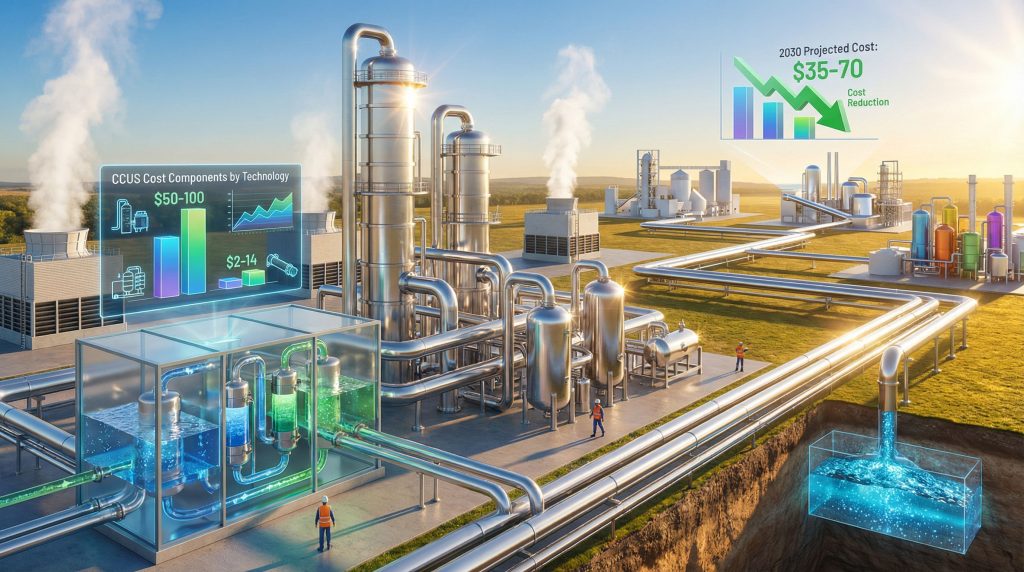
CCUS Cost Breakdown by Component:
| Cost Category | Current Range ($/tonne CO₂) | 2030 Projection | Primary Cost Drivers |
|---|---|---|---|
| Capture (Power Plants) | 50-100 | 35-70 | Energy penalty, equipment costs |
| Capture (Industrial) | 60-120 | 40-80 | Process integration, heat recovery |
| Transport (Pipeline 100km) | 5-15 | 3-10 | Capacity utilisation, terrain |
| Transport (Ship 1000km) | 15-30 | 10-20 | Vessel costs, terminal infrastructure |
| Storage (Depleted Fields) | 3-15 | 2-8 | Site preparation, monitoring |
| Storage (Saline Aquifer) | 8-25 | 5-15 | Characterisation, injection wells |
Revenue Generation Opportunities
Carbon credit monetisation provides primary revenue streams for CCUS projects in regions with carbon pricing mechanisms or voluntary offset markets. Credit values typically range from $10-100 per tonne CO₂ depending on market structure, additionality requirements, and permanence verification protocols.
Enhanced oil recovery (EOR) applications offer additional revenue through increased hydrocarbon production, with CO₂-EOR projects typically recovering 8-16% additional oil from depleted reservoirs. Oil price relationships and reservoir characteristics determine EOR economics, with break-even oil prices typically ranging from $40-80 per barrel depending on CO₂ costs and technical factors.
Product sales from utilisation pathways generate direct revenue streams, though market sizes limit scalability for most applications. High-value chemical products and construction materials offer the most promising near-term opportunities, with aggregate potential markets capable of utilising 200-500 million tonnes CO₂ annually at competitive economics, aligning with evolving energy transition strategies globally.
The next major ASX story will hit our subscribers first
How Do Policy Frameworks Support CCUS Deployment?
Regulatory Enablers
Environmental permitting frameworks continue evolving to address CCUS operations across capture, transport, and storage phases. Permitting timelines typically require 3-7 years for storage site authorisation, including environmental impact assessment, public consultation, and regulatory review processes.
Safety standards for CO₂ handling and transport draw from existing industrial gas regulations while addressing specific characteristics of dense-phase CO₂ systems. Pipeline safety regulations require emergency shutdown systems, leak detection protocols, and emergency response planning for potential exposure scenarios.
Cross-border transport agreements become necessary for international CCUS networks, particularly in regions where optimal storage sites exist in different countries from major emission sources. Protocol development includes liability allocation, monitoring requirements, and dispute resolution mechanisms for transnational carbon transport and storage.
Long-term liability frameworks address stewardship responsibilities for CO₂ storage sites over centuries to millennia time periods. Most jurisdictions require demonstration of storage security over 10-50 year operational periods before transferring long-term liability to government entities or insurance mechanisms, supporting broader industry innovation trends across carbon management.
Financial Incentives and Support Mechanisms
Tax credit systems provide deployment incentives through production-based credits or investment tax credits for CCUS infrastructure. Credit values typically range from $15-85 per tonne CO₂ depending on application and policy design, with longer credit periods supporting project financing for capital-intensive infrastructure.
Government funding programmes support technology development, demonstration projects, and infrastructure deployment through grants, loans, and risk-sharing arrangements. Public funding commitments for CCUS development exceed $25 billion globally across multiple countries, with emerging economies increasingly recognising the strategic importance of carbon management technologies for their industrial competitiveness.
Carbon pricing mechanisms create market demand for CCUS services by establishing economic penalties for unabated emissions. Effective carbon prices above $40-60 per tonne CO₂ typically enable commercial CCUS deployment for most applications, though current prices in most jurisdictions remain below these thresholds.
What Industrial Sectors Benefit Most from CCUS Integration?
Hard-to-Abate Industries
Cement production generates unavoidable process emissions through limestone calcination, accounting for 60-70% of total cement industry emissions globally. CCUS integration can address these process emissions while maintaining production capacity, with capture rates typically achieving 85-95% of total facility emissions including energy-related sources.
Steel manufacturing applications focus on blast furnace operations and direct reduction processes, where carbon serves as both fuel and chemical reductant. CCUS integration with hydrogen-based steelmaking can reduce emissions by 80-95% while maintaining product quality, supporting Australia's emerging green metals leadership position in global markets.
Chemical processing facilities, particularly ammonia and ethylene production, generate concentrated CO₂ streams suitable for capture with minimal additional processing. Ammonia plants typically emit 1.5-2.0 tonnes CO₂ per tonne ammonia, with capture opportunities enhanced by existing high-pressure process conditions.
Sectoral Emission Characteristics:
• Cement: 0.8-1.0 tonnes CO₂ per tonne cement (60% process, 40% energy)
• Steel: 1.8-2.5 tonnes CO₂ per tonne steel (varies by production route)
• Aluminium: 1.5-2.0 tonnes CO₂ per tonne aluminium (mostly energy-related)
• Ammonia: 1.5-2.0 tonnes CO₂ per tonne ammonia (process emissions)
• Ethylene: 1.3-1.8 tonnes CO₂ per tonne ethylene (process and energy)
Refining operations produce multiple CO₂ streams from hydrogen production, catalytic cracking, and other processes, with total emissions typically ranging from 0.3-0.8 tonnes CO₂ per tonne crude oil processed. Integration opportunities include combining multiple emission sources and utilising existing hydrogen infrastructure for utilisation pathways.
Power Generation Applications
Coal-fired power plant retrofits represent large-scale CCUS opportunities, with individual facilities capable of capturing 3-10 million tonnes CO₂ annually. Retrofit applications typically achieve 85-95% capture rates while accepting efficiency penalties of 8-12 percentage points including parasitic power requirements.
Natural gas combined cycle integration offers lower-cost capture opportunities due to higher CO₂ concentrations and lower impurity levels in flue gas streams. Efficiency penalties for natural gas applications typically range from 6-9 percentage points, making economic thresholds more achievable than coal applications.
Biomass energy with carbon capture and storage (BECCS) provides negative emission opportunities when sustainable biomass sources are utilised. BECCS systems can achieve net carbon removal of 0.5-0.9 tonnes CO₂ per MWh of electricity generation, though biomass supply sustainability remains a critical consideration for large-scale deployment.
How Do CCUS Projects Scale from Pilot to Commercial Deployment?
Technology Readiness and Demonstration
Pilot project outcomes demonstrate technology performance at scales ranging from 0.1-10 tonnes CO₂ daily, providing operational data for scale-up design and economic assessment. Successful pilot programmes typically operate for 12-36 months to demonstrate reliability across seasonal and operational variations.
Demonstration projects bridge the gap between pilot testing and commercial deployment, operating at scales of 100-1,000 tonnes CO₂ daily while integrating capture, transport, and storage components. These projects typically require $100-500 million investment and operate for 3-10 years to demonstrate commercial viability.
Commercial deployment timelines vary by application and regulatory environment, with power plant retrofits typically requiring 5-8 years from final investment decision to commercial operation. Industrial applications may achieve shorter timelines of 3-5 years when utilising existing infrastructure and established supply chains.
Technology Maturity Assessment:
• Post-combustion capture: Commercial ready for power and industrial applications
• Pre-combustion capture: Demonstrated at scale, requires hydrogen infrastructure
• Direct air capture: Early commercial phase, high energy requirements
• CO₂ transport: Mature technology, requires network development
• Geological storage: Proven in oil and gas industry, scaling for dedicated storage
• Utilisation pathways: Variable maturity, limited by market scale
Infrastructure Development Pathways
Industrial cluster development strategies focus on connecting multiple emission sources to shared transport and storage infrastructure, reducing per-tonne costs through economies of scale. Cluster approaches typically achieve cost reductions of 30-50% compared to individual facility solutions while improving overall project economics within broader sustainability transformation frameworks.
Hub-and-spoke network configurations utilise central processing facilities to aggregate CO₂ from multiple sources before transport to storage sites. Hub facilities provide compression, purification, and temporary storage capabilities while optimising transport logistics and storage injection schedules.
International cooperation frameworks facilitate technology transfer and infrastructure development across national boundaries, particularly important for smaller countries lacking adequate storage resources. International partnerships can reduce overall system costs while accelerating technology deployment timelines.
What Are the Environmental and Safety Considerations?
Environmental Impact Assessment
Life cycle analysis of CCUS systems must account for energy consumption, infrastructure materials, and operational impacts across the complete carbon management chain. Well-designed systems typically achieve net carbon reduction of 85-95% compared to unabated emissions, with energy integration and renewable power improving overall performance.
Water usage requirements vary significantly by capture technology and cooling system design, with post-combustion systems typically requiring 1.5-4.0 cubic metres per tonne CO₂ captured for solvent-based processes. Closed-loop cooling systems and air cooling reduce water requirements while increasing capital and operating costs.
Waste stream management includes spent solvents, solid sorbents, and other process materials requiring disposal or recycling. Advanced solvent systems achieve degradation rates below 0.1% annually, reducing waste generation while improving overall process economics.
Biodiversity and ecosystem impact assessment addresses potential effects from pipeline construction, storage site development, and facility operations. Environmental impact mitigation typically includes wildlife corridor preservation, habitat restoration, and long-term monitoring programmes according to established environmental management frameworks.
Safety Protocols and Risk Management
CO₂ handling safety protocols address risks from high-pressure systems, oxygen displacement, and potential exposure scenarios during normal and emergency operations. Worker safety systems include atmospheric monitoring, emergency evacuation procedures, and specialised personal protective equipment for confined space operations.
Emergency response procedures cover potential leak scenarios, equipment failures, and transport incidents involving dense-phase CO₂. Response protocols include coordination with local emergency services, public notification systems, and specialised equipment for CO₂ leak mitigation.
Public safety considerations include evacuation planning for communities near transport corridors and storage sites, though CO₂ dispersion modelling indicates minimal risk beyond 1-2 km from potential release points under most meteorological conditions.
Safety Design Standards:
• Pipeline pressure ratings: 1.5-2.0 times maximum operating pressure
• Emergency shutdown systems: Automatic isolation within 15 minutes
• Leak detection sensitivity: 1% of transported volume detection capability
• Worker exposure limits: 5,000 ppm 8-hour time-weighted average
• Emergency response time: <2 hours for qualified response teams
Community engagement strategies involve ongoing dialogue with local stakeholders, transparency in operations and monitoring data, and community benefit programmes that provide economic opportunities related to CCUS infrastructure development.
How Does CCUS Integration Support Net-Zero Targets?
Sectoral Decarbonisation Pathways
Industrial emission reduction roadmaps incorporate CCUS as a critical technology for sectors where alternative decarbonisation approaches face technical or economic limitations. CCUS typically contributes 20-40% of required emission reductions in industrial sectors under net-zero scenarios, complementing energy efficiency and electrification measures.
Integration with renewable energy systems optimises overall carbon management by utilising excess renewable generation for energy-intensive CCUS operations. Power-to-X integration can shift CCUS energy consumption to periods of high renewable availability, improving grid integration while reducing overall system costs.
Circular carbon economy development treats CO₂ as a feedstock for industrial processes rather than solely a waste product, creating value chains that incentivise capture and utilisation across multiple sectors. This approach requires coordination between emission sources, transport infrastructure, and utilisation markets to achieve economic viability.
Global Climate Impact Assessment
CCUS contribution to Paris Agreement objectives requires deployment at scales exceeding 5-10 billion tonnes CO₂ annually by 2050 according to most scenarios limiting warming to 1.5-2.0°C. This deployment level requires significant acceleration from current operational capacity of approximately 50 million tonnes annually.
Technology transfer to developing economies becomes critical for achieving global deployment scales, as emerging economies account for increasing shares of global emissions while often lacking financial resources for CCUS infrastructure development. International climate financing mechanisms increasingly recognise CCUS as an eligible technology for carbon market mechanisms.
Long-term carbon cycle management considerations include permanent storage verification, monitoring protocol development, and institutional frameworks for century-scale stewardship responsibilities. These requirements necessitate international cooperation on standards, verification protocols, and liability frameworks for transnational carbon management systems.
CCUS deployment success requires coordinated development across capture, transport, and storage infrastructure, with industrial cluster approaches and government policy support proving essential for achieving commercial viability and deployment scale consistent with climate objectives.
Future Technology Development and Innovation Trends
Emerging Capture Technologies
Novel solvent development focuses on reducing energy penalties through advanced chemical formulations that require lower regeneration temperatures or offer higher CO₂ loading capacities. Next-generation solvents target regeneration energy reductions of 20-35% while maintaining or improving capture rates and environmental performance.
Solid sorbent advancement emphasises metal-organic frameworks, porous organic polymers, and other structured materials offering working capacities exceeding 6 mmol CO₂ per gram with regeneration temperatures below 100°C. These materials enable modular capture systems with reduced water requirements and simplified process integration.
Electrochemical and photochemical capture methods utilise electrical or solar energy to drive CO₂ separation processes, potentially offering integration advantages with renewable energy systems. While early in development, these approaches target energy requirements below 200 kWh per tonne CO₂ for direct air capture applications.
Advanced Utilisation Pathways
Consequently, the advancement of Carbon Capture Utilisation and Storage technologies represents a critical component in achieving global decarbonisation objectives while maintaining industrial productivity. Furthermore, the integration of these systems across industrial clusters, combined with supportive policy frameworks and technological innovation, creates pathways for commercial viability at scales necessary for meaningful climate impact. Ultimately, successful CCUS deployment requires coordinated development of capture, transport, and storage infrastructure, supported by robust monitoring and safety protocols that ensure long-term effectiveness and public acceptance.
Ready to Invest in Carbon Management Opportunities?
Discovery Alert instantly identifies ASX-listed companies developing carbon capture, utilisation, and storage technologies through its proprietary Discovery IQ model, providing subscribers with rapid insights into emerging opportunities in this rapidly expanding sector. Understand why major technological breakthroughs can lead to significant market returns by exploring Discovery Alert's dedicated discoveries page, showcasing historic examples of exceptional outcomes across transformative technology sectors.