June 18, 2026
European steel producers face unprecedented challenges as regulatory frameworks reshape industrial economics. The viability of transformative investments increasingly depends on carbon pricing mechanisms, particularly within the complex landscape where energy transition challenges intersect with traditional manufacturing processes. EU Allowance prices in Europe's green steel transition have emerged as the primary determinant of investment flows, where emission reduction pathways require substantial capital commitments and extended payback periods.
Carbon Cost Dynamics Reshaping European Steel Economics
European steel production operates under unique regulatory pressures that distinguish it from other global manufacturing regions. The EU Emissions Trading System creates direct financial consequences for carbon emissions, transforming environmental compliance from a regulatory obligation into a core business cost driver. This mechanism generates immediate impacts on production economics, where high-emission blast furnace operations can face carbon-related expenses representing up to 34% of total production costs by 2035 under elevated EU Allowance pricing scenarios.
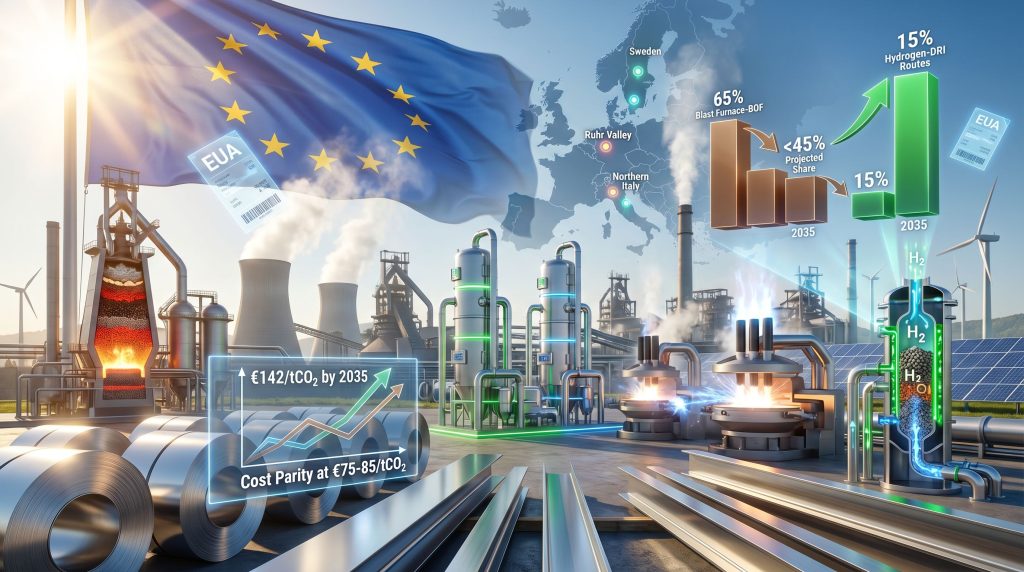
The threshold dynamics of carbon pricing create distinct competitive advantages for lower-emission technologies. Research indicates that EU Allowance prices above €75 per tonne CO₂ enable hydrogen-based direct reduced iron production to achieve cost parity with conventional blast furnace routes. This price level represents a critical inflection point where investment decisions fundamentally shift from maintaining existing high-emission assets toward deploying transformative technologies.
Technology arbitrage opportunities emerge through several pathways:
- Electric arc furnace operations gain competitive advantages as carbon costs penalise blast furnace production
- Hydrogen-based direct reduced iron becomes economically viable at sustained carbon prices above €75/tCO₂
- Scrap steel utilisation increases as virgin iron ore-based production faces higher carbon cost burdens
- Regional production cost differentials create geographic optimisation opportunities
The carbon cost amplification effect operates through multiple channels beyond direct emission charges. Supply chain partners increasingly factor carbon intensity into procurement decisions, creating market premiums for low-emission steel products. This dynamic generates compound advantages for producers investing in decarbonisation technologies, while conventional high-emission facilities face both direct carbon costs and market access constraints.
Furthermore, the critical minerals energy transition creates additional considerations for steel producers evaluating technology pathways. The availability and cost of critical materials required for green steel production technologies directly influence the economic competitiveness of different production routes.
When big ASX news breaks, our subscribers know first
Market Structure Transformation Under Alternative Carbon Pricing Scenarios
EU Allowance prices in Europe's green steel transition generate measurable impacts on European steel market composition, with production technology distribution shifting dramatically based on sustained carbon cost levels. High carbon price environments accelerate the transition away from conventional blast furnace-basic oxygen furnace operations toward electric arc furnace and hydrogen-based production routes.
Production Technology Redistribution Projections:
| Technology Route | Current Share (2025) | High EUA Scenario (2035) | Low EUA Scenario (2035) |
|---|---|---|---|
| Blast Furnace-BOF | 65% | 42% | 58% |
| Electric Arc Furnace | 28% | 43% | 35% |
| Hydrogen-DRI Routes | 2% | 15% | 7% |
Under elevated carbon pricing scenarios reaching €142 per tonne CO₂ by 2035, blast furnace operations face accelerated phase-out timelines. The economic pressure from sustained high carbon costs creates conditions where conventional steel producers must choose between extensive capital investments in emission reduction technologies or facility closure.
Emissions Intensity Convergence Patterns
The weighted-average carbon intensity of European steel production exhibits significant sensitivity to EU Allowance price levels. High carbon cost scenarios drive emissions intensity reductions from current levels of 2.1 tonnes CO₂ per tonne of steel to approximately 1.4 tonnes CO₂ per tonne by 2035. This improvement reflects both technology switching and operational optimisation responses to sustained carbon pricing pressure.
Moderate carbon pricing scenarios, with EU Allowances reaching €85 per tonne CO₂ by 2035, extend transition timelines and preserve higher market shares for conventional production technologies. Under these conditions, blast furnace operations maintain 55% or greater market share through 2035, while hydrogen-based production routes achieve only 8-10% of total output. Consequently, the emissions implications are substantial, with moderate carbon pricing scenarios generating an additional 13 million tonnes of CO₂ emissions in 2035 compared to high carbon price trajectories.
Investment Risk Assessment and Capital Allocation Implications
Carbon price volatility creates distinct investment risk profiles across different steel production technologies and geographic locations. Traditional blast furnace operators face potential stranded asset exposure ranging from €2 billion to €4 billion under sustained high EU Allowance price scenarios. These valuations reflect the replacement cost of existing infrastructure against the backdrop of accelerated depreciation under carbon cost pressure.
Critical Investment Decision Points:
- Blast furnace reline decisions become technology switching opportunities at €90+ per tonne CO₂ carbon costs
- Electric arc furnace capacity additions achieve attractive returns at €70 per tonne CO₂ sustained levels
- Hydrogen-based direct reduced iron projects require minimum €90 per tonne CO₂ for 15% internal rates of return
- Geographic concentration risk emerges in traditional steel regions facing coordinated facility transitions
Capital allocation strategies must account for the dual nature of carbon pricing impact: direct cost exposure and technology competitiveness shifts that compound over investment horizons extending through the 2030s.
Green steel project economics demonstrate high sensitivity to carbon price assumptions, with hydrogen-based production routes requiring sustained EU Allowance prices above €90 per tonne CO₂ to achieve acceptable investment returns. This threshold reflects the capital intensity of new technology deployment, hydrogen feedstock costs, and the operational complexities of transitioning from established production systems.
Financial Risk Management Considerations
The alignment with broader critical minerals strategy becomes essential for steel producers planning technology transitions. Access to lithium, nickel, and rare earth elements required for green steel production technologies affects both project economics and supply chain security.
Key financial risk factors include:
- Carbon cost hedging strategies becoming essential for multi-year investment planning
- Technology roadmap decisions requiring scenario stress testing across carbon price ranges
- Asset impairment provisions increasing for high-emission facilities under elevated carbon costs
- Working capital requirements shifting based on carbon cost pass-through capabilities
The timing of investment decisions becomes crucial as carbon price trajectories influence both the competitive positioning of different technologies and the availability of transition financing. Early movers in low-emission technology deployment can capture first-mover advantages, while late adopters face compressed transition timelines and potentially higher technology costs as demand increases.
EU ETS Reform Dynamics and Policy Intervention Scenarios
European Commission evaluations of EU Emissions Trading System modifications focus primarily on Market Stability Reserve mechanisms that could materially alter carbon price trajectories through the 2030s. Proposed reforms include threshold adjustments for allowance releases from 400 million to 600 million Total Number of Allowances in Circulation, enhanced credit release volumes during supply shortages, and modifications to the Linear Reduction Factor affecting long-term supply dynamics.
Reform Impact Modelling Results:
| Reform Scope | EUA Price Effect | Green Steel Timeline | Investment Certainty |
|---|---|---|---|
| Minimal Intervention | +5-10% support | Accelerated deployment | Enhanced |
| Moderate Reform | -15-25% reduction | Delayed competitiveness | Reduced |
| Substantial Changes | -40-50% suppression | Extended transition | Minimal |
The policy trade-offs embedded in EU ETS reform proposals reflect competing priorities between industrial competitiveness and decarbonisation signal strength. However, measures designed to reduce carbon cost burdens on European manufacturers could undermine the economic drivers necessary for green steel investment, potentially extending the operational life of high-emission assets and delaying sectoral transformation.
Market Stability Reserve Modification Scenarios
Reform proposals targeting short-term cost relief through enhanced allowance releases address immediate industrial competitiveness concerns but may compromise long-term investment signals. The threshold increase for allowance releases would activate supply mechanisms earlier in market cycles, potentially capping carbon prices at levels insufficient to drive hydrogen-based steel technology adoption.
Linear Reduction Factor adjustments represent more fundamental interventions in long-term carbon market dynamics. Modifications to the annual reduction in allowance supply directly influence post-2030 carbon price trajectories, affecting investment decisions with decades-long payback periods. For instance, the European Commission faces the challenge of calibrating these mechanisms to maintain industrial competitiveness while preserving decarbonisation incentives.
Regional Production Cost Differentials and Trade Flow Implications
Carbon pricing differentials between European production and international steel imports create complex competitive dynamics that influence both domestic investment decisions and trade patterns. EU-based steel production can incur carbon costs of approximately €150 per tonne under current EU ETS operations, compared to roughly €30 per tonne under Carbon Border Adjustment Mechanism provisions for imported semi-finished products, plus approximately €20 per tonne in freight costs.
Import Substitution Economics
This cost differential generates economic incentives for European steel processors to substitute domestic production with imported semi-finished products, particularly during periods of elevated EU Allowance prices in Europe's green steel transition. Industry data indicates that EU mills imported over 300,000 tonnes of slab from Brazil in January 2026, reflecting the price sensitivity of European steel procurement to carbon cost differentials.
Geographic Production Advantages:
- Southern European facilities benefit from renewable energy access and lower carbon intensity electricity grids
- Northern European integrated mills face highest carbon cost exposure due to coal-dependent electricity and blast furnace concentration
- Coastal locations gain advantages from hydrogen import infrastructure proximity and maritime logistics optimisation
Regional specialisation patterns emerge as carbon pricing creates location-specific competitive advantages. Areas with access to low-carbon electricity, hydrogen infrastructure, and scrap steel availability become preferred locations for electric arc furnace and hydrogen-based direct reduced iron investments. Nevertheless, traditional steel regions face adaptation challenges requiring substantial infrastructure investments or production technology transitions.
The Carbon Border Adjustment Mechanism provides partial protection against carbon cost disadvantages but does not eliminate trade flow pressures entirely. Import competition intensifies during periods of elevated EU Allowance prices, creating utilisation rate pressures on European steel assets and influencing the economics of domestic capacity maintenance versus replacement.
Green Steel Premium Evolution and Market Positioning Dynamics
Current green steel market premiums range from €120 to €180 per tonne for flat products, representing 20-30% premiums above conventional steel pricing. These premiums reflect both production cost differentials and customer willingness-to-pay for low-emission products, with demand concentration in automotive and appliance manufacturing sectors where sustainability commitments drive procurement decisions.
Premium Compression Scenarios
High EU Allowance price environments drive green steel premium compression toward 7-10% above conventional steel by 2035. This convergence results from rising carbon costs on conventional production routes and volume-driven cost reductions in green steel manufacturing. The narrowing price differential accelerates mainstream adoption across construction, infrastructure, and industrial applications.
Market Positioning Evolution:
- High Carbon Cost Environment: Green steel achieves cost parity across most applications by 2032-2035
- Low Carbon Cost Environment: Premiums persist at 25-35% levels, limiting adoption to specialised applications
- Moderate Carbon Cost Environment: Gradual premium compression supports steady but measured market expansion
Customer procurement strategies increasingly incorporate carbon pricing expectations into long-term sourcing decisions. Automotive manufacturers and appliance producers with sustainability targets demonstrate higher willingness-to-pay for green steel, creating market segmentation opportunities. Construction and infrastructure applications show greater price sensitivity but represent larger volume potential as premiums compress.
Volume-Premium Relationship Dynamics
Green steel production scaling creates cost reduction opportunities through learning curve effects, supply chain optimisation, and technology improvements. However, these benefits materialise primarily under sustained high carbon pricing that supports investment in production capacity expansion. Lower carbon cost scenarios limit scale benefits and extend premium persistence timelines.
The next major ASX story will hit our subscribers first
How Does Carbon Pricing Affect Steel Production Technology Selection?
EU Allowance prices in Europe's green steel transition serve as the primary economic signal determining technology pathway selection. Steel producers evaluate investment decisions based on carbon cost projections, with different technologies becoming economically viable at specific price thresholds.
The mining industry evolution significantly influences steel production technology options. Advanced extraction techniques for iron ore and critical minerals affect feedstock availability and cost structures for different steel production routes.
Technology Viability Thresholds:
- Electric Arc Furnaces: Become cost-competitive at €40-50 per tonne CO₂
- Hydrogen-based DRI: Require €75-90 per tonne CO₂ for economic viability
- Carbon Capture Storage: Economically justified above €100 per tonne CO₂
- Advanced Recycling: Competitive across all carbon price scenarios
What Investment Strategies Work Best in This Environment?
Effective investment strategy essentials for the steel sector must incorporate carbon price scenario planning as a fundamental component. Investment decisions require evaluation across multiple carbon cost trajectories to assess technology risk exposure and competitive positioning outcomes.
For Steel Producers
Carbon price forecasting becomes central to technology roadmap planning, requiring integration of EU ETS policy scenarios into capital allocation processes. Producers must evaluate blast furnace maintenance investments against green technology deployment based on carbon cost trajectories and competitive positioning objectives.
Geographic optimisation strategies increasingly depend on regional carbon cost differentials, renewable energy availability, and hydrogen infrastructure development. Production footprint decisions require evaluation of carbon pricing exposure, logistics costs, and market access considerations across multiple facility locations.
For Industrial Customers
Supply chain resilience planning must account for green steel availability and pricing dynamics under different carbon cost scenarios. Long-term procurement strategies benefit from diversification between conventional and green steel suppliers while managing sustainability commitment fulfilment and cost optimisation trade-offs.
Carbon intensity reporting requirements drive supplier selection criteria evolution, with steel carbon footprints becoming key procurement variables. Customer organisations require carbon price scenario planning to manage input cost volatility and sustainability target achievement timelines.
For Investment Stakeholders
Steel sector investment decisions require carbon price scenario stress testing to evaluate technology exposure, geographic positioning, and timing considerations. Green steel technology companies demonstrate positive correlation with sustained high EU Allowance price environments, while conventional steel assets face valuation pressure under elevated carbon costs.
Portfolio allocation strategies must consider the sector rotation dynamics driven by carbon pricing trajectories. European steel investments carry higher carbon policy exposure compared to other regions, requiring specialised analysis of EU ETS reform scenarios and decarbonisation timeline implications.
EU Allowance prices in Europe's green steel transition represent the primary policy variable determining sectoral transformation speed, technology adoption patterns, and competitive positioning outcomes. The mechanism's effectiveness in driving decarbonisation investment depends on sustained price signals sufficient to overcome the capital intensity and operational complexity of steel production technology transitions.
Policy decisions regarding EU ETS reform carry implications extending throughout European industrial competitiveness, environmental outcomes, and capital allocation efficiency. The steel sector's transformation timeline remains directly linked to carbon pricing trajectories, making EU Allowance price developments among the most consequential economic variables in European decarbonisation planning.
This analysis reflects current market conditions and policy frameworks. Steel sector investment decisions should incorporate comprehensive risk assessment and professional advisory services. Carbon pricing forecasts involve regulatory uncertainties that may materially affect projected outcomes.
Ready to Capitalise on Steel Sector Transformation Opportunities?
Discovery Alert's proprietary Discovery IQ model delivers real-time alerts on significant ASX mineral discoveries, including iron ore and critical minerals essential for green steel production technologies. While European steel producers navigate carbon pricing challenges, Australian mining companies developing the raw materials for this transformation present compelling investment opportunities—visit Discovery Alert's discoveries page to see how major mineral discoveries have generated substantial returns, then begin your 14-day free trial to position yourself ahead of the market.