June 4, 2026
The global trade landscape faces unprecedented transformation as climate policies increasingly intersect with international commerce. Carbon pricing mechanisms, traditionally confined within national borders, now extend their reach across international supply chains through sophisticated regulatory frameworks designed to prevent environmental arbitrage. The implementation of these mechanisms has far-reaching implications, particularly as tariffs impact investment markets across various sectors.
The EU carbon border adjustment mechanism represents the world's first comprehensive attempt to align international trade with climate objectives through mandatory carbon cost equalisation. This regulatory innovation operates within the broader architecture of European climate law, specifically building upon the foundation established by the EU Emissions Trading System since 2005.
Understanding CBAM's Regulatory Framework
CBAM functions as an anti-leakage instrument, addressing the fundamental challenge where stringent domestic climate policies inadvertently encourage production migration to jurisdictions with weaker environmental standards. The mechanism creates economic parity between EU producers subject to ETS carbon costs and international competitors operating under different regulatory environments.
The regulatory framework incorporates WTO compliance principles through non-discriminatory application, ensuring that both domestic EU producers and international exporters face equivalent carbon cost burdens. This design prevents the mechanism from functioning as a protectionist trade barrier while maintaining its environmental integrity.
Integration with the existing ETS occurs through direct price linkage, where CBAM certificate costs mirror weekly ETS allowance auction results. This creates a unified carbon pricing signal across both domestic production and international imports, eliminating competitive distortions that previously favoured high-carbon production outside EU jurisdiction.
When big ASX news breaks, our subscribers know first
Which Industries Face CBAM Requirements?
The initial implementation phase targets six industrial sectors representing the highest carbon leakage risk and accounting for approximately 50% of EU ETS emissions. These sectors demonstrate significant energy intensity, substantial international trade exposure, and documented evidence of production migration to avoid carbon costs. Furthermore, these industries often rely on critical raw materials supply chains that span multiple jurisdictions.
Initial Sector Coverage (2026-2030)
| Sector | CN Codes | Coverage Rationale |
|---|---|---|
| Cement and clinker | 2523.29, 2523.30 | High carbon intensity (0.6-0.8 t CO₂/t) |
| Iron and steel | 7201-7226 | Major trade volumes (~35 million tonnes annually) |
| Aluminium | 7601-7616 | Energy-intensive smelting process |
| Fertilizers | 3102, 3105 | Ammonia, urea, ammonium nitrate production |
| Electricity | N/A | Direct power imports |
| Hydrogen | N/A | Grey and low-carbon production pathways |
Steel products represent the largest category by import volume, with approximately 35 million tonnes entering the EU annually under CBAM requirements. The sector's inclusion reflects both its carbon intensity, typically ranging from 1.8-2.2 tonnes CO₂ per tonne of finished steel, and its significant exposure to international competition.
Cement manufacturing faces CBAM obligations due to process emissions from limestone decomposition, creating embedded carbon content of 0.6-0.8 tonnes CO₂ per tonne regardless of energy source. This makes the sector particularly vulnerable to carbon leakage, as production can relocate without significant logistical constraints.
Future Expansion Timeline
Phase two expansion, anticipated between 2031-2035, will extend coverage to organic chemicals, polymers, and comprehensive indirect emissions scope. The European Commission has indicated alignment with the Fit for 55 package objectives, potentially encompassing all EU ETS sectors by 2030.
Current legislative proposals suggest inclusion of downstream manufacturing sectors, though concrete timelines remain subject to ongoing policy development. The expansion methodology will prioritise sectors demonstrating measurable carbon leakage evidence and administrative feasibility for cross-border enforcement.
How Do CBAM Compliance Obligations Work?
The compliance architecture operates through a two-phase implementation model, transitioning from voluntary reporting to mandatory financial obligations. This graduated approach allows market participants to adapt systems and establish necessary data collection procedures before full enforcement begins.
Transitional Reporting Phase (2023-2025)
During the preparatory period, approximately 14,000 installations globally registered within the CBAM Transitional Registry system. Quarterly reporting requirements captured emissions data across direct production processes and electricity consumption, establishing baseline measurements for subsequent certificate pricing.
The transitional phase achieved an 85% compliance rate among major known producers by late 2024, indicating substantial industry engagement despite the absence of financial penalties. Reporting methodologies allowed flexibility between actual facility-level monitoring, conservative estimates, and default values when precise data remained unavailable.
Key operational requirements included:
• Company and facility registration through national competent authorities
• Quarterly emissions declarations within 15 days of period closure
• Documentation of production processes and energy consumption patterns
• Verification procedures for data quality assurance
Full Implementation Phase (2026+)
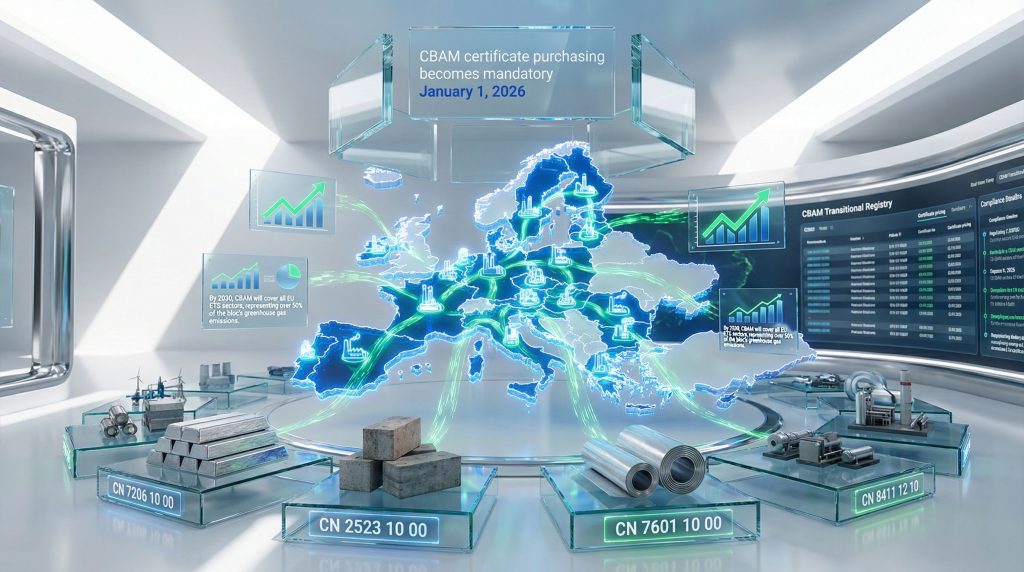
Financial obligations commenced January 1, 2026, requiring CBAM certificate purchases equivalent to embedded carbon content in covered imports. Certificate pricing operates through weekly reference prices derived from ETS allowance auction averages, published each Monday by the European Commission's Carbon Border Adjustment Mechanism.
The compliance framework shifts primary responsibility to importers rather than EU authorities, creating operational dependencies on international cooperation and data transparency standards.
Integration with EU customs procedures occurs through digital validation systems, where border authorities verify certificate holdings against declared shipment emissions before releasing goods for free circulation. This real-time verification prevents circumvention through documentation manipulation or timing arbitrage.
Credit mechanisms allow importers to deduct verified carbon costs paid in origin countries, provided documentation meets EU verification standards. Eligible schemes include national carbon taxes, emissions trading systems, and sectoral climate agreements with transparent pricing mechanisms.
What Are the Financial Implications for Importers?
CBAM implementation creates substantial new cost structures for international trade, with annual financial impacts varying significantly across sectors and origin countries. Historical ETS pricing data indicates certificate costs ranging from €70-95 per tonne CO₂ throughout 2024-2025, establishing baseline expectations for ongoing obligations.
Certificate Pricing Structure
| Reference Period | Average EUA Price | Pricing Mechanism |
|---|---|---|
| 2024 Annual | €82.15/t CO₂ | Weekly auction averages |
| 2025 Annual | €76.40/t CO₂ | Monday publication schedule |
| 2026 Q1 (Projected) | €80-90/t CO₂ | Market-driven volatility |
Weekly price volatility reflects broader carbon market dynamics, including economic conditions, energy prices, and policy announcements affecting ETS allowance demand. This creates ongoing cost uncertainty for importers, necessitating sophisticated hedging strategies or financial risk management approaches.
Cost Pass-Through Analysis
Steel sector impacts demonstrate the mechanism's substantial financial implications. For a typical import scenario involving 1,000 tonnes of hot-rolled steel coils with 1.95 tonnes CO₂ per tonne embedded carbon, total CBAM liability reaches approximately €175,500 at €90/tonne CO₂ pricing levels.
Third-country carbon cost deductions provide partial relief where origin countries maintain credible carbon pricing systems. For example, South Korean steel exports benefit from K-ETS carbon cost credits, while Turkish producers face higher net CBAM obligations due to limited domestic carbon pricing coverage.
Construction materials experience compounding effects as multiple CBAM-covered inputs aggregate within building projects. Cement, steel reinforcement, and aluminium components each carry separate certificate obligations, potentially increasing overall project costs by 2-4% depending on material specifications and origin countries.
How Does CBAM Affect Global Trade Relationships?
The mechanism's implementation catalyses significant shifts in international trade patterns and diplomatic relationships, as third countries adapt industrial policies to maintain EU market access. These adaptations extend beyond immediate compliance requirements, influencing long-term investment decisions and technological development priorities. Consequently, many nations are reassessing their energy transition strategies to remain competitive in global markets.
Third-Country Response Strategies
Several major trading partners have accelerated domestic carbon pricing development specifically in response to CBAM implementation. South Korea expanded K-ETS coverage to include additional industrial sectors, while Turkey initiated feasibility studies for comprehensive carbon tax implementation.
Clean production technology investments represent another strategic response, as manufacturers pursue low-carbon production processes to minimise CBAM exposure. This technology migration creates competitive advantages for early adopters while potentially stranding high-carbon production assets in countries maintaining status quo approaches.
Bilateral climate cooperation agreements offer alternative pathways for CBAM cost mitigation, where third countries demonstrate equivalent environmental ambition through verifiable policy frameworks. These agreements require substantial diplomatic coordination and technical harmonisation between different carbon accounting methodologies.
Regional Impact Assessment
OECD analysis demonstrates CBAM reduces carbon leakage by 0.19 tons CO₂ per ton avoided in EU production, indicating meaningful environmental effectiveness alongside trade policy objectives.
South Korean supply chains face particular vulnerabilities due to heavy reliance on energy-intensive manufacturing exports to EU markets. Steel, petrochemicals, and shipping sectors must navigate both direct CBAM obligations and indirect effects through downstream customer requirements.
US blue ammonia exports encounter complex compliance challenges as production processes involve both natural gas reforming and carbon capture utilisation. CBAM treatment of captured carbon credits remains subject to ongoing technical guidance development, creating regulatory uncertainty for American producers.
China-EU climate policy dialogue has intensified following CBAM implementation, with both sides exploring cooperation mechanisms that could facilitate trade while advancing decarbonisation objectives. These discussions encompass technology transfer, standard harmonisation, and potential mutual recognition frameworks.
What Compliance Challenges Do Companies Face?
Operational complexity represents the most significant hurdle for importers adapting to CBAM requirements, particularly given the mechanism's novel approach to cross-border emissions verification. Traditional trade documentation systems lack integration with carbon accounting frameworks, necessitating substantial procedural modifications. Moreover, companies are increasingly pursuing mining sustainability transformation initiatives to align with evolving regulatory requirements.
Verification and Documentation Requirements
Facility-level emissions monitoring demands coordination between importers and overseas producers, often involving multiple intermediaries and varying technical capabilities. Many third-country facilities lack sophisticated carbon accounting systems, requiring substantial investment in monitoring equipment and training.
Third-party verification standards must align with EU requirements while accommodating diverse national regulatory frameworks. This harmonisation challenge becomes particularly acute for smaller producers lacking resources to engage international verification bodies or implement comprehensive monitoring systems.
Anti-circumvention measures prevent manipulation through transshipment, processing modifications, or artificial supply chain restructuring. Enforcement relies on customs authorities' enhanced capabilities to identify potential avoidance schemes and verify the authenticity of emissions declarations.
Administrative Burden Management
CBAM Registry navigation requires technical expertise spanning international trade, carbon accounting, and EU regulatory procedures. Many importers engage specialised consultants or invest in dedicated compliance personnel to manage ongoing obligations effectively. For detailed insights into the mechanism's requirements, companies can refer to comprehensive guides such as the OECD's explanation of CBAM.
Quarterly reporting deadlines create time-sensitive operational requirements:
• Q1 reports due: April 15
• Q2 reports due: July 15
• Q3 reports due: October 15
• Q4 reports due: January 15 (following year)
Record-keeping obligations extend beyond immediate reporting periods, as importers must maintain comprehensive documentation supporting emissions calculations, verification procedures, and certificate transactions for potential audit or enforcement actions.
The next major ASX story will hit our subscribers first
How Will CBAM Evolve Beyond 2026?
Regulatory refinements continue through ongoing stakeholder consultation and operational experience assessment. The European Commission has indicated willingness to address implementation challenges through targeted modifications while maintaining the mechanism's fundamental environmental integrity. Additionally, the integration of renewable energy solutions across industrial sectors will likely influence future CBAM developments.
Regulatory Refinements in Development
Simplification proposals focus on reducing administrative burden for smaller importers while maintaining robust environmental standards. Potential measures include streamlined reporting procedures, expanded default value applications, and enhanced digital integration with customs systems.
ETS free allocation adjustment mechanisms will gradually phase out as CBAM coverage expands, eliminating dual protection for EU producers. This transition requires careful calibration to prevent competitive disadvantages during the adjustment period while ensuring effective carbon leakage prevention.
Loophole closure initiatives target potential circumvention strategies identified during initial implementation phases. These measures encompass transshipment monitoring, processing threshold definitions, and enhanced cooperation with third-country authorities for verification purposes.
Long-Term Policy Integration
By 2030, CBAM will cover all EU ETS sectors, representing over 50% of the bloc's greenhouse gas emissions, creating the world's most comprehensive carbon border adjustment system.
Fit for 55 package alignment ensures CBAM contributes meaningfully toward EU climate neutrality objectives by 2050. This integration encompasses sectoral expansion, scope broadening to include additional emission categories, and enhanced coordination with other climate policy instruments.
The 55% emissions reduction pathway by 2030 relies partially on CBAM's effectiveness in preventing carbon leakage while encouraging global decarbonisation. Success metrics will include measurable reductions in emission-intensive imports, increased third-country carbon pricing adoption, and overall EU carbon footprint improvement.
What Are the Global Implications for Climate Policy?
CBAM establishes a precedent-setting regulatory model that extends domestic climate policy jurisdiction across international borders through trade mechanisms. This approach potentially influences climate governance frameworks globally, as other jurisdictions consider similar instruments for addressing carbon leakage and competitive concerns.
Precedent-Setting Regulatory Model
The mechanism represents the first major carbon border adjustment implementation at scale, providing practical insights into technical feasibility, administrative requirements, and economic impacts. Lessons learned from EU experience will inform similar policy development in other jurisdictions considering carbon border measures.
International climate policy influence extends through demonstration effects, where CBAM's operational success or challenges shape global debates about climate policy design and international cooperation approaches. Third-country policy adaptations indicate the mechanism's effectiveness in encouraging climate action beyond EU borders.
Carbon pricing mechanism standardisation benefits from CBAM's detailed technical requirements for emissions monitoring, verification, and reporting. These standards potentially emerge as international benchmarks for carbon accounting in trade contexts, facilitating broader climate policy harmonisation.
Economic Competitiveness Considerations
Domestic industry protection objectives must balance against international cooperation requirements to maintain the mechanism's environmental credibility. Critics argue CBAM creates de facto protectionism, while supporters emphasise its role in preventing unfair competition from high-carbon production.
Clean investment incentive structures emerge through CBAM's preferential treatment of low-carbon production processes, potentially accelerating global decarbonisation by making clean technology investments more economically attractive. This market-driven approach complements traditional climate finance mechanisms.
Trade policy climate integration represents a broader trend toward environmental considerations in international commerce. CBAM's implementation may encourage similar environmental trade measures addressing other sustainability challenges, from deforestation to biodiversity protection.
Frequently Asked Questions About CBAM
Implementation Timeline Questions
When do financial obligations begin?
Financial obligations commenced January 1, 2026, following a three-year transitional reporting period. Importers must purchase CBAM certificates equivalent to embedded carbon content in covered goods from this date forward.
How are certificate prices determined?
Certificate prices derive from weekly average ETS allowance auction results, published each Monday by the European Commission. Pricing reflects broader carbon market dynamics and policy developments affecting ETS allowance demand.
What happens if third countries implement carbon pricing?
Importers can deduct verified carbon costs paid in origin countries from CBAM obligations, provided documentation meets EU verification standards. Eligible schemes include carbon taxes, emissions trading systems, and sectoral climate agreements.
Compliance and Enforcement Questions
Who is responsible for CBAM obligations?
Importers bear primary responsibility for CBAM compliance, including certificate purchases, emissions reporting, and documentation maintenance. This declarant responsibility model shifts burden away from EU authorities toward private sector participants.
What are the penalties for non-compliance?
Non-compliance penalties vary by member state but typically include administrative fines proportional to violation severity, potential customs holds on shipments, and enhanced scrutiny for future import operations.
How are emissions calculations verified?
Verification procedures require third-party assessment of facility-level monitoring data, production records, and energy consumption patterns. Verification bodies must meet EU accreditation standards and demonstrate technical competence in relevant industrial sectors.
Conclusion: CBAM's Role in Global Climate Architecture
The EU carbon border adjustment mechanism establishes a transformative precedent in international climate policy, demonstrating how domestic environmental regulations can extend influence across global supply chains through trade mechanisms. Early implementation results suggest meaningful potential for reducing carbon leakage while encouraging international climate action.
Strategic Policy Assessment
Carbon leakage prevention effectiveness emerges through measurable changes in trade patterns, third-country policy responses, and overall EU carbon footprint metrics. Initial data indicates import volume reductions in high-carbon sectors alongside increased domestic production and intra-EU trade flows.
International trade law compatibility requires ongoing monitoring and potential adjustments to maintain WTO compliance while achieving environmental objectives. The mechanism's non-discriminatory application and credit provisions for third-country carbon pricing demonstrate commitment to fair trade principles.
Climate diplomacy advancement through regulatory leadership creates opportunities for enhanced international cooperation on carbon pricing, technology transfer, and climate policy harmonisation. CBAM's success may encourage broader adoption of carbon border adjustments, contributing to more effective global climate governance frameworks.
Please note: Policy details and implementation specifics continue evolving through ongoing regulatory refinement processes. Importers and affected industries should consult current official guidance from relevant national competent authorities for the most up-to-date compliance requirements and operational procedures.
Looking to Navigate Climate-Driven Trade Regulations and Investment Opportunities?
Discovery Alert's proprietary Discovery IQ model delivers real-time alerts on significant ASX mineral discoveries, empowering subscribers to identify actionable opportunities in sectors increasingly shaped by climate policies and carbon regulations. As global trade frameworks like CBAM reshape industrial competitiveness, explore Discovery Alert's discoveries page to understand how major mineral discoveries can generate substantial returns, and begin your 14-day free trial today to position yourself ahead of evolving market dynamics.