August 6, 2026
The Regulatory Architecture Behind Caribbean Energy Enforcement
Regional energy security in the Western Hemisphere operates through complex policy frameworks that extend far beyond simple bilateral trade agreements. The U.S. moves to disrupt the Venezuela-Cuba oil axis represent sophisticated regulatory approaches designed to reshape economic dependencies across multiple jurisdictions. Understanding these systems requires examining how administrative tools, legal precedents, and multi-agency coordination create pressure points within established energy corridors.
The intersection of sanctions law, maritime jurisdiction, and energy diplomacy creates unique enforcement opportunities for policymakers seeking to influence regional stability. Recent developments demonstrate how targeting financial intermediaries and transportation networks can disrupt traditional oil-for-services arrangements that have sustained authoritarian regimes for decades.
When big ASX news breaks, our subscribers know first
Strategic Foundations of Energy Interdependence Policy
Historical Context of U.S.-Caribbean Energy Relations
Energy security policy in the Caribbean basin reflects decades of strategic thinking about hemispheric stability and economic influence. Since the Cold War era, U.S. policymakers have recognised that control over energy flows provides significant leverage in regional diplomatic relationships. The evolution of this approach demonstrates how energy infrastructure becomes intertwined with broader geopolitical objectives.
The framework for modern Caribbean energy policy emerged from lessons learned during previous oil crises and regional conflicts. Policymakers developed sophisticated understanding of how energy dependencies create vulnerabilities that can be exploited through targeted administrative actions rather than military intervention.
Regulatory Framework Governing Cross-Border Oil Transactions
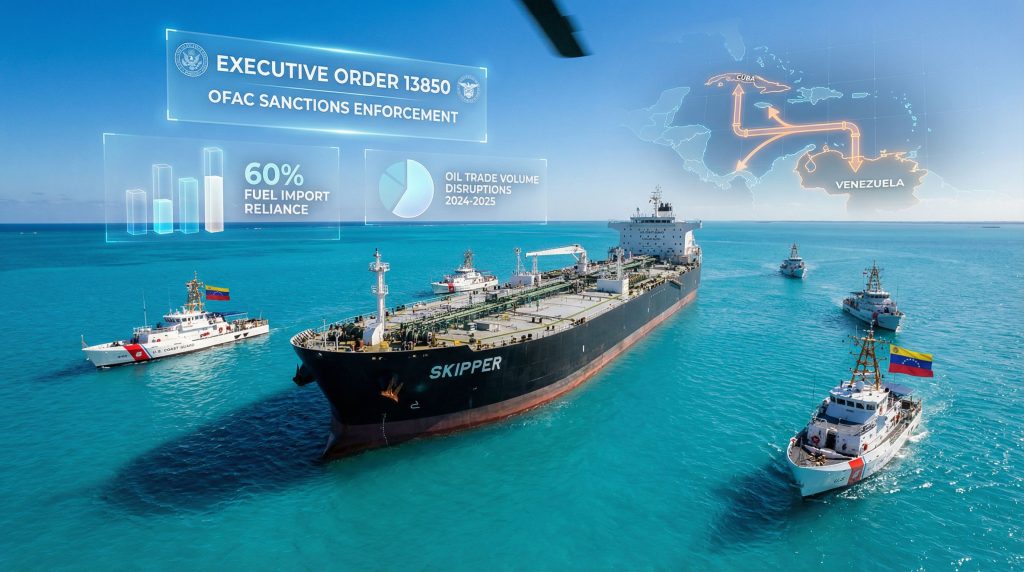
Executive Order 13850 established the legal architecture for targeting Venezuelan petroleum transactions, creating expanding authorities for Treasury Department enforcement. This regulatory structure allows for designation of individuals, entities, and vessels involved in Venezuelan oil trade, regardless of their direct relationship to the Venezuelan government.
Key Enforcement Mechanisms:
- Asset freezing procedures for designated persons and entities
- Vessel designation authority targeting transportation infrastructure
- Third-party liability provisions affecting intermediaries
- Secondary sanctions threatening non-U.S. persons facilitating prohibited transactions
- Enhanced due diligence requirements for financial institutions
The Treasury Department's Office of Foreign Assets Control (OFAC) operates these enforcement tools through administrative procedures that allow rapid response to changing circumstances without requiring new legislative authority.
Multi-Jurisdictional Sanctions Targeting Complex Trading Networks
Evolution of Maritime Enforcement Capabilities
Modern sanctions enforcement relies heavily on enhanced vessel tracking technology and maritime surveillance capabilities. Recent seizure actions demonstrate sophisticated intelligence gathering that enables real-time monitoring of cargo transfers, vessel movements, and transshipment operations across international waters.
The development of what regulators term the dark fleet has prompted corresponding innovations in enforcement methodology. These vessels, often with complex ownership structures and flags of convenience, require specialised legal approaches that address jurisdictional challenges while maintaining enforcement effectiveness.
Furthermore, oil market dynamics play a crucial role in enforcement planning. Consequently, understanding market volatility helps predict the effectiveness of disruption strategies.
Regulatory Tools for Complex Oil Trading Networks:
| Enforcement Mechanism | Legal Authority | Target | Implementation |
|---|---|---|---|
| Asset Freezing | Executive Order 13850 | Individual/Entity Assets | Immediate upon designation |
| Vessel Designation | Maritime sanctions authority | Transportation infrastructure | Upon evidence of prohibited use |
| Secondary Sanctions | Comprehensive sanctions regime | Non-U.S. facilitators | Case-by-case assessment |
| Third-Party Liability | Sanctions regulations | Service providers | Due diligence requirements |
Case Study: Sophisticated Enforcement Coordination
The December 2025 seizure of the vessel carrying Venezuelan crude demonstrates multi-agency coordination between Treasury Department sanctions authorities, maritime enforcement agencies, and intelligence services. According to reporting from OilPrice.com, this operation involved tracking a vessel with previous Iranian fleet connections, monitoring cargo transfer operations, and coordinating seizure actions in international waters.
Vessel tracking data from maritime analytics firm Kpler revealed that approximately 50,000 barrels were transferred to another vessel heading toward Cuba, while the majority of the cargo continued toward Asian markets. This transshipment pattern exemplifies the sophisticated operations that modern enforcement mechanisms must address.
Economic Models Sustaining Regional Energy Partnerships
Structure of Oil-for-Services Arrangements
The Venezuela-Cuba energy partnership operates through a complex barter system that exchanges petroleum products for human resources and technical services. This arrangement allows both countries to circumvent traditional financial systems while maintaining economic interdependence that serves political objectives.
However, the broader context of US‑China trade war implications affects how these arrangements function within global markets. In addition, tariff impact analysis reveals how trade disputes create opportunities for alternative economic partnerships.
According to Guardian reporting, this system involves Venezuela providing oil to Cuba at subsidised prices in exchange for deployment of Cuban personnel including medical professionals, security specialists, and technical advisors. The economic value of these services creates accounting challenges for sanctions enforcement, as traditional market pricing mechanisms do not apply to barter arrangements.
Hard Currency Generation Through Oil Resale Operations
Analysis of Venezuelan state oil company PDVSA documents reveals that only a fraction of oil allocated for Cuba actually reaches the island for domestic consumption, with the majority being resold to generate crucial hard currency revenues.
This monetisation strategy transforms the nominal Cuba-Venezuela energy partnership into a sophisticated arbitrage operation. Cuban intermediaries receive Venezuelan crude at subsidised transfer prices, then sell the petroleum at market rates to generate foreign exchange revenues that both countries desperately require for international transactions.
For instance, recent oil price rally conditions have made these arbitrage operations even more lucrative. Moreover, Saudi exploration licenses affect global supply dynamics that these partnerships seek to exploit.
Key Players in Energy Monetisation:
- Cubametales: Cuba's state-run oil trading firm managing official transactions
- Private Intermediaries: Panamanian and other regional businesspeople facilitating transfers
- Chinese Buyers: End purchasers providing hard currency through legitimate market transactions
- Maritime Operators: Vessel owners and operators managing transportation logistics
The Treasury Department's December 2025 sanctions designation of Panamanian businessman Ramón Carretero, identified as "the main person managing the flow of oil between Cuba and Venezuela," demonstrates how enforcement targets these crucial intermediary functions.
Impact of Maritime Seizures on Regional Energy Security
Legal Precedents and International Law Considerations
Maritime seizures in international waters raise complex questions under the UN Convention on the Law of the Sea regarding freedom of navigation, flag state authority, and enforcement jurisdiction. These legal frameworks create both opportunities and constraints for sanctions enforcement actions targeting oil transportation networks.
The principle of sovereign immunity potentially applies to state-owned vessels, creating additional legal complexity when enforcement targets vessels owned by sanctioned governments or their instrumentalities. However, commercial activities may fall outside sovereign immunity protections, allowing enforcement actions against vessels engaged in petroleum trading.
Market Impact and Insurance Disruption
Recent enforcement actions have created significant volatility in tanker markets, with rates reportedly increasing by 467% according to industry reports. This dramatic increase reflects market perception of elevated seizure risks for vessels involved in sanctions-sensitive trade routes.
Insurance market disruption affects the entire maritime transportation sector, as underwriters reassess coverage for vessels potentially subject to seizure. Enhanced due diligence requirements create operational friction that increases costs and delays for all market participants, not just those directly targeted by sanctions.
Timeline of Recent Enforcement Escalation:
| Date | Action | Significance |
|---|---|---|
| December 2025 | Vessel seizure with Venezuelan crude | Demonstrated enhanced enforcement capability |
| December 2025 | Sanctions designation of key intermediary | Targeted financial facilitators |
| December 2025 | Tanker rate surge (467% increase) | Market response to seizure risks |
Strategic Competition and Regional Realignment
Chinese Energy Security Interests in the Caribbean
Chinese involvement in Caribbean energy markets represents a strategic challenge for U.S. enforcement policy. Beijing's purchases of Venezuelan crude through Cuban intermediaries provide crucial hard currency that sustains both the Cuban and Venezuelan economies, creating diplomatic complications for aggressive enforcement actions.
The absence of immediate Chinese diplomatic response to recent vessel seizures suggests potential high-level coordination between Washington and Beijing. This implies that energy enforcement actions may be occurring within broader diplomatic frameworks designed to avoid escalation.
Alternative Energy Infrastructure Development
Regional energy partnerships are adapting to enforcement pressure through infrastructure investments that reduce dependence on vulnerable transportation routes. Chinese investment in Caribbean renewable energy projects and refining capacity represents long-term strategic responses to U.S. sanctions pressure.
Potential Adaptation Strategies:
- Enhanced vessel disguise and tracking evasion techniques
- Development of indigenous refining capabilities
- Alternative financing through cryptocurrency and barter systems
- Diversification of supplier relationships beyond Venezuela
The next major ASX story will hit our subscribers first
Policy Effectiveness and Long-term Implications
Measuring Sanctions Success Beyond Regime Change
Traditional metrics for sanctions effectiveness focus on regime change or policy modification by targeted governments. However, modern energy sanctions serve multiple objectives including market disruption, alliance weakening, and demonstration of enforcement capabilities to deter similar networks globally.
The U.S. moves to disrupt the Venezuela-Cuba oil axis demonstrate how energy sanctions can target systemic vulnerabilities in authoritarian governance models that depend on external support networks. By disrupting financial flows and increasing operational costs, enforcement actions create cascading pressure across multiple political relationships.
Balancing Energy Security with Humanitarian Considerations
Comprehensive energy sanctions risk creating humanitarian consequences for civilian populations, particularly in Cuba where energy imports are essential for basic services. Policymakers must balance enforcement effectiveness against potential unintended impacts on non-combatant populations.
Nevertheless, the U.S. moves to disrupt the Venezuela-Cuba oil axis continue to evolve as policymakers refine targeting mechanisms. Furthermore, these actions establish precedents for addressing similar networks globally.
Assessment Framework for Energy Sanctions:
- Economic Impact: Quantified revenue disruption and operational cost increases
- Political Effectiveness: Changes in regime behaviour and alliance relationships
- Humanitarian Consequences: Impact on civilian access to energy and essential services
- Regional Stability: Broader implications for Caribbean economic and political relationships
Future regulatory development will likely focus on enhanced multilateral coordination to prevent sanctions evasion through jurisdiction shopping. Technology integration, including blockchain transaction monitoring and enhanced satellite surveillance, will provide additional enforcement capabilities while requiring updated legal frameworks to address emerging evasion techniques.
The Caribbean energy enforcement case establishes important precedents for addressing similar networks globally. Consequently, the U.S. moves to disrupt the Venezuela-Cuba oil axis demonstrate how administrative tools can achieve strategic objectives traditionally requiring military intervention while creating sustainable pressure for long-term policy change.
Looking for Investment Opportunities in Resource-Rich Regions?
Discovery Alert's proprietary Discovery IQ model delivers real-time notifications on significant ASX mineral discoveries, helping subscribers identify promising opportunities as geopolitical events reshape global resource markets. With major discoveries historically generating substantial returns for early investors, Discovery Alert's discoveries page showcases how strategic positioning ahead of major announcements can create exceptional investment outcomes.