August 25, 2026
Caribbean energy markets stand at a pivotal juncture where offshore gas development could fundamentally reshape regional supply dynamics and investment flows. The confluence of underutilized liquefied natural gas infrastructure, substantial untapped reserves, and evolving geopolitical frameworks creates unprecedented opportunities for transformative energy partnerships across maritime boundaries. Shell in advanced talks with Venezuela for offshore gas expansion represents a significant shift in regional energy security benefits considerations.
Understanding Shell's Strategic Caribbean Gas Play
Shell's Caribbean expansion strategy centres on leveraging existing infrastructure advantages whilst accessing significant untapped offshore reserves. The company's positioning in Trinidad provides a strategic foundation for broader regional gas development initiatives.
The Geographic Advantage of Cross-Border Gas Development
The proximity between Venezuelan offshore fields and Trinidad's established processing infrastructure creates compelling economic synergies. Shell's pursuit of the Dragon field, containing 4.2 trillion cubic feet (tcf) of reserves, represents the initial phase of a broader strategy to integrate Venezuelan gas resources with Trinidad's Atlantic LNG facility.
The Mariscal Sucre megaproject, encompassing 12 tcf across multiple fields including Dragon, Rio Caribe, Patao, and Mejillones, positions itself closer to Trinidad's infrastructure than to Venezuelan processing facilities. This geographic reality fundamentally shapes the economic case for cross-border development partnerships.
Furthermore, key infrastructure advantages include:
- Established Atlantic LNG processing capacity of 15.5 million tons per annum (mtpa)
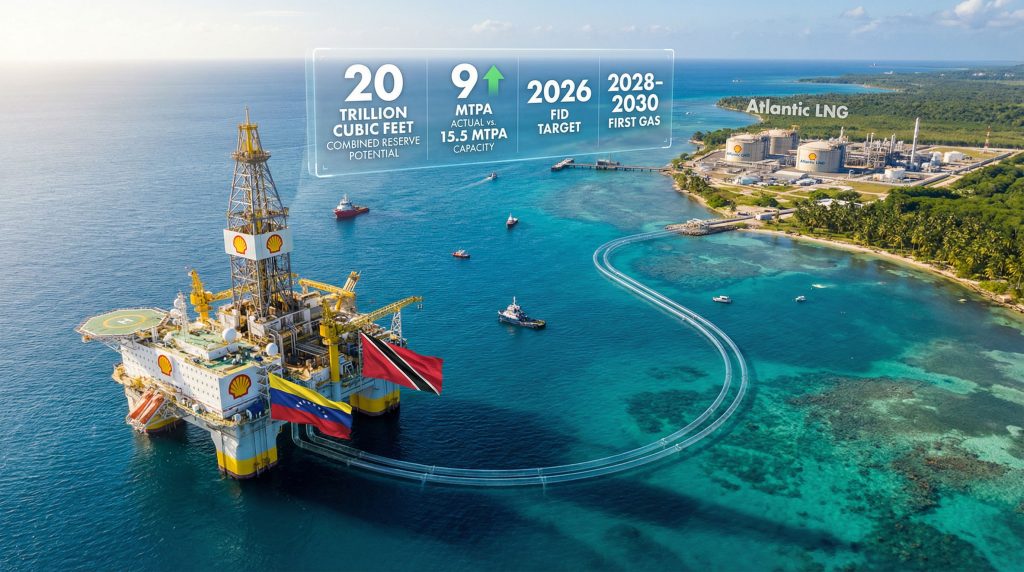
- Current underutilisation at 58% capacity (9 mtpa actual versus design capacity)
- Shell's existing 45% stake in Atlantic LNG operations
- Proven submarine pipeline connectivity through existing Manatee platform operations
Reserve Magnitude and Market Impact Potential
The combined reserve potential across Shell's targeted areas reaches approximately 20 tcf, representing one of the largest undeveloped gas accumulations in the Caribbean basin. The Loran area contributes 7.3 tcf as a transfrontier reservoir shared between Venezuelan and Trinidad waters.
This reserve magnitude enables production scenarios spanning 15-20 years at substantial volumes, potentially transforming regional LNG supply availability. The scale compares favourably with major global LNG projects, though development timelines depend heavily on regulatory framework evolution and infrastructure integration complexity.
In addition, production timeline scenarios suggest:
- 2026: Potential final investment decision announcement
- 2028-2030: First gas production from integrated field development
- 2030+: Full field optimisation and capacity expansion phases
When big ASX news breaks, our subscribers know first
What Makes the Dragon-Loran Gas Complex Strategically Critical?
The strategic value of these offshore developments extends beyond immediate reserve access, encompassing operational integration opportunities and geopolitical risk management across multiple jurisdictions.
Technical Integration Opportunities
Shell's technical approach involves submarine pipeline connectivity between the Loran field and existing Manatee platform infrastructure in Trinidad waters. This integration strategy maximises existing operational capabilities whilst minimising new infrastructure investment requirements.
The company's current operations on the Trinidad side of the Loran-Manatee complex provide operational experience and technical understanding crucial for expanded development. Processing optimisation at the Atlantic LNG facility could accommodate Venezuelan gas volumes through relatively modest facility modifications rather than greenfield construction.
Technical integration benefits include:
- Submarine perforations linking Loran to Manatee platform systems
- Processing capacity optimisation utilising existing Atlantic LNG infrastructure
- Operational efficiency gains from integrated field development approaches
- Cost advantages compared to standalone Venezuelan processing development
Geopolitical Risk-Reward Assessment
The project operates within complex regulatory frameworks spanning U.S. sanctions considerations, Venezuelan government policies under interim President Delcy Rodriguez, and Trinidad regulatory requirements. Russian stakeholder involvement through previous Rosneft agreements adds additional complexity layers.
Shell executives have indicated confidence in overcoming Russian participation complications, though specific resolution mechanisms remain undisclosed. The preliminary agreements signed in March 2026 with Venezuelan authorities demonstrate progress toward regulatory framework clarification.
However, risk mitigation strategies encompass:
- U.S. sanctions compliance through Treasury Department engagement protocols
- Venezuelan fiscal terms optimisation for sustainable partnership structures
- Russian stakeholder resolution through asset restructuring or compensation mechanisms
- Cross-border regulatory harmonisation for operational efficiency
How Could This Expansion Transform Regional LNG Supply Chains?
The integration of Venezuelan gas resources into Trinidad's processing infrastructure could fundamentally alter Caribbean energy supply dynamics and regional import dependency patterns. These developments contrast with natural gas trends 2025 elsewhere.
Atlantic LNG Capacity Utilisation Analysis
Current Atlantic LNG operations demonstrate significant capacity underutilisation, with 2025 export volumes of less than 9 mtpa against design capacity of 15.5 mtpa. This 58% utilisation rate reflects regional gas supply constraints that Venezuelan field integration could address.
Optimisation scenarios suggest capacity utilisation improvements to 80%+ through steady Venezuelan gas supply integration. The economic benefits extend beyond volume increases to include operational stability and export contract reliability improvements.
| Utilisation Metric | Current Performance | Integration Potential |
|---|---|---|
| Design Capacity | 15.5 mtpa | 15.5 mtpa |
| 2025 Actual Exports | <9 mtpa | 12-13 mtpa projected |
| Utilisation Rate | 58% | 80%+ target |
| Shell Ownership | 45% stake | 45% stake maintained |
Caribbean Energy Security Implications
Enhanced regional LNG supply availability supports energy security objectives across Caribbean nations whilst reducing import dependency on distant suppliers. The proximity advantages create opportunities for flexible supply arrangements and competitive pricing structures.
Regional energy transition support through increased natural gas availability facilitates cleaner fuel adoption compared to oil-based power generation systems. This transition potential aligns with regional decarbonisation objectives whilst maintaining energy security priorities.
Consequently, Shell in advanced talks with Venezuela for offshore gas expansion could deliver multiple benefits:
- Supply stability enhancement through diversified source development
- Import dependency reduction via regional production increases
- Price competitiveness from reduced transportation costs and proximity advantages
- Energy transition support through cleaner fuel availability expansion
What Are the Investment Decision Drivers for 2026?
Shell's 2026 investment decision framework centres on fiscal terms optimisation, regulatory clarity achievement, and technical integration feasibility confirmation across the complex cross-border development scenario. These considerations parallel global patterns affecting US natural gas forecasts.
Financial Framework Requirements
CEO Wael Sawan's statements at CERAWeek Houston indicated possible approvals for Venezuelan projects contingent on improved fiscal and legal terms. The emphasis on monetisable gas via LNG positions these developments within Shell's broader portfolio optimisation strategy.
Financial decision drivers encompass:
- Fiscal terms optimisation between Shell and Venezuelan government entities
- Capital expenditure efficiency through infrastructure integration approaches
- Revenue sharing models balancing Venezuelan government participation with investor returns
- Investment return projections competitive with alternative global LNG opportunities
The proximity to existing Manatee infrastructure positions Loran as particularly attractive within Shell's investment evaluation framework, though specific return threshold requirements remain undisclosed.
Competitive Positioning Analysis
Chevron's strategic pivot away from Venezuelan gas interests toward Orinoco heavy oil development creates market positioning opportunities for Shell's expanded Caribbean presence. The anticipated Loran area re-offering following Chevron's withdrawal provides additional access possibilities.
Shell's early mover advantages in Venezuelan offshore gas development could establish dominant regional market positioning, particularly given the scale of combined reserves and processing infrastructure integration potential.
For instance, competitive advantages include:
- Market positioning from Chevron's strategic withdrawal from gas development
- Infrastructure leverage through existing Atlantic LNG operations and expertise
- Scale advantages from 20 tcf combined reserve potential
- Regional dominance potential in Caribbean LNG supply chains
Which Technical Challenges Must Be Overcome?
Offshore development complexities span deep-water drilling requirements, cross-border pipeline engineering specifications, and environmental compliance across multiple jurisdictions with differing regulatory frameworks. These challenges reflect broader offshore drilling challenges facing the industry.
Offshore Development Complexities
Dragon field development requires sophisticated offshore drilling capabilities appropriate for the specific water depths and geological conditions. Whilst exact technical specifications remain proprietary, the offshore nature of these developments demands significant engineering expertise and specialised equipment deployment.
Cross-border pipeline engineering presents unique challenges in designing systems capable of handling gas transport between Venezuelan fields and Trinidad processing facilities. Technical specifications must accommodate pressure requirements, corrosion resistance, and operational flexibility across varying seabed conditions.
Technical challenges include:
- Deep-water drilling requirements for Dragon field expansion phases
- Submarine pipeline engineering connecting Venezuelan fields to Trinidad infrastructure
- Gas composition compatibility ensuring processing facility optimisation
- Environmental compliance across Venezuelan and Trinidad jurisdictional requirements
Processing Infrastructure Adaptation
Atlantic LNG facility modifications must accommodate Venezuelan gas composition characteristics whilst maintaining operational efficiency for existing supply sources. Processing capacity expansion versus efficiency optimisation trade-offs require careful engineering analysis.
The integration of multiple gas sources with potentially varying compositions demands sophisticated processing flexibility and quality control systems. Technical solutions must balance operational complexity with economic efficiency objectives.
Infrastructure adaptation requirements encompass:
- Processing equipment modifications for gas composition variations
- Capacity expansion planning versus operational efficiency optimisation
- Quality control systems ensuring LNG specification compliance
- Operational flexibility maintaining multi-source processing capabilities
How Will This Impact Global LNG Market Dynamics?
The addition of Venezuelan gas resources to global LNG supply chains could influence regional pricing dynamics and supply security calculations across multiple market segments. However, these developments occur against a backdrop of tariff-induced market impacts affecting global energy trade.
Supply Addition Timing and Scale
Production ramp-up scenarios through 2030 suggest gradual capacity increases rather than immediate large-scale supply additions. The phased development approach allows market integration without overwhelming regional demand patterns or disrupting established supply relationships.
Regional LNG market share implications depend on development timing coordination with demand growth patterns across Caribbean and broader Atlantic basin markets. Price stability contributions from steady supply additions support long-term contract structures and investment planning.
Market impact factors include:
- Production ramp-up timing coordination with regional demand growth
- Market share implications for existing Caribbean LNG suppliers
- Price stability contributions from reliable supply source development
- Contract structure flexibility supporting diverse buyer requirements
Strategic Partnerships and Joint Venture Potential
PDVSA collaboration framework development requires balancing Venezuelan government participation objectives with international investor requirements for operational efficiency and return generation.
Third-party infrastructure sharing opportunities could optimise development costs whilst accelerating project implementation timelines. Technology transfer and local capacity building initiatives support Venezuelan energy sector revitalisation objectives whilst ensuring operational standards maintenance.
Partnership considerations encompass:
- PDVSA collaboration balancing government participation with operational efficiency
- Technology transfer supporting Venezuelan technical capacity development
- Infrastructure sharing optimising development costs and implementation timing
- Local capacity building ensuring sustainable operational capability development
The next major ASX story will hit our subscribers first
What Does Success Look Like for All Stakeholders?
Successful development creates value across multiple stakeholder categories through revenue generation, energy security enhancement, and regional economic development contributions.
Venezuela's Energy Sector Revitalisation
Foreign investment attraction beyond Shell's initial partnership could catalyse broader energy sector recovery and technical capability development. Shell has reportedly entered advanced discussions with Venezuelan authorities regarding expanded offshore gas development opportunities. Revenue generation from gas monetisation supports economic stabilisation objectives whilst demonstrating successful international partnership models.
Technical expertise development through technology transfer and operational collaboration builds Venezuelan capacity for sustainable energy sector management. Knowledge transfer initiatives ensure long-term capability development beyond immediate project implementation.
Venezuelan benefits include:
- Foreign investment attraction demonstrating successful partnership models
- Revenue generation supporting economic recovery and stabilisation
- Technical capability development through technology transfer and training
- International relationship normalisation via successful energy cooperation
Shell's Portfolio Strengthening
Gas asset diversification across Caribbean operations reduces concentration risk whilst building regional market presence. LNG market position enhancement supports Shell's global strategy through portfolio optimisation and operational synergy realisation.
The integration of Venezuelan reserves with Trinidad processing capabilities creates operational efficiencies and cost advantages compared to standalone development approaches. Regional hub establishment positions Shell for additional Caribbean opportunities as energy markets evolve.
Shell's strategic gains encompass:
- Portfolio diversification reducing geographic and operational concentration risks
- Regional market dominance through integrated infrastructure and supply control
- Operational synergies optimising existing asset utilisation and efficiency
- Growth platform development for expanded Caribbean energy market participation
Success metrics ultimately depend on navigating complex regulatory frameworks whilst executing technically challenging offshore developments that deliver sustainable returns for all stakeholders. The strategic value extends beyond immediate financial benefits to encompass regional energy security enhancement and economic development acceleration through responsible resource development partnerships.
Furthermore, industry analysts suggest that Shell in advanced talks with Venezuela for offshore gas expansion could establish a significant precedent for international energy cooperation in the region. The combination of substantial reserves, existing infrastructure, and strategic partnerships creates conditions favourable for sustained development across multiple phases.
According to recent reports from Reuters, Shell's expansion discussions encompass multiple offshore areas beyond the initial Dragon field development. These negotiations could result in one of the most significant energy partnerships in the Caribbean basin, with implications extending far beyond immediate production targets.
This analysis is based on publicly available information and industry reports. Investment decisions should consider comprehensive due diligence and professional financial advice. Forward-looking statements involve uncertainties and actual results may vary significantly from projections discussed.
Ready to Capitalise on Energy Sector Opportunities?
Discovery Alert's proprietary Discovery IQ model delivers real-time alerts on significant ASX mineral and energy discoveries, empowering investors to identify actionable opportunities ahead of the broader market. Begin your 14-day free trial today and position yourself to benefit from the next major breakthrough in Australia's dynamic resource sector.