August 13, 2026
When Infrastructure Becomes the Acquisition Currency in Australian Copper
The economics of copper project development have shifted fundamentally over the past decade. Across Australia's established mining districts, the traditional model of building standalone processing infrastructure for new copper discoveries is rapidly giving way to a more capital-efficient logic: acquire assets that sit within reach of existing mills, and let proximity do the heavy lifting. This infrastructure-first acquisition framework is reshaping how mid-tier producers evaluate copper targets, and the Carnaby Resources Evolution Mining deal is one of the clearest expressions of that philosophy yet seen in Queensland's north-west corridor.
Understanding why this transaction matters requires stepping back from the headline numbers and examining what it reveals about the structural forces now driving copper consolidation in Australia.
When big ASX news breaks, our subscribers know first
The Cloncurry Copper Corridor: Why Geography Shapes Deal Value
Queensland's Cloncurry district occupies a unique position in Australia's copper landscape. Sitting within the broader Mount Isa Inlier, one of the world's most prolific copper-gold geological provinces, the region hosts a concentration of mineralised systems that have attracted exploration and development capital for more than a century. What distinguishes the current cycle from previous ones is the density of processing infrastructure already in place — infrastructure that dramatically compresses the capital requirements for bringing new discoveries to production.
Evolution Mining's Ernest Henry operation anchors this advantage. As a large-scale copper-gold mine with established milling capacity, Ernest Henry creates what mining economists call an infrastructure shadow: a geographic zone within which nearby undeveloped resources carry meaningfully higher intrinsic value than equivalent deposits located in more remote settings. The Greater Duchess copper-gold project, held by Carnaby Resources, sits squarely within that shadow.
This is not incidental. When Evolution Mining signed a binding scheme implementation deed with Carnaby Resources at the end of July 2026, the deal architecture was explicitly built around the proposition that routing Greater Duchess ore through Ernest Henry's processing circuit represents a demonstrably superior development pathway compared to any standalone alternative. The economic logic is compelling: incremental mill throughput costs a fraction of greenfield processing construction, permitting timelines are compressed, and operational ramp-up complexity is substantially reduced. Furthermore, the copper supply crunch facing the industry globally makes this kind of capital-efficient approach increasingly attractive to mid-tier producers.
Deal Architecture: Breaking Down the Carnaby Resources–Evolution Mining Transaction
Core Financial Terms and Structure
The Carnaby Resources Evolution Mining deal is structured as a binding scheme of arrangement, a legal mechanism that requires court oversight and shareholder approval but offers acquirers certainty of 100% ownership upon completion. The financial terms are straightforward in structure, though significant in implication.
| Term | Detail |
|---|---|
| Transaction value | Approximately A$213 million (~US$149 million) |
| Consideration type | All-scrip |
| Exchange ratio | 0.0682 Evolution Mining shares per Carnaby share |
| Implied price per Carnaby share | A$0.77 |
| Post-completion Carnaby shareholder ownership | Approximately 0.9% of enlarged Evolution entity |
| Binding deed signed | Late July 2026 |
The all-scrip structure deserves particular attention. Rather than deploying cash, Evolution preserves balance sheet flexibility while offering Carnaby shareholders direct participation in the enlarged company's copper growth profile. In periods of commodity price volatility, this approach reduces acquisition risk for the acquirer while aligning target shareholders with future upside rather than locking them into a fixed cash exit.
An all-scrip deal at this scale signals that Evolution views the Carnaby acquisition not as a distressed asset purchase but as a strategic portfolio extension where both parties benefit from shared ownership of the combined copper platform.
Approval Pathway and Regulatory Considerations
The transaction faces several standard approval hurdles before completion.
| Approval Requirement | Current Status |
|---|---|
| Carnaby shareholder vote | Pending |
| ACCC regulatory review | Pending |
| Federal Court approval | Pending |
| Board recommendation | Unanimous |
The unanimous board recommendation carries meaningful weight in scheme vote analysis. Carnaby's directors have collectively indicated their intention to vote their combined 7.3% stake in favour of the scheme. Historically, scheme-of-arrangement transactions in the Australian mining sector that carry unanimous board endorsement and no competing bid proceed to completion at high rates.
The independent expert report, a mandatory component under ASX scheme rules, will need to conclude the transaction is fair and reasonable to Carnaby shareholders. ACCC scrutiny is relevant given the concentration of copper processing capacity in the Cloncurry region. Regulators will assess whether Evolution's copper expansion strategy creates any material constraint on competitive processing access for other operators in the district. This is a credible but manageable hurdle given the geographic specificity of the assets involved.
The Glencore Offtake Termination: What Changes Economically
One of the less-discussed but commercially significant components of this transaction is the termination of Carnaby's existing tolling and offtake arrangements with Glencore. These agreements provided Carnaby with a defined processing and revenue pathway, but they also imposed external commercial terms that would no longer reflect the integrated economics available under Evolution ownership.
Once Greater Duchess ore moves through Ernest Henry's circuit under Evolution's commercial framework, the revenue recognition and processing cost structure changes meaningfully. Integrated processing eliminates the margin leakage inherent in third-party tolling arrangements, and the unit cost outcomes achievable within an established operation are typically superior to those negotiated at arm's length. For investors modelling Greater Duchess economics, this transition from Glencore terms to Ernest Henry terms represents a genuine improvement in the project's margin profile, particularly when assessed against broader copper processing economics.
Asset Deep Dive: Greater Duchess Copper-Gold Project
Resource and Reserve Profile
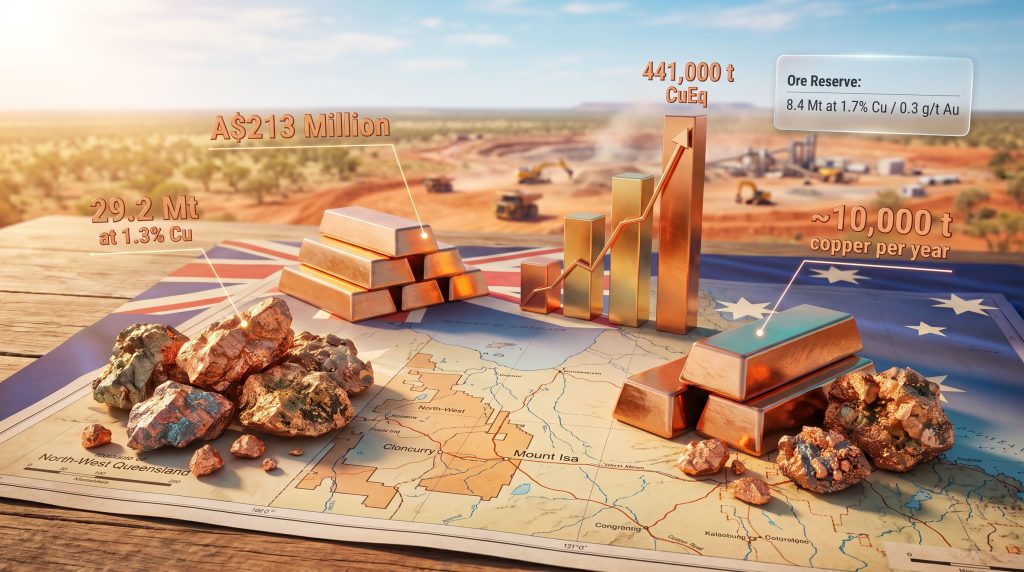
Greater Duchess holds a mineral resource of 29 million tonnes at 1.5% copper equivalent, containing 441,000 tonnes of copper equivalent. The ore reserve stands at 8.4 million tonnes at 1.9% CuEq. The reserve grade exceeding the overall resource grade is an important technical signal: it indicates that the higher-confidence, higher-grade portions of the deposit have been selectively delineated for initial mining, with lower-grade material remaining in the broader resource inventory for potential future conversion.
| Category | Tonnage | Grade (CuEq) | Contained CuEq |
|---|---|---|---|
| Mineral Resource | 29 Mt | 1.5% | 441,000 t |
| Ore Reserve | 8.4 Mt | 1.9% | Not separately stated |
The dual-commodity nature of the deposit — copper and gold — provides a natural revenue hedge. When copper prices soften, gold exposure cushions the revenue impact, and vice versa. This characteristic is particularly valued in mid-tier producer portfolios where single-commodity price swings can disproportionately affect cash generation.
Final Drill Program: Two Discoveries That Reframe the Resource Ceiling
Carnaby completed its final drilling program at Greater Duchess and released results confirming two new discoveries at the project. These results, compiled and released concurrent with the acquisition process, add a layer of geological optionality to what the acquisition price reflects.
Miniboom Discovery at Mount Hope
Located on the margin of the Mount Hope open pit, the Miniboom discovery returned drill intersections that are notable for their near-surface, high-grade character.
- First hole: 20 metres at 2.2% CuEq, including a 5-metre interval grading 5.4% CuEq
- Second hole: 12 metres at 2.3% CuEq, including a 5-metre section at 4.1% CuEq
High-grade intervals at open pit margins carry particular strategic value because they can be incorporated into existing pit designs at relatively low incremental cost. The 5.4% CuEq intercept over 5 metres is exceptionally high-grade for a bulk open pit system, suggesting the presence of a structurally controlled high-grade corridor that may extend at depth into a potential underground target. Whether this translates to meaningful resource additions will depend on follow-up drill spacing and geological interpretation, but the geometry is encouraging.
Trek 1 Footwall Lode at Trekelano
The Trek 1 discovery at Trekelano delivered a materially different style of result: broad, consistent mineralisation with a distinct high-grade footwall lode.
- Primary intersection: 88.6 metres at 1.2% CuEq, including 35.6 metres at 1.8% CuEq
- Footwall lode: 38 metres at 1.9% CuEq, including 15 metres at 3.2% CuEq
The 88.6-metre intersection represents bulk tonnage potential that is well-suited to the production rates achievable through Ernest Henry's processing circuit. The footwall lode intersection introduces a structurally separate, higher-grade zone running parallel to the main mineralised corridor, which is a geological configuration often associated with more complex, multi-lode systems that can support expanded resource models over time.
| Discovery | Standout Intersection | Peak Grade (CuEq) | Development Significance |
|---|---|---|---|
| Miniboom (Mount Hope) | 5m | 5.4% | Near-surface, open pit margin, potential underground extension |
| Trek 1 Main (Trekelano) | 88.6m | 1.2% avg / 1.8% core | Broad bulk tonnage, Ernest Henry throughput-compatible |
| Trek 1 Footwall Lode | 15m | 3.2% | Parallel lode system, structural complexity upside |
Operational Integration: The Ernest Henry Processing Advantage
Why Spare Mill Capacity Is the Critical Deal Enabler
The central value proposition of the Carnaby Resources Evolution Mining deal is not simply the size of the Greater Duchess resource. It is the ability to monetise that resource through existing infrastructure at a fraction of the capital cost that standalone development would require. Evolution Mining has indicated that Greater Duchess could contribute approximately 10,000 tonnes of copper per year by utilising available capacity at Ernest Henry.
To contextualise that figure: building a standalone processing facility capable of generating equivalent annual copper production in a remote Queensland setting would require hundreds of millions of dollars in capital expenditure, multi-year permitting timelines, and the establishment of entirely new workforce and logistics systems. The brownfield integration pathway eliminates all of those costs and delays.
Infrastructure and Logistics in the Cloncurry District
The Cloncurry region's established road network, power infrastructure, and water access are often underappreciated factors in project economics. Mining development in remote Australian settings frequently encounters cost blowouts driven not by processing or mining complexity but by the need to build supporting infrastructure from scratch. Greater Duchess benefits from a district that has been industrially active for decades, compressing development lead times and reducing sustaining capital requirements.
Ore haulage from Greater Duchess to Ernest Henry represents the primary incremental logistics cost in the integrated development model. Haulage economics are a function of distance, road quality, payload capacity, and diesel costs. While detailed haulage modelling is not publicly disclosed, the proximity of both assets within the Cloncurry district positions this as a manageable variable rather than a deal-defining cost driver.
The Macro Copper Investment Thesis Behind the Acquisition
Structural Demand Growth and Why Mid-Tier Producers Are Accelerating Exposure
Evolution Mining's pursuit of Greater Duchess reflects a broader strategic response to copper's evolving demand profile. The copper demand drivers — including electrification of transport, expansion of grid infrastructure, and the manufacturing ramp-up of renewable energy systems — are collectively driving copper consumption at rates that analysts widely expect to outpace supply growth through the early 2030s. The International Energy Agency and various commodity research bodies have consistently highlighted the widening gap between projected copper demand and the supply pipeline's ability to respond.
On the supply side, the structural headwinds are substantial:
- Average copper ore grades at major global operations have declined by roughly 25% over the past two decades, increasing processing costs per tonne of refined copper produced
- Permitting timelines for new copper mines have extended materially in most major jurisdictions, with some projects requiring a decade or more from discovery to first production
- The global pipeline of development-ready copper projects capable of entering production before 2030 is widely regarded as insufficient to meet demand projections
Australian copper assets in established mining districts occupy an advantaged position within this supply-constrained environment. They offer geological quality, existing infrastructure, and a regulatory framework that, while rigorous, is broadly predictable. These characteristics are increasingly reflected in acquisition pricing, with premium valuations being paid for projects that can demonstrate a credible, near-term production pathway.
The Risk-Adjusted Case for Bolt-On Over Greenfield
Acquiring a resource-defined, drill-tested copper-gold project adjacent to existing processing infrastructure systematically eliminates the three development risks that most frequently destroy value in greenfield mining projects: permitting uncertainty, infrastructure capital intensity, and operational ramp-up complexity. The remaining geological risk is substantially reduced by a completed, multi-phase drilling program.
This risk decomposition framework helps explain why the Carnaby Resources Evolution Mining deal, at approximately A$213 million, represents rational capital allocation rather than premium overpayment. The implied acquisition cost per tonne of contained copper equivalent, adjusted for the processing cost advantages of the Ernest Henry integration, compares favourably to the capital cost of developing equivalent production capacity through greenfield means. Consequently, this deal structure shares characteristics with other successful majors-junior copper deals seen across the Australian market in recent cycles.
The next major ASX story will hit our subscribers first
Shareholder and Market Implications
What the All-Scrip Structure Means in Practice
Carnaby shareholders receiving 0.0682 Evolution Mining shares per Carnaby share will hold a collective stake of approximately 0.9% in the enlarged Evolution entity post-completion. While this is a small aggregate ownership position, it provides exposure to a diversified mid-tier producer with established cash generation from multiple operations, rather than the binary development risk of a single junior explorer.
For Australian tax purposes, scrip-for-scrip transactions structured through a scheme of arrangement can attract capital gains tax rollover relief, potentially allowing Carnaby shareholders to defer any capital gain until they ultimately dispose of their Evolution shares. This is a meaningful consideration for long-term holders with a low cost base in Carnaby stock, and eligibility conditions should be assessed with reference to individual tax circumstances.
Reading the Board Signal Correctly
The unanimous board recommendation, combined with directors' stated intention to vote their combined 7.3% stake in favour, is a structurally significant confidence signal. In scheme vote history across the Australian market, unanimous board endorsement combined with an independent expert finding of fair and reasonable has correlated with high completion rates. Investors interpreting this signal should also monitor for any competing bid emergence during the scheme process, as the receipt of a superior proposal would trigger the board's fiduciary obligations to reconsider its recommendation.
Frequently Asked Questions: Carnaby Resources and Evolution Mining Deal
What is the Carnaby Resources Evolution Mining deal?
Evolution Mining entered a binding scheme of arrangement to acquire 100% of Carnaby Resources for approximately A$213 million, structured entirely as scrip consideration at a ratio of 0.0682 Evolution shares per Carnaby share.
What is the Greater Duchess project?
Greater Duchess is a copper-gold development project situated near Mount Isa in north-west Queensland, holding a total mineral resource of 29 million tonnes at 1.5% copper equivalent for 441,000 tonnes of contained CuEq, and an ore reserve of 8.4 million tonnes at 1.9% CuEq.
Why does Evolution Mining want to acquire Carnaby Resources?
The acquisition gives Evolution a capital-efficient pathway to adding approximately 10,000 tonnes of annual copper production by processing Greater Duchess ore through spare capacity at its existing Ernest Henry operation in the Cloncurry district.
What approvals are required before the deal completes?
The transaction requires a favourable shareholder vote from Carnaby shareholders, ACCC regulatory clearance, and approval from the Federal Court of Australia under the scheme of arrangement process.
What happens to the Glencore offtake arrangement?
The tolling and offtake agreements between Carnaby and Glencore are required to be terminated as a precondition of the acquisition. Greater Duchess ore will subsequently be processed and sold under the commercial terms applying to Evolution's Ernest Henry operation.
What did Carnaby's final drilling program reveal?
The completed program confirmed two new discoveries: Miniboom at Mount Hope, which returned up to 5.4% CuEq over 5 metres at the open pit margin, and the Trek 1 Footwall Lode at Trekelano, which intersected up to 3.2% CuEq over 15 metres in a parallel lode structure adjacent to the main Trek 1 system.
What This Deal Reveals About the Future of Queensland Copper M&A
A Template That Other Operators Will Study
The Carnaby Resources Evolution Mining deal establishes a replicable template for copper consolidation in Queensland's north-west: identify a resource-defined project within infrastructure range of an existing processing hub, structure the acquisition as an all-scrip scheme of arrangement to preserve acquirer balance sheet flexibility, and terminate third-party commercial arrangements that would otherwise dilute integrated economics.
For remaining junior copper-gold explorers operating in the Cloncurry district, this transaction has two simultaneous effects. It validates the quality of mineralisation in the region and demonstrates that mid-tier producers are willing to pay meaningful consideration for development-stage assets with credible processing pathways. At the same time, it narrows the field of potential acquirers for any given junior, concentrating negotiating leverage with operators that control processing infrastructure.
Forward Outlook: What 10,000 Tonnes Per Annum Means for Evolution's Portfolio
If Greater Duchess delivers on its indicated contribution of approximately 10,000 tonnes of copper per year through Ernest Henry, the impact on Evolution's copper revenue profile through 2028 to 2030 would be material. Copper's price trajectory over that period will determine the absolute revenue contribution, but the cost structure of an integrated brownfield operation provides meaningful downside protection compared to higher-cost standalone alternatives.
The new discoveries at Miniboom and Trek 1 Footwall Lode, confirmed in Carnaby's final drilling program, embed optionality into the acquisition price that was not fully captured in the existing reserve base. Depending on follow-up drilling outcomes under Evolution's ownership, the resource ceiling at Greater Duchess may prove higher than current estimates suggest. Reporting from Mining Technology confirms the breadth of industry attention this deal has attracted, adding a speculative but geologically grounded upside case for investors in the enlarged Evolution entity.
Want to Track the Next Major Copper Discovery Before the Market Does?
Discovery Alert's proprietary Discovery IQ model scans ASX announcements in real time, instantly alerting subscribers to significant mineral discoveries — just as the infrastructure-driven consolidation reshaping Queensland's copper sector creates new opportunities for well-positioned investors. Explore how major discoveries have historically generated substantial returns on Discovery Alert's dedicated discoveries page, and begin your 14-day free trial today to stay ahead of the next transformative copper deal.