August 12, 2026
The Recurring Fault Lines in Southeast Asia's Copper Refining Infrastructure
Copper smelting is one of the most capital-intensive and technically demanding stages in the metals supply chain. Unlike mining, which can often absorb partial operational disruptions without catastrophic downstream consequences, the refining stage is a chokepoint. When a large-scale smelter goes offline, the ripple effects move quickly through concentrate markets, cathode pricing, and the downstream industries that depend on refined copper for manufacturing.
Indonesia sits at an increasingly important position within this global architecture. As one of the world's largest copper concentrate producers, its domestic processing capacity has become both a strategic national priority and a critical variable in regional supply dynamics. The August 2026 Freeport Indonesia Smelting Gresik furnace repairs are not an isolated technical event. They represent the latest chapter in a pattern of operational disruptions at a facility that handles some of the most significant copper volumes in the Asia-Pacific region.
When big ASX news breaks, our subscribers know first
What PT Smelting Gresik Actually Does and Why Its Scale Matters
A Processing Node With Region-Wide Reach
PT Smelting's Gresik facility, situated in East Java, Indonesia, functions as the primary domestic refining destination for copper concentrate extracted from the Grasberg mine complex, one of the largest copper and gold deposits on Earth. The facility converts raw copper concentrate into finished copper cathode, a refined product that feeds directly into manufacturing supply chains across electronics, construction, power transmission, and electric vehicle production.
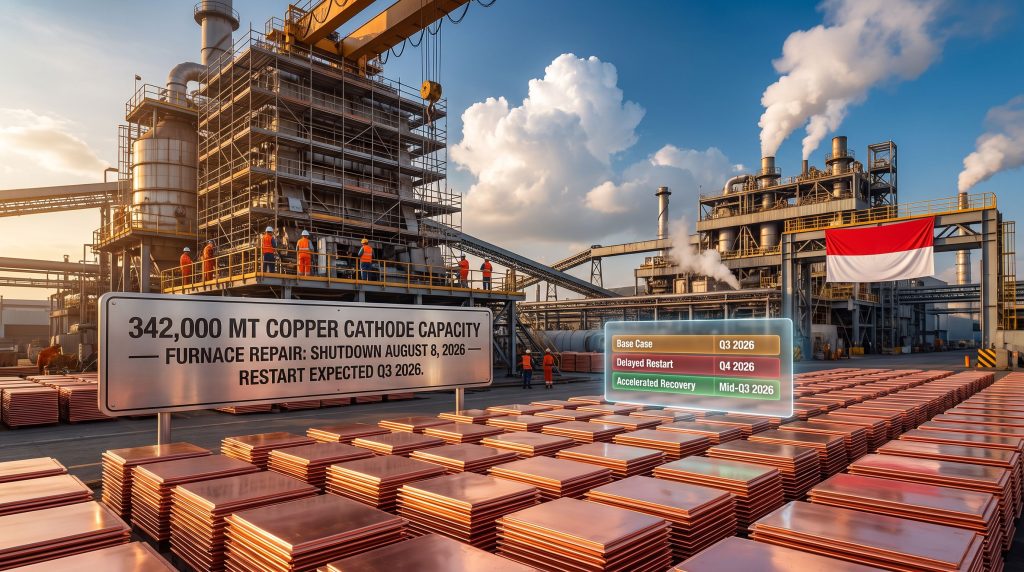
Its annual copper cathode capacity of 342,000 metric tons places it among the larger single-facility smelters in Southeast Asia. The joint venture structure underpinning the operation gives it both regional and international significance. Furthermore, global copper production trends indicate that facilities of this scale play an increasingly pivotal role in balancing refined metal availability across Asian markets.
| Metric | Detail |
|---|---|
| Copper Cathode Capacity | 342,000 metric tons per annum |
| Ownership: Freeport Indonesia | 66% |
| Ownership: Mitsubishi Materials | 34% |
| Location | Gresik, East Java, Indonesia |
| Shutdown Commencement | August 8, 2026 |
| Expected Repair Completion | Within Q3 2026 |
The 34% stake held by Japan's Mitsubishi Materials is particularly noteworthy from a supply chain perspective. Japanese copper consumers, including manufacturers of specialty alloys, electrical components, and precision industrial goods, maintain downstream dependencies on cathode flows that trace back to this facility. When PT Smelting halts, the disruption does not stop at Indonesia's borders.
The Pyrometallurgical Process and Where Furnaces Fit In
Understanding why furnace integrity is so consequential requires a brief look at how flash smelting works. PT Smelting uses the Outokumpu flash smelting process, a high-temperature pyrometallurgical method in which dried copper concentrate is injected into a reaction shaft along with oxygen-enriched air. The resulting exothermic reaction produces copper matte, which is then converted and refined into cathode-grade copper.
In this process, the furnace refractory lining, a heat-resistant ceramic layer, absorbs enormous thermal stress over time. Key failure modes include:
- Refractory lining wear from repeated thermal cycling between extreme temperatures
- Tuyere erosion, where the injection ports for oxygen and concentrate degrade under constant high-velocity gas flow
- Slag line deterioration, where the interface between molten slag and the furnace wall experiences the highest corrosive wear
- Cooling element failures, particularly water-cooled copper staves that regulate heat transfer through the furnace shell
Each of these degradation mechanisms can trigger a maintenance halt, and in flash smelting operations, partial repairs are rarely practical. The facility must typically cease production entirely to allow safe access and thorough restoration of furnace integrity.
A History of Disruptions: Gresik's Operational Track Record Since 2024
Chronological Breakdown of Major Incidents
The August 2026 shutdown does not emerge from a clear operational history. PT Smelting Gresik has experienced a series of significant disruptions over the preceding two years, creating what analysts may reasonably classify as a recurring asset integrity risk profile rather than a pattern of isolated incidents.
| Event Period | Nature of Disruption | Operational Response |
|---|---|---|
| October 2024 | Fire-related force majeure incident | Emergency shutdown declared |
| Late 2024 to 2025 | Major repair mobilisation with approximately 2,000 workers deployed | Ramp-up targeted for December 2025 |
| 2025 | Oxygen plant maintenance delays | Restart timelines extended; copper shipments affected |
| August 8, 2026 | Furnace repair shutdown | Shipment schedule adjusted; Manyar smelter restart accelerated |
The October 2024 fire incident was particularly significant because it triggered a force majeure declaration, a legal designation that allowed Freeport Indonesia to suspend contractual delivery obligations without penalty. Force majeure events in commodity supply contracts are relatively rare at major facilities and typically signal a disruption of material severity. For broader context, copper smelting expansion across the Asia-Pacific region has introduced additional complexity into how smelter downtime affects regional concentrate flows.
What Repeated Downtime Signals About Asset Condition
From an infrastructure investment and risk assessment perspective, repeated shutdowns at a single facility over a compressed timeframe raise questions that go beyond individual incident causation. The deployment of approximately 2,000 workers during the 2024 to 2025 repair mobilisation suggests the scope of structural remediation required was substantial, not merely routine maintenance.
Smelting facilities of this scale typically operate on multi-year maintenance cycles. When unplanned shutdowns cluster within a two-year window, it often indicates that earlier maintenance deferrals, design limitations, or accelerated wear from high operational intensity may be contributing factors.
Comparing Gresik's recent downtime frequency against global copper smelter benchmarks is instructive. World-class copper smelting operations typically target availability rates above 90%, with planned maintenance shutdowns lasting two to four weeks per year. Multiple multi-month outages within a two-year period falls well below that benchmark and has meaningful implications for long-term asset reliability assessments.
How Freeport Indonesia Is Bridging the Supply Gap
The Manyar Smelter as an Operational Hedge
Freeport Indonesia's most strategically significant response to the August 2026 shutdown is the accelerated restart of its Manyar smelter, also located in Gresik. The Manyar facility was already in a restart phase, but the PT Smelting outage prompted Freeport Indonesia to pull that timeline forward, with a resumed operations target set for the end of August 2026, ahead of the original schedule.
This decision reflects deliberate operational risk management. By maintaining two smelting facilities in geographic proximity, Freeport Indonesia has built structural redundancy into its downstream processing capacity, even if the two facilities are not perfectly interchangeable in terms of technology, capacity, or product specification.
Grasberg Mine Operations: Unaffected Upstream
A critical distinction that affects how market participants should interpret this disruption is the separation between mining and refining operations. Key points regarding Grasberg include:
- Grasberg mine production remains fully unaffected by the smelter halt
- The disruption is entirely downstream of the mining stage, confined to concentrate processing and cathode production
- Copper concentrate extracted at Grasberg may require alternative routing or temporary stockpiling during the repair window
- Freeport Indonesia has confirmed it is evaluating the impact on previously announced sales forecasts, though no specific forecast revision had been published at the time of the announcement
This upstream-downstream separation is an important nuance for investors tracking Freeport McMoRan's overall production profile. Mine output volumes will not decline as a result of this event, but refined copper sales and shipment revenues may be affected depending on repair duration and Manyar's ramp trajectory.
Copper Market Implications: Quantifying the Supply Pressure
Regional Cathode Availability and Pricing Dynamics
A 342,000 metric ton per annum facility operating at or near capacity produces roughly 85,500 metric tons of copper cathode per quarter. Even partial output disruption during Q3 2026, offset by Manyar's accelerated restart, represents a measurable reduction in refined copper availability across Asian physical markets. Consequently, the global copper supply gap is likely to widen further if additional smelting disruptions coincide with this outage window.
Asian copper cathode demand remains structurally elevated, driven by three concurrent forces:
- Electric vehicle manufacturing expansion across China, South Korea, Japan, and emerging Southeast Asian production hubs
- Grid infrastructure buildout, including high-voltage transmission lines and transformer capacity additions across the region
- Consumer electronics production cycles that maintain baseline cathode demand regardless of broader economic conditions
Against this demand backdrop, any reduction in regional cathode supply tends to manifest in widened spot premiums rather than sharp price spikes, as buyers compete for available material and logistics networks adjust to new sourcing patterns.
Concentrate Flow Disruptions and Treatment Charge Dynamics
The shutdown also affects the treatment charge and refining charge (TC/RC) economics that sit between miners and smelters. When smelting capacity goes offline unexpectedly, concentrate that would have been processed domestically must either be stockpiled or redirected to alternative smelters, typically in China, Japan, or South Korea.
This dynamic temporarily reduces the bargaining leverage of miners in TC/RC negotiations and can compress smelting margins for third-party operators who absorb diverted concentrate volumes at competitive rates. In addition, the copper supply crunch already under way in global markets means there is limited buffer capacity to absorb these redirected volumes without creating measurable tightness.
Indonesia's Downstream Processing Mandate and Its Structural Tensions
The Regulatory Framework Shaping Domestic Smelting
Indonesia's minerals policy framework requires that copper concentrate be processed domestically before export. This downstream processing mandate was designed to capture greater economic value from the country's natural resource endowment by developing in-country refining and manufacturing capabilities rather than exporting raw materials.
PT Smelting Gresik sits at the centre of this policy architecture. It is the principal facility through which Grasberg's concentrate must pass to satisfy domestic processing requirements. When the facility is offline, a structural tension emerges between regulatory obligations and physical production realities.
Extended smelter outages at a facility of this regulatory importance can create pressure on export licensing frameworks, potentially requiring government-level review of how concentrate export permissions are handled during maintenance periods. This is a policy dynamic that market participants tracking Indonesian copper flows should monitor closely, though no specific government intervention or export exemption had been confirmed at the time of reporting.
The next major ASX story will hit our subscribers first
Scenario Analysis: Three Paths Forward for Gresik's Recovery
| Scenario | Repair Completion | Market Impact |
|---|---|---|
| Base Case | End of Q3 2026 | Manyar offset limits supply shock; modest price support for Asian cathode premiums |
| Delayed Restart | Q4 2026 | Increased cathode tightness; sustained upward pressure on spot premiums; TC/RC disruption widens |
| Accelerated Recovery | Mid-Q3 2026 | Minimal lasting market disruption; sentiment stabilises; Manyar ramp provides bridge coverage |
The base case aligns with Freeport Indonesia's stated expectation that repairs will conclude within Q3 2026. However, given the facility's history of repair timeline extensions, particularly the oxygen plant delays experienced during 2025, market participants may assign non-trivial probability to the delayed restart scenario. A copper price rally driven by broader supply concerns could amplify these market dynamics further if the delayed scenario materialises.
Key Indicators to Watch During the Repair Window
- Manyar smelter first production confirmation and initial throughput rates relative to design capacity
- Any revision to Freeport Indonesia's quarterly sales forecast, which management indicated was under evaluation following the shutdown announcement
- Copper cathode spot premiums in Asian physical markets, particularly Shanghai bonded warehouse premiums and Singapore CIF assessments
- Indonesian government commentary on concentrate handling during the outage period
- PT Smelting's official repair completion announcement and the subsequent ramp-up timeline disclosed to the market
Frequently Asked Questions: Freeport Indonesia Smelting Gresik Furnace Repairs
What caused the Gresik smelter shutdown in August 2026?
PT Smelting halted operations at the Gresik facility beginning August 8, 2026, to conduct furnace repairs. Freeport Indonesia confirmed the shutdown publicly and indicated repairs were expected to be completed within Q3 2026. The specific technical cause of the furnace degradation requiring the shutdown was not detailed in public disclosures.
How long will the Gresik furnace repairs take?
Based on Freeport Indonesia's public statement, the repairs were expected to conclude within the third quarter of 2026. Given the facility's history of extended repair timelines, the actual duration may vary.
Does the smelter shutdown affect Grasberg copper mine output?
No. Freeport Indonesia confirmed that Grasberg mine production is unaffected by the smelter halt. The disruption is confined to downstream processing and refining operations.
What is the annual copper cathode capacity of PT Smelting Gresik?
The facility has an annual copper cathode production capacity of 342,000 metric tons.
Who owns PT Smelting Gresik?
PT Smelting operates as a joint venture, with Freeport Indonesia holding a 66% stake and Japan's Mitsubishi Materials holding the remaining 34%.
What is the Manyar smelter and how does it relate to the Gresik shutdown?
The Manyar smelter is a separate Freeport Indonesia facility also located in the Gresik district of East Java. Following the PT Smelting shutdown, Freeport Indonesia accelerated the Manyar facility's restart timeline, targeting resumed operations by the end of August 2026, earlier than originally planned, to partially offset the loss of PT Smelting's cathode output.
Has the Gresik smelter experienced previous shutdowns?
Yes. The facility has experienced multiple significant disruptions since late 2024, including a fire-related force majeure event in October 2024, a major multi-month repair programme involving approximately 2,000 workers, and oxygen plant maintenance delays that extended restart timelines into 2025.
The Bigger Picture for Indonesian Copper Infrastructure
The August 2026 Freeport Indonesia Smelting Gresik furnace repairs represent more than a short-term operational disruption. They illuminate a deeper challenge facing Indonesia's copper processing infrastructure: the gap between the ambition of its downstream processing mandate and the asset reliability of the facilities tasked with fulfilling it.
PT Smelting Gresik is not simply a commercial smelter. It is foundational to Indonesia's minerals value-add strategy. Its recurring maintenance challenges underscore the need for sustained capital reinvestment in smelting infrastructure if the country's downstream processing goals are to be durably achieved rather than intermittently realised.
For copper market participants, the near-term focus should remain on Manyar's ramp trajectory and any revision to Freeport Indonesia's sales guidance. For longer-term observers of Indonesian industrial policy, the more consequential question is whether the country's domestic processing ambitions can be supported by infrastructure that demonstrably requires more intensive maintenance investment than its current operational track record has so far delivered.
This article is intended for informational purposes only and does not constitute financial or investment advice. Forecasts, scenarios, and market projections discussed herein involve uncertainty and should not be relied upon as predictions of future outcomes. Readers seeking additional context on base metals markets and copper sector developments may find relevant reporting at Kitco News.
Want to Stay Ahead of the Next Major Copper Discovery on the ASX?
Discovery Alert's proprietary Discovery IQ model delivers real-time alerts on significant ASX mineral discoveries — instantly cutting through complex data to surface actionable opportunities in copper and beyond, whether you're a short-term trader or a long-term investor. Explore how historic mineral discoveries have generated substantial returns on Discovery Alert's dedicated discoveries page, and begin your 14-day free trial today to position yourself ahead of the broader market.