August 11, 2026
The Hidden Economics of Copper Tailings: Why Asset Turnover Speed Is Becoming a Junior Miner Superpower
In commodity cycles driven by supply scarcity, the companies that tend to outperform are rarely those with the largest asset inventories. They are the ones that move capital fastest toward the highest-returning opportunities. This counterintuitive principle sits at the heart of one of the more instructive capital reallocation stories currently unfolding across Africa's copper belt, where Jubilee to sell Zambia copper tailings project assets has become a defining strategic signal for the sector.
Understanding why this decision makes strategic sense requires examining the structural economics of copper tailings reprocessing, the mechanics of greenfields project risk, and how near-record copper prices in 2026 are reshaping the risk tolerance of junior miners who have historically struggled to attract institutional capital. Furthermore, the copper supply crunch is making every capital allocation decision in this space more consequential.
When big ASX news breaks, our subscribers know first
What Makes Copper Tailings Projects Simultaneously Attractive and Dangerous
Copper tailings dumps, the residual material left behind after historical ore processing, represent one of mining's most misunderstood asset classes. On the surface, they appear low-risk: the ore body is already exposed, no underground development is required, and the material has already been partially characterised. This is why junior miners are frequently drawn to them, particularly in Zambia where colonial-era copper production left behind enormous legacy dumps across the Copperbelt.
However, the distinction between a brownfields tailings expansion and a greenfields tailings project is critical and frequently overlooked by retail investors.
- A brownfields tailings operation already has processing infrastructure in place, established water circuits, existing power connections, and a commissioned plant.
- A greenfields tailings project, by contrast, requires the construction of all processing infrastructure from scratch, including leaching circuits, solvent extraction and electrowinning (SX-EW) plants, tailings return systems, and reagent supply chains.
- The capital intensity difference between these two categories can be substantial, often running to tens of millions of dollars before a single tonne of copper cathode is produced.
- Greenfields tailings projects also carry significant execution risk: grade variability across historic dump faces, inconsistent mineralogy, and uncertain acid consumption rates can all undermine project economics.
The copper leaching process is particularly sensitive to these variables, which is why the distinction between brownfields and greenfields assets matters so profoundly to investors evaluating tailings projects. This distinction explains precisely why Jubilee Metals has chosen to divest the Large Waste Project, a greenfields copper tailings resource in Zambia containing more than 240 million tonnes of material, despite having paid approximately US$18 million for it less than a year ago.
The Asset: Scale Versus Readiness
At 240 million tonnes, the Large Waste Project is not a small deposit. In fact, its sheer scale is arguably one of its most marketable characteristics in a copper market experiencing supply tightness. The challenge is not the volume of material but the capital and time required to transform that volume into producing copper cathode.
| Asset Attribute | Detail |
|---|---|
| Asset Name | Large Waste Project (Zambia) |
| Material Volume | Over 240 million tonnes |
| Asset Classification | Greenfields copper tailings resource |
| Original Acquisition Cost | ~US$18 million |
| Sale Completion Target | Q4 2026 |
| Number of Binding Offers Received | Two |
For a company like Jubilee Metals, which has already built and operates the Sable refinery, a functioning SX-EW processing facility, the opportunity cost of tying up capital and management bandwidth in a greenfields build-out is significant. The internal rate of return on incremental tonnes fed through an existing, already-commissioned refinery will almost always exceed the return from constructing an entirely new circuit elsewhere, particularly when the copper price provides a strong incentive to accelerate production through the lowest-friction route.
A $100 Million Asset Monetisation Programme in Context
The Large Waste Project divestment does not exist in isolation. Jubilee Metals has now sold more than US$100 million worth of assets as part of a deliberate portfolio rationalisation strategy. This programme reflects a broader shift in junior mining philosophy: away from asset accumulation as a proxy for value creation, and toward disciplined capital cycling that prioritises near-term cashflow generation over long-term optionality.
Consequently, this approach is particularly relevant in copper, where the market is increasingly bifurcated between:
- Primary producers with large, low-cost operations that attract institutional coverage and premium valuations.
- Processing and reprocessing specialists that generate margins through operational efficiency rather than resource scale.
- Greenfields developers that carry the highest risk premium and typically trade at the deepest discounts to net asset value until permitting and capital commitments are secured.
Jubilee occupies the second category, and its ongoing mining asset sales reflect a management team that has consciously decided to optimise within that positioning rather than attempt a costly transformation into a primary producer.
Deal Mechanics: What Two Competing Offers Reveal About Tailings Valuations in 2026
The fact that Jubilee has received two binding offers for the Large Waste Project, both at an outright premium to the original US$18 million acquisition price, is itself a significant market signal. It confirms that large-scale copper tailings assets in Zambia are being revalued upward in real time, driven by copper prices approaching record territory. For further context on this transaction, Jubilee's official announcement provides additional detail on the company's broader Zambia copper strategy.
The deal structure is equally instructive for understanding how junior mining transactions are being structured in the current cycle.
Deal Mechanics Snapshot:
- Initial deposit deadline: August 27, 2026
- Due diligence period: Up to 90 days following deposit payment
- Definitive agreement window: 10 days post-due diligence completion
- Remaining consideration: Paid in instalments over up to three years
The instalment structure deserves particular attention. Spreading the remaining purchase price over three years reduces the immediate capital burden on the buyer while simultaneously providing Jubilee with a recurring receivable stream. For the seller, this introduces some counterparty risk, but it also allows the buyer to fund instalments partly from the cash flows generated by the asset itself, which is a standard risk-distribution mechanism in junior mining M&A.
Settling the Outstanding Balance: The Share Issuance Mechanics
Because Jubilee had not yet completed its own payment obligations from the original Large Waste Project acquisition, the company has negotiated a share-based settlement with the original vendor. This is a technically important detail that carries both a dilution impact and a pricing signal.
| Share Issuance Detail | Figure |
|---|---|
| Total Shares to Be Issued | ~150.5 million |
| Issuance Price | 2.5 pence per share |
| Approximate USD Equivalent | ~US$5 million |
| Proportion of Enlarged Share Capital | ~4.5% |
| Prevailing London Market Price | 2.6 pence per share |
The issuance price of 2.5 pence against a market price of 2.6 pence represents a modest but real discount of approximately 3.8%. For existing shareholders, the key consideration is whether the capital being freed up by this transaction generates sufficient future value to offset the dilution. Given that the proceeds are earmarked for a specific, high-visibility production expansion at Molefe mine, the dilution calculus is reasonably transparent, which is not always the case in junior mining share issuances.
Where the Capital Goes: The Molefe Mine Expansion Blueprint
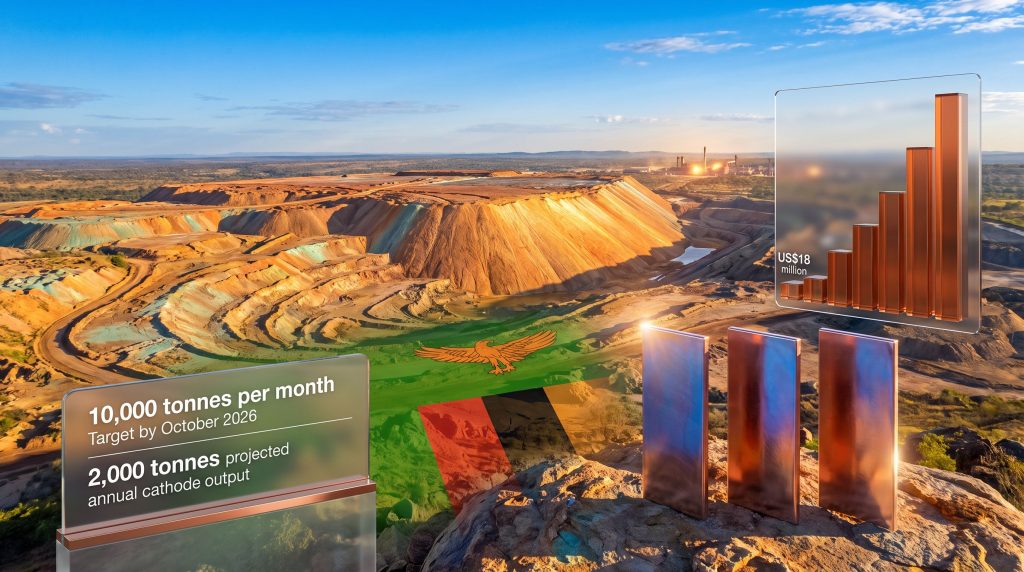
The strategic logic behind selling the Large Waste Project only makes complete sense when viewed alongside Jubilee's investment plans for its Molefe copper mine. The company is targeting a dramatic increase in ore throughput, from the current range of 3,500 to 4,500 tonnes per month to a target of 10,000 tonnes per month by October 2026.
This is not a modest incremental improvement. It represents a more than doubling of ore feed volumes into the Sable refinery, which would push the facility's total annual copper cathode output to approximately 2,000 tonnes.
Production Expansion Metrics:
- Current Molefe ore throughput: 3,500 to 4,500 tonnes per month
- Target throughput by October 2026: 10,000 tonnes per month
- Projected annual cathode output from Sable: 2,000 tonnes
The Sable refinery is also supplied with copper concentrate from Jubilee's Roan processing facilities, which additionally sells material to third parties. This diversified feed structure means Sable is not solely dependent on Molefe ore, providing a degree of production resilience even as the mine expansion is executed.
The Galileo Resources Farm-In: Sharing Exploration Risk at Molefe
Jubilee has also structured a farm-in agreement with Galileo Resources, a UK-listed development company, granting Galileo a 23.75% interest in Molefe in exchange for the developer spending US$700,000 on resource definition drilling and exploration. This arrangement achieves two objectives simultaneously: it funds geological work that Jubilee would otherwise need to finance internally, and it brings a second perspective on the deposit's resource potential.
Farm-in agreements of this type are a common risk-sharing mechanism in junior mining, particularly when the acquiring company wants to maintain operational control while distributing exploration expenditure. In addition, copper investment strategies that incorporate such risk-sharing structures are becoming increasingly common in the current cycle.
The next major ASX story will hit our subscribers first
Why Jubilee's Shares Trade at a Structural Discount Despite a Strong Copper Market
Perhaps the most analytically interesting dimension of this story is the persistent gap between Jubilee's share price performance and the copper price cycle. Jubilee shares have fallen approximately 27% year-to-date in 2026, even as copper has approached record price levels.
This divergence reflects a well-documented but often underappreciated structural issue in copper equities: the third-party supplier discount. Companies that process ore or concentrate sourced from external parties, rather than mining it themselves, are typically valued at a significant discount to primary producers for several reasons:
- Revenue is partly dependent on third-party supply agreements that can be renegotiated or disrupted.
- Margins are compressed by the need to purchase feed material at market-related prices.
- Investors cannot apply straightforward reserve-to-production valuation frameworks.
- Analysts covering the copper sector tend to underweight processors relative to miners in portfolio construction.
Jubilee's decision to withdraw copper production guidance for the year, citing weather disruptions and changes to the Molefe mine plan, compounded this discount by introducing uncertainty about near-term cashflow. In copper equities, guidance withdrawal is typically interpreted as a signal of operational instability, even when the underlying causes are transitory.
The Molefe expansion strategy is explicitly designed to address this structural discount over time, by increasing the proportion of Jubilee's ore feed that comes from its own captive mining operations rather than third-party sources.
Zambia's Copper Belt as a Tailings Monetisation Frontier
Zambia's Copperbelt is one of the world's most historically significant copper-producing regions, and its legacy infrastructure has created an abundance of tailings monetisation opportunities that are only now being systematically evaluated using modern hydrometallurgical techniques. For reference, Jubilee's copper operations overview provides useful context on the company's broader strategy within this region.
The economics of copper tailings reprocessing in Zambia are compelling under the right conditions:
| Project Type | Capital Requirement | Execution Risk | Timeline to Production |
|---|---|---|---|
| Greenfields Tailings | High | High | Long |
| Brownfields Expansion | Moderate | Lower | Near-term |
| Established Processing Scale-Up | Low to Moderate | Low | Immediate |
The key variable is always the relationship between copper grade, acid consumption, and cut-off grade economics. Zambian tailings dumps vary considerably in their copper tenor, ranging from very low-grade material that requires significant acid volumes for heap leach or agitated leach processing, to higher-grade dumps where copper recovery through SX-EW is economically attractive even at lower copper prices.
Near-record copper prices in 2026 have effectively expanded the universe of economically viable tailings projects, which explains why the Large Waste Project has attracted two competing buyers despite its greenfields status and the capital intensity that entails.
Frequently Asked Questions
Why is Jubilee Metals selling the Large Waste Project so quickly after acquiring it?
The divestment reflects a capital allocation decision rather than a change in view on the asset's fundamental value. The Large Waste Project requires substantial upfront capital and carries greenfields execution risk. By selling at a premium and redeploying the proceeds into expanding the Molefe mine through existing Sable refinery infrastructure, Jubilee aims to generate faster and more certain returns.
What premium are buyers offering over the original US$18 million purchase price?
Jubilee has confirmed that both competing offers represent an outright premium to the original acquisition cost, but the precise figures have not been publicly disclosed. The instalment-based payment structure means the total realised value will depend on counterparty performance over up to three years.
How does the share issuance affect existing Jubilee shareholders?
The issuance of approximately 150.5 million shares at 2.5 pence represents around 4.5% of the enlarged share capital, creating a modest dilution for existing holders. However, the shares settle an existing payment obligation, meaning the dilution is offset by the extinguishment of a corresponding liability.
What risks remain for Jubilee after the divestment is completed?
The primary risks centre on execution of the Molefe mine expansion to 10,000 tonnes per month by October 2026, continuity of third-party concentrate supply to the Sable refinery, and the creditworthiness of the Large Waste Project buyer across a three-year instalment schedule. Jubilee's share price also remains sensitive to any future changes in copper production guidance.
Capital Discipline as Competitive Advantage: What This Deal Tells Broader Junior Mining
The decision for Jubilee to sell Zambia copper tailings project assets acquired less than a year earlier, at a premium, in a rising copper market, illustrates a maturation in junior mining capital strategy that is worth broader attention. The traditional junior mining model, accumulate assets during down cycles and wait for commodity price recovery, is being replaced in some companies by a more active portfolio management approach.
In this evolving model, assets are cycled based on their relative return profiles, not held indefinitely as optionality plays. For investors monitoring African copper equities, the Large Waste Project transaction offers a clear template: identify operators with established processing infrastructure, watch for disciplined divestment of capital-intensive greenfields assets, and track whether reinvestment proceeds are channelled into measurable, near-term production expansion.
In the current copper cycle, the companies executing this playbook most effectively are likely to close the valuation gap to their primary mining peers faster than the market currently anticipates.
This article contains forward-looking statements and analysis based on publicly available information. It does not constitute financial advice. Investors should conduct their own due diligence and consult a licensed financial adviser before making investment decisions.
Want to Stay Ahead of the Next Major ASX Copper Discovery?
Discovery Alert's proprietary Discovery IQ model scans ASX announcements in real time, instantly identifying significant mineral discoveries across copper and 30+ other commodities — delivering actionable insights to subscribers before the broader market reacts. Start your 14-day free trial today and explore how historic discoveries have generated extraordinary returns for investors who positioned early.