August 12, 2026
The Structural Supply Problem Hiding in Plain Sight
The copper market has spent years fixating on demand projections tied to electrification, grid expansion, and the global energy transition. Yet some of the most consequential forces shaping copper's supply outlook through the end of this decade are not emerging from new demand models or policy shifts. They are playing out deep underground, in aging rock formations, at extreme depth, under the Andes mountains of central Chile.
Understanding what is happening at one of the world's most storied copper operations requires setting aside the headline numbers and examining the engineering, geological, and financial mechanics underneath them. When one of the largest underground copper mines on Earth enters a managed production plateau rather than a growth trajectory, the consequences ripple across global commodity markets in ways that quarterly production reports rarely capture in full.
When big ASX news breaks, our subscribers know first
What El Teniente's Output Plateau Actually Represents
Translating Raw Numbers Into Market Consequences
El Teniente, operated by Chilean state mining company Codelco, is not simply a large mine. It is one of the largest underground copper deposits ever developed, with an ore body that has been mined continuously for over a century and reserves that extend deeper than most operating copper mines globally.
The production figures tell a story that deserves careful reading:
| Metric | Figure |
|---|---|
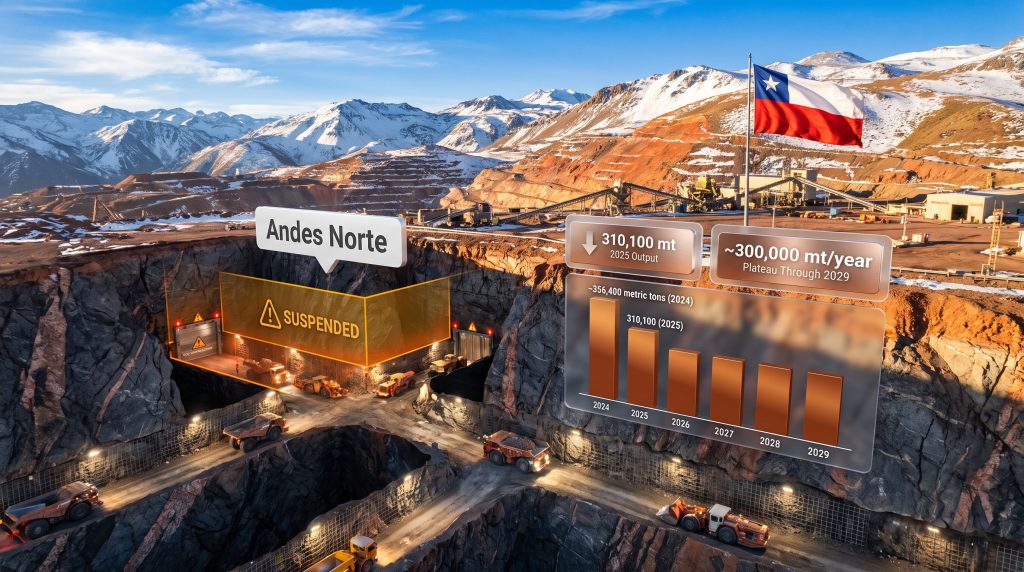
| El Teniente output (2024) | ~356,400 metric tons |
| El Teniente output (2025) | 310,100 metric tons |
| Year-on-year decline | ~13% |
| Projected annual plateau through 2029 | ~300,000 metric tons |
| Cumulative foregone output vs. 2024 baseline | ~280,000 metric tons |
A 13% single-year production decline at a mine of this magnitude is not a rounding error. Held flat across five years against a 2024 baseline, that differential compounds into a cumulative shortfall of roughly 280,000 metric tons of copper that markets had, at least implicitly, expected to receive. To put that figure in context, 280,000 metric tons represents more than the entire annual output of many mid-tier copper-producing nations.
"The critical distinction here is between a mine that is producing and a mine that is expanding. El Teniente is in neither a growth phase nor a temporary disruption cycle. It is in a managed stability phase, and that classification has very different implications for supply-side modelling through 2029."
The Seismic Event That Reset the Timeline
What Happened at Andes Norte and Why It Changed Everything
On July 31, a fatal incident occurred within the El Teniente underground complex. The operational and regulatory consequences moved swiftly. By August 4, Codelco had formally announced the suspension of development activity within the Andes Norte section of the mine, citing revised seismic risk assessments that revealed conditions more hazardous than engineering models had previously anticipated.
Company executive Gustavo Reyes subsequently confirmed that Codelco El Teniente mine production in 2029 is now the revised target for the stalled development section, representing a significant timeline reset for one of Codelco's most important growth levers within its broader portfolio.
Why Seismic Risk in Underground Mining Is a Managed Variable, Not an Anomaly
This is where industry-specific knowledge becomes essential context. El Teniente operates using panel cave and block cave mining methods, where large volumes of ore are drawn down through engineered drawpoints after the rock mass above is deliberately fractured. This extraction method is extraordinarily efficient for accessing deep, large-tonnage ore bodies, but it fundamentally changes the stress environment within the surrounding rock.
As mining progresses deeper and the caved zone expands:
- Stress redistribution in the surrounding rock mass becomes increasingly complex
- The risk of seismic events triggered by mining activity, known as rockbursts, rises with depth
- Ground support systems must be engineered to absorb sudden energy releases that can be orders of magnitude more violent than typical ground movement
- Regulatory thresholds in Chilean mining law require formal reassessment when measured seismicity exceeds design parameters
In deep underground hard-rock environments, seismic hazard zoning is a standard engineering discipline. What triggers a suspension is not the presence of seismic activity per se, but a formal determination that measured or modelled risk has moved outside the tolerances that the current ground support design was built to manage. Once that threshold is crossed, Chilean mining regulations require a suspension of activity in the affected zone until a revised engineering design receives regulatory approval.
Furthermore, the mining pause at El Teniente over seismic risk has attracted significant industry attention, reinforcing how geotechnical complexity can reshape even well-established production timelines at depth.
"In underground cave mining at depth, seismic risk is not an external threat to be avoided. It is an inherent consequence of the extraction method itself. The engineering challenge is not eliminating seismic risk, but designing systems capable of tolerating it safely at each successive depth horizon."
The Andes Norte Section: Why It Mattered to the Growth Case
The Andes Norte section was central to Codelco's plans for extending and expanding El Teniente's productive life. Positioned at considerable depth within the sprawling underground complex, this section was targeted for development because of its ore body geometry, which offered the kind of continuous, high-grade copper mineralisation that justifies the substantial capital expenditure required for deep cave development.
Its suspension does not halt the broader El Teniente operation. The existing producing sections continue to extract copper. However, what it removes from the equation is the incremental production growth that Andes Norte was designed to deliver, effectively capping output at current levels rather than allowing the mine to grow into its long-term resource potential on the originally projected schedule.
The Engineering Pathway from Suspension to a 2029 Restart
Phase-by-Phase: What Has to Happen Before Production Can Resume
The journey from a seismic-driven suspension to a 2029 production restart involves several distinct and sequential stages, each carrying its own timeline and risk of delay:
- Geotechnical Reassessment – Comprehensive seismic modelling and hazard mapping across the Andes Norte section, incorporating revised rock mass characterisation data and updated seismic monitoring records
- Engineering Redesign – Ground support system upgrades, including energy-absorbing rock bolt systems, reinforced mesh, and potentially revised drawpoint geometry to manage the revised seismic load environment
- Regulatory Review and Approval – Formal submission of revised development plans to Chilean mining authorities, with sign-off required before physical work can resume
- Infrastructure Recommissioning – Physical reconstruction of suspended development headings, access corridors, and ventilation infrastructure within the redesigned parameters
- Controlled Production Ramp-Up – Gradual resumption of ore extraction with ongoing seismic monitoring, targeting stabilised output rates by 2029
Each of these phases carries execution risk. Geotechnical reassessments at depth frequently surface complexities not visible in initial modelling. Regulatory review timelines in the Chilean mining permitting system are not always predictable. Consequently, any slippage in phases one through three propagates directly into the 2029 production target.
Codelco's Broader Structural Challenges Amplify the Stakes
A Portfolio Under Pressure Beyond El Teniente
El Teniente's plateau does not exist in isolation. The Codelco production decline across its portfolio has been driven by ageing infrastructure, deepening ore bodies, and the capital intensity required to extend the productive lives of mines that were designed for different eras of mining engineering.
The fiscal dimension of this pressure is substantial. Codelco functions as a critical revenue engine for the Chilean government, with copper royalties and dividends from the state miner forming a meaningful component of national budget receipts. A sustained reduction in output of roughly 56,000 metric tons per year relative to the 2024 production baseline, multiplied across five years and by prevailing copper prices, represents a material cumulative revenue shortfall.
The sensitivity of that fiscal impact to copper price movements cuts both ways. Higher copper prices partially offset the volume shortfall in revenue terms, but they also elevate the opportunity cost of every tonne not produced, intensifying political pressure on Codelco to execute its turnaround timeline without further delays.
Global Copper Supply: Why the Plateau Matters Beyond Chile
The Structural Supply Gap and Where El Teniente Sits Within It
Copper demand growth through the remainder of this decade is being driven by a convergence of forces that are largely independent of economic cycles:
- Grid infrastructure expansion to support renewable energy integration
- Electric vehicle manufacturing and charging network buildout
- Data centre and AI infrastructure growth, which is copper-intensive at scale
- Industrial reshoring and manufacturing capital expenditure in major economies
Against this demand backdrop, the copper supply crunch faces structural headwinds that go well beyond El Teniente. New greenfield copper projects carry development timelines of 15 to 20 years from discovery to first production. The pipeline of projects capable of delivering meaningful new supply before 2030 is limited.
Brownfield expansions at existing operations, which were long considered the faster and lower-risk pathway to incremental supply, are increasingly demonstrating that they carry their own schedule and technical risks, as the Andes Norte situation illustrates directly. In addition, the Chile copper supply gap reinforces how concentrated global copper supply remains within a single country's geological and regulatory environment.
When a tier-one copper operation holds output flat rather than growing, the effect on the global supply-demand balance is not simply the absence of growth. It is an active contribution to the structural deficit, because demand projections were modelling supply growth from assets like El Teniente that is now not materialising on schedule.
"For copper market participants, the cumulative production shortfall at El Teniente through 2029 is not a temporary supply disruption to be discounted. It is a structural constraint embedded into global supply forecasts for the remainder of the decade, occurring precisely when demand growth is accelerating."
The next major ASX story will hit our subscribers first
Frequently Asked Questions: El Teniente and the 2029 Production Outlook
What is El Teniente and where is it located?
El Teniente is an underground copper mine situated in the Andes mountains of Chile's Libertador General Bernardo O'Higgins Region, operated by Codelco, Chile's state-owned mining company. It is recognised as one of the largest underground copper mines in the world by reserve volume and has been in continuous operation for over a century.
Why was part of El Teniente suspended?
The Andes Norte development section was paused following a fatal incident on July 31 and a subsequent seismic risk reassessment announced on August 4. Studies revealed that the section carries greater seismic risk than engineering models had initially estimated, triggering a formal suspension under Chilean mining regulations.
What is El Teniente's expected production through 2029?
Codelco has indicated that output is expected to stabilise at approximately 300,000 metric tons of copper per year through the end of the decade, representing a plateau rather than a growth trajectory. The Chile copper outlook for this period remains closely tied to how efficiently Codelco executes its engineering and regulatory pathway.
How much did El Teniente's output fall in 2025?
Production declined by approximately 13%, dropping from roughly 356,400 metric tons in 2024 to 310,100 metric tons in 2025.
When is the Andes Norte section expected to restart production?
Company guidance, as confirmed by Codelco executive Gustavo Reyes, targets Codelco El Teniente mine production in 2029 from the Andes Norte section, following the completion of geotechnical reassessment, engineering redesign, regulatory approval, and infrastructure recommissioning.
What does this mean for copper investors?
A sustained production plateau at one of the world's most significant copper operations, occurring against a backdrop of rising demand and limited new supply development, reinforces the structural supply-side case for copper pricing through the late 2020s. Investors exposed to copper through equities, commodity indices, or physical holdings should factor this constraint into supply-side modelling.
Key Takeaways for Market Participants
The trajectory of Codelco El Teniente mine production in 2029 has moved from a growth story to a managed stability narrative, and the distinction carries real weight for commodity markets, Chilean fiscal policy, and copper-exposed investment portfolios.
Several conclusions stand out for analysts and investors tracking this situation:
- The ~300,000 mt/year ceiling at El Teniente is not a temporary disruption. It is a structural production constraint extending to the end of this decade
- The seismic-driven suspension of Andes Norte highlights the underappreciated geotechnical execution risk embedded in deep underground copper development globally, a risk that brownfield expansion narratives have historically underweighted
- Codelco's ability to execute the 2029 restart without further delays will serve as a meaningful signal for the broader viability of panel cave and block cave expansion strategies in Chilean copper mining
- The cumulative foregone production from El Teniente's plateau, measured against the 2024 output baseline, reinforces the structural supply-demand thesis that has underpinned the long-term copper bull case
- For copper market participants, the 2029 timeline should be tracked not as a fixed date but as a range, with each phase of the engineering and regulatory process carrying independent delay risk
This article is intended for informational purposes only and does not constitute financial or investment advice. Forecasts, timelines, and production figures referenced herein are subject to change based on operational, regulatory, and market developments. Readers should conduct independent due diligence before making any investment decisions.
Want to Stay Ahead of the Next Major Copper Discovery?
Discovery Alert's proprietary Discovery IQ model scans ASX announcements in real time, instantly identifying significant mineral discoveries across copper and 30+ other commodities — turning complex geological data into clear, actionable investment insights. Explore how historic discoveries have delivered extraordinary returns on Discovery Alert's discoveries page, and begin your 14-day free trial today to position yourself ahead of the market before the next major find is announced.