May 21, 2026
The global mining equipment sector continues evolving toward more sustainable, technologically integrated machinery that prioritises operational longevity over traditional replacement cycles. This transformation reflects broader industry evolution trends for cost optimisation, environmental compliance, and operational efficiency in increasingly challenging mining environments across emerging markets. Within this context, heavy hauling systems represent a critical component of mining productivity, where equipment selection directly impacts per-tonne costs, operational uptime, and long-term asset management strategies.
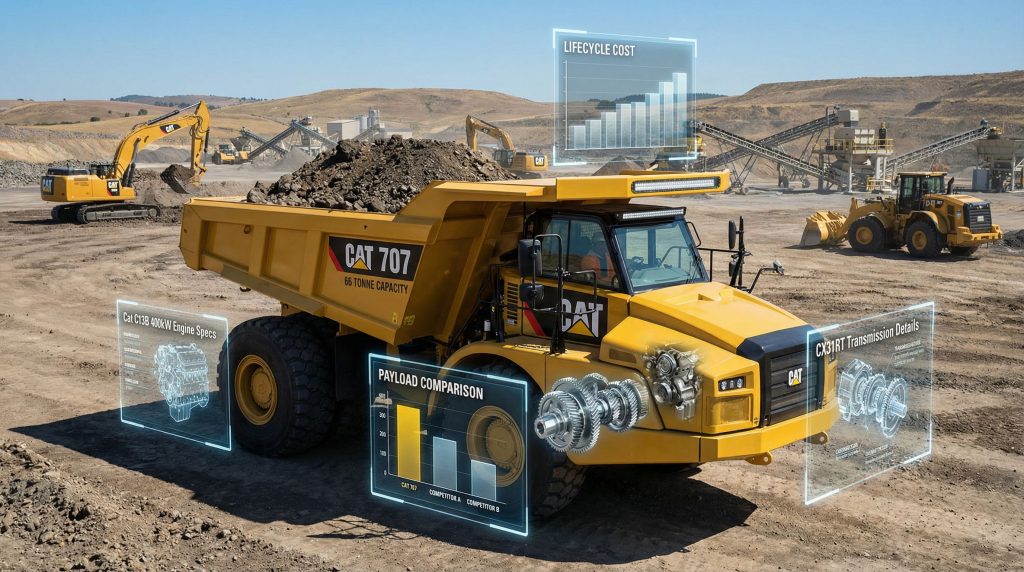
The Caterpillar 707 wide body truck emerges as a significant development in this evolving landscape, introducing innovative approaches to equipment lifecycle management while addressing specific operational requirements in developing mining markets. Its 66-tonne maximum payload capacity positions it strategically within the mid-tier hauling segment, offering mining operators an alternative to both smaller standard trucks and ultra-heavy class vehicles that may prove oversised for certain applications.
Technical Specifications and Powertrain Engineering Excellence
Advanced Engine Technology and Emissions Compliance
The Caterpillar 707 wide body truck incorporates dual engine options designed to meet varying regional emission standards while maintaining consistent performance characteristics. The Cat C13B configuration delivers 400kW power output whilst meeting China Nonroad Stage IV emissions standards, representing one of the strictest environmental compliance frameworks for mobile mining equipment. Alternatively, the Cat C13 variant provides 358kW power output equivalent to U.S. EPA Tier 3 regulations, ensuring broad market accessibility across international mining operations.
Both powertrain options integrate high-rated engine brake systems as standard equipment, providing engine-driven retardation capabilities independent of hydraulic systems. This redundancy proves critical in mining environments where multiple braking system failures could create significant safety hazards during loaded downhill operations.
Transmission and Drivetrain Integration
The truck features a six-speed Cat automatic transmission (CX31RT) with simplified gear selection controls optimised for operator efficiency during demanding loading cycles. Furthermore, this design contributes to enhanced reliability through reduced manual intervention requirements. Optional hydraulic retarder systems provide additional braking capability, creating three distinct brake and retardation levels:
- Integrated Cat engine brake (standard on both variants)
- Optional Cat hydraulic retarder for enhanced downhill control
- Parking and service brakes for stationary operations
The integrated powertrain approach emphasises reliability through proprietary component design, including Cat axles, integrated powertrain controllers, and Cat wiring harnesses. Consequently, this vertical integration strategy reduces potential failure points whilst improving diagnostic capabilities across the drivetrain system.
| Component | Standard Configuration | Enhanced Option |
|---|---|---|
| Engine Output | Cat C13 (358kW) | Cat C13B (400kW) |
| Emissions Standard | EPA Tier 3 Equivalent | China Nonroad Stage IV |
| Transmission | CX31RT 6-speed automatic | CX31RT with retarder |
| Brake Systems | Engine + service brakes | Engine + hydraulic + service |
When big ASX news breaks, our subscribers know first
Innovative Safety Systems and Operator Experience Design
Cab Configuration and Protection Systems
The Caterpillar 707 wide body truck incorporates comprehensive safety features beginning with its cab design philosophy. Left-side operator positioning provides optimal visibility for loading equipment interaction, whilst an optional right-side instructor seat enables on-site operator training capability. This dual-seat configuration addresses real operational needs in mining sectors where operator skill development directly impacts safety outcomes and equipment utilisation rates.
Moreover, the implementation of enhanced haulage safety protocols becomes increasingly critical in modern mining operations. Structural protection includes:
- Standard FOPS (Falling Object Protective Structure) certification
- Optional ROPS (Rollover Protective Structure) protection
- Four-point cab mounting system for vibration isolation
- Reversing camera system for enhanced manoeuvring safety
Advanced Visibility and Lighting Technology
The truck replaces traditional lighting systems with LED illumination technology that provides longer operational life, brighter illumination with reduced power consumption, and enhanced resistance to vibration and water damage. In mining environments characterised by dust, humidity, and continuous vibration exposure, these characteristics translate to significantly reduced maintenance intervals compared to conventional halogen or incandescent systems.
The four-point cab mounting system specifically addresses operator fatigue reduction through improved vibration isolation. Extended shift operations, often lasting 12 hours in mining contexts, create cumulative vibration exposure that can degrade operator alertness and reaction time. This mounting design helps maintain operator performance throughout extended operational periods.
Revolutionary "Built to be Rebuilt" Lifecycle Philosophy
Second Lifecycle Engineering Approach
The Caterpillar 707 wide body truck introduces a fundamental shift from traditional mining equipment economics through its second lifecycle engineering approach. Rather than following conventional 5-7 year depreciation cycles followed by equipment liquidation, the Cat 707 assumes a 10-15 year operational lifespan with mid-life rebuild capabilities.
This philosophy represents a departure from disposal-based equipment cycles toward sustainable, long-term asset management strategies. In addition to cost benefits, the approach aligns with broader sustainability transformation initiatives across the mining sector. The approach enables mining operations to:
- Extend equipment return on investment beyond traditional depreciation cycles
- Maintain consistent mechanical availability through systematic component renewal
- Reduce per-tonne hauling costs over extended operational periods
- Optimise capital allocation through predictable rebuild scheduling
Parts Commonality and Maintenance Optimisation
The truck leverages existing Cat C13 engine platform components, CX31RT transmission parts, and common cab architecture already deployed across multiple Caterpillar machines. This parts commonality strategy reduces spare parts inventory burden on mining operations whilst improving component availability and reducing lead times.
Grouped service points cluster lubrication points, fluid level checks, and filter replacements in accessible locations, reducing technician time per service cycle. Combined with a ground-level engine shut-off switch for safety during maintenance operations, these design elements contribute to reduced operational costs throughout the equipment lifecycle.
The Cat 707's rebuild philosophy represents a fundamental shift from traditional disposal-based equipment cycles to sustainable, long-term asset management strategies that can significantly reduce per-tonne hauling costs over extended operational periods.
Productivity Enhancement Through Strategic Equipment Matching
Loading Equipment Compatibility and Cycle Optimisation
The Caterpillar 707 wide body truck achieves optimal productivity through strategic pairing with compatible loading equipment. Ideal pass matches include Cat 986, 988, and 988 XE loaders, along with Cat 350, 374, and 395 excavators. This equipment matching approach optimises loading cycles whilst ensuring consistent material flow rates that maximise truck utilisation.
However, optimal productivity requires more than equipment matching; it demands comprehensive data-driven operations that monitor performance metrics continuously. The truck's body volume configurations of 40-42 m³ capacity provide operational flexibility based on material density and haul distance requirements.
Hoist System Performance and Cycle Efficiency
The integrated hoist system delivers fast 20-second raise and lower cycle times for material unloading operations. This rapid cycling capability directly impacts productivity metrics by reducing truck cycle times and improving overall fleet utilisation rates. Combined with automatic shifting transmission controls, these features contribute to enhanced operational efficiency throughout typical mining applications.
| Productivity Metric | Specification | Operational Impact |
|---|---|---|
| Payload Capacity | 66 tonnes maximum | Mid-tier hauling flexibility |
| Body Volume | 40-42 m³ options | Material density optimisation |
| Hoist Cycle Time | 20 seconds (raise/lower) | Reduced unloading time |
| Equipment Matching | Cat 986/988/988XE loaders | Optimised loading cycles |
Market Positioning and Competitive Landscape Analysis
Regional Deployment Strategy and Market Focus
The Caterpillar 707 wide body truck targets select regional markets including Africa, Asia, and developing mining sectors where mid-tier hauling capacity meets specific operational requirements. This strategic market focus reflects recognition that emerging mining markets often require equipment solutions that balance capability with operational flexibility.
The 66-tonne payload positioning places the Cat 707 between standard 50-60 tonne trucks and ultra-heavy class 75+ tonne vehicles, addressing market segments where larger trucks may prove oversised for certain mining applications or infrastructure limitations. Furthermore, Caterpillar's launch strategy emphasises cost-effective design principles that resonate with developing market requirements.
Technology Differentiation and Service Infrastructure
Key differentiating factors include:
- Integrated Cat ecosystem advantages through common component platforms
- Comprehensive service network accessibility in target regions
- Enhanced parts availability in remote mining locations
- Established training and support infrastructure leveraging existing Cat dealer networks
The truck's introduction as the first model in a new Cat wide body product family suggests potential for expanded variant development, creating a scalable technology platform for future market expansion. Additionally, the implementation of advanced mining technologies continues across various equipment categories.
Long-Term Industry Implications and Future Development Pathways
Mining Equipment Evolution Trends
The Caterpillar 707 wide body truck reflects several significant industry evolution trends that extend beyond individual equipment specifications. The shift toward sustainable equipment lifecycles challenges traditional mining equipment procurement models by demonstrating economic viability of extended asset management approaches.
Integration of advanced powertrain technologies with established component platforms creates opportunities for continuous technological advancement without complete platform redesign. This evolutionary approach enables mining operations to benefit from technological improvements whilst maintaining operational familiarity and service infrastructure continuity.
Innovation Pipeline and Market Expansion Opportunities
The Cat 707's positioning as the foundation model for an expanded wide body product family indicates strategic intentions for comprehensive market coverage. Future development pathways may include:
- Scaled payload variants addressing different operational requirements
- Enhanced technology integration building on the established platform
- Regional customisation options for specific market needs
- Advanced automation capabilities integrated with existing systems
These development opportunities suggest the Cat 707 represents not merely a new product introduction, but a strategic platform for long-term market expansion and technological advancement in the mining equipment sector. For instance, the integration of AI in mining innovation could enhance future variants significantly.
The next major ASX story will hit our subscribers first
Implementation Considerations and Operational Applications
Total Cost of Ownership Framework
Mining operations evaluating the Caterpillar 707 wide body truck must consider comprehensive total cost of ownership factors that extend beyond initial acquisition costs. The second lifecycle engineering approach fundamentally alters traditional equipment economics by:
- Extending asset utilisation periods through systematic rebuild programs
- Reducing long-term capital requirements via extended equipment lifecycles
- Optimising maintenance efficiency through grouped service points and parts commonality
- Improving operational predictability through established rebuild protocols
Regional Availability and Service Support
Current select regional availability includes Africa, Asia, and developing markets with specific emissions compliance options. The Cat C13B variant meets China Nonroad Stage IV standards, whilst the Cat C13 option satisfies EPA Tier 3 equivalent requirements, ensuring broad international market accessibility.
Mining operations interested in deployment should contact authorised Cat dealers for region-specific availability and compliance verification, as emission standards and equipment specifications may vary based on local regulatory requirements.
Disclaimer: This analysis is based on publicly available technical specifications and industry information. Mining operations should conduct comprehensive evaluation of equipment suitability for specific applications and consult with authorised dealers for detailed technical specifications, service support availability, and regional compliance requirements. Equipment performance may vary based on operational conditions, maintenance practices, and application-specific factors.
Looking to Capitalise on Mining Equipment Innovation?
Discovery Alert's proprietary Discovery IQ model delivers instant alerts on significant mining technology and equipment discoveries across the ASX, empowering subscribers to identify actionable investment opportunities ahead of the broader market. Begin your 14-day free trial today to explore historic discovery returns and secure your competitive advantage in the evolving mining sector.