July 8, 2026
Why Caterpillar Acquires Skycatch Matters Beyond One Deal
Mining productivity has always been constrained by one stubborn problem: operations change faster than mine models do.
A pit wall shifts, a haul road degrades, a dump point moves, or a stockpile grows unevenly, yet many sites still depend on survey intervals that can leave planners, dispatchers, and autonomous fleets acting on yesterday's picture of today's mine.
That is why the news that Caterpillar acquires Skycatch matters well beyond a standard technology tuck-in. The transaction, announced in July 2026, adds spatial data capture, drone automation, and AI-driven mine analytics to Caterpillar's growing mining software and automation ecosystem. Financial terms were not publicly disclosed.
The strategic significance is larger than the acquisition price alone. It points to a mining industry in which competitive advantage is increasingly won through data freshness, software integration, and closed-loop decision-making, not just machine size, engine power, or fleet count. Furthermore, it reflects broader shifts already underway in data-driven mining operations across the sector.
The core issue is not simply collecting more mine data. It is reducing the delay between what is happening on site and what operators believe is happening.
When big ASX news breaks, our subscribers know first
What Skycatch Brings to Caterpillar
Skycatch was founded in 2013 and is based in San Francisco, California. Over more than a decade, it built technology focused on capturing and processing mine-site spatial data at high speed and high precision.
Its tools are designed to support several operational workflows:
- Stockpile measurement
- Material movement tracking
- Pit geometry analysis
- Haul road condition monitoring
- Progress-versus-plan comparison
- Digital mine model updates
At a technical level, Skycatch's offering combines drone-based or automated site capture with software that converts raw imagery and topographic information into operationally useful models. That processing layer uses AI and computer vision methods to turn large spatial datasets into updated mine intelligence.
Skycatch at a Glance
| Attribute | Detail |
|---|---|
| Founded | 2013 |
| Headquarters | San Francisco, California |
| Core focus | Spatial data capture, drone automation, AI mine analytics |
| Mining use cases | Stockpiles, haul roads, pit monitoring, progress tracking |
| Acquisition by Caterpillar | July 2026 |
| Deal value | Not publicly disclosed |
For miners, the real value is not the drone itself. It is the ability to compress the cycle from capture to decision.
What a Digital Twin Means in Mining
A digital twin in mining is a continuously refreshed virtual representation of a physical mine, built from spatial data, operational inputs, and analytics.
In practical terms, that means teams can compare the mine plan with the actual mine shape and current operating conditions, then adjust accordingly.
Why Digital Twins Matter on Mine Sites
- More accurate reconciliation between planned and actual movement of material
- Faster response to changing road geometry or active work zones
- Improved risk visibility for slopes, traffic interactions, and work sequencing
- Better planning discipline as models are updated with fresher field conditions
Traditional mine surveying is often periodic, with updates arriving weekly or monthly depending on the site, budget, and operating rhythm. That can be acceptable for some long-range planning tasks, but it becomes a limitation when sites are running autonomous haulage, dynamic dispatch, or short-interval planning. In addition, tools such as 3D geological modelling are increasingly being used alongside digital twins to enhance spatial understanding across complex mine environments.
A digital twin only improves decisions if it reflects the mine as it exists now, not as it looked during the last survey window.
How the Acquisition Fits Caterpillar's Broader Mining Technology Strategy
The phrase Caterpillar acquires Skycatch is best understood as one part of a broader platform buildout.
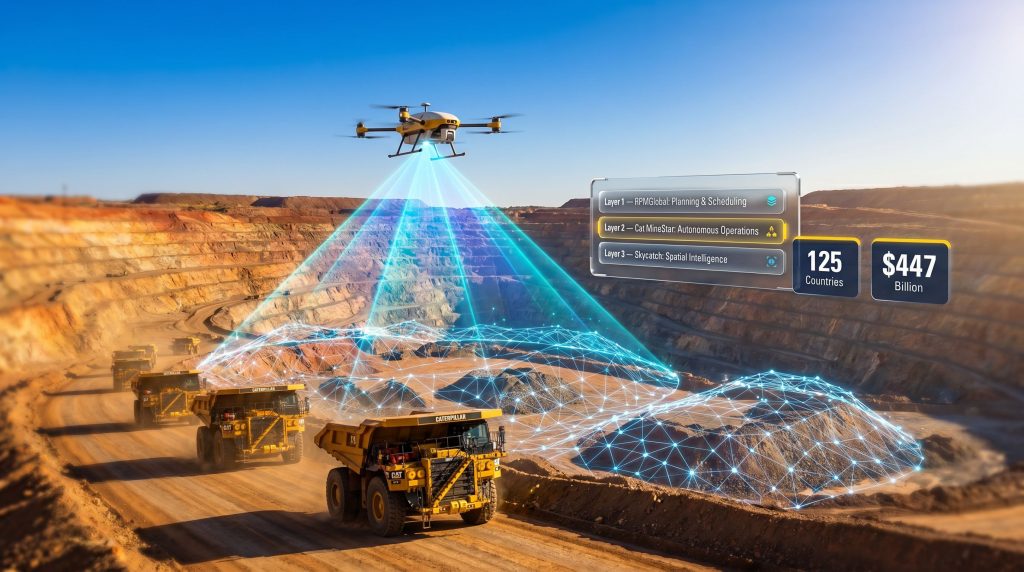
Earlier in February 2026, Caterpillar acquired RPMGlobal, a mining software business with more than 30 applications spanning long-term mine planning, production scheduling, asset performance modelling, project optimisation, and equipment simulation. Before that acquisition, RPMGlobal software was used by mining companies in 125 countries.
Taken together with Cat MineStar, Caterpillar is assembling a three-layer mining intelligence stack.
The Emerging Three-Layer Architecture
| Layer | Platform | Primary role |
|---|---|---|
| Planning | RPMGlobal | Mine design, scheduling, simulation, optimisation |
| Execution | Cat MineStar | Fleet management, autonomous operations, traffic coordination |
| Measurement | Skycatch | Spatial capture, AI analytics, near-real-time site updates |
This architecture matters because each layer solves a different part of the mining workflow:
- RPMGlobal helps determine how the mine should run.
- MineStar helps run the fleet in real time.
- Skycatch helps verify what the mine actually looks like right now.
That closes a longstanding gap between plan and reality.
The Survey Gap Problem Skycatch Is Designed to Solve
In mining, poor decisions are often made not because operators lack intelligence, but because they lack current intelligence.
A weekly or monthly survey cycle can leave operations vulnerable to data latency. By the time planners import surfaces, update pit shells, check dump progress, or revise haul routes, conditions may already have changed materially.
Why Stale Spatial Data Creates Operational Friction
- Autonomous trucks may route on outdated road assumptions
- Dispatch decisions can misread congestion or active work areas
- Stockpile volumes may be estimated with lower confidence
- Short-term plans can drift away from actual pit development
- Slope and geotechnical changes may be identified later than ideal
This is especially relevant for large open-pit operations where benches, ramps, and loading areas can change rapidly. In these settings, even small geometry changes can affect cycle times, fuel burn, equipment wear, queueing behaviour, and safety conditions.
Conventional Surveys Versus Skycatch-Enabled Workflows
| Capability | Conventional approach | Skycatch-enabled approach |
|---|---|---|
| Data refresh | Weekly to monthly | Near-real-time |
| Mine model updates | Batch cycles | Continuously refreshed inputs |
| Stockpile measurement | Periodic survey-based | High-frequency digital measurement |
| Fleet support | Lagging spatial context | Current site geometry |
| Planning integration | Manual or delayed | Better alignment with live operations |
A lesser-known point for non-mining audiences is that data latency compounds across systems. If a survey update is late, dispatch is late, reconciliation is late, and planning feedback is late. The problem is multiplicative, not isolated.
How Caterpillar Skycatch Integration Could Improve Safety and Productivity
Caterpillar stated that integrating Skycatch into MineStar and RPMGlobal is intended to improve safety, productivity, and predictability. That framing is important because those three goals interact rather than compete.
1. Safety Improvements
Fresher spatial awareness can support safer operations by helping teams identify changes in:
- Haul road conditions
- Pit wall geometry
- Dump locations
- Traffic patterns in mixed staffed and autonomous environments
In mining, interface risk between people-driven and autonomous equipment is a major operational consideration. A shared, updated digital view of work zones and travel paths can reduce uncertainty around those interactions.
2. Productivity Gains
Productivity benefits are likely to come from better routing and fewer mismatches between assumptions and field reality.
Potential sources of value include:
- Reduced rework from outdated plans
- Better route efficiency for autonomous or dispatched fleets
- Improved stockpile inventory accuracy
- Faster progress checks against mine schedules
- Better material movement reconciliation
Even minor route changes can matter at scale. On large haulage circuits, small inefficiencies repeated across hundreds of truck cycles per day can materially change cost per tonne moved.
3. Predictability and Planning Accuracy
Predictability is often undervalued by investors, but mine operators care deeply about it. A site that consistently hits plan is easier to manage, easier to maintain, and often more profitable than one with volatile daily performance.
By feeding current site geometry into scheduling and planning tools, operators can continuously compare intended outcomes with actual mine development.
The real prize is not simply automation. It is a closed-loop operating system where planning, execution, and measurement constantly inform each other.
The next major ASX story will hit our subscribers first
Why This Matters in the Autonomous Mining Race
Autonomous haulage is no longer an experimental edge case. It is an expanding competitive battleground among major mining technology providers. Consequently, the mining automation transformation underway across the industry is placing new demands on the quality and freshness of spatial data.
One notable industry data point is that Komatsu reported its 1,000th autonomous truck milestone in April 2026, underscoring how far driverless haulage has advanced commercially.
That context matters because the next phase of competition may be less about whether trucks can drive themselves and more about how well they understand the changing mine environment.
Is Spatial Data Quality the Next Frontier?
Autonomous systems depend on:
- Current maps
- Reliable obstacle and route context
- Updated work-zone information
- Consistent terrain understanding
If those inputs are stale, autonomy performance can degrade even when the vehicles and algorithms are otherwise capable.
This gives the Caterpillar Skycatch combination a plausible strategic edge. MineStar already manages fleet and autonomous functions. Skycatch adds a higher-frequency reality layer that could improve route logic and reduce uncertainty in changing mine conditions. For further context, Caterpillar autonomous haulage capabilities have already been advancing independently of this acquisition.
There is also a broader AI angle. Caterpillar's Cat AI Assistant is built on Nvidia's industrial-grade edge AI platform, suggesting that the company is investing across the stack, from AI interfaces and edge processing to operational automation and spatial analytics. This aligns with wider industry moves toward AI-powered mining efficiency across major operations globally.
While it is too early to claim guaranteed performance outcomes, the architecture suggests a push toward an end-to-end mining intelligence model.
Is Caterpillar Becoming a Mining Technology Platform?
The answer is not that Caterpillar has stopped being a machinery company. It has not. However, the acquisitions of RPMGlobal and Skycatch strongly suggest that it wants machinery to sit inside a larger software and data ecosystem.
Why Investors Should Pay Attention
For a company with a market capitalisation context cited at roughly $447 billion, recurring software and data revenues can be strategically attractive because they may offer:
- Higher-margin revenue streams
- Subscription and licensing opportunities
- Stronger customer retention
- Greater switching costs once a miner runs planning, execution, and measurement through one ecosystem
This kind of platform strategy can be powerful in mining because mines are complex, long-life assets with deeply embedded workflows. Once a site standardises around a tightly integrated operating system, replacement becomes difficult and expensive.
That said, investors should avoid assuming seamless integration. Acquisitions in industrial software often face challenges around product interoperability, sales alignment, customer migration, and on-site implementation.
Important disclaimer: any discussion of future revenue mix, margin uplift, competitive advantage, or platform dominance is analytical interpretation, not a confirmed outcome. Execution risk remains substantial.
What Mining Operators Should Watch Next
For site operators, technology buyers, and investors, the most important questions now are practical ones.
Key Watchpoints After Caterpillar Acquires Skycatch
- Integration timing between Skycatch, RPMGlobal, and MineStar deployments.
- Customer adoption speed across existing Caterpillar mining accounts.
- Workflow depth, meaning whether data moves beyond visualisation into dispatch, short-term planning, and maintenance decisions.
- International scaling, especially through Caterpillar's global mining footprint.
- Expansion into adjacent use cases, such as tailings monitoring, plant area mapping, or broader site situational awareness.
A speculative but reasonable industry view is that the biggest long-term value may come not from replacing survey teams, but from creating a mine where every important system operates on a common, continuously updated ground truth.
That would move the sector closer to a genuine operational feedback loop, where software no longer just models the mine, but keeps pace with it. According to reporting from Mining.com, this acquisition is being viewed broadly as a significant step in Caterpillar's push to lead AI-enabled mine technology.
Frequently Asked Questions About Caterpillar Acquires Skycatch
When Was the Acquisition Announced?
Caterpillar announced the Skycatch acquisition in July 2026.
How Much Did Caterpillar Pay?
The financial terms were not publicly disclosed.
What Does Skycatch Do?
Skycatch develops spatial data capture, drone automation, and AI-powered mine-site analytics for applications such as stockpile measurement, haul road monitoring, pit analysis, and mine model updates.
How Does This Connect to RPMGlobal?
RPMGlobal, acquired by Caterpillar in February 2026, provides mine planning and scheduling software. Skycatch adds a high-frequency measurement layer that can help keep those plans aligned with actual site conditions.
Will This Improve Autonomous Mining?
It could. The strongest expected benefit is better spatial awareness for systems like Cat MineStar, which may improve route planning and reduce uncertainty. However, actual gains will depend on implementation quality, site conditions, and customer adoption.
Why Is This Strategically Important?
Because Caterpillar acquires Skycatch is not just a hardware company buying a drone-data specialist. It is a sign that the future of mining competition may be shaped by who best integrates planning, execution, AI, and live spatial intelligence into one operating environment.
Want to Know Which ASX Mining Companies Are Harnessing the Next Wave of Discovery?
As the mining sector accelerates toward data-driven operations and autonomous technologies, the companies making significant mineral discoveries stand to benefit enormously — and Discovery Alert's proprietary Discovery IQ model delivers real-time ASX discovery alerts straight to subscribers, ensuring actionable opportunities are never missed. Explore historic discoveries and their extraordinary returns, then begin your 14-day free trial at Discovery Alert to position yourself ahead of the market.