
July 8, 2026
The Slow-Burn Risk That Mining Boardrooms Are Underpricing
Supply chain risk in mining has traditionally been framed around sudden shocks: a mine closure, a port strike, an export ban. These events are dramatic, visible, and relatively easy to price into forward curves and insurance policies. The more insidious threat is the kind that compounds quietly across months, eroding project economics without triggering a single headline. That is precisely the risk profile that mining's exposure to Middle East conflict is beginning to reveal in 2026, and it deserves far more rigorous analysis than most capital allocation frameworks currently apply to it.
The distinction between a price spike and structural cost inflation is not academic. A price spike is mean-reverting. Structural inflation reshapes feasibility studies, alters offtake economics, and forces project deferrals that ripple through commodity supply balances for years. Understanding which category the current disruption falls into is the central challenge facing mining executives, analysts, and investors right now.
When big ASX news breaks, our subscribers know first
The Strait of Hormuz: Far More Than an Oil Corridor
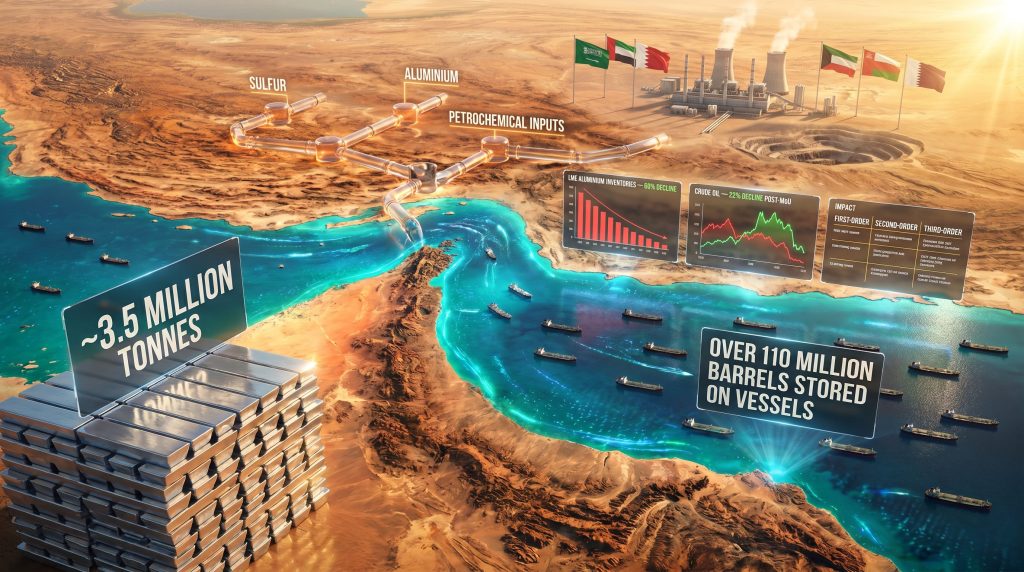
Most financial coverage of the Strait of Hormuz focuses on crude oil transit volumes, and understandably so. At peak disruption, approximately 11 million barrels per day of crude production was halted, and over 110 million barrels were reported stored on vessels as transit uncertainty persisted. These are figures that command attention in energy markets.
What receives far less attention is the Strait's role as a critical transit route for inputs that sit at the heart of global mining operations. Sulfur, aluminium feedstocks, and a range of petrochemical process chemicals all move through this corridor in volumes that are small relative to crude oil but disproportionately consequential for specific mining value chains.
The Gulf Cooperation Council member states, comprising Bahrain, Kuwait, Oman, Qatar, Saudi Arabia, and the UAE, collectively represent a significant concentration of energy-intensive metals processing capacity. This geographic clustering of smelting and refining assets within a single geopolitical risk zone is a structural vulnerability that the industry has historically underweighted because the region's political stability was taken for granted.
According to Wood Mackenzie, even under a favourable diplomatic resolution scenario, the full value chain from wellhead to Gulf ports could require the better part of a year to fully normalise. That timeline has profound implications for input cost planning across the mining sector globally.
Three Orders of Impact: A Framework for Understanding Mining's Exposure
Geopolitical disruption rarely transmits to mining through a single mechanism. A useful analytical framework identifies three distinct orders of impact, each with a different timeline and a different set of affected operations.
| Impact Order | Mechanism | Example from Current Conflict | Timeline |
|---|---|---|---|
| First-Order | Physical asset destruction | ~3.5 million tonnes of aluminium output removed | Immediate |
| Second-Order | Supply chain and logistics disruption | LME aluminium inventories fell ~60%; bunker fuel costs surged | Weeks to months |
| Third-Order | Demand suppression and preference shifts | Input inflation eroding industrial demand growth | 12 to 36 months |
The third-order effects are the most difficult to model and the most consequential over the medium term. As research director and head of metals and mining at Wood Mackenzie Peter Schmitz noted at the Junior Indaba conference in June 2026, these softer secondary effects still require significant effort to resolve and carry inflationary consequences that will suppress demand growth in ways that may only become apparent well after the conflict itself has receded from headlines.
The analytical challenge is that third-order effects are invisible in short-term price data. They accumulate in input cost indices, project capex estimates, and demand forecasts, emerging as a pattern rather than an event.
Aluminium: The Most Visible First-Order Casualty
The aluminium market has experienced the most immediate and quantifiable impact from the current conflict. Following strikes on smelter facilities owned by Emirates Global Aluminium attributed to Iranian military action, an estimated 3.5 million tonnes of aluminium output was effectively removed from global supply in 2026. The downstream consequence was dramatic: London Metal Exchange aluminium inventories fell approximately 60%, and futures prices surged in response to the sudden supply contraction.
This matters beyond the aluminium market itself. Aluminium is a critical input for renewable energy infrastructure, automotive manufacturing, and construction activity, three sectors that are themselves major consumers of other mined commodities. Supply shocks in aluminium therefore transmit into adjacent commodity demand in ways that can be counterintuitive.
The aluminium episode illustrates a broader principle: when conflict destroys processing infrastructure rather than mine sites, the impact on commodity markets is often faster and more severe, because smelters and refineries represent years of capital investment that cannot be replicated quickly.
The comparison with the Russia-Ukraine conflict's impact on aluminium markets is instructive. In that episode, sanctions-related disruption to Russian aluminium exports created sustained LME price volatility over multiple quarters. The current disruption involves physical destruction of assets rather than trade restriction, which implies a longer recovery timeline for affected production capacity.
Sulfur: Mining's Most Underappreciated Supply Chain Vulnerability
If aluminium represents the visible first-order impact of the current conflict on mining, sulfur represents the hidden systemic risk that most market commentary has failed to adequately address. Approximately 50% of global marine sulfur supply originates from Persian Gulf export terminals, making it one of the most geographically concentrated critical inputs in the entire mining value chain.
Why Does Sulfur Dependency Matter So Profoundly?
Sulfur is the essential reagent in hydrometallurgical acid leaching processes used to extract nickel, copper, and cobalt from lower-grade ore bodies. As the industry has progressively shifted toward processing lower-grade, more complex ores, the dependency on sulfuric acid, which is derived from sulfur, has intensified substantially. The High-Pressure Acid Leach (HPAL) process used in Indonesian nickel operations is particularly exposed. Furthermore, critical minerals energy security concerns are amplified considerably when key chemical inputs are this geographically concentrated.
| Mining Region | Dependency on Persian Gulf Sulfur | Primary Commodity Affected |
|---|---|---|
| Indonesia (HPAL sector) | ~75% of supply sourced from Persian Gulf | Nickel |
| Democratic Republic of Congo (Copperbelt) | >90% of acid supply sourced from the Gulf | Copper, Cobalt |
| Chile (copper leaching operations) | Significant but partially diversified | Copper |
The DRC Copperbelt's dependency figure is particularly alarming. With more than 90% of acid supply sourced from the Gulf region, sustained disruption to sulfur exports could meaningfully constrain cobalt and copper output from one of the world's most strategically important mining jurisdictions, at precisely the moment when battery supply chains are counting on expanded production from that region.
Indonesia's HPAL sector faces a similar structural vulnerability. The country's ambitions to become a dominant producer of battery-grade nickel intermediates depend critically on uninterrupted access to Persian Gulf sulfur. Any prolonged disruption to that supply corridor would force throughput reductions at operating HPAL facilities and delay commissioning of projects currently under development.
What makes this vulnerability particularly difficult to hedge is the absence of readily available alternative supply sources. Sulfur is a byproduct of oil and gas processing, which means production volumes are tied to hydrocarbon output levels rather than independent market signals. Diversifying away from Persian Gulf supply requires either accessing sulfur from alternative oil and gas processing regions or switching to alternative leaching reagents, neither of which is achievable quickly or cheaply at industrial scale.
Input Cost Transmission: From Energy Markets to Mine Sites
The inflationary pathway from Middle East conflict to mine-site operating costs runs through several interconnected mechanisms, and the speed of transmission varies considerably by geography and commodity.
In South Africa, the mining composite input cost index recorded a 2.7% increase in April 2026, described by the Minerals Council as a moderate rise. However, May data revealed an acceleration to 5.3% year-on-year, with the Minerals Council directly attributing the jump to energy cost shock transmission from the conflict. This progression from moderate to accelerating inflation within a single month illustrates how quickly geopolitical disruption can pass through to operational costs once energy price effects propagate through supply chains.
The transmission mechanisms include:
- Diesel price increases flowing directly into haulage, processing, and generation costs at open-pit operations
- Rising bunker fuel costs increasing the landed price of all seaborne chemical and equipment imports
- Steel price volatility affecting capital equipment procurement and infrastructure maintenance
- Chemical input inflation reducing processing margins at hydrometallurgical operations
One notable finding from South Africa's experience is that the much-anticipated shortages of diesel and processing chemicals did not materialise in the immediate term. This suggests that some of the initial market panic was not grounded in actual supply disruption, and that strategic inventory buffers provided a degree of short-term insulation. However, the absence of immediate shortages does not resolve the medium-term inflationary pressure that is now embedded in input cost trajectories.
Steel production data from the region adds another dimension to the demand-side picture. Middle East crude steel production fell approximately 33% in March during peak conflict intensity, while Iranian steel mill output declined by approximately 55% over the same period. Reduced regional steel demand suppresses iron ore and metallurgical coal consumption, creating flow-on effects for major producers that are entirely separate from the supply-side disruption narrative.
The next major ASX story will hit our subscribers first
The Project Planning Dilemma: Doubled Lead Times and Capital Uncertainty
Beyond input costs, the conflict is creating a more subtle but equally consequential challenge for project development: the collapse of planning certainty. James Smith, CEO of project engineering firm DRA, has noted that project lead times may need to approximately double under current geopolitical uncertainty conditions. That is not merely an inconvenience; it is a structural shift in the economics of project development that affects everything from capital budgeting cycles to offtake contract negotiations.
When lead times double, the net present value of projects under development is directly impaired, financing costs increase as drawdown periods extend, and the risk of cost escalation grows with every additional month of uncertainty.
The nuanced view from Smith is that while practical execution becomes significantly more complex, particularly for projects in or near the Middle East region, the fundamental market economics of most operations outside the immediate conflict zone are unlikely to be permanently altered. The distinction between increased operational complexity, which is manageable with adequate planning, and fundamental demand destruction, which is a more serious long-term threat, is critical for capital allocation decisions.
Investors should be cautious about conflating these two categories. A company facing doubled lead times on a project in a geopolitically distant jurisdiction is facing a different risk profile from one with direct exposure to Gulf-region supply chains or customer bases.
Energy Transition Demand: Conflict as an Accelerant With Complications
Geopolitical disruption to fossil fuel supply chains has historically strengthened policy commitments to energy transition technologies. The logic is straightforward: energy insecurity created by hydrocarbon supply disruption increases the political and economic attractiveness of renewables and electrified transport systems that reduce dependency on imported oil.
Andrew van Zyl, managing director of SRK Consulting (South Africa), has observed that the conflict may filter through to changed product preferences and increased adoption of hybrid vehicles, EVs, wind turbines, solar panels, and battery storage systems, with corresponding effects on mining demand and pricing for the relevant commodities. In addition, critical minerals demand from energy transition sectors could receive a structural boost if policymakers accelerate decarbonisation commitments in response to fossil fuel supply insecurity.
The potential demand beneficiaries include:
- Copper: Essential for EV powertrains, charging infrastructure, wind turbines, and solar panel connections. The copper demand outlook remains broadly positive over the medium term despite near-term headwinds
- Nickel: Critical for high-energy-density battery cathodes in EVs and grid storage
- Lithium: The foundational element of lithium-ion battery chemistry across all applications
- Cobalt: Required in specific battery cathode chemistries, with significant DRC concentration
- Rare Earth Elements: Used in permanent magnets for EV motors and wind turbine generators
However, the hybrid vehicle dimension introduces an important complication that is often overlooked in mainstream energy transition analysis. Hybrid vehicles contain platinum group metals (PGMs) in their catalytic converter systems, unlike pure battery EVs which do not. If the conflict environment encourages greater adoption of hybrids relative to pure EVs, due to consumer preferences for dual powertrain flexibility and range security, the demand implications for South African PGM producers are meaningfully different from a scenario of accelerating pure EV penetration.
Craig Miller, CEO of Valterra Platinum, South Africa's largest refined platinum group metals producer, has expressed scepticism that geopolitical events will substantially alter battery EV adoption trajectories in ways that would affect PGM demand. His view reflects a broader industry caution about assuming that conflict-driven energy insecurity translates directly into changed consumer purchasing behaviour for vehicles, particularly given that EV adoption faces structural constraints beyond geopolitics.
Analytical tension: The same conflict that could accelerate energy transition demand for battery metals also creates the economic slowdown and input inflation conditions that suppress overall industrial demand growth. These forces do not cancel each other out; they create a bifurcated demand environment where different commodity segments experience fundamentally different trajectories simultaneously.
Strategic Minerals Security and the Government Policy Response Risk
U.S. defence planning assessments have identified approximately 69 critical materials for which supply chain vulnerability exists in a major conflict scenario. The current episode has intensified focus on rebuilding domestic mining capacity and securing strategic mineral reserves, with munitions stockpile replenishment requirements adding near-term demand pressure for specific industrial minerals.
The policy response dimension carries its own set of risks for the mining industry, particularly in resource-rich developing economies. Rising inflation combined with fuel, fertiliser, and food cost pressures is forcing governments to consider interventionist responses that could directly affect mining sector economics. As van Zyl has pointed out, profitable mining sectors may face targeted new tax measures or pressure to increase local beneficiation and employment as governments seek additional revenue sources. Government intervention risk of this kind is not hypothetical; it has materialised in multiple jurisdictions during previous periods of commodity price volatility.
This creates an asymmetric risk for mining companies: they face both rising input costs from the conflict and potential revenue pressure from policy responses to the conflict's broader economic consequences. Companies operating in jurisdictions with weaker fiscal positions or stronger resource nationalism tendencies are disproportionately exposed to this dynamic. Furthermore, geopolitical supply chain risks from other theatres compound the challenge for companies already navigating Gulf-related disruption.
A Stress-Testing Framework for Conflict Exposure
Given the complexity and multidimensional nature of mining's exposure to Middle East conflict, a structured stress-testing approach is more useful than attempting to forecast a single outcome. The following framework provides a practical starting point:
- Map input supply chain geography to identify all critical inputs and their origin regions, with particular attention to sulfur, diesel, processing chemicals, and steel
- Quantify Strait of Hormuz dependency by calculating what percentage of inputs or exports transit through or originate from the Persian Gulf corridor
- Model three distinct scenarios: full normalisation within six to twelve months, prolonged partial disruption lasting one to two years, and renewed escalation potentially driving crude back toward risk levels above $100 per barrel
- Assess demand-side exposure by evaluating how input inflation in customer industries affects end-market demand for produced commodities across different scenario pathways
- Review insurance and hedging coverage to ensure geopolitical risk scenarios are adequately reflected in commodity price hedging strategies and political risk insurance structures
- Engage government relations proactively to anticipate potential tax or beneficiation policy responses and position accordingly before reactive policy measures are implemented
Key Data Summary
| Metric | Data Point | Significance |
|---|---|---|
| Aluminium output removed from global supply | ~3.5 million tonnes | Major supply shock to LME markets |
| LME aluminium inventory decline | ~60% | Acute near-term supply tightness |
| Crude oil price decline post-MoU | ~22% in one month | Short-term input cost relief |
| Crude production halted at peak disruption | ~11 million barrels/day | Scale of energy market disruption |
| South Africa mining input cost inflation (May) | 5.3% year-on-year | Accelerating cost pressure |
| Persian Gulf share of global marine sulfur supply | ~50% | Critical vulnerability for HPAL and leaching operations |
| Indonesia HPAL sulfur sourced from Persian Gulf | ~75% | Severe single-region dependency |
| DRC Copperbelt acid supply from Gulf | >90% | Extreme concentration risk |
| Middle East crude steel output decline (March) | ~33% | Demand suppression for iron ore and met coal |
| Iranian steel mill output decline (March) | ~55% | Acute regional production collapse |
| U.S. critical materials identified as vulnerable | ~69 materials | Strategic minerals security imperative |
| Estimated project lead time extension | Up to double normal | Capital planning disruption |
The Structural Signal Behind the Temporary Disruption
The most important analytical conclusion to draw from this episode is not about the near-term trajectory of aluminium prices or South African input cost indices. It is about what the conflict has revealed regarding structural vulnerabilities that existed before the first shot was fired and will persist long after diplomatic frameworks take hold.
The geographic concentration of sulfur supply, the clustering of energy-intensive metals processing capacity within a single geopolitical risk zone, and the deep dependency of HPAL nickel and DRC copper operations on Gulf-region chemical supply chains are not temporary features of the global mining landscape. They are the product of decades of infrastructure investment decisions made when Gulf region stability was treated as a permanent given.
Mining companies that treat the current episode as a temporary disruption to be managed through inventory drawdowns and spot purchasing risk being structurally exposed to the next shock without having resolved the underlying vulnerabilities. As Mining Technology has noted, the slow-burn nature of the current impact, unfolding across input cost indices and project lead times rather than dramatic price spikes, is precisely what makes mining's exposure to Middle East conflict easy to underestimate and dangerous to ignore.
This article contains forward-looking analysis, scenario projections, and references to industry forecasts. All projections involve uncertainty and should not be interpreted as investment advice. Readers should conduct independent research and seek professional financial advice before making investment decisions based on any of the information presented here.
Want To Stay Ahead of the Next Major ASX Mineral Discovery?
Discovery Alert's proprietary Discovery IQ model scans ASX announcements in real time, instantly translating complex mineral data across 30+ commodities into actionable investment insights — so subscribers are positioned well ahead of the broader market. Start your 14-day free trial at Discovery Alert today, or explore how historic discoveries have generated exceptional returns to understand the full scale of opportunity.