August 21, 2026
The Quiet Revolution Reshaping Surface Mining From the Ground Up
Long before autonomous technology captured headlines in deep underground mines or sprawling iron ore operations in the Pilbara, a more modest transformation was already underway in the aggregate and industrial minerals sector. Quarries have historically been viewed as operationally simpler than hard-rock mines, yet the complexity of running safe, efficient, and cost-effective extraction at mid-scale sites has always been underestimated. Now, as the economics of automation finally align with the realities of the quarry environment, the decision by Caterpillar to automate Michigan quarry operations at Carmeuse's Drummond Island dolomite site marks a genuinely significant turning point, not just for one operator, but for an entire industry segment.
When big ASX news breaks, our subscribers know first
Why Quarries Have Been Slower to Embrace Autonomy
The adoption curve for autonomous haulage technology has followed a predictable but uneven path. Large-scale bulk commodity mining, particularly in iron ore and copper, gave OEMs the operational scale, capital budgets, and productivity mandates needed to justify autonomous fleet investments. A single Pilbara iron ore operation might run hundreds of trucks across predictable haul roads, making the return on autonomous investment straightforward to model.
Quarries present a fundamentally different challenge. Operations tend to be smaller in fleet size, haul roads are shorter and more dynamic, and the quarry face changes geometry more frequently as extraction progresses through different rock layers. The diversity of material types, blast fragmentation patterns, and dust conditions creates a more variable sensing environment for autonomous systems.
Furthermore, several structural forces have now shifted this calculus:
- Persistent workforce shortages in rural and island-accessible quarry locations, where recruiting and retaining qualified equipment operators is increasingly difficult
- Evolving safety expectations from regulators and operators alike, centred on removing personnel from blast radius zones and active haul corridors
- Productivity pressure driven by rising operational costs across fuel, maintenance, and labour, which compress margins in a commodity-price-sensitive segment
- Technology maturity, as sensor hardware costs have fallen and software platforms have accumulated millions of operating kilometres of real-world training data
What MineStar Command for Hauling Actually Does
Caterpillar's MineStar Command for Hauling platform is the operational brain behind autonomous truck deployments across the company's global fleet. Rather than a single device or sensor, it is best understood as an integrated system architecture that binds together multiple data streams to produce real-time navigational and operational decisions.
The Sensor Fusion Backbone
The system combines inputs from several sensing technologies simultaneously:
- LiDAR (Light Detection and Ranging) builds continuous three-dimensional maps of the truck's immediate environment, identifying obstacles, terrain edges, and approaching equipment
- Radar provides reliable object detection under conditions that challenge optical sensors, including dust, rain, and low-visibility environments common in active quarry operations
- High-resolution cameras supply visual context for computer vision algorithms, enabling the system to classify objects and assess their relevance to the truck's path
- GPS positioning anchors the truck within the pre-mapped operational zone, ensuring haul route compliance and dump zone precision
These data streams are not processed sequentially. The system uses sensor fusion methodology, where inputs are integrated simultaneously to produce a more reliable environmental picture than any single sensor could provide alone. This redundancy is critical in safety-critical environments where sensor degradation from dust or weather must not compromise decision-making.
Edge Computing: Why Processing Happens on the Machine
A technically important but often overlooked aspect of autonomous mining systems is where computational decisions are made. MineStar Command for Hauling employs edge computing principles, meaning the core navigational and safety decisions are processed aboard the machine itself, rather than being routed through a centralised network. This approach ensures that latency, connectivity interruptions, or network congestion do not compromise the truck's ability to respond to hazards in real time.
Remote operators at a monitoring centre maintain oversight, receive alerts, and can intervene when the system encounters situations that exceed its autonomous resolution capability. This human-in-the-loop model is not a workaround for technology immaturity; it is a deliberate operational architecture that maintains accountability while maximising uptime.
Cat 777 Autonomous Capability Profile
| Feature | Specification |
|---|---|
| Truck Model | Caterpillar 777 |
| Payload Capacity | Approximately 100 tonnes |
| Autonomous System | MineStar Command for Hauling |
| Sensing Suite | LiDAR, Radar, GPS, High-Resolution Cameras |
| Operation Mode | Fully Autonomous with Remote Supervision |
| Primary Material Application | Dolomite, Limestone, Aggregate |
Drummond Island: Geography, Geology, and Operational Context
Drummond Island sits in the northeastern corner of Michigan's Upper Peninsula, accessible by ferry across the Detour Passage. Its geographic isolation creates logistical constraints that compound the standard challenges of quarry operations. Recruiting and housing equipment operators in a remote island setting involves cost and complexity that land-accessible operations do not face to the same degree.
Carmeuse, a global producer of lime and limestone products serving steelmaking, environmental, and construction markets, operates dolomite extraction at the site. Dolomite, a calcium magnesium carbonate mineral, presents specific engineering considerations for autonomous systems. The material produces significant dust during extraction and haulage, placing elevated demands on sensor performance and requiring regular calibration protocols to maintain reliable environmental perception.
Dolomite quarry faces also tend to produce irregular fragmentation geometries during blasting, meaning the loading zone environment is less predictable than the steady ore flow seen at large-scale bulk operations. The MineStar system must accommodate variable loading positions and adjust haul route parameters as the working face retreats.
The Drummond Island deployment is not a technology experiment at the margins of Caterpillar's autonomous programme. It represents a deliberate commercial extension of a mature system into a market segment where autonomous penetration has historically been minimal.
The Luck Stone Virginia Deployment: De-Risking the Quarry Sector
Before Drummond Island, the critical proof point for autonomous hauling in aggregate environments came from Luck Stone's Bull Run plant in Virginia. The 2024 deployment placed four autonomous Cat 777 trucks into service within an active aggregate quarry, an operational environment meaningfully different from the large open-pit mines where the technology had accumulated most of its prior operating history.
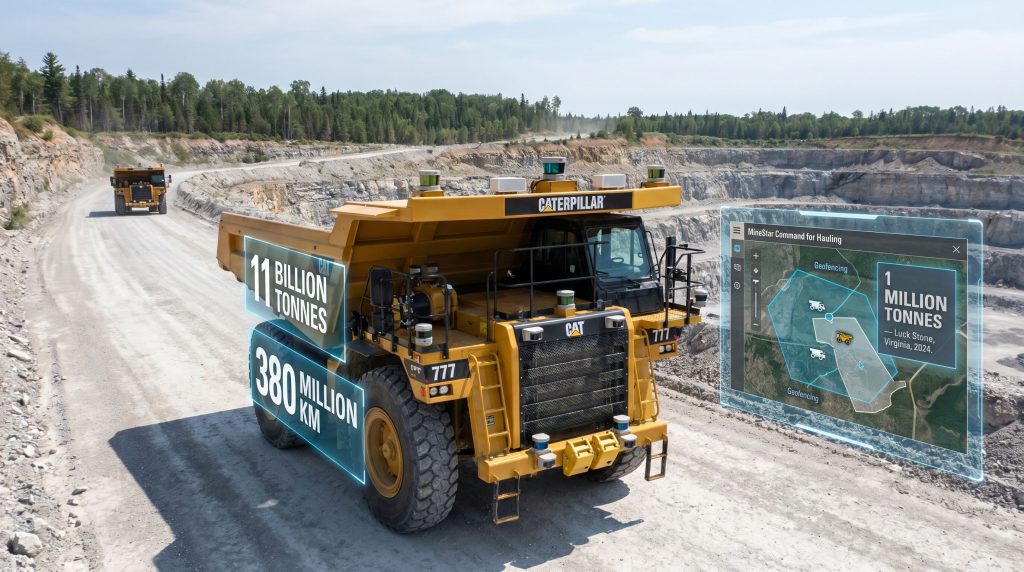
The performance outcomes at Bull Run provided the industry with its first quantified benchmark for quarry-specific autonomous hauling. The fleet exceeded one million tonnes of autonomous material movement within twelve months of operation, a milestone that addressed the central uncertainty many mid-scale quarry operators had about whether autonomous systems could sustain meaningful throughput in their environment. Indeed, mining automation trends across the sector confirm that this kind of proof-of-concept performance is increasingly critical in driving adoption.
Caterpillar's Global Autonomous Fleet Performance Benchmarks
| Performance Metric | Recorded Figure |
|---|---|
| Total Material Moved (Global Autonomous Fleet) | Over 11 billion tonnes |
| Total Distance Travelled (Global Autonomous Fleet) | More than 380 million kilometres |
| First Quarry-Specific Deployment | 2024, Luck Stone Bull Run, Virginia |
| Autonomous Hauling Milestone at Luck Stone | 1 million tonnes in under 12 months |
| Current Michigan Deployment Site | Carmeuse, Drummond Island |
The significance of the Luck Stone precedent for Drummond Island cannot be overstated from an investment decision perspective. Carmeuse was not evaluating unproven technology. The operational lessons accumulated at Bull Run — including sensor calibration adjustments for aggregate dust environments, remote operations centre procedures, and maintenance interval refinements — transferred directly into the planning framework for the Michigan deployment. Risk profile assessments by operators considering autonomous investment are materially shaped by whether a comparable environment has already demonstrated sustained performance.
How an Autonomous Haul Cycle Functions Step by Step
Understanding the operational mechanics of an autonomous truck cycle clarifies why the technology performs consistently in environments that might appear too variable for driverless equipment.
- Pre-shift configuration: Route parameters, geofencing boundaries, and hazard zone definitions are loaded into the MineStar platform before operations begin. This step is completed by human planners based on current quarry face positions and road conditions.
- Machine initialisation: Each truck conducts onboard sensor self-diagnostics and establishes GPS positioning within the operational zone before entering the active haul corridor.
- Loading zone navigation: The truck travels autonomously to the designated loading position, using its sensor suite to identify the precise location of the excavator or front-end loader and position itself accurately for payload transfer.
- Payload receipt: The truck receives material from the loading unit. The onboard payload monitoring system confirms load weight before departure.
- Haul route execution: AI-driven mining efficiency shapes how the path planning selects and continuously adjusts the optimal route to the dump zone, accounting for other vehicles, road conditions, and any obstacles detected in real time.
- Dump zone operation: Material is deposited with precision positioning at the designated dump point. The truck confirms dump completion before initiating the return cycle.
- Return and repeat: The truck autonomously returns to the loading zone and begins the next cycle without requiring human instruction at each stage.
- Exception management: When an obstacle is detected or a situation exceeds the system's autonomous resolution capability, the truck halts safely, logs the event, and alerts the remote operations centre for human assessment and clearance.
What Happens During an Obstacle Detection Event
The response sequence when an obstacle is encountered is designed to prioritise safety without defaulting to permanent stoppage:
- LiDAR and computer vision algorithms classify the obstacle and assess whether it represents a genuine hazard or a transient obstruction
- If classified as hazardous, the system initiates controlled deceleration to a safe stop
- The remote operations centre receives an alert with sensor data and camera imagery from the truck's position
- Human operators assess the situation and either clear the truck to resume autonomously or dispatch personnel to physically resolve the obstruction
- All events are logged and fed back into the system's machine learning refinement processes, progressively improving its obstacle classification accuracy over time
The next major ASX story will hit our subscribers first
Safety Economics: Removing the Human Variable
The safety case for autonomous quarry hauling operates across several distinct risk categories. The most immediate benefit is spatial: removing operators from zones that carry inherent exposure during blasting, face scaling, and active haulage creates a categorical reduction in personnel risk rather than an incremental improvement.
Fatigue-related incidents represent one of the most persistent risk factors in haul truck operations across surface mining globally. Research published by the National Institute for Occupational Safety and Health has documented the relationship between extended shift driving and elevated incident rates in surface mining environments. Autonomous systems do not experience fatigue, do not make micro-decisions affected by attention degradation, and do not vary their behaviour based on end-of-shift tiredness.
The consistency dimension of autonomous operation extends beyond fatigue. Speed limit compliance, following distance maintenance, and load limit adherence are enforced algorithmically on every cycle, eliminating the behavioural variability that contributes to a meaningful proportion of haul road incidents in conventional operations.
Across Caterpillar's global autonomous fleet, more than 380 million kilometres of operation have been accumulated, a dataset that has informed industry understanding of autonomous vehicle performance in real mining conditions.
Disclaimer: Specific incident rate comparisons between autonomous and conventional quarry hauling require site-level operational data. Readers should seek primary safety performance documentation from operators and OEMs rather than relying solely on general industry claims when making safety-related investment or operational decisions.
The Operational Economics Case for Quarry Operators
For a mid-scale quarry operator evaluating autonomous investment, the financial framework involves several interconnected variables rather than a single cost-benefit calculation.
Comparative Operational Profile: Autonomous vs. Conventional Hauling
| Operational Variable | Conventional Hauling | Autonomous Hauling |
|---|---|---|
| Operator Requirement | One per truck per shift | Remote supervisor managing multiple trucks |
| Shift Coverage | Constrained by fatigue regulations | Extended operational windows possible |
| Speed and Route Consistency | Variable based on operator behaviour | Algorithm-controlled on every cycle |
| Hazard Response | Human reaction time dependent | Sensor-governed with sub-second response |
| Operational Data Capture | Manual and limited | Continuous and real-time via telematics |
| Fuel Consumption Pattern | Variable | Optimised through consistent throttle management |
| Maintenance Predictability | Reactive or scheduled | Predictive via integrated condition monitoring |
Several of these variables compound over time. Fuel efficiency improvements from consistent throttle management and optimised routing may appear modest on a per-cycle basis but accumulate significantly across annual operating hours. Similarly, tyre wear, which represents a substantial ongoing cost in quarry hauling, is reduced when algorithmic driving eliminates the aggressive acceleration and braking patterns that characterise some human-operated cycles.
The labour model transformation is more nuanced than a simple headcount reduction. Autonomous deployments shift the workforce profile from on-machine operators to remote operations supervisors and technology maintenance specialists. This transition requires training investment but also changes the recruiting environment, as remote supervision roles are accessible to a broader labour pool than those requiring on-site machine operation in physically demanding or remote locations such as Drummond Island. Furthermore, data-driven mining operations enable more accurate workforce planning and resource allocation across the entire site.
Where Drummond Island Fits in Caterpillar's Broader Strategic Arc
Caterpillar's autonomous mining programme did not begin in quarries. Its commercial origins lie in the large-scale iron ore operations of Western Australia and the copper belts of South America, where fleet sizes, haul distances, and capital budgets provided ideal conditions for autonomous system deployment and refinement. Over more than a decade of operation in those environments, the MineStar platform accumulated the operational history and software maturity that now underpins its extension into the quarry sector.
Key Milestones in Caterpillar's Autonomous Hauling Commercialisation
- Early commercial deployments in large-scale hard-rock and bulk commodity operations, primarily in Australia and South America
- Gradual expansion of the autonomous fleet to additional commodities and geographies throughout the 2010s and early 2020s
- 2024: First quarry-specific autonomous deployment at Luck Stone's Bull Run plant in Virginia, establishing the aggregate sector proof of concept
- 2026: Drummond Island dolomite quarry deployment at Carmeuse's Michigan operation, representing a second commercial quarry implementation
- Strategic trajectory: scaling MineStar Command for Hauling across North American aggregate and industrial mineral producers
The pivot toward mid-scale quarry markets reflects a deliberate market expansion strategy. The addressable market for autonomous hauling among large mining majors operating ultra-class truck fleets is more finite than the aggregate and industrial minerals sector, which encompasses thousands of operations across North America alone. For Caterpillar, establishing MineStar as the platform of choice for quarry automation represents a long-term revenue and service opportunity that extends well beyond individual truck sales.
Industry-Wide Implications: What This Means for North American Quarry Operators
The transition from isolated proof-of-concept deployments to multiple commercial quarry implementations creates a different conversation for mid-tier operators. The question is no longer whether autonomous hauling can function in a quarry environment. It is now a question of timing, scale, and return on investment modelling.
OEM-led autonomous solutions like MineStar present a structurally different entry point than third-party retrofit systems. When the autonomous capability is integrated at the platform level by the truck manufacturer, compatibility, support infrastructure, and software updates are managed within a single vendor relationship. This reduces the integration complexity that has deterred some smaller operators from pursuing third-party autonomous solutions.
Workforce planning implications extend beyond individual sites. Union considerations, training transition programmes, and regulatory frameworks governing autonomous vehicle operation in surface mining vary across US jurisdictions. Michigan's regulatory environment for autonomous surface mining vehicles will be a reference point for operators in neighbouring aggregate-producing states as deployment evidence accumulates.
The maturation from proof-of-concept trials to multi-site commercial rollouts signals that autonomous hauling technology has crossed a threshold of accessibility. It is no longer the exclusive domain of mining majors with nine-figure capital budgets.
Frequently Asked Questions: Caterpillar Autonomous Quarry Operations
What is Cat MineStar Command for Hauling?
Cat MineStar Command for Hauling is Caterpillar's integrated autonomous truck management platform. It combines AI, machine learning, LiDAR, radar, GPS, and high-resolution cameras to enable haul trucks to navigate, load, haul, and deposit material without an on-board operator, within a defined and monitored operational zone.
Which trucks are being deployed at Drummond Island?
Caterpillar's 777 series haul trucks are being used at Carmeuse's Drummond Island dolomite quarry in Michigan as part of the autonomous hauling implementation.
Has Caterpillar deployed autonomous trucks in quarries previously?
Yes. In 2024, Caterpillar completed its first quarry-specific autonomous deployment at Luck Stone's Bull Run plant in Virginia, where a fleet of four autonomous Cat 777 trucks surpassed one million tonnes of autonomous material movement within twelve months of commencing operations.
How much material has Caterpillar's autonomous fleet moved globally?
Across all deployments, Caterpillar's autonomous mining fleet has moved more than 11 billion tonnes of material and travelled in excess of 380 million kilometres.
Is autonomous hauling viable for operations smaller than major mines?
The Drummond Island and Luck Stone deployments demonstrate that autonomous hauling systems are now being commercially adapted for mid-scale quarry environments, extending the technology's applicability well beyond the large-scale mining operations that formed its initial commercial base.
The Road Ahead: Autonomy Beyond the Haul Truck
The Drummond Island deployment is best understood as one data point within a longer trajectory rather than an endpoint. The next phase of quarry automation is likely to involve integration across the full production chain, connecting autonomous hauling with autonomous drilling systems and eventually creating end-to-end extraction workflows where human intervention is reserved for supervisory, planning, and maintenance functions.
Several emerging developments will shape how quickly this trajectory advances:
- 5G connectivity expansion into rural and remote quarry locations will enhance the bandwidth available to remote operations centres, improving multi-truck supervision capabilities and real-time data transfer
- Battery-electric autonomous trucks represent the intersection of two major technology trends, where the shift away from diesel powertrains combines with autonomous control systems to address both emissions and operational cost objectives simultaneously. In fact, the future of mining transformation points firmly toward this convergence of electrification and automation
- Platform expansion beyond haul trucks is already underway within the MineStar ecosystem, with autonomous dozing, drilling, and loading applications at various stages of commercial development
- Workforce evolution will progressively transform the quarry labour model, shifting from equipment operator roles toward technology supervision, data analysis, and system maintenance positions that require different but not necessarily reduced skill sets
For quarry operators evaluating when to engage with autonomous technology, the accumulating operational evidence from sites like Luck Stone and Drummond Island reduces the information asymmetry that has historically made the investment decision difficult to justify. The performance benchmarks are now real, the technology is commercially available, and the vendor ecosystem to support deployment is established.
As Seeking Alpha has noted, Caterpillar's move to extend autonomy beyond traditional mining into the quarry sector represents a meaningful commercial milestone, signalling that the addressable market for MineStar Command for Hauling is considerably broader than previously assumed. Meanwhile, coverage from Aggregates Business highlights how this autonomous hauling solution is already reshaping expectations for limestone and aggregate producers assessing their own operational futures.
Disclaimer: This article contains references to operational performance data and forward-looking assessments of technology deployment trends. Readers should conduct independent due diligence before making investment or operational decisions. Past performance of autonomous systems in specific deployments does not guarantee equivalent outcomes at other sites.
Want To Capitalise On The Mining Companies Driving The Next Wave Of Autonomous Innovation?
Discovery Alert's proprietary Discovery IQ model delivers real-time alerts the moment significant ASX mineral discoveries are announced, transforming complex data across more than 30 commodities into clear, actionable insights for both short-term traders and long-term investors. Explore how historic discoveries have generated substantial returns — then begin your 14-day free trial at Discovery Alert to position yourself ahead of the market.