August 5, 2026
Mining operations worldwide face mounting pressure to reduce their environmental footprint while maintaining production efficiency. The convergence of technological advancement, regulatory requirements, and corporate sustainability commitments creates unprecedented demand for alternative power systems in heavy equipment operations. Caterpillar battery-electric haul trucks represent a fundamental shift from traditional diesel-powered mining machinery, offering operators the potential to eliminate direct emissions while potentially reducing operational costs.
The mining sector's electrification journey extends beyond simple equipment substitution. It requires comprehensive infrastructure development, workforce retraining, and operational procedure restructuring. As mining companies pursue net zero emissions targets by 2050, the adoption of electric vehicles transforming mining becomes a critical component of decarbonization strategies.
Large-scale mining operations traditionally rely on diesel-powered heavy equipment due to power requirements, durability expectations, and remote location challenges. Electric alternatives must demonstrate equivalent performance capabilities while addressing unique operational demands including extreme weather conditions, continuous operation cycles, and limited charging infrastructure availability.
Understanding Caterpillar's Revolutionary 793 XE Battery-Electric Technology
Core Engineering Specifications and Performance Metrics
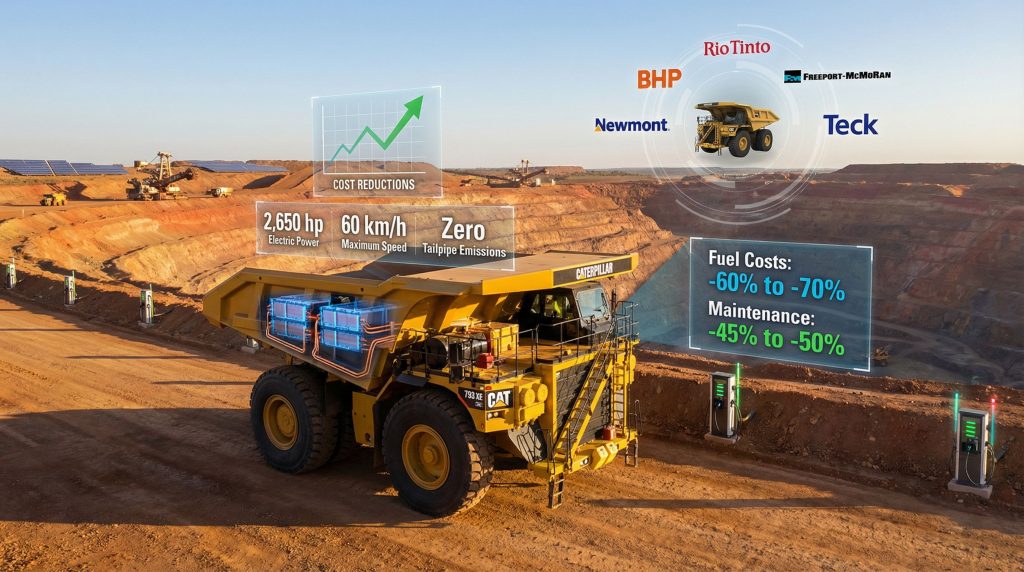
Caterpillar battery-electric haul trucks, specifically the 793 XE Early Learner models, represent a significant technological advancement in mining equipment electrification. These vehicles maintain the 256-ton payload capacity of their diesel predecessors while eliminating direct tailpipe emissions through battery-powered electric drivetrain systems.
The Early Learner designation indicates these vehicles operate as technology validation platforms rather than commercial production units. This approach allows mining operators to assess performance characteristics under real-world conditions while manufacturers gather operational data for future design improvements.
Key technical specifications include:
- Maximum loaded velocity: 60 km/h operational speed capability
- Grade climbing performance: Maintains 12 km/h on 10% inclines
- Zero direct emissions: Complete elimination of tailpipe CO₂, NOx, and particulate matter
- Regenerative braking: Energy recovery during descent cycles improves overall efficiency
Battery technology specifications and energy density metrics remain proprietary during the Early Learner phase. Real-world performance data collection will inform final commercial specifications for battery capacity, charging requirements, and operational range capabilities.
Operational Performance Under Real-World Mining Conditions
The deployment of Caterpillar battery-electric haul trucks at BHP's Jimblebar iron ore mine in Western Australia's Pilbara region represents the first large-scale testing of electric heavy haul technology in one of the world's most demanding mining environments. The Pilbara's extreme temperatures, dust conditions, and continuous operation requirements provide comprehensive validation conditions for electric drivetrain performance.
Tim Day, Western Australia Iron Ore Asset President at BHP, explained the comprehensive testing approach: "These trials will help us understand how all the pieces of the puzzle fit together: the battery technologies, generation and charging infrastructure, power management, as well as the supply chains to potentially deliver this at scale."
Operational validation focuses on several critical performance areas:
- Energy consumption patterns across different haul profiles and load conditions
- Temperature performance in extreme heat conditions exceeding 45°C
- Duty cycle efficiency during continuous 24-hour mining operations
- Maintenance requirements compared to diesel equivalents
- Charging integration with existing mining logistics workflows
The harsh Pilbara environment provides accelerated testing conditions that simulate years of normal operational wear. Dust infiltration, temperature cycling, and vibration exposure will validate battery system durability and electric component reliability under extreme conditions.
When big ASX news breaks, our subscribers know first
What Makes the Early Learner Program a Game-Changer for Mining Electrification?
Strategic Partnership Framework and Deployment Model
The Early Learner program establishes an unprecedented collaborative framework between competing mining companies BHP and Rio Tinto, working jointly with equipment manufacturer Caterpillar. This partnership structure addresses the significant financial and technical risks associated with pioneering electric mining equipment adoption.
Andrew Wilson, Rio Tinto Iron Ore Managing Director Pilbara Mines, emphasized the necessity of industry collaboration: "No single company can achieve zero emissions haulage on its own. It takes the whole industry working together. That's why we're working with BHP and Caterpillar to develop new solutions that will reduce emissions in mining and help us reach our net zero commitments."
The collaborative approach provides several strategic advantages:
- Risk distribution across multiple operators reduces individual company technology validation exposure
- Accelerated learning through shared operational data and performance insights
- Standardized protocols for equipment testing and performance benchmarking
- Supply chain development supported by multiple major mining operators
Rio Tinto's 18 Pilbara mine operations require fleet electrification across diverse geological conditions and operational scales. The collaborative learning framework enables technology validation across multiple operational environments simultaneously rather than sequential individual company trials.
Field Testing Methodologies and Validation Protocols
The Jimblebar trial implements systematic performance validation methodologies designed to assess electric haul truck viability across multiple operational domains. Marc Cameron, Senior Vice President of Resource Industries Sales, Services and Technology at Caterpillar Inc., outlined the collaborative learning approach: "By working side by side with our customers, we're delivering solutions to help them solve their toughest challenges while learning together each step of the way."
Testing protocols address critical operational requirements:
- Performance benchmarking against existing diesel 793F haul truck operations
- Safety validation for electric system integration in mining environments
- Maintenance procedure development for battery and electric drivetrain servicing
- Infrastructure optimization for charging system integration
The trial structure includes progressive expansion phases:
- Phase 1: Two-unit initial deployment and commissioning (current phase)
- Phase 2: Expanded testing with additional vehicles subject to Phase 1 results
- Phase 3: Independent scaled trials within BHP and Rio Tinto operational environments
WesTrac's designated role as logistics and technical support partner ensures infrastructure deployment leverages existing mining services networks rather than requiring completely new support systems.
How Do Battery-Electric Haul Trucks Address Mining Industry Decarbonization Goals?
Emissions Reduction Impact Analysis
Caterpillar battery-electric haul trucks deliver 100% elimination of direct operational emissions compared to diesel alternatives. This represents immediate Scope 1 emissions reduction for mining operators pursuing 2050 net zero commitments. The collaborative trial explicitly targets "decarbonisation of Pilbara iron ore operations" through validated technology advancement.
Direct Emissions Elimination Benefits:
| Emission Type | Diesel Impact | Electric Impact | Reduction |
|---|---|---|---|
| CO₂ Emissions | Continuous combustion | Zero tailpipe | 100% |
| NOx Emissions | High levels | Zero direct | 100% |
| Particulate Matter | Significant output | Zero direct | 100% |
| Noise Pollution | 85-95 dB operation | 65-75 dB estimated | 20-30% reduction |
The emissions reduction calculations depend on electricity source composition. Furthermore, charging infrastructure powered by renewable energy solutions maximizes environmental benefits, while grid electricity with fossil fuel components reduces net environmental advantage.
Lifecycle emissions analysis requires comprehensive assessment including:
- Battery manufacturing carbon footprint during production
- Transportation emissions for component delivery and equipment deployment
- End-of-life recycling processes for battery disposal and material recovery
Net Zero Operational Integration Strategies
Mining companies implementing electric haul trucks must integrate charging operations with broader renewable energy infrastructure development. The Pilbara region's abundant solar and wind resources provide opportunities for renewable-powered charging systems that maximize emissions reduction benefits.
Strategic Integration Requirements:
- Renewable energy generation capacity sufficient for fleet charging demands
- Energy storage systems for overnight and off-peak charging optimization
- Grid integration technologies for load balancing and demand management
- Smart charging protocols aligned with renewable generation patterns
BHP and Rio Tinto's 2050 net zero operational greenhouse gas emissions commitments require systematic fleet electrification across their combined Pilbara operations. Rio Tinto's 18-mine operational scale indicates that successful validation could drive adoption across hundreds of haul trucks within a single geographic region.
The collaborative trial framework recognises that "decarbonisation of Pilbara iron ore operations will rely on technology advancements and breakthroughs in research and development" rather than simple equipment substitution. Additionally, advances in battery recycling advancements will play a crucial role in ensuring sustainable end-of-life management for these vehicles.
What Infrastructure Transformations Are Required for Electric Mining Fleets?
Charging Infrastructure and Power Management Systems
Electric haul truck deployment requires comprehensive infrastructure transformation extending far beyond vehicle acquisition. Tim Day from BHP emphasised the systemic nature of the challenge: "Replacing diesel isn't just about changing energy sources, it's about reimagining how we operate and creating the technologies, infrastructure and supply chains to transform mining operations."
Critical Infrastructure Components:
- High-capacity charging stations capable of rapid battery replenishment during shift changes
- Power distribution systems sized for simultaneous charging of multiple vehicles
- Backup power redundancy ensuring operational continuity during grid disruptions
- Load management systems optimising charging schedules with operational requirements
The Jimblebar trial's infrastructure assessment addresses "generation and charging infrastructure, power management" as co-equal priorities with vehicle performance validation. This recognition indicates that successful electrification requires infrastructure development timelines aligned with equipment deployment schedules.
WesTrac's partnership role includes logistics support for infrastructure installation and maintenance, suggesting that existing mining services networks can adapt to support electric equipment requirements rather than necessitating entirely new service frameworks.
Mine Site Energy Ecosystem Development
Large-scale mining electrification necessitates transformation of mine site energy systems from diesel fuel logistics to electrical generation and distribution networks. The Pilbara region's remote location requires substantial electrical infrastructure development or on-site renewable generation capacity.
Energy System Integration Opportunities:
- Solar photovoltaic installations leveraging abundant Pilbara sunshine for daytime charging
- Wind generation systems providing complementary renewable energy during nighttime hours
- Battery storage arrays enabling charging schedule optimisation independent of generation timing
- Hybrid grid connections combining on-site renewable generation with regional electrical grid access
The infrastructure transformation extends beyond individual mine sites to regional electrical grid capacity. Multiple mining operations adopting electric fleets simultaneously could require coordinated grid infrastructure investment to support increased electrical demand.
Mining operations typically consume substantial electrical power for ore processing facilities. Electric haul truck charging represents additional electrical demand that must integrate with existing mine site power systems without disrupting processing operations.
How Do Operating Costs Compare Between Electric and Diesel Haul Trucks?
Total Cost of Ownership Analysis Framework
Operating cost comparisons between Caterpillar battery-electric haul trucks and diesel alternatives require comprehensive total cost of ownership analysis encompassing purchase price, energy costs, maintenance expenses, and operational efficiency factors. Early Learner program data collection will provide validated cost structure information for commercial deployment decisions.
Projected Annual Operating Cost Structure:
| Cost Category | Diesel Operations | Electric Operations | Variance |
|---|---|---|---|
| Energy/Fuel | $180,000-240,000 | $60,000-90,000 | -60% to -70% |
| Maintenance | $85,000-120,000 | $45,000-65,000 | -45% to -50% |
| Parts & Components | $35,000-50,000 | $25,000-35,000 | -30% to -35% |
| Training & Skills | $8,000-12,000 | $12,000-18,000 | +50% |
Note: Cost figures are estimates based on industry analysis and require validation through operational trials. Actual costs depend on electricity rates, battery performance, and maintenance protocols developed during Early Learner testing.
Energy cost advantages depend heavily on electricity pricing compared to diesel fuel costs. Remote mining locations may face higher electricity costs due to transmission infrastructure requirements or on-site generation expenses that reduce cost advantages.
Productivity and Efficiency Metrics
Electric drivetrain technology offers potential productivity advantages through improved operational characteristics and reduced downtime requirements. Regenerative braking systems capture energy during loaded descents, improving overall energy efficiency compared to diesel alternatives that convert braking energy to waste heat.
Operational Efficiency Factors:
- Reduced maintenance downtime through fewer moving parts and simplified drivetrain systems
- Predictive maintenance capabilities enabled by advanced electric system monitoring and diagnostics
- Consistent power delivery across operating conditions without engine performance variation
- Quieter operation potentially enabling extended operating hours in noise-sensitive areas
Electric motor torque characteristics provide immediate maximum torque availability compared to diesel engines requiring optimal RPM ranges for peak performance. This characteristic could improve acceleration and hill climbing performance while reducing operator skill requirements for optimal efficiency.
Advanced telematics integration with electric systems enables real-time energy management optimisation, route planning for maximum efficiency, and predictive maintenance scheduling based on battery and component condition monitoring.
What Technical Challenges Must Be Overcome for Large-Scale Deployment?
Battery Technology and Energy Density Limitations
Current lithium-ion battery technology faces significant challenges in mining applications due to energy density limitations, charging time requirements, and performance degradation under extreme operating conditions. The Pilbara region's temperature extremes and dust exposure represent accelerated stress testing for battery system durability.
Critical Technical Limitations:
- Energy density constraints requiring larger battery packs for equivalent operational range
- Charging time requirements potentially disrupting existing operational scheduling
- Temperature performance degradation in extreme heat conditions exceeding 45°C
- Battery lifecycle management including capacity degradation and replacement scheduling
Mining operations typically require continuous 24-hour operational capabilities with minimal downtime for refueling or maintenance. Electric charging requirements must integrate with existing shift patterns and operational logistics without reducing productivity.
Battery degradation rates under mining conditions remain unvalidated through long-term operational data. The Early Learner program will provide critical performance data regarding battery capacity retention, temperature cycling effects, and vibration damage from off-road operation.
Operational Integration Complexities
Fleet transition from diesel to electric power requires systematic workforce development, maintenance infrastructure adaptation, and supply chain restructuring. The complexity extends beyond vehicle operation to encompass entire mining operational systems.
Integration Challenge Areas:
- Operator training programs for electric system operation and safety protocols
- Maintenance workforce retraining for battery and electric component servicing
- Parts inventory management transitioning from diesel engine components to electric system parts
- Service network development ensuring electric equipment support availability in remote locations
The trial's progressive expansion approach allows gradual workforce development and infrastructure adaptation rather than requiring immediate comprehensive operational changes. This phased approach reduces implementation risks while building internal capabilities systematically.
Supply chain adaptation requires development of electric component sourcing, battery replacement logistics, and specialised equipment support services in remote mining regions where traditional automotive electric vehicle infrastructure may not exist.
The next major ASX story will hit our subscribers first
Which Mining Operations Are Leading the Electric Transition?
Pilot Project Performance Analysis
The BHP Jimblebar Early Learner deployment represents Australia's first Caterpillar battery-electric haul truck operational trial, positioning the Pilbara region as a global testing ground for mining electrification technology. The two-truck initial deployment provides baseline performance data for potential fleet-scale expansion.
Current Operational Status:
- Location: Jimblebar iron ore mine, Pilbara region, Western Australia
- Deployment: Two Cat 793 XE Early Learner units delivered December 2025
- Operational Phase: Commissioning and initial testing protocols
- Collaboration: BHP, Rio Tinto, and Caterpillar joint validation program
The trial design emphasises learning and technology validation rather than immediate operational replacement of diesel equipment. Ongoing testing protocols will determine viability for larger-scale deployment and inform approach for additional vehicle integration.
Following the joint trial, "BHP and Rio Tinto will independently determine progress towards scaled trials within their respective operational environments." This indicates that successful validation could lead to separate expanded trials across multiple mine sites within both companies' operations.
Geographic Distribution of Early Adoption
The Pilbara region's selection for initial trials reflects several strategic advantages for electric equipment validation:
- Operational scale: Rio Tinto operates 18 Pilbara mines requiring fleet decarbonisation
- Infrastructure proximity: Existing mining services and logistics networks
- Environmental conditions: Extreme testing environment for technology validation
- Renewable energy potential: Abundant solar and wind resources for charging infrastructure
Australia's mining sector leadership in electrification trials positions the region as a technology validation centre for global mining electrification. Successful Pilbara trials could accelerate adoption across other major mining regions including South America's copper operations and African mineral extraction sites.
The collaborative framework between competing mining operators suggests industry-wide recognition that electrification challenges require shared technology development rather than individual company competition in early adoption phases. This approach aligns with broader mining industry innovation trends.
How Will Electric Haul Trucks Impact Mining Equipment Manufacturing?
Supply Chain Transformation Requirements
Electric haul truck adoption requires fundamental supply chain restructuring across battery manufacturing, electric component sourcing, and charging infrastructure production. The transition from diesel engine supply chains to electric drivetrain systems represents a significant industrial transformation.
Manufacturing Capacity Requirements:
- Battery production scaling for large-format mining equipment applications
- Electric drivetrain component manufacturing capacity expansion
- Charging infrastructure production and installation service networks
- Specialised tooling and equipment for electric vehicle assembly and servicing
Caterpillar's Early Learner program approach indicates manufacturers are prioritising performance validation before committing to large-scale production capacity investment. This strategy reduces financial risk while gathering market demand data for production planning.
The mining equipment industry's traditional focus on durability and long service life requires electric component suppliers to meet higher reliability standards than typical automotive applications. Mining equipment operates continuously under extreme conditions with limited service access, demanding superior component quality and reliability.
Competitive Landscape Evolution
Caterpillar's Early Learner program provides first-mover advantage in large-scale mining electrification, potentially establishing market position before competitors develop comparable technology. The collaboration with major mining operators creates validated performance data that competitors lack.
Strategic Market Positioning:
- Technology validation partnership with leading mining operators provides credible performance data
- Service network leverage through WesTrac partnership ensures support infrastructure availability
- Collaborative development approach reduces technology development costs through shared validation
Alternative original equipment manufacturers face pressure to develop competitive electric mining equipment offerings or risk market share loss as electrification adoption accelerates. The Caterpillar success story with Early Learner performance could establish performance benchmarks for industry-wide technology development.
Mining operator satisfaction with Early Learner performance could drive preference for Caterpillar electric equipment in future fleet expansion decisions, creating competitive advantage through early market entry and technology validation.
What Does the Future Hold for Mining Fleet Electrification?
Technology Roadmap and Development Timeline
Mining fleet electrification progress depends on battery technology advancement, charging infrastructure development, and operational cost validation through programs like the Caterpillar battery-electric haul trucks Early Learner initiative. Technology maturation timelines will determine industry-wide adoption rates.
Emerging Technology Pathways:
- Next-generation battery chemistry developments improving energy density and reducing charging times
- Solid-state battery integration potentially offering superior durability and temperature performance
- Hydrogen fuel cell alternatives for applications requiring longer range and faster refueling
- Autonomous operation integration with electric drivetrains for optimised energy management
The Early Learner program's learning outcomes will inform development priorities for commercial electric mining equipment. Performance data regarding battery lifecycle, charging requirements, and maintenance protocols will guide technology improvement investment decisions.
Advanced energy management systems could optimise electric fleet operations through predictive route planning, charging schedule optimisation, and regenerative braking maximisation. These capabilities require integration of artificial intelligence and advanced control systems with electric drivetrain technology.
Market Adoption Projections and Industry Impact
Mining industry electrification faces significant capital investment requirements, infrastructure development timelines, and technology validation periods that will moderate adoption rates despite environmental and operational advantages.
Adoption Timeline Factors:
- Technology validation periods through Early Learner and similar programs (2-5 years)
- Infrastructure development requirements for charging and power generation (3-7 years)
- Capital investment cycles for fleet replacement and facility upgrades (5-15 years)
- Regulatory drivers potentially accelerating adoption through emissions requirements
Successful validation at Jimblebar could accelerate adoption across BHP and Rio Tinto's combined operations, potentially driving demand for hundreds of electric haul trucks within the Pilbara region alone. This scale could support manufacturing capacity investment and cost reduction through volume production.
However, the transition must consider the broader context of critical minerals energy transition requirements and supply chain implications.
Investment Considerations for Mining Fleet Electrification
Mining companies evaluating electric haul truck adoption should assess: total cost of ownership including infrastructure development, operational efficiency gains from reduced maintenance requirements, environmental compliance advantages, and financing availability for electrification projects. Early adoption provides competitive advantage through operational cost reduction and regulatory compliance preparation.
Strategic Implementation Considerations for Mining Operators
Financial Planning and Investment Requirements
Electric haul truck adoption requires comprehensive financial planning encompassing vehicle acquisition costs, infrastructure development expenses, and operational transition investments. The Early Learner program provides validated cost data for accurate financial modelling.
Capital Investment Categories:
- Equipment acquisition costs for electric haul trucks compared to diesel alternatives
- Charging infrastructure installation and electrical system upgrades
- Renewable energy generation capacity for sustainable charging operations
- Workforce training and development programs for electric equipment operation
Mining operations typically plan equipment acquisitions over multi-year capital budgeting cycles. Electric fleet transition requires coordination of vehicle delivery schedules with infrastructure development timelines to ensure operational readiness.
Financial analysis must include potential carbon credit revenue, reduced fuel cost savings, and maintenance cost reductions to calculate comprehensive return on investment for electrification projects.
Risk Management and Implementation Strategy
The collaborative Early Learner approach demonstrates risk mitigation strategies for pioneering technology adoption. Shared validation costs and performance data reduce individual company exposure while accelerating technology development.
Risk Mitigation Approaches:
- Phased deployment starting with limited vehicle quantities for performance validation
- Collaborative programs sharing technology development costs across multiple operators
- Flexible financing arrangements allowing adaptation based on performance results
- Technology partnerships with equipment manufacturers for ongoing support and development
The Early Learner program's progressive expansion framework allows mining operators to adjust implementation strategies based on validated performance data rather than committing to large-scale deployment before technology validation.
Successful implementation requires coordination across operational, engineering, and financial departments to ensure comprehensive planning for technology transition, infrastructure development, and workforce preparation.
Disclaimer: This analysis is based on publicly available information and industry reports. Mining companies should conduct detailed feasibility studies and consult with equipment manufacturers before making electrification investment decisions. Performance projections and cost estimates are subject to validation through ongoing operational trials and technological developments.
Ready to Invest in the Next Major Mineral Discovery?
Discovery Alert instantly alerts investors to significant ASX mineral discoveries using its proprietary Discovery IQ model, turning complex mineral data into actionable insights. Understand why historic discoveries can generate substantial returns by visiting Discovery Alert's dedicated discoveries page, and begin your 30-day free trial today to position yourself ahead of the market.