June 9, 2026
The Hidden Cost of Disconnected Subsurface Workflows
Every borehole tells a story, but extracting that story accurately depends heavily on the tools used to read it. Across the geotechnical, mining, and energy sectors, subsurface engineers have long operated in fragmented software environments, bouncing between specialised rock mechanics calculators, external statistical packages, and bespoke spreadsheet models to piece together a coherent picture of formation behaviour. The inefficiency is not merely inconvenient. It introduces interpretation variability, creates auditability gaps, and slows down decisions at precisely the moments when speed and precision matter most.
This is the operational reality that platform consolidation in borehole analysis software is designed to address. ALT updates WellCAD with new geomechanics modules in its version 6.1 release, continuing a trajectory toward a more unified, calculation-driven analytical environment for subsurface characterisation. Understanding what this means technically and operationally requires looking closely at what has changed, what has been added, and why the architecture of integrated geomechanical workflows is becoming a baseline expectation rather than a premium feature.
When big ASX news breaks, our subscribers know first
From Module Introduction to Platform Expansion: The WellCAD 6.0 to 6.1 Journey
WellCAD 6.0, released in 2025, represented ALT's formal entry into rock mechanics computation through the introduction of its Geomechanics module. That initial release established the foundational calculation architecture: elastic property derivation, stress modelling, and fracture stability analysis within the WellCAD environment. It was a significant step, but it was also the beginning of a longer development arc.
WellCAD 6.1, released in February 2026, is best understood as the expansion phase of that arc. Rather than a ground-up redesign, it builds systematically on the 6.0 foundation, extending the property calculation set, introducing new visualisation capabilities, adding a customer-specific processing plug-in, and delivering stability and workflow continuity improvements across core modules.
The version comparison below illustrates the scope of what changed between the two releases:
| Feature / Capability | WellCAD 6.0 | WellCAD 6.1 |
|---|---|---|
| Geomechanics Module | Introduced | Expanded |
| Rock Mechanics Calculations | Core property set | Extended property set |
| Box Plots | Not available | Included |
| Spider Plots | Not available | Included |
| Script Console | Not available | Included |
| KS/GK Processing Plug-in | Not available | Customer-specific addition |
| Fracture Stability (Mohr-Coulomb) | Available | Refined workflows |
| ISI + FWS Module Integration | Available | Maintained and enhanced |
This incremental but substantive release cadence reflects a broader industry pattern in geotechnical software development, where capability depth is built progressively rather than delivered wholesale in a single release.
What the WellCAD 6.1 Geomechanics Workspace Actually Computes
Rock Mechanics Property Computation
The Geomechanics Workspace in WellCAD 6.1 addresses two distinct but related domains of subsurface characterisation: elastic properties and strength parameters. Together, these describe how a rock formation will deform under stress and at what point it will fail, both of which are critical inputs for wellbore stability analysis, casing design, and drilling risk assessment.
Elastic properties calculated within the workspace include:
- Poisson's ratio: the ratio of lateral to axial strain under compressive loading, used to model how formations deform under stress changes
- Young's modulus: a measure of stiffness, describing resistance to deformation along the axis of applied force
- Shear modulus: resistance to shearing deformation, relevant to fault and fracture reactivation analysis
- Bulk modulus: the formation's resistance to volumetric compression, an input for pore pressure and compaction modelling
Strength parameters addressed by the platform include:
- Unconfined Compressive Strength (UCS): the load a rock sample can sustain before failure under zero confining pressure, one of the most widely used geomechanical inputs in drilling
- Tensile strength: resistance to pulling forces, relevant to hydraulic fracture initiation thresholds
- Friction angle: a measure of internal resistance to shear failure along a plane, central to Mohr-Coulomb analysis
- Cohesive strength: the baseline shear resistance of a rock independent of normal stress
In-Situ Stress Modelling and Mohr-Coulomb Fracture Stability
Beyond static rock properties, the workspace addresses the dynamic stress environment in which formations exist. In-situ stress computation within WellCAD 6.1 takes user-defined inputs and assumptions about overburden, pore pressure, and tectonic regime to generate a stress tensor representation of the subsurface.
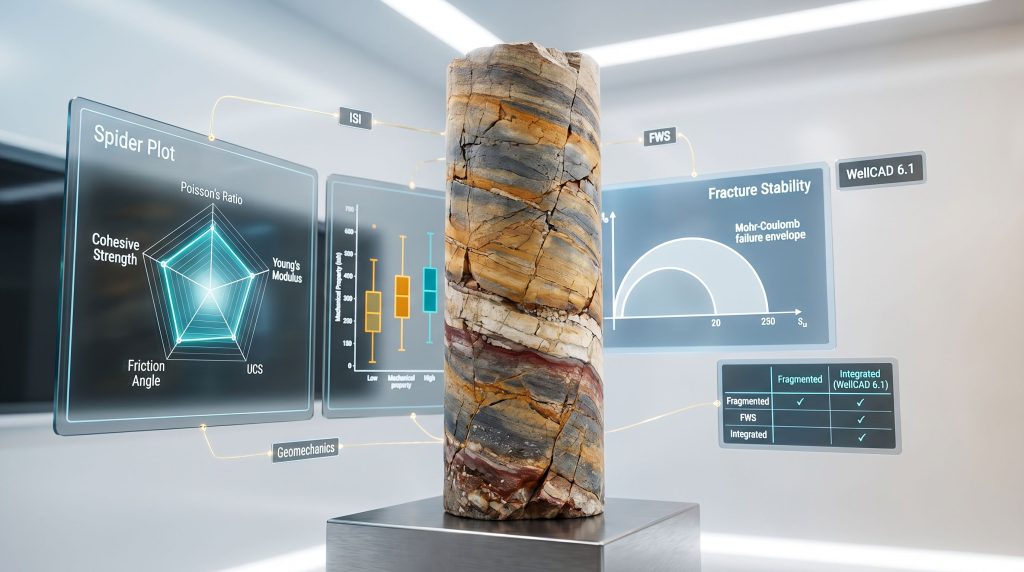
Mohr-Coulomb fracture stability analysis then uses this stress state, combined with friction angle and cohesive strength inputs, to construct failure envelopes that define the conditions under which pre-existing fractures will reactivate or new fractures will propagate. This is directly relevant to wellbore integrity management, particularly in naturally fractured reservoirs and structurally complex geotechnical settings. Furthermore, understanding downhole geophysics principles helps contextualise how these stress measurements relate to broader formation evaluation.
Mohr-Coulomb analysis has been a cornerstone of rock mechanics for over a century, but its integration into real-time borehole interpretation workflows remains limited in many organisations. The WellCAD 6.1 implementation reduces the barrier to applying this analysis at the data acquisition stage rather than retrospectively.
The Lithology-Aware Reference Library: A Meaningful Differentiator
One of the less-discussed but practically significant features of the WellCAD 6.1 Geomechanics Workspace is its built-in reference library. This compiles academically and industrially recognised methodologies for property estimation and organises them by lithology type.
Why does this matter? In heterogeneous subsurface environments, applying a single empirical formula across an entire borehole produces systematically inaccurate results. A UCS correlation calibrated for sandstone will misrepresent shale behaviour. A Young's modulus estimate optimised for carbonate sequences will introduce errors when applied to volcanic formations. The reference library allows practitioners to select the most appropriate calculation methodology for each rock type encountered, without leaving the WellCAD environment to consult external literature or rely on operator memory.
Key Insight: Lithology-aware methodology selection is particularly valuable in mixed-lithology boreholes common in mineral exploration and geotechnical site investigation, where a single borehole may intersect multiple rock types with fundamentally different mechanical behaviours.
Cross-Module Integration: Why the Platform Architecture Matters
ISI and FWS Connectivity
The Geomechanics Workspace does not operate in isolation within WellCAD. It connects natively with two other modules that supply critical inputs for geomechanical analysis:
- ISI (Image Log) Module: Fracture picks, bedding orientations, and breakout geometries identified in image log interpretation feed directly into geomechanical workflows, enabling stress direction analysis and fracture stability assessment without data re-entry
- FWS (Full Waveform Sonic) Module: Compressional and shear wave velocities derived from full waveform sonic processing are the primary inputs for elastic property calculation, and native integration ensures these are available directly to the Geomechanics Workspace
This architecture eliminates the export-import cycle that plagues multi-tool workflows, where data converted between formats introduces transcription errors and version control complications. In addition, practitioners working with geological logging codes will recognise that standardised data classification is equally essential when feeding formation data into integrated geomechanical platforms.
Who Uses the Geomechanics Workspace
The workspace is designed for three primary practitioner profiles:
- Subsurface engineers managing wellbore stability and drilling risk, who require real-time or pre-drilling geomechanical assessment to define safe mud weight windows and casing setting depths
- Geomechanists conducting stress regime characterisation for reservoir management, field development planning, or induced seismicity assessment
- Geoscientists integrating rock mechanics parameters into formation evaluation workflows, particularly in resource estimation and geotechnical reporting contexts
Box Plots and Spider Plots: Closing the Statistical Analysis Gap
Box Plots: Understanding Variability Across the Subsurface
Box plots are a standard tool in statistical analysis but have historically been absent from dedicated borehole interpretation platforms. Their inclusion in WellCAD 6.1 fills a practical gap. A box plot displays the median, interquartile range, minimum, maximum, and outliers of a dataset simultaneously, making it possible to assess the distribution of a mechanical property across multiple wells, depth zones, or lithological units in a single visual.
Practical applications in the geomechanical context include:
- Comparing UCS variability across wells within the same formation to assess lateral heterogeneity
- Identifying anomalous zones where mechanical properties deviate significantly from formation averages, potentially indicating alteration, fracturing, or data quality issues
- Supporting quality control of input data before geomechanical modelling to catch outliers that could skew stress calculations
Spider Plots: Multi-Parameter Comparison in Radar Format
Spider plots, also known as radar charts, enable the simultaneous visual comparison of multiple parameters across different samples, formations, or boreholes. In geomechanical analysis, this translates to the ability to plot several rock properties together and immediately identify which parameters differ most between two zones or two wells.
Applications include:
- Comparing the full mechanical property profile of different formations before selecting a target interval for drilling or completion
- Rapid identification of parameter outliers in multi-well datasets during peer review
- Generating visually intuitive outputs for reporting to non-specialist stakeholders who need to understand geomechanical risk without detailed technical knowledge
Visualisation Note: The addition of both Box Plots and Spider Plots moves WellCAD meaningfully closer to the statistical analysis capabilities of general-purpose environments, reducing the need to export data to tools such as Excel or Python-based packages for comparative analysis.
The KS and GK Processing Plug-In: Replacing Legacy Resistivity and Radiometry Workflows
Technical Scope and Processing Steps
The WellCAD 6.1 release includes a customer-specific development delivering a new plug-in for resistivity (KS) and radiometry (GK) processing, supporting end-to-end interpretation for Kobra and DLL3 logging tools.
The processing workflow the plug-in covers is comprehensive:
- Signal smoothing: removing high-frequency noise from raw log data before interpretation
- Segmentation: dividing the log into geologically meaningful intervals based on signal character
- Environmental corrections: compensating for borehole diameter, fluid type, and tool standoff effects that distort raw resistivity and radiometry readings
- Lithology attribution: assigning formation type labels to segmented intervals based on the corrected log response
- Permeability (filtration coefficient) calculation: deriving a hydraulic conductivity estimate from the processed resistivity data, relevant to groundwater and mineral exploration applications
- Grade-thickness (GT) computation: calculating the product of mineralisation grade and interval thickness, a fundamental metric in resource estimation for mineralised zones identified through radiometry
Why This Replaces Legacy Workflows
The grade-thickness product is a particularly important output in uranium and potash exploration contexts, where radiometry tools are used to log mineralised intervals and GT values feed directly into resource estimation models. Legacy workflows for this computation typically involve manual correction steps applied operator-by-operator, creating inconsistencies that are difficult to audit and harder to defend in a regulatory reporting context.
The new plug-in establishes a consistent, configurable, and auditable processing chain. Configurable rather than fixed, it can be aligned with site-specific geological and operational constraints while still maintaining a standardised methodology record. Consequently, practitioners familiar with drill results interpretation will appreciate how this kind of end-to-end auditability strengthens the credibility of reported mineralisation data.
Operational Advantage: Auditability is increasingly important in mining and geotechnical reporting, where regulatory frameworks and resource reporting codes require demonstrable methodological consistency. An end-to-end processing framework that maintains a full calculation trail addresses this requirement directly.
The next major ASX story will hit our subscribers first
Integrated vs. Fragmented Workflows: The Operational Case
The table below captures the practical differences between conducting geomechanical analysis across multiple disconnected tools versus within an integrated platform like WellCAD 6.1:
| Workflow Attribute | Fragmented Multi-Tool | Integrated WellCAD 6.1 |
|---|---|---|
| Data transfer between tools | Manual export and import | Seamless within platform |
| Methodology consistency | Variable by operator | Standardised via reference library |
| Auditability | Limited | Full calculation trail |
| Time to interpretation | Extended | Reduced through automation |
| Cross-module data use | Requires reformatting | Native integration (ISI, FWS) |
| Lithology-specific methods | User-defined externally | Built-in reference library |
| Statistical visualisation | Requires third-party tools | Box Plots and Spider Plots included |
The cost of geomechanical blind spots is not abstract. Unplanned wellbore instability events during drilling can cost hundreds of thousands of dollars per incident in lost time, remediation, and equipment. Casing failures driven by underestimated formation stress can compromise well integrity over the production lifetime.
Addressing these risks requires geomechanical analysis that is accurate, timely, and traceable. That is precisely the operational case ALT updates WellCAD with new geomechanics modules to support. For those also involved in exploration reporting, understanding true vs apparent widths is similarly critical to ensuring formation measurements translate accurately into resource models.
Frequently Asked Questions: WellCAD 6.1 Geomechanics Update
What is WellCAD 6.1?
WellCAD 6.1 is the latest release of Advanced Logic Technology's borehole data analysis platform, released in February 2026. It expands the Geomechanics module introduced in WellCAD 6.0, adds Box Plot and Spider Plot visualisation tools, introduces a KS and GK processing plug-in, and delivers stability and workflow improvements across core modules.
What rock mechanics properties can WellCAD 6.1 calculate?
The platform computes Poisson's ratio, Young's modulus, shear modulus, bulk modulus, UCS, tensile strength, friction angle, and cohesive strength, covering both elastic deformation characterisation and failure threshold assessment.
What is Mohr-Coulomb fracture stability analysis used for in WellCAD?
It is used to assess the conditions under which natural or induced fractures will reactivate or propagate under the prevailing in-situ stress state, directly informing wellbore integrity evaluation and drilling risk management.
What does the KS and GK plug-in do?
It provides end-to-end processing of resistivity and radiometry data from Kobra and DLL3 tools, covering signal smoothing through to grade-thickness computation, replacing manual legacy workflows with a consistent and auditable interpretation chain.
How does the Geomechanics Workspace integrate with other WellCAD modules?
It connects natively with the ISI image log module and the FWS full waveform sonic module, allowing fracture picks and sonic-derived velocity data to feed directly into geomechanical calculations without data migration between separate software environments.
What WellCAD 6.1 Signals About the Direction of Subsurface Software
The WellCAD 6.1 release, while an incremental update in technical terms, reflects several converging trends in how subsurface characterisation software is evolving. Furthermore, resources such as the WellCAD geomechanics module overview offer additional technical detail for practitioners evaluating the platform's full capability set.
- Platform consolidation is accelerating as practitioners push back against the cost and inconsistency of multi-tool workflows
- Lithology-aware methodology libraries represent a meaningful step toward reducing the subjectivity that has long characterised empirical rock property estimation
- Statistical visualisation tools are becoming baseline features rather than optional extras as data volumes in borehole analysis grow
- Auditable, end-to-end processing frameworks are transitioning from differentiating features to minimum viable requirements in regulated mining and geotechnical contexts
- The inclusion of customer-specific developments like the KS/GK plug-in signals a development model that balances standardised platform capability with the flexibility to address site-specific workflows
However, the broader implication is clear: when ALT updates WellCAD with new geomechanics modules, it reinforces a shift toward platforms where interpreting drill results and conducting rock mechanics analysis occur within the same cohesive environment, rather than across a patchwork of disconnected tools.
Disclaimer: This article is intended for informational purposes only. It does not constitute financial, investment, or professional engineering advice. Readers should conduct their own due diligence before making decisions based on the information presented.
Want to Know When Major Mineral Discoveries Hit the ASX?
Discovery Alert's proprietary Discovery IQ model instantly notifies subscribers of significant ASX mineral discoveries, transforming complex geological data into clear, actionable investment insights — explore the historic returns major discoveries have generated and begin your 14-day free trial at Discovery Alert to position yourself ahead of the broader market.