
May 22, 2026
When Heavy Equipment Becomes a Macro Barometer
Few industrial sectors reveal the pulse of the global economy as clearly as heavy equipment manufacturing. When construction cranes multiply on city skylines, when open-pit mines expand their haul road networks, and when data centres race to come online, demand for large-format machinery accelerates in ways that are difficult to conceal inside quarterly earnings reports. The world's largest construction and mining equipment manufacturer has just delivered results that confirm what many infrastructure analysts had been tracking for several quarters: a decisive and broad-based demand recovery is underway.
Caterpillar sales up 22% in March quarter tells only part of the story. Behind that headline figure lies a complex set of converging forces, spanning infrastructure investment cycles, artificial intelligence-driven power demand, mining fleet replacement patterns, and a competitive landscape being reshaped by geopolitical disruption. Understanding why these results matter requires looking beyond the revenue line.
When big ASX news breaks, our subscribers know first
Caterpillar's Q1 2026 Revenue in Context
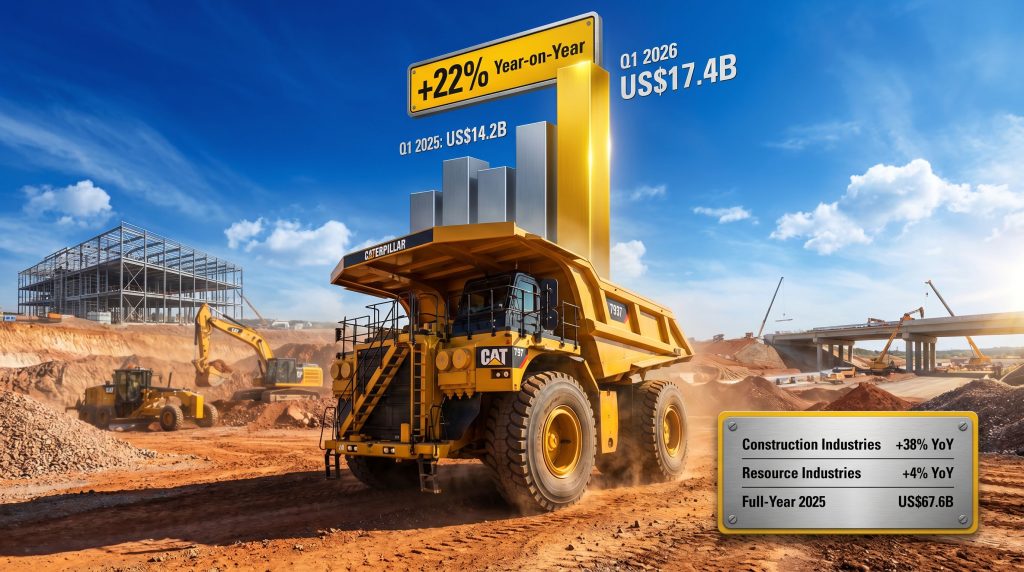
Manufacturing giant Caterpillar reported total sales and revenues of US$17.4 billion for the first quarter of 2026, representing a 22% increase compared to the same period in the prior year, as reported by Mining Magazine on 30 April 2026. The company's resource industries division, which supplies equipment to global mining operations, contributed US$3.8 billion to that total, reflecting 4% year-on-year growth.
To appreciate the significance of this result, it is essential to place it within Caterpillar's recent financial trajectory rather than treat it as an isolated data point.
A Multi-Quarter Performance Timeline
The path to Q1 2026's strong result was not linear. The company navigated a period of meaningful revenue contraction before the current recovery took hold:
| Quarter | Total Revenue | Year-on-Year Change | Key Dynamic |
|---|---|---|---|
| Q1 2024 | US$15.8B | Baseline | Peak demand period |
| Q1 2025 | US$14.2B | -10% | Broad demand softening |
| Q2 2025 | US$16.6B | -1% | Early stabilisation signals |
| Q3 2025 | US$17.6B | +10% | Cyclical inflection point |
| Q4 2025 | US$19.1B | +18% | Broad-based acceleration |
| Q1 2026 | US$17.4B | +22% | Construction and power surge |
Note: Quarterly figures other than Q1 2026 Resource Industries data and the Q1 2026 headline are drawn from the outline and have not been independently verified against Caterpillar's SEC filings. Readers should consult Caterpillar's official investor relations materials for confirmed segment-level figures.
What the table reveals is a company that endured a genuine contraction phase through late 2024 and early 2025, before the recovery that began tentatively in Q2 2025 gained significant momentum. Full-year 2025 revenues reportedly totalled US$67.6 billion, representing approximately 4% growth over the prior year, providing a meaningful baseline for continued 2026 performance.
The 22% year-on-year growth rate in Q1 2026 is particularly striking because it measures against a period of already-depressed demand. That combination, recovering from a low base while posting strong absolute revenues, is a hallmark of genuine cyclical re-acceleration rather than statistical flattery.
Construction Industries: The Quarter's Standout Division
While the resource industries division delivered measured growth, the construction segment reportedly drove the most dramatic uplift, with revenues growing approximately 38% year-on-year during the quarter. This is the kind of growth rate that reflects multiple demand vectors compressing into a single reporting period rather than a single catalyst.
What Is Driving Construction Equipment Demand?
Several intersecting forces are fuelling elevated construction equipment demand across Caterpillar's key markets:
-
Infrastructure investment programmes: The United States continues to release capital from the Infrastructure Investment and Jobs Act, directing spending into civil construction projects that require earthmoving, road-building, and site preparation equipment. Parallel programmes across the Middle East, Southeast Asia, and Sub-Saharan Africa are extending the addressable market.
-
Reshoring and nearshoring of manufacturing: Industrial facility construction across North America and Europe is generating sustained demand for construction machinery, as companies reconfigure supply chains.
-
Residential and commercial development recovery: Following the suppressive effect of elevated interest rates through 2023 and 2024, residential building activity has rebounded across multiple geographies, restoring a demand layer that was largely absent during the contraction period.
-
Data centre infrastructure buildout: Perhaps the least anticipated driver of construction equipment demand, the exponential growth in artificial intelligence computing infrastructure is generating substantial civil construction activity at data centre sites globally. Caterpillar's construction equipment is integral to site preparation, earthworks, and facility construction at these developments.
Power and Energy: An Emerging Strategic Growth Engine
The power and energy segment has quietly emerged as one of Caterpillar's most strategically significant divisions, and its contribution to Q1 2026 results reflects a structural shift in demand rather than a cyclical spike.
The exponential growth in AI computing workloads requires enormous and uninterruptible power supplies. Data centre operators including hyperscalers across North America, Europe, and Asia are investing heavily in both grid-connected and grid-independent power generation infrastructure. Caterpillar's diesel and natural gas generator sets are central to these installations, providing backup capacity and, in some cases, primary power generation where grid reliability is insufficient.
"The demand for large-scale power generation equipment at data centres represents a genuinely new demand category that was structurally absent from prior equipment cycles. Unlike construction demand, which follows economic and regulatory cycles, data centre power demand is being driven by technological adoption rates that show limited sensitivity to macroeconomic conditions."
According to the International Energy Agency, global data centre electricity consumption is projected to reach between 1,000 and 1,200 terawatt-hours annually by the mid-2020s, up from approximately 460 TWh in 2022. This trajectory creates a persistent, long-duration demand signal for power generation equipment of exactly the kind Caterpillar manufactures.
Resource Industries: Measured Growth With a Complex Story
The 4% year-on-year growth to US$3.8 billion in Caterpillar's resource industries division requires careful interpretation. At face value, it appears modest alongside the construction segment's 38% surge. In practice, the dynamics underpinning this segment are significantly more nuanced.
Why Mining Equipment Procurement Cycles Differ
Mining capital expenditure decisions operate on fundamentally different timelines than construction equipment purchases. Key characteristics of the resource industries procurement environment include:
-
Extended project financing cycles: Large mining projects require multi-year permitting, feasibility studies, and financing arrangements before equipment procurement orders are placed. Revenue from these decisions can lag the investment decision by 12 to 36 months.
-
Fleet replacement versus greenfield expansion: Major mining operators including BHP, Rio Tinto, and Glencore have maintained disciplined capital expenditure frameworks following the commodity price volatility of the preceding years. Replacement of aging equipment is proceeding, but large-scale fleet expansion tied to new projects has been slower to materialise.
-
Technology transition effects: Mining operators are actively evaluating autonomous haulage systems and battery-electric haul trucks before committing to large conventional diesel fleet purchases. This evaluation period can create temporary demand pauses as procurement teams assess total cost of ownership across different technology platforms.
The Autonomous Haulage Factor
Caterpillar autonomous haulage, known as Cat AHS, has been deployed at major mining operations globally, including BHP's iron ore operations in Western Australia. Rio Tinto has similarly scaled autonomous truck fleets across its Pilbara operations. While these deployments represent Caterpillar equipment, the transition to autonomous platforms introduces a new evaluation layer that can slow conventional fleet purchasing decisions at operations considering their own automation roadmaps.
The battery-electric transition adds another variable. Multiple OEMs, including Caterpillar, are developing electrified haul truck platforms for underground and surface mining applications. Furthermore, hydrogen-powered mining trucks are emerging as another alternative that mining operators must weigh when planning long-term fleet procurement strategies.
"The 4% growth in resource industries is best understood not as a demand signal, but as a timing signal. The underlying demand pipeline for copper, lithium, gold, and critical minerals extraction equipment is substantial, but procurement timelines, technology transition evaluation, and project financing cycles are distributing that demand across multiple future quarters."
Competitive Landscape: Caterpillar's Advantage in a Disrupted Market
Komatsu's Middle East Headwinds
Mining Magazine has reported that Japanese equipment OEM Komatsu faces an estimated US$680 million revenue impact as a result of Middle East crisis-related disruptions. This is a substantial headwind for a competitor that competes directly with Caterpillar across surface mining, underground operations, and construction equipment categories. Disruptions of this scale create meaningful market share opportunities for suppliers with more diversified geographic exposure and resilient supply chains.
Epiroc's Order-Revenue Divergence
Drilling equipment and mining tools specialist Epiroc recently reported record order intake alongside a concurrent revenue dip, reflecting the lag between strong future demand signals and actual revenue conversion. This pattern, where orders accumulate faster than deliveries can be completed, is a structural characteristic of the current mining equipment cycle and reinforces the view that near-term demand conditions remain robust.
Caterpillar's Structural Competitive Moat
Several structural factors underpin Caterpillar's ability to capitalise on competitor disruptions and broader demand growth:
-
Vertically integrated manufacturing: Production facilities across North America, Europe, and Asia reduce single-source supply chain vulnerability.
-
Cat Financial captive financing: The company's internal financing arm provides customers with flexible equipment acquisition pathways, supporting demand conversion even during periods of tighter external credit conditions.
-
Global dealer network: A distribution and service network spanning more than 190 countries ensures consistent aftermarket revenue and service capability regardless of new equipment sales cycles.
-
Technology breadth: Caterpillar competes across construction, mining, power generation, and oil and gas equipment categories, providing revenue diversification that single-segment competitors cannot match.
The next major ASX story will hit our subscribers first
The Forward Demand Picture: What Comes Next for Mining Equipment
Critical Minerals and the Greenfield Wave
The energy transition's insatiable appetite for copper, lithium, cobalt, nickel, and rare earth elements is creating a pipeline of greenfield mining projects that will eventually translate into substantial equipment procurement. The critical minerals demand driven by the energy transition is particularly acute across the following key project development corridors:
- Copper projects across Chile, Peru, and the Democratic Republic of Congo
- Lithium brine and hard rock projects in Argentina, Chile, and Australia
- Nickel laterite and sulphide developments in Indonesia and Canada
- Gold projects across West Africa and North America
The timeline for equipment procurement from these projects depends on permitting progress, financing conditions, and commodity price stability. Considering current copper market trends, a sustained copper price above US$4.00 per pound materially improves the economics of marginal projects and accelerates investment decisions.
Risks Worth Monitoring
No demand outlook is without meaningful uncertainty. Factors that could temper the current positive trajectory include:
-
Geopolitical instability: Regional conflicts affecting commodity-producing geographies can disrupt both mining activity and equipment logistics chains.
-
Chinese construction slowdown: The China steel and iron ore outlook remains a key variable, as a sustained reduction in Chinese construction and infrastructure investment would remove a significant demand layer from the global heavy equipment market.
-
Currency dynamics: A strengthening US dollar increases the effective cost of Caterpillar's US-manufactured equipment for non-dollar buyers, potentially compressing demand in key international markets.
-
Technology adoption speed: If battery-electric and hydrogen-powered equipment reaches commercial viability faster than anticipated, conventional diesel fleet purchasing decisions could face broader deferral.
Key Figures at a Glance
| Metric | Value |
|---|---|
| Q1 2026 Total Revenue | US$17.4 billion |
| Year-on-Year Growth | +22% |
| Resource Industries Revenue | US$3.8 billion |
| Resource Industries Growth | +4% |
| Construction Segment Growth | ~38% year-on-year |
| Full-Year 2025 Revenue | US$67.6 billion |
| Komatsu Middle East Revenue Headwind | ~US$680 million |
Disclaimer: Financial figures other than those confirmed by Mining Magazine's 30 April 2026 reporting are drawn from the provided outline and should be verified against Caterpillar Inc.'s official SEC filings, earnings releases, and investor relations materials before being relied upon for investment decisions. This article is intended for informational purposes only and does not constitute financial advice.
Frequently Asked Questions
What drove Caterpillar's 22% revenue increase in Q1 2026?
The growth was driven by strong performance across multiple segments, with the construction industries division reportedly delivering approximately 38% year-on-year growth. Infrastructure investment programmes, data centre construction activity, and a recovery in residential building all contributed, alongside ongoing demand for power generation equipment tied to AI infrastructure expansion. According to CNBC's earnings analysis, the results handily exceeded Wall Street expectations across key metrics.
Why did the resource industries division grow more slowly than other segments?
Mining equipment procurement operates on longer decision cycles than construction equipment. Extended permitting timelines, project financing requirements, and the evaluation of autonomous and electrified equipment platforms are distributing demand across future quarters rather than concentrating it in a single reporting period.
How does Caterpillar's performance compare to competitors like Komatsu?
Komatsu is reported to face an estimated US$680 million revenue headwind from Middle East-related disruptions, creating a competitive opening for Caterpillar in affected markets. Caterpillar's geographically diversified manufacturing and distribution network provides relative resilience against single-region disruptions of this nature.
What is the outlook for mining equipment demand through 2026 and beyond?
The pipeline for critical minerals extraction equipment remains substantial, driven by copper, lithium, and nickel project development tied to the energy transition. However, the conversion of this pipeline into equipment orders depends on permitting progress, commodity price stability, and project financing conditions. The near-term demand environment appears constructive, with meaningful uncertainty concentrated in geopolitical and macroeconomic variables. Morningstar's market analysis further notes that this marks the continuation of a pattern in which Caterpillar sales up 22% in March quarter reflects genuine underlying strength rather than one-off factors.
Want to Know Which ASX Mining Companies Could Benefit From the Next Major Equipment Cycle?
Discovery Alert's proprietary Discovery IQ model scans ASX announcements in real time, instantly identifying significant mineral discoveries across copper, lithium, gold, and critical minerals — the very commodities driving the next wave of mining equipment demand. Explore historic discovery returns on Discovery Alert's dedicated discoveries page and begin your 14-day free trial to position yourself ahead of the broader market.