July 8, 2026
The Hidden Vulnerability at the Heart of Every Electric Vehicle
Most conversations about electric vehicle supply chains fixate on lithium, cobalt, or rare earth elements. These materials attract headlines, geopolitical scrutiny, and billions in investment. Yet sitting quietly inside every lithium-ion battery cell is a material that outweighs all of them combined by volume: graphite. The anode of a standard EV battery contains roughly 10 times more graphite than lithium by weight, making it the single largest material input in the entire cell. Despite this, graphite rarely receives the same strategic attention, and that oversight is beginning to cost the industry.
The CATL CarbonScape biographite EV batteries partnership, announced in mid-2026, represents one of the most consequential developments in battery materials in years. To understand why, it is worth stepping back to examine precisely why conventional graphite has become a liability, and why a wood-derived alternative is now attracting investment from the world's largest battery manufacturer.
When big ASX news breaks, our subscribers know first
Why Conventional Graphite Is a Structural Problem
Battery-grade graphite comes in two primary forms: natural graphite mined from geological deposits and synthetic graphite manufactured from petroleum-derived needle coke. Both carry significant drawbacks that have become increasingly difficult to ignore. Furthermore, the global graphite shortage is accelerating the urgency for manufacturers to find credible alternatives.
Natural graphite production is heavily concentrated in China, which accounts for approximately 65-70% of global mined output and an even higher share of processed, battery-grade material. This geographic concentration creates substantial geopolitical exposure for automakers in North America and Europe who are under growing pressure to diversify their supply chains. Trade restrictions, export controls, or shifts in bilateral relations can ripple directly through to battery production schedules.
Synthetic graphite presents a different but equally serious problem. Its production relies on petroleum-derived feedstocks and requires energy-intensive processing at temperatures exceeding 2,800 degrees Celsius, resulting in a carbon footprint that is difficult to reconcile with the emissions targets that automakers and regulators are increasingly holding the industry to. The lifecycle carbon cost of putting synthetic graphite into an EV battery can partially undermine the very climate benefits that electrification is supposed to deliver.
The table below illustrates the core trade-offs across the three major graphite categories:
| Graphite Type | Carbon Footprint | Feedstock Source | Cost Position | Supply Chain Risk |
|---|---|---|---|---|
| Mined Natural Graphite | High | Geological extraction | Low-Medium | High (geopolitical) |
| Synthetic Graphite | Very High | Petroleum-based | High | Medium |
| CarbonScape Biographite | Carbon-Negative | Forestry by-products | Target parity | Low (renewable) |
What Biographite Actually Is and How It Works
CarbonScape has developed a proprietary process that converts forestry residues — the woody by-products left behind after timber harvesting — into battery-grade graphite suitable for use in lithium-ion anodes. The feedstock is biomass that would otherwise be burned, left to decompose, or processed at low value, meaning the carbon sequestered in that wood is effectively locked into a durable, high-performance battery material rather than re-emitted.
The resulting material is described as a true drop-in solution for existing lithium-ion manufacturing lines. This is a technically significant claim. Many alternative anode chemistries, such as silicon-dominant anodes, require modifications to cell design, formation protocols, and battery management systems. Biographite avoids this integration friction by delivering a material that functions within the same processing parameters as conventional graphite, which means battery manufacturers do not need to redesign their production lines to adopt it.
*Independent analysis suggests that replacing conventional graphite with biographite in an EV battery pack can reduce that pack's total carbon footprint by approximately 30%, a decarbonisation impact that operates at the fundamental material level rather than at the manufacturing or logistics stage.*
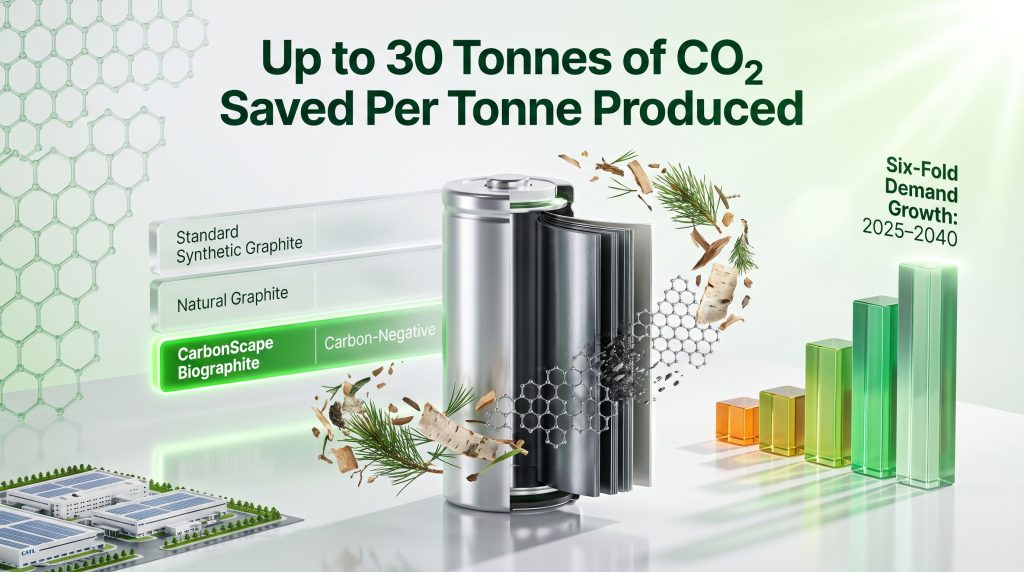
Perhaps most striking is the carbon accounting. CarbonScape has indicated that its process can save up to 30 tonnes of CO2 equivalent per tonne of biographite produced when compared to synthetic graphite production. This carbon-negative profile stems from the renewable feedstock, lower processing temperatures enabled by the biomass chemistry, and the displacement of fossil-fuel-derived alternatives.
Performance Parity: The Critical Commercialisation Question
For any alternative anode material, electrochemical performance is non-negotiable. Battery manufacturers will not accept a sustainable material that compromises energy density, cycle life, or fast-charging capability. CarbonScape has positioned biographite as achieving performance comparable to conventional battery-grade graphite. Consequently, the CATL partnership is specifically structured to validate this at demonstration scale using CATL's own manufacturing infrastructure before any commercial commitment is made. This technical de-risking pathway is one of the more sophisticated aspects of the deal structure.
The Strategic Weight of CATL's Involvement
CATL is not a passive financial backer in this arrangement. The company controls approximately 38-40% of the global EV battery market and operates 15 manufacturing facilities across multiple continents, supplying battery systems to Tesla, BMW, Mercedes-Benz, Volkswagen, and dozens of other automotive brands. When a company with that market footprint takes an equity stake, accepts a board seat, and commits manufacturing resources to validate a new technology, the signal to the broader industry is unmistakable.
Oscar Luo, Executive President and Global Head of Business Development at CATL, described the collaboration as one focused on redefining how critical battery materials are sourced and produced, characterising CarbonScape's technology as a genuine breakthrough in material science that supports the broader vision of a zero-carbon energy future. This framing positions the investment not as a speculative bet but as a deliberate strategic move to address a known vulnerability in CATL's own supply chain.
The partnership structure includes several features worth examining closely:
- Equity participation by CATL alongside co-investor Lochpine Capital, giving CarbonScape a strengthened balance sheet for technology scale-up
- Board representation by CATL, ensuring strategic alignment rather than arms-length oversight
- Equity-based incentive mechanisms tied to commercial deployment milestones, which align CATL's financial returns with the actual success of commercialisation
- Access to CATL manufacturing facilities for demonstration-scale validation, removing the need for CarbonScape to fund and construct its own pilot infrastructure
This last point is particularly important. Building pilot and demonstration plants is one of the most capital-intensive and time-consuming phases of any advanced materials startup's journey. By embedding the validation work within CATL's existing infrastructure, the partnership significantly compresses the timeline and reduces the capital at risk.
The Commercialisation Roadmap
CarbonScape CEO Ivan Williams has described the partnership as providing a clear pathway to gigafactory-scale deployment, with commercial biographite production targeted by the end of the decade. The phased framework for getting there follows a logical technical progression:
-
Phase 1 – Technology Validation: Demonstration-scale testing within CATL's existing manufacturing network to confirm performance at commercially relevant throughputs
-
Phase 2 – Process Optimisation: Collaborative engineering work between CarbonScape and CATL teams to refine yield, energy efficiency, and cost parameters
-
Phase 3 – Commercial Scale-Up: Construction and commissioning of full-scale commercial production plants, targeting operational readiness by approximately 2030
-
Phase 4 – Supply Chain Integration: Incorporation of biographite into CATL's global battery manufacturing network, potentially reaching CATL's supplier base and, by extension, the automakers it supplies
This progression reflects how serious battery material commercialisation actually works. It is not linear, and each phase gate carries technical and economic risks. The involvement of CATL's engineering teams and the use of real manufacturing environments rather than laboratory analogues materially improves the probability of navigating each transition successfully.
Market Scale and the Urgency Behind This Technology
The macro context for this partnership is a projected six-fold increase in battery-grade graphite demand between 2025 and 2040, driven by the continued expansion of electric vehicles and grid-scale energy storage. Against that backdrop, the structural inadequacy of current supply chains becomes a commercial urgency, not merely an environmental aspiration. Indeed, the broader battery raw materials market is experiencing parallel pressures across multiple input categories simultaneously.
This is not CarbonScape's first significant vote of confidence from the forestry and materials industry. The company raised $18 million in a 2023 funding round led by Stora Enso, a major global forest products company with deep expertise in converting wood-based materials into industrial products. That prior investment established both the technical credibility of the biographite process and the commercial logic of integrating it into existing forestry supply chains where feedstock is already being harvested and processed.
With battery-grade graphite demand forecast to expand six-fold within 15 years, the gap between available sustainable supply and projected consumption creates a critical commercialisation window that biographite producers are now racing to fill before the decade closes.
Vincent Ledoux-Pedailles, Chief Commercial Officer at CarbonScape, has noted that graphite functions as the overlooked giant of the battery supply chain, simultaneously the largest material by volume in every EV battery and one predominantly derived from oil-based processing. His framing of biographite as the only proven pathway to produce battery-grade graphite from forestry residues at target cost parity and with a carbon-negative footprint reflects the company's claim to a distinct competitive position among emerging anode material developers.
The next major ASX story will hit our subscribers first
What Scale Adoption Would Mean for EV Emissions Profiles
The scenario implications of widespread biographite adoption are material from both a carbon accounting and supply chain resilience perspective:
| Scenario | Biographite Adoption Rate | EV Battery Carbon Reduction | Supply Chain Impact |
|---|---|---|---|
| Conservative (2030) | 5-10% of graphite supply | ~3% per battery | Niche premium segment |
| Moderate (2035) | 20-30% of graphite supply | ~9% per battery | Mainstream integration begins |
| Accelerated (2040) | 40-50%+ of graphite supply | ~15-20% per battery | Structural supply chain shift |
Even the conservative scenario represents meaningful carbon reduction at aggregate scale given the number of EV batteries expected to be produced annually by 2030. The accelerated scenario, while dependent on successful commercialisation and cost parity being achieved and sustained, would represent a genuinely transformative shift in how battery lifecycle emissions are calculated.
For automakers supplying vehicles into regulated markets with tightening lifecycle emissions standards, a material that reduces per-battery carbon intensity by 15-20% without requiring cell redesign is not a niche sustainability option. It is a compliance tool. This dynamic also intersects with growing interest in lithium-ion battery recycling as manufacturers seek to address end-of-life carbon liabilities alongside upstream production impacts.
Three Conditions for Mainstream Adoption
Disclaimer: The following analysis involves forward-looking projections and should not be interpreted as investment advice. Commercialisation timelines and adoption rates are subject to significant technical, commercial, and market risks.
For biographite to transition from a validated technology to a mainstream battery material by 2035, three conditions must be met:
-
Cost parity must be achieved and maintained at scale. Forestry residue feedstocks offer inherent cost stability advantages over petroleum-derived inputs, but processing economics at gigafactory throughputs are yet to be fully demonstrated. The CATL partnership is specifically designed to generate the cost and yield data needed to confirm this.
-
Electrochemical performance must match or exceed conventional graphite across full commercial qualification cycles. CATL's internal testing protocols are among the most rigorous in the industry, and passing them would provide a level of validation that no independent laboratory assessment could replicate.
-
Supply chain infrastructure for forestry feedstocks must be developed in proximity to battery manufacturing hubs. This is potentially the most complex logistical challenge, requiring coordination between the forestry sector, processing facilities, and battery plants in regions like the US Southeast, Scandinavia, and Central Europe.
Frequently Asked Questions
What is biographite and how does it differ from conventional graphite?
Biographite is battery-grade graphite produced from biomass feedstocks, specifically forestry residues such as wood chips and timber processing by-products, rather than from petroleum derivatives or geological mining. The resulting material is chemically similar to conventional graphite but carries a carbon-negative production profile.
How much can biographite reduce an EV battery's carbon footprint?
Available analysis suggests the substitution of conventional graphite with biographite can reduce the total carbon footprint of an EV battery pack by approximately 30%, with up to 30 tonnes of CO2 equivalent saved per tonne of biographite produced compared to synthetic graphite.
What is CATL's ownership stake in CarbonScape?
CATL has become a strategic shareholder in CarbonScape alongside Lochpine Capital. Reports indicate CATL holds approximately a 20% equity stake alongside board representation. The agreement also includes equity-based incentives tied to commercial deployment milestones.
When is commercial-scale production targeted?
CarbonScape and CATL have both indicated a target of bringing commercial biographite production online by the end of the decade, with the 2030 timeframe referenced in public statements from CarbonScape's leadership.
Does biographite perform comparably to synthetic graphite in battery cells?
CarbonScape has characterised its biographite as a drop-in replacement for conventional anode graphite, indicating comparable electrochemical performance. Full commercial validation is being pursued through the demonstration-scale testing programme with CATL.
What to Watch Over the Next 18 Months
The most important near-term milestones for assessing the credibility of this partnership are the outputs from the demonstration-scale validation programme at CATL facilities. If biographite passes CATL's internal qualification thresholds at meaningful throughput, the pathway to commercial-scale investment becomes significantly clearer. Equally important will be any announcements relating to feedstock supply agreements, which would indicate that the logistical infrastructure needed to support commercial production is being actively built out.
However, the broader picture also matters. The critical minerals demand outlook for the energy transition continues to intensify, and graphite sits squarely within that pressure. For battery supply chain planners and policymakers focused on critical minerals diversification, the CATL CarbonScape biographite EV batteries collaboration represents precisely the kind of private sector partnership that can shift a technology from laboratory credibility to industrial reality. Whether it ultimately transforms the graphite supply chain depends on execution, but the structural logic and the weight of CATL's commitment make this one of the more consequential developments in sustainable battery materials to date.
Want to Stay Ahead of the Next Major Battery Materials Discovery?
Discovery Alert's proprietary Discovery IQ model scans ASX announcements in real time, instantly identifying significant mineral discoveries across graphite, lithium, and more than 30 other commodities — turning complex data into actionable investment insights before the broader market catches on. Explore historic discoveries and their extraordinary returns, then begin your 14-day free trial at Discovery Alert to position yourself ahead of the next major find.