July 8, 2026
Sonora Mining Exports Jump Into the Global Critical Minerals Conversation
The global race to secure critical mineral supply chains has fundamentally altered how resource-rich regions are evaluated by investors, industrial buyers, and policymakers alike. Copper, lithium, silver, and a growing list of strategic metals have moved from commodity spreadsheets to the centre of national security discussions across three continents. Within this broader context, the Sonora mining exports jump of recent quarters has added significant weight to the state's already considerable strategic profile, attracting scrutiny from subnational jurisdictions that would have been unimaginable a decade ago.
When big ASX news breaks, our subscribers know first
Decoding a 33.8% Export Surge: What the Numbers Actually Reveal
From US$739 Million to Nearly US$1 Billion in Twelve Months
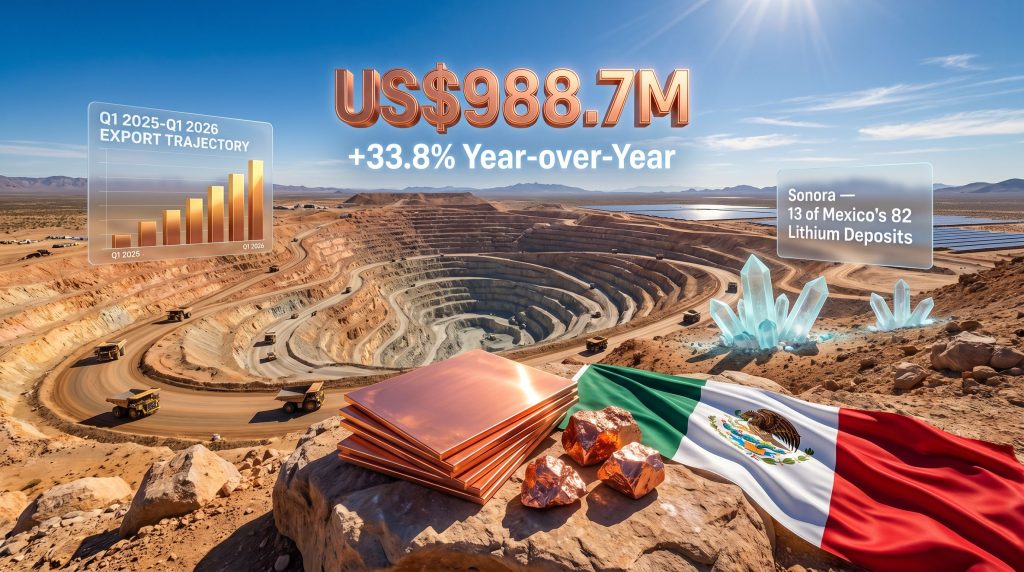
Sonora's mining sector generated US$988.7 million in export revenue during the first quarter of 2026, compared with US$739.1 million during the same period in 2025. That 33.8% year-over-year increase, verified through data published by Mexico's national statistics institute INEGI, pushed the state to fourth place among Mexico's 32 states in mining export value and reinforced its standing as the country's single largest mineral-producing state by volume.
A single-quarter export figure approaching US$1 billion is not routine cyclical noise. It reflects a combination of expanded productive capacity at established operations and a favourable commodity pricing environment, particularly for copper. Understanding which factor is contributing more in any given quarter matters enormously for projecting whether the growth trend is durable or price-driven and therefore reversible.
The following table contextualises Sonora's Q1 2026 performance within its broader strategic position:
| Metric | Value |
|---|---|
| Q1 2026 Mining Export Value | US$988.7 million |
| Q1 2025 Mining Export Value | US$739.1 million |
| Year-over-Year Growth | 33.8% |
| National Ranking (Mining Exports) | 4th of 32 states |
| Mining Share of Sonora Total Exports | 14.9% |
| Mexico's Copper Output from Sonora | Over 80% |
| Identified Lithium Deposits in Sonora | 13 of Mexico's 82 |
| National Lithium Reserve Estimate | 1.7 million tonnes |
Mining accounted for 14.9% of Sonora's total export basket in Q1 2026, making it the state's second-largest export sector after manufacturing. The distinction between Sonora's fourth-place ranking in export value and its first-place standing in total mineral production volume is worth emphasising. Export value rankings capture commodity pricing dynamics and product mix, while production volume leadership reflects geological endowment and operational scale. Sonora holds both dimensions simultaneously, which is an unusual and strategically significant combination.
The Copper Foundation: Why One Metal Shapes Everything
Structural Demand and Sonora's Outsized Role
Copper is not simply Sonora's largest export commodity. It is the architectural foundation upon which the state's entire mining identity rests. Sonora accounts for more than 80% of Mexico's national copper output, and Mexico itself ranks among the world's leading copper producers alongside Chile, Peru, and the Democratic Republic of Congo.
The structural demand drivers for copper extend well beyond traditional construction and electronics. Electrification of transportation networks, expansion of power grid infrastructure, and the proliferation of renewable energy installations all consume copper at rates that existing global supply pipelines are struggling to meet. Furthermore, each electric vehicle contains roughly two to four times the copper of an internal combustion engine vehicle, and each kilometre of high-voltage transmission line requires substantial copper wiring.
These demand vectors are not cyclical. They are structural, which means Sonora's copper export revenues carry a medium-term tailwind that is largely independent of short-term price fluctuations. Consequently, understanding the copper supply crunch facing global markets helps contextualise why Sonora's production capacity has attracted such intense international attention.
The dominant production model in Sonora remains large-scale open-pit mining, which offers the cost efficiency needed to sustain output at internationally competitive margins but also generates significant land disturbance, water consumption, and community engagement obligations. These environmental and social dimensions are increasingly scrutinised by institutional investors applying ESG criteria to mining sector allocations.
Precious and Strategic Metals Completing the Portfolio
Beyond copper, Sonora contributes meaningfully to Mexico's national output of gold, silver, zinc, and antimony. Mexico holds global standing in several of these categories, ranking among the world's top silver producers and maintaining a notable position in antimony, a metal attracting growing attention from defence and electronics manufacturers seeking to diversify away from Chinese supply dominance.
This multi-metal profile gives Sonora a degree of revenue resilience that single-commodity mining jurisdictions lack. When copper prices soften, gold and silver often provide partial revenue offsetting. However, when industrial demand for base metals slows, precious metal operations can sustain cash flows. The portfolio effect is underappreciated by analysts who focus exclusively on copper when evaluating Sonora's mining sector.
Lithium's Promise and the Clay Problem
Geological Endowment Without Commercialisation
Sonora holds 13 of Mexico's 82 identified lithium deposits, the largest state-level concentration in the country. Puebla follows with 12 deposits and Oaxaca with 9. Mexico's national lithium reserve estimate stands at approximately 1.7 million tonnes, placing it among the more significant endowments in the Western Hemisphere. In addition, growing critical minerals demand driven by the global energy transition means these reserves are attracting considerable international interest.
| State | Identified Lithium Deposits |
|---|---|
| Sonora | 13 |
| Puebla | 12 |
| Oaxaca | 9 |
| All Other States Combined | 48 |
However, Sonora's lithium geology presents a challenge that distinguishes it sharply from the world's most productive lithium jurisdictions. The lithium is hosted within clay formations rather than the brine-saturated salt flats that underpin commercial production in Chile, Bolivia, and Argentina's Lithium Triangle. This is not simply a cost differential. It is a fundamentally different engineering problem requiring different extraction chemistry, different processing infrastructure, and different water management protocols.
Clay-hosted lithium extraction typically involves acid leaching or other hydrometallurgical methods to release lithium ions from mineral matrices, followed by purification stages to achieve battery-grade lithium carbonate or hydroxide specifications. These processes are capital-intensive, water-intensive, and currently more expensive per tonne than conventional operations in the lithium brine market. Direct lithium extraction technology shows promise for brine applications, but its adaptation to clay substrates remains an active area of research without a commercially validated, cost-competitive solution at scale.
This technical reality means that even if every regulatory, funding, and trade policy constraint were resolved tomorrow, Sonora's lithium could not reach commercial production without a technology breakthrough that the global mining industry has not yet delivered.
Plan Sonora: The Vision and the Gap
Ambition Backed by Real Geological Assets
Plan Sonora represents the state's strategic framework for converting its raw mineral endowment into participation in higher-value industrial supply chains. The programme's internal logic rests on a dual resource thesis: lithium provides the electrochemical input for battery manufacturing, while copper provides the wiring and charging infrastructure material for electric vehicles and the grid systems that power them. Sonora's exceptional solar irradiance adds a third dimension, offering renewable energy generation capacity to power the energy-intensive mineral processing and manufacturing operations that battery and EV supply chains require.
The ambition expressed through Plan Sonora is substantial. The objective is not merely to supply raw materials to foreign manufacturers but to attract battery cell production and ultimately electric vehicle assembly into the state itself, capturing the value-added margins that currently flow to East Asian and European industrial hubs.
Closing that gap between Plan Sonora's industrial vision and current operational reality requires simultaneous progress across multiple dimensions:
- Commercially viable clay lithium extraction technology must be proven at scale
- Federal investment in LitioMx must increase by orders of magnitude from current levels
- USMCA trade review outcomes must create regulatory clarity for private investment participation
- Transmission infrastructure and renewable generation capacity must be developed to support processing operations
- A skilled technical workforce pipeline must be established to staff facilities that do not yet exist
Each of these conditions is individually uncertain. Their simultaneous achievement within a politically meaningful timeframe is the central strategic risk facing Plan Sonora.
The LitioMx Budget Problem: A Structural Mismatch
When Policy Ambition and Fiscal Reality Diverge
LitioMx, the federal entity holding exclusive rights over Mexico's lithium resources, received a 2026 federal budget allocation of MX$13.9 million, equivalent to approximately US$805,000. Analysts widely characterise this figure as sufficient only to cover administrative overhead, not the capital-intensive exploration drilling, geochemical analysis, technology procurement, pilot plant construction, and processing infrastructure development that commercial lithium production demands.
A credible lithium exploration and development programme at the scale Mexico is targeting would realistically require tens or hundreds of millions of dollars in annual investment, depending on the stage and scope of activity. Peer nations that have successfully developed state-linked critical mineral entities, including Chile through CODELCO's copper model and Australia through various state-facilitated exploration incentive programmes, have consistently demonstrated that geological endowment alone does not translate into export revenue without commensurate institutional investment.
The gap between LitioMx's current budget and the capital requirements of meaningful lithium development creates a de facto standstill. The monopoly prevents private capital from filling the void while the public entity lacks the resources to advance the resource itself. This structural contradiction is the single largest near-term constraint on Mexico's lithium development trajectory.
The next major ASX story will hit our subscribers first
Trade Pressure and the USMCA Dimension
Lithium Governance as a Bilateral Negotiation Issue
Mexico's lithium governance framework has moved beyond domestic policy into the arena of international trade negotiations. The 2026 US National Trade Estimate Report formally identifies Mexico's state monopoly over lithium as an investment barrier, elevating the issue from regulatory preference to bilateral trade concern. Furthermore, the broader trade war impacts reshaping global supply chains have intensified pressure on resource-holding nations to clarify their investment frameworks for strategic minerals.
Three broad scenario pathways define the range of possible outcomes:
| Scenario | Description | Key Implication |
|---|---|---|
| Status Quo Maintained | Full state monopoly retained; foreign investment restricted | Lithium development stalls; copper-led exports dominate medium term |
| Hybrid Access Framework | Partial private participation under state oversight | Accelerated exploration; LitioMx retains revenue rights |
| Full Liberalisation | Monopoly dismantled under trade pressure | Rapid capital inflow but loss of state resource sovereignty |
The tension between Mexico's resource nationalism framework and the investment conditions that lithium development requires is not easily resolved. Each scenario carries different implications for the pace of Sonora's lithium commercialisation and the distribution of economic benefits between the Mexican state and international capital.
The IDB's Macroeconomic Thesis and Mexico's Minerals Diplomacy
The Inter-American Development Bank has identified critical minerals development as one of the few available levers to meaningfully lift Mexico's growth trajectory above its projected 1.3% GDP growth rate for 2026. The transmission mechanisms the IDB highlights include increased foreign direct investment flows, expanded export revenue from mineral production, and higher fiscal receipts through royalties and corporate taxation.
In states like Sonora, where mining anchors regional employment and supplier ecosystems, the sector's multiplier effect on local economic activity amplifies the national-level impact. At the federal level, Economy Minister Marcelo Ebrard has identified 13 minerals that Mexico currently lacks or produces in insufficient quantities, creating import dependencies the government is actively working to reduce.
Mexico is simultaneously seeking to place critical minerals trade on the agenda of the WTO Ministerial Conference while pursuing bilateral supply relationship diversification with partners in Latin America, India, and Canada. According to industry forecasts, export earnings from resource-rich jurisdictions that align their regulatory frameworks with investor expectations are positioned to outperform those that do not. Sonora's demonstrated export performance strengthens Mexico's credibility in these multilateral conversations considerably.
Scenario Pathways: Reading Sonora's Export Trajectory Through 2027 and Beyond
Near Term: Copper Sustains the Growth Story
The base case for Sonora's mining export performance through 2027 centres on continued expansion at established copper and precious metals operations, supported by the structural demand tailwinds driving copper prices. This scenario does not require any technological breakthroughs or regulatory changes. It rests on incremental capacity growth, operational efficiency improvements, and commodity pricing conditions that remain broadly supportive of revenue expansion.
Medium Term: The Conditions for Lithium's Entry
Lithium entering Sonora's commercial export portfolio within a three-to-five-year horizon would require simultaneous validation of clay extraction technology, a material increase in LitioMx's operational budget, and sufficient regulatory clarity from the USMCA review process to attract private technical and financial partners. None of these conditions is imminent, but the convergence of all three is not impossible within this timeframe.
Long Term: The Integrated Supply Chain Scenario
The full realisation of Plan Sonora's industrial vision, where copper and lithium production feeds into domestic battery manufacturing and electric vehicle assembly, represents the highest-value and highest-uncertainty pathway. It requires not just technological and regulatory progress but sustained federal investment, infrastructure development at scale, and private capital commitments that would rank among the largest industrial investments in Mexico's modern economic history.
Disclaimer: This article contains forward-looking scenarios and analysis based on publicly available data and reported information. These scenarios are not investment advice and should not be interpreted as predictions of specific outcomes. Readers should conduct independent research before making any investment or business decisions related to the sectors or jurisdictions discussed.
What Sonora's Export Performance Signals to the Market
The Sonora mining exports jump of 33.8% in a single quarter is analytically significant precisely because it coincides with a period of maximum uncertainty about the state's medium-term trajectory. The copper-led export machine is clearly functioning at a high level. The lithium chapter, however, remains largely unwritten. The regulatory environment is in active negotiation, and the industrial transformation envisioned under Plan Sonora sits at the intersection of technology risk, fiscal constraint, and geopolitical trade dynamics.
For sophisticated observers of Latin America's critical minerals landscape, that combination of near-term performance strength and medium-term uncertainty is itself informative. It suggests that Sonora's immediate investment case rests on the solidity of its conventional mining operations, while its longer-term strategic value depends on developments that are genuinely difficult to forecast with precision. Understanding which time horizon matters most for any given assessment of Sonora's mining sector is the essential analytical starting point.
Want to Stay Ahead of the Next Major Mineral Discovery?
Discovery Alert's proprietary Discovery IQ model delivers real-time alerts on significant ASX mineral discoveries — instantly translating complex geological data into actionable investment insights for both short-term traders and long-term investors. Explore Discovery Alert's discoveries page to see how historic finds have generated substantial returns, and begin your 14-day free trial today to position yourself ahead of the broader market.