July 8, 2026
The Hidden Fault Lines in Global Sulphur Trade Chains
Every commodity market carries embedded fragilities that remain invisible during periods of stable supply. These vulnerabilities only reveal themselves under stress, and when they do, the consequences travel far beyond the commodity itself. Sulphur is a textbook example of this dynamic. Underappreciated by mainstream commodity observers, it sits at the foundation of some of the world's most critical industrial processes, connecting oil refining, agricultural production, copper mining, and chemical manufacturing through a single elemental thread.
When geopolitical shocks sever established sulphur trade routes, the downstream consequences do not stay contained. They propagate across sectors in ways that are difficult to anticipate and even harder to reverse quickly. The South Africa sulphur imports fall 68pc during the first five months of 2026 offers one of the most instructive case studies in supply chain concentration risk the commodity world has seen in recent years. Understanding the commodity price impacts of such disruptions is essential for any analyst tracking southern African industrial supply chains.
When big ASX news breaks, our subscribers know first
Why South Africa's Sulphur Import Structure Was a Vulnerability Waiting to Be Exposed
The Geographic Concentration Problem
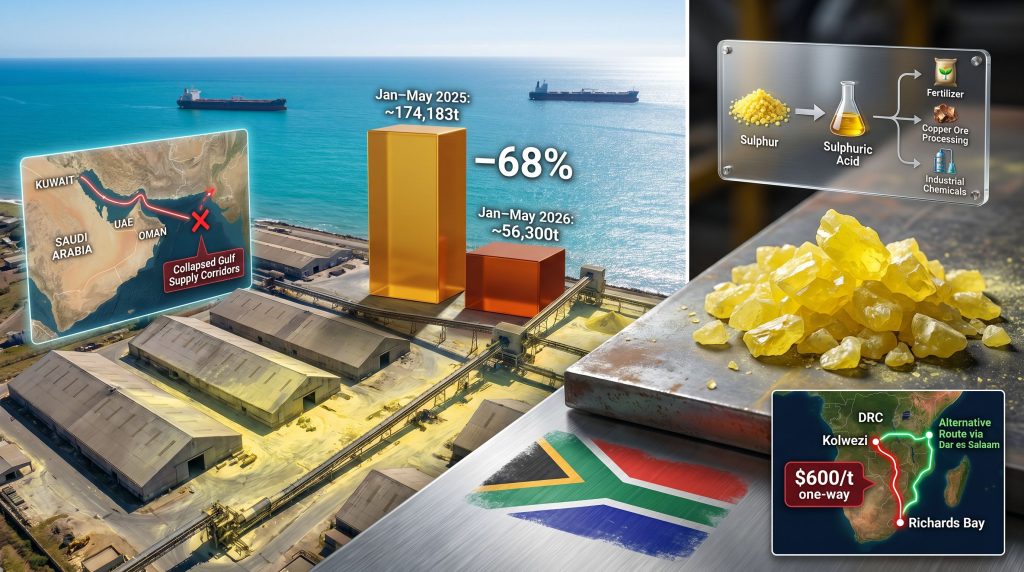
South Africa's sulphur import profile entering 2026 was heavily skewed toward a single producing region. During January through May 2025, the country received approximately 174,183 tonnes of sulphur, with the overwhelming majority arriving from Gulf state producers. The breakdown illustrates just how concentrated this dependency had become:
| Supplier Country | Jan-May 2025 Volume (t) | Jan-May 2026 Volume (t) |
|---|---|---|
| Kuwait | 62,600 | 0 |
| Oman | 40,000 | 0 |
| Saudi Arabia | 38,500 | 0 |
| UAE | 31,500 | 0 |
| Other / Single Cargo | ~1,583 | ~56,300 |
| Total | ~174,183 | ~56,300 |
This structure created a textbook single-point-of-failure architecture. More than 99% of Middle East sulphur volumes that reached South Africa in early 2025 simply ceased arriving in the equivalent 2026 period. A single cargo of approximately 55,000 tonnes delivered in February 2026 represented the near-entirety of Gulf-origin receipts for the entire five-month window.
What Sulphur Actually Does in an Industrial Economy
One reason sulphur supply disruptions attract less mainstream attention than oil or gas shocks is that sulphur itself is rarely the finished product anyone purchases. It is a foundational intermediate. Its primary industrial conversion pathway runs through sulphuric acid production, after which it becomes embedded in a remarkably wide range of end uses:
- Phosphate fertiliser manufacturing, where sulphuric acid reacts with phosphate rock to produce superphosphate and diammonium phosphate (DAP)
- Hydrometallurgical copper leaching, where sulphuric acid dissolves copper oxide minerals in heap leach and tank leach operations across the Copperbelt
- Chemical processing, pulp and paper production, and water treatment applications
- Petroleum refining desulphurisation processes, which paradoxically also produce recovered sulphur as a by-product
This multi-sector dependency means sulphur shortages do not produce isolated effects. They generate simultaneous pressure across multiple industries, and the sectors most economically vulnerable tend to absorb the greatest damage.
The Geopolitical Trigger: How a Conflict Halted an Entire Trade Lane
From Stability to Shock
The proximate cause of the South Africa sulphur imports fall was the outbreak of US-Iran conflict beginning on 27 February 2026. Gulf state sulphur cargo deliveries to South Africa, which had been operating on established rhythms, effectively ceased almost immediately. What had been a steady flow of four distinct national supplier streams collapsed into a single February cargo and then silence.
This kind of abrupt trade lane disruption exposes a critical reality about how commodity supply chains function. Furthermore, the geopolitical mining risks embedded in Middle Eastern supply corridors had long been underpriced by market participants who assumed political stability was the default condition rather than a temporary state.
The February 2026 cargo of approximately 55,000 tonnes was not a sign of market resilience. It was the last remnant of a supply relationship that had already fractured, arriving under momentum rather than as evidence of ongoing trade.
Why Alternative Origins Could Not Fill the Gap
When Gulf supply disappeared, alternative sulphur sources did exist, including the US Gulf Coast, Vancouver, and Black Sea producers. However, access to these alternatives was not equally distributed among market participants. Copperbelt mining companies, benefiting from the substantially higher margins available in copper production, moved rapidly and decisively to secure these volumes at premium prices.
Their purchasing power in a seller's market was structurally superior to that of fertiliser producers, chemical manufacturers, and pulp and paper operations. This dynamic illustrates an underappreciated feature of sulphur markets: demand is not homogeneous. Mining-sector buyers and agricultural-sector buyers are not equivalent competitors. When supply is constrained, the better-capitalised, higher-margin segment wins, and the agricultural supply chain absorbs the shortfall.
How the Supply Shock Cascaded Through South African Industry
Foskor: The Anchor Producer Goes Dark
Foskor, one of South Africa's most significant integrated fertiliser and sulphuric acid producers, suspended operations in March 2026 following the depletion of its sulphur feedstock inventory. The shutdown carried dual consequences. Foskor had been supplying both the domestic South African sulphuric acid market and export volumes destined for Copperbelt mining operations.
Its simultaneous withdrawal from both roles created a multiplying effect on regional acid availability. This illustrates a systemic characteristic of southern African sulphur markets that is often overlooked: South Africa functions as a net exporter of sulphuric acid to the Copperbelt, meaning that domestic supply disruptions have regional, not merely national, consequences.
Sasol's Unplanned Shutdown Compounded the Crisis
Sasol, the integrated energy and chemicals company, experienced an unplanned shutdown at one of its facilities in the same month. As a producer of sulphur and sulphuric acid from its operations, the halt eliminated another major source of domestic acid supply. Sasol's facility was expected to remain in maintenance through August 2026, extending the period of reduced production well beyond the initial disruption window.
The simultaneous curtailment of both Foskor and Sasol created a compounding deficit that the market was structurally unable to self-correct in the short term. No single alternative producer held sufficient spare capacity to absorb the combined loss of these two contributors.
Richards Bay: From Constrained to Depleted
Richards Bay is South Africa's primary sulphur import terminal and the logistical hub through which virtually all imported volumes flow into the domestic market and onward to regional buyers. By April 2026, warehouse stocks at Richards Bay had been entirely committed to downstream buyers with pre-existing agreements. No spot inventory remained available for uncommitted purchasers.
This transition from a supply-constrained market to an effectively zero-availability spot market represents a critical threshold in commodity shortages. It signals that price mechanisms alone can no longer clear the market, because the physical material simply does not exist in uncommitted form at any price. As of June 2026, inbound cargo deliveries had partially resumed at Richards Bay, though volumes available outside pre-committed allocations remained limited.
The Logistics Cost Spiral: A Secondary Crisis Within the Crisis
Trucking Rates Reach Extraordinary Levels
Diesel price increases in March and April 2026 drove trucking costs on southern African trade corridors to levels that materially altered the economics of established trade routes. The numbers involved are striking:
| Route | Peak Freight Cost (2026) | Economic Status |
|---|---|---|
| Richards Bay to DRC (round trip via Durban) | ~$1,000/t | Severely impaired |
| Richards Bay to Kolwezi, DRC (one-way) | ~$600/t | Uncompetitive vs. alternatives |
| Dar es Salaam to Copperbelt (backhaul) | Lower (relative) | Preferred alternative corridor |
At $600/t in one-way trucking costs from Richards Bay to Kolwezi, the traditional southern African logistics corridor became commercially unviable for many buyers. This represents a fundamental repricing of the supply chain that, when added to elevated spot material costs, pushed landed acid and sulphur costs beyond the operational tolerances of lower-margin consumers. The broader supply chain disruption dynamics at play here mirror patterns seen across other strategically concentrated commodity corridors in 2025 and 2026.
The Dar es Salaam Shift and Its Long-Term Implications
The relative competitiveness of backhaul routing through Dar es Salaam, Tanzania created a structural incentive to redirect flows through East African port infrastructure. While this alternative reduced costs for Copperbelt-bound material, it did nothing to address South African domestic shortages and effectively accelerated the diversion of available supply away from Richards Bay.
This rerouting dynamic carries longer-term implications. If Tanzanian port infrastructure continues to gain competitiveness relative to the Richards Bay corridor, the structural architecture of sulphur and sulphuric acid trade in southern and central Africa could shift in ways that persist well beyond the resolution of the immediate geopolitical disruption.
Three Recovery Scenarios: From Rapid Normalisation to Structural Realignment
Scenario 1: Gulf Supply Restoration (Conditional Recovery)
If US-Iran tensions de-escalate sufficiently to allow Middle East sulphur exports to resume at scale, South Africa could see a partial import volume recovery in the second half of 2026. However, physical cargo resumption and genuine market recovery are separate processes. Rebuilding committed inventory pipelines, restarting Foskor's production train, and waiting for Sasol's maintenance completion would introduce lags of several weeks to months even under a favourable geopolitical scenario.
Scenario 2: Prolonged Disruption and Forced Diversification
An extended period of Gulf supply absence would compel South African importers to build durable relationships with alternative origins. This structural diversification would reduce concentration risk over the medium term but would come at the cost of persistently higher landed prices. The flow-through to fertiliser pricing and agricultural input costs would be material, with implications for food production economics across the region.
Scenario 3: Demand Destruction and Capacity Rationalisation
The most severe scenario involves extended operating rate reductions converting into permanent capacity closures. Producers running below economic thresholds for sustained periods face fixed cost absorption challenges that can render marginal facilities unviable. This outcome would have lasting consequences for South Africa's position as a regional fertiliser and sulphuric acid supplier, and for the broader agricultural input supply chains that depend on domestic production.
The next major ASX story will hit our subscribers first
The Overlooked Food Security Dimension
The connection between the South Africa sulphur imports fall and regional food security deserves explicit attention. Sulphuric acid is an essential input in phosphate fertiliser production, and phosphate fertilisers are foundational to crop productivity across sub-Saharan Africa. A sustained reduction in South African fertiliser manufacturing capacity does not simply affect industrial economics; it reduces the availability and affordability of crop nutrition products across a region where smallholder agriculture remains the primary livelihood for hundreds of millions of people.
The asymmetric competition between mining-sector and agricultural-sector buyers during supply shocks therefore carries a dimension that extends well beyond commodity market dynamics. It represents a recurring structural vulnerability in the regional food system that commodity market frameworks rarely quantify adequately. According to Kpler's sulphur market analysis, this feedstock crisis is cascading through copper, nickel, and fertiliser value chains simultaneously, compounding the pressure on food system stakeholders.
Key Structural Lessons from the 2026 South Africa Sulphur Supply Shock
The experience of the first half of 2026 encodes several durable lessons for commodity market participants, policymakers, and industrial strategists. Furthermore, these lessons apply equally to the emerging copper supply crunch unfolding across southern African mining corridors, where sulphuric acid availability is already becoming a binding constraint on production growth.
- Concentration risk requires active management: Reliance on a single regional source for more than 99% of an industrial feedstock is not a market efficiency; it is a systemic exposure that will eventually crystallise into disruption.
- Sector purchasing power is structurally asymmetric: Mining-sector buyers will consistently outcompete agricultural and chemical sector buyers during scarcity, creating predictable and recurring food system vulnerabilities.
- Logistics costs are not a secondary consideration: Transport cost escalation can transform a manageable supply constraint into a full industrial crisis, as the Richards Bay corridor dynamics demonstrated.
- Physical availability and market availability are distinct: The resumption of cargo arrivals does not immediately translate into spot market availability. Pre-committed volumes absorb initial supply resumption, leaving uncommitted buyers exposed for extended periods.
- Regional export roles amplify domestic disruptions: South Africa's role as a sulphuric acid exporter to the Copperbelt means that domestic production curtailments have consequences that extend well beyond national borders. Consequently, the copper supply gap narrative increasingly applies to acid feedstock availability, not only to ore reserve depletion.
In addition, independent pricing data and trade flow verification remain essential for any commercial decision-maker operating in these markets. The World Bank's WITS trade database provides a useful baseline for South African sulphur import verification and historical benchmarking.
Disclaimer: This article contains forward-looking scenario analysis and market observations based on publicly available information current as of the time of writing. Scenario projections are speculative in nature and should not be construed as investment advice or commercial recommendations. Readers should conduct independent due diligence before making any commercial or financial decisions based on the information presented here.
Want to Stay Ahead of Mineral Discoveries Driven by Commodity Supply Shocks?
When sulphur supply disruptions cascade through copper and fertiliser value chains, the mining companies best positioned to respond can represent significant investment opportunities — Discovery Alert's proprietary Discovery IQ model scans ASX announcements in real time, delivering instant alerts on significant mineral discoveries across 30+ commodities so investors can act before the broader market catches on. Explore historic discoveries and their returns, then begin a 14-day free trial at Discovery Alert to gain a market-leading edge.