
July 7, 2026
The Anatomy of a Market-Moving Mine Shutdown
When a single licensing technicality can erase billions in market capitalisation overnight and trigger a wave of speculative repositioning across lithium futures markets, it reveals something fundamental about how fragile supply chain confidence actually is. The lithium market downturn in 2025 and 2026 provided an almost textbook demonstration of this dynamic, as a routine permit expiry at one Chinese operation cascaded into months of price volatility, strategic uncertainty, and forced supply chain restructuring for one of the world's most powerful battery manufacturers.
The CATL Jianxiawo lithium mine restart, formalised through a safety production permit secured on 29 June 2026, marks the resolution of a nearly year-long regulatory interruption that exposed multiple structural vulnerabilities in how markets price Chinese domestic lithium supply risk. Understanding what actually happened, and what comes next, requires looking well beyond the headline.
When big ASX news breaks, our subscribers know first
Why Jianxiawo Carries Disproportionate Market Weight
A Single Operation With Systemic Reach
The Jianxiawo mine sits within Yichun city in Jiangxi Province, a region that has emerged as one of China's most consequential lithium production corridors. Jiangxi's lepidolite-bearing geology has made it a key source of battery-grade lithium carbonate, distinct from the hard-rock spodumene extraction methods dominating Australian output or the brine-based methods used across the South American Lithium Triangle.
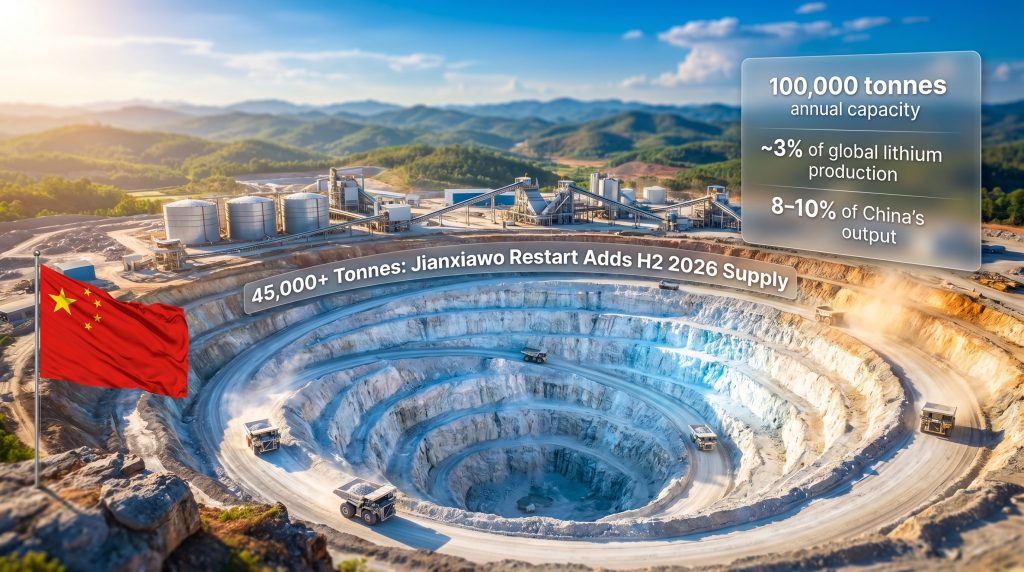
What makes Jianxiawo genuinely significant is not just its size but its concentration of output within a single ownership structure. With a rated annual production capacity of approximately 46,000 metric tons of lithium carbonate equivalent according to Australian government data, the mine accounts for roughly 3% of 2025 global lithium production capacity. When viewed through the lens of domestic Chinese supply, its contribution is even more substantial, representing an estimated 8 to 10% of China's lithium carbonate output prior to the suspension.
For a commodity market already navigating structural oversupply, the temporary removal of that volume was never going to create sustained scarcity. But it did expose how quickly sentiment can decouple from fundamentals when a significant producer goes dark.
The Lepidolite Factor: Understanding Jianxiawo's Ore Type
One dimension of this story that rarely receives adequate attention is the geological character of the Jianxiawo deposit itself. Jiangxi Province's lithium resources are predominantly hosted in lepidolite, a lithium-bearing mica mineral, rather than the spodumene pegmatites that dominate Australian production.
Lepidolite processing is more complex and energy-intensive than spodumene refining, and it typically yields lower lithium recovery rates per tonne of ore processed. This has historically made Jiangxi-sourced lithium carbonate somewhat more expensive to produce than its Australian-derived equivalent. However, CATL's scale and integration across the processing chain have allowed it to manage these cost headwinds more effectively than smaller domestic competitors.
This geological context matters for investors: lepidolite-sourced lithium carbonate from Jiangxi is not perfectly fungible with spodumene-derived product, and when Jianxiawo went offline, CATL could not simply substitute its internal feedstock with externally sourced lepidolite concentrate on a like-for-like basis without incurring meaningful cost and logistics friction.
The Shutdown Timeline: What Actually Happened
A Regulatory Event, Not an Operational Failure
The distinction matters enormously for how investors should interpret the suspension. When mining operations cease due to safety incidents or environmental enforcement actions, the path to resumption is typically longer, more uncertain, and often accompanied by remediation costs. The Jianxiawo shutdown was categorically different.
Operations were suspended on 10 August 2025, when the mine's existing operating licence reached its expiry date. No safety breach was cited. No environmental violation triggered the halt. The shutdown was, in regulatory terms, an administrative event — the consequence of a renewal process that had not been completed before the licence clock ran out.
| Milestone | Date |
|---|---|
| Previous mining permit expiry / operations suspended | August 10, 2025 |
| CATL begins sourcing lithium ore from external suppliers | October 2025 |
| Anticipated Lunar New Year restart (did not occur) | February 2026 |
| Electric mining trucks observed at mine entrance | June 28, 2026 |
| Local workforce begins pre-restart training | Late June 2026 |
| Safety production permit secured | June 29, 2026 |
| Permit validity period ends | February 27, 2028 |
China's Two-Permit Regulatory Architecture
Understanding why the approval process took nearly eleven months requires familiarity with how China structures mining authorisations. Chinese lithium mining operations must hold two distinct and separately administered permits to legally operate:
- A mining licence (矿山开采许可证) that grants the right to extract mineral resources from a designated area.
- A safety production permit (安全生产许可证) that certifies the operation meets workplace and environmental safety standards.
Both must remain current and valid simultaneously. The lapse of either one is sufficient to trigger a legal suspension of operations. Crucially, these permits are administered by different regulatory bodies, which means the renewal timeline for each is independent and subject to separate bureaucratic processes. This multi-layered architecture creates windows of regulatory risk that are structurally embedded in Chinese mining operations, regardless of the operator's scale or political profile.
Credit China, the state-run corporate compliance platform, serves as the official public transparency mechanism for tracking permit status. It was through this platform that the June 29 safety production permit issuance was first publicly confirmed.
The gap between the anticipated February 2026 restart and the actual June 2026 resumption illustrates how consistently market participants underestimate the complexity of China's multi-agency permit renewal process. Even for a company of CATL's stature, the bureaucratic pathway cannot be compressed indefinitely.
Market Reactions: Sentiment Versus Structural Reality
How Speculation Amplified the Initial Price Signal
The immediate market response to the August 2025 suspension was swift and, in retrospect, disproportionate. Lithium futures prices spiked sharply in the days following the announcement, and lithium-linked equities across multiple markets recorded meaningful gains. Two narratives simultaneously gained traction among market participants:
- The suspension might signal a broader Chinese government-coordinated effort to curtail domestic lithium overcapacity through selective regulatory tightening.
- CATL's removal from domestic supply would create a meaningful supply gap that third-party producers could fill at improved margins.
Both narratives proved premature. The regulatory event was specific to permit administration, not a coordinated supply management strategy. Furthermore, CATL's pivot to external lithium ore suppliers, confirmed by Reuters reporting in October 2025, partially offset the production gap without meaningfully tightening the spot market for other producers.
The Oversupply Context That Capped the Rally
The lithium market entering the second half of 2025 was already characterised by a pronounced structural surplus. New capacity from Australian spodumene producers, expanded lithium brine extraction operations in South America, and incremental Chinese domestic projects had collectively pushed the market into territory where even a meaningful supply disruption could not generate sustained price recovery.
The removal of approximately 46,000 tonnes of annual lithium carbonate equivalent capacity from a market producing in the range of 1.5 million tonnes annually (as per industry estimates for 2025) was mathematically insufficient to reverse the oversupply dynamic. Consequently, the temporary rally faded as this arithmetic became apparent. For additional context, lithium prices plunged in China on speculation over the mine's operational status, underscoring just how sensitive markets had become to any signal from Jianxiawo.
What the Restart Means for H2 2026 Supply Dynamics
Incremental Volume Into an Already-Pressured Market
| Metric | Jianxiawo Figure |
|---|---|
| Annual production capacity (LCE) | ~46,000 tonnes |
| Share of China's lithium carbonate output (pre-suspension) | 8-10% |
| Share of 2025 global lithium production capacity | ~3% |
| Estimated incremental H2 2026 capacity addition | ~23,000+ tonnes |
The mid-year timing of the restart is operationally significant. Mines restarting after extended suspensions do not immediately return to full rated capacity. Equipment recommissioning, workforce retraining, and the re-establishment of ore haulage logistics all consume time. The observation of electric mining trucks at the mine entrance on 28 June 2026, and the commencement of workforce training in late June, suggest that production volumes will ramp progressively through Q3 2026, rather than snapping back immediately to pre-suspension levels.
This ramp-up dynamic means that the effective incremental supply contribution to the 2026 market will be meaningfully below the mine's full annualised capacity figure, though still sufficient to add further weight to an already-oversupplied market. The broader lithium carbonate dynamics at play in 2026 suggest limited near-term price relief, even as the CATL Jianxiawo lithium mine restart adds fresh volume to the equation.
Upstream Cost Relief for CATL's Battery Manufacturing Chain
Beyond the headline supply volume, the restart carries significant operational importance for CATL's internal economics. Sourcing lithium ore from external suppliers at market spot prices during the suspension period introduced cost and procurement complexity that would not exist when drawing from a captively owned, vertically integrated mine.
CATL's battery manufacturing competitiveness is, in substantial part, a function of its ability to control input costs across the value chain. Restoring Jianxiawo to active production directly supports the company's margins by replacing external procurement with lower-cost internal feedstock — a consideration that investors in battery supply chains should not underestimate.
Could the Jianxiawo Restart Trigger a Broader Wave of Resumptions?
The Template Effect in Chinese Mining Regulation
One of the least-discussed implications of this episode is the precedent it establishes for other suspended Chinese lithium operations. China's lithium sector entered the mid-2020s with a significant number of operations facing permit renewal requirements across various regulatory dimensions. The successful navigation of Jianxiawo's approval process, by one of China's most politically and economically significant corporations, creates a de facto template for how other producers might approach similar regulatory pathways.
If the approval timeline — roughly eleven months from suspension to safety permit issuance — becomes understood as the standard regulatory processing window for major lithium mine permit renewals, it allows market participants to more accurately model potential return-to-production timelines for other suspended operations. In addition, innovations such as direct lithium extraction could further reshape how Chinese producers manage future supply disruptions.
Scenario Analysis: Cascading Restarts Through 2027
If between three and five additional Chinese lithium operations with lapsed or pending permit renewals follow the Jianxiawo regulatory pathway and return to production by mid-2027, the combined incremental output could represent an additional 5 to 8% of current global lithium supply. Under this scenario, any investment thesis built on Chinese supply tightness as a catalyst for lithium price recovery would face severe structural headwinds.
This is a speculative projection, not a confirmed outcome, and should be treated accordingly. However, it represents a risk scenario that sophisticated lithium market participants would be prudent to include in their scenario modelling. Analysts tracking implications of mine restarts in China have flagged precisely this cascading risk as a key variable for 2027 pricing models.
The next major ASX story will hit our subscribers first
Key Takeaways for Investors and Market Watchers
- Regulatory events carry unique market risk in Chinese mining. The CATL Jianxiawo lithium mine restart demonstrates that permit administration timelines are difficult to predict, even for China's largest and most influential mining operators.
- Supply fundamentals capped the speculative rally. The oversupply context meant the suspension could not generate sustained price recovery, a dynamic that remained intact throughout the suspension period.
- CATL's vertical integration thesis is reinforced. The cost and complexity of external procurement during the suspension period underscores why captive mine ownership remains central to CATL's competitive strategy.
- The restart adds downward pressure to H2 2026 lithium pricing. Incremental supply returning to an oversupplied market supports a bearish near-term price outlook for battery-grade lithium carbonate.
- The precedent may unlock further Chinese mine resumptions. Market participants should monitor whether additional suspended operations in Jiangxi and other Chinese lithium provinces follow a similar regulatory pathway through 2026 and 2027.
This article is intended for informational purposes only and does not constitute financial or investment advice. Lithium market forecasts and scenario analyses involve inherent uncertainty. Readers should conduct their own due diligence before making investment decisions. For additional context on global lithium market dynamics, visit mining.com.
Want to Catch the Next Major ASX Mineral Discovery Before the Market Does?
Discovery Alert's proprietary Discovery IQ model scans ASX announcements in real time, instantly identifying high-potential mineral discoveries across more than 30 commodities and translating complex data into clear, actionable insights — start your 14-day free trial at Discovery Alert today, or explore how historic discoveries have generated extraordinary returns to understand the scale of opportunity these moments can present.