June 30, 2026
The Battery Anode Supply Chain Is Approaching a Structural Turning Point
For decades, the lithium-ion battery industry operated under a quiet assumption: graphite anodes were good enough. They were cheap, scalable, and well-understood. But as electric vehicle manufacturers push harder on range, charging speed, and energy density targets, that assumption is cracking. The industry is now in the early stages of a material transition that could reshape upstream battery supply chains just as profoundly as the shift from lead-acid to lithium-ion reshaped energy storage itself.
Silicon-carbon anodes sit at the centre of this transition. And the Sicona silicon-carbon anode funding milestone secured in mid-2026 offers one of the clearest signals yet that this technology is moving from laboratory promise into commercial reality.
When big ASX news breaks, our subscribers know first
Why Graphite's Reign as the Default Anode Material Is Under Pressure
Graphite has served as the dominant anode material in commercial lithium-ion cells since the early 1990s. Its theoretical capacity sits at around 372 milliampere-hours per gram (mAh/g), a figure that battery chemists have been pushing against for years. While cathode chemistry has evolved substantially across NMC, LFP, and NCA formulations, the anode side of the cell has remained relatively static.
The problem is not graphite's stability — it is its ceiling. As EV manufacturers target ranges exceeding 600 kilometres per charge and rapid charging times under 15 minutes, graphite anodes become a limiting factor. Higher charging rates cause lithium plating on graphite surfaces, which degrades cycle life and raises safety concerns. The material's structural properties, while excellent for slow charging, are not optimised for the fast-charge demands of modern EVs.
Silicon addresses this limitation at a fundamental electrochemical level. Its theoretical storage capacity reaches approximately 3,579 mAh/g, nearly ten times that of graphite. The challenge has always been silicon's tendency to expand volumetrically by as much as 300% during lithiation, which causes particle cracking, capacity fade, and premature cell failure. This is the engineering problem that silicon-carbon composite architectures are specifically designed to solve.
Furthermore, graphite supply constraints are adding urgency to the search for viable alternatives, making the commercial development of silicon-carbon composites even more strategically important for battery manufacturers worldwide.
How Silicon-Carbon Composites Solve the Expansion Problem
The silicon-carbon composite approach works by embedding nanoscale silicon particles within a carbon matrix. The carbon acts as both a structural buffer and a conductive scaffold, absorbing silicon's expansion stress while maintaining electron pathways throughout the electrode. This architecture dramatically reduces mechanical degradation compared to pure silicon anodes.
Sicona's proprietary SiCx® material is engineered around this principle. According to ARENA's assessment of the technology, SiCx® delivers:
- Up to 20% higher energy density compared to conventional graphite anodes
- Charging speeds up to 40% faster than graphite-based cells
- Drop-in manufacturing compatibility with existing lithium-ion production lines
That last point is arguably the most commercially significant. Many next-generation anode chemistries, particularly those involving nano-silicon structures or pure silicon formulations, require substantial retooling of electrode coating and calendering equipment. SiCx® is specifically designed to avoid this barrier, reducing the adoption friction for battery cell manufacturers who have invested heavily in existing infrastructure.
Performance Comparison: Anode Technology Landscape
| Anode Technology | Energy Density Advantage | Cycle Life | Manufacturing Compatibility |
|---|---|---|---|
| Graphite (baseline) | Baseline | High | Existing lines |
| Silicon Oxide (SiOx) | Moderate | Moderate-High | Mostly compatible |
| Silicon-Carbon Composite (SiCx®) | High (20%+) | Improving | Drop-in compatible |
| Pure Silicon | Very High | Currently limited | Requires new processes |
Sicona's Funding Journey: From Deep-Tech Spinout to Commercial-Scale Producer
Sicona Battery Technologies emerged from academic research origins and has since built a capital structure that reflects growing institutional confidence in its technology platform. The company's funding history tells a story of accelerating validation within a rapidly evolving battery raw materials market.
Capital Raise Timeline
| Funding Stage | Amount | Notes |
|---|---|---|
| Total Prior Equity Raised | ~AUD 41.7 million | Across two equity rounds |
| Series Round (May 2025) | AUD 26.8 million | Included Himadri licensing and investment |
| Himadri Follow-On Investment | AUD 17.5 million | Part of May 2025 strategic partnership |
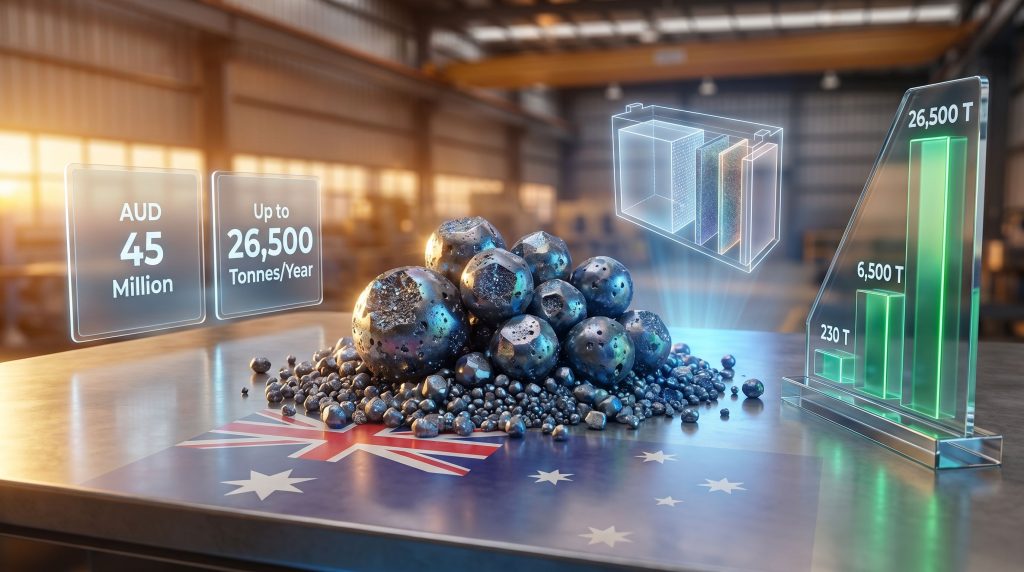
| ARENA Battery Breakthrough Initiative Grant | Up to AUD 45 million | July 2026, largest single funding event |
The Himadri Speciality Chemical Ltd. partnership, formalised in May 2025, deserves particular attention beyond its capital contribution. Himadri is one of India's leading specialty carbon and advanced materials producers, with an established position in coal tar pitch, carbon black, and naphthalene derivatives. Its strategic pivot toward advanced battery materials reflects a broader industrial repositioning as Indian manufacturing scales up its clean energy ambitions.
The licensing agreement embedded within the Himadri partnership gives the Indian company rights to deploy SiCx® technology, effectively creating a mechanism for international technology transfer. For Sicona, this provides both financial depth and a pathway into Asian battery supply chains without requiring direct capital deployment into Asian manufacturing at an early stage.
The ARENA grant of up to AUD 45 million represents not just Sicona's largest single capital event, but also a third-party technology validation from a federal agency with a mandate to fund commercially credible clean energy innovations. ARENA funding is awarded through a competitive assessment process, making selection itself a meaningful signal of technology maturity.
The Port Kembla Facility: Industrial Logic Behind the Location Choice
The decision to site Sicona's commercial-scale demonstration facility at BlueScope Steel's Port Kembla precinct in the Wollongong region of New South Wales carries both practical and symbolic weight. From a purely logistical standpoint, the site offers:
- Established heavy industrial utilities including power, water, and gas infrastructure
- Deep logistics connectivity via road, rail, and proximity to Port Kembla harbour
- An existing industrial workforce with advanced manufacturing experience
- Reduced greenfield development costs compared to establishing an entirely new industrial site
The symbolic dimension is equally interesting. Port Kembla has historically been synonymous with Australian heavy industry, particularly steelmaking. Co-locating advanced battery materials production within a precinct built around traditional industrial processes represents a tangible example of industrial transition in action — high-value manufacturing evolving alongside legacy sectors rather than replacing them.
Phase-by-Phase Production Scale-Up Roadmap
| Production Phase | Annual Capacity | Primary Purpose |
|---|---|---|
| Phase 1 (Initial) | Up to 230 tonnes/year | Customer qualification samples and initial commercial sales |
| Phase 2 (Expansion) | Up to 6,500 tonnes/year | Full commercial supply to battery manufacturers |
| Long-Term Target | Up to 26,500 tonnes/year | Large-scale global offtake supply |
Critical analytical note: The 230-tonne Phase 1 capacity is deliberately calibrated for qualification engagement, not revenue generation at scale. Sicona's commercial trajectory will hinge on converting qualification relationships with tier-1 battery manufacturers into binding offtake agreements before committing Phase 2 capital. This sequencing is commercially disciplined but introduces a critical execution dependency.
Qualification timelines with major battery cell manufacturers typically run between 12 and 36 months from sample delivery to supply agreement execution. This means the period between Phase 1 commissioning and Phase 2 capital deployment will be the most commercially consequential window in the company's near-term history.
Parallel US Expansion: Why the Southeastern United States Matters
Sicona's ambitions extend beyond the Australian market. The company has announced plans for a US anode manufacturing facility in the Southeastern United States, targeting an initial capacity of approximately 6,700 tonnes per year, with long-term expansion to 26,500 tonnes annually by the early 2030s.
The strategic rationale for a US facility is inseparable from the Inflation Reduction Act (IRA). The IRA's domestic content requirements and battery component sourcing provisions create meaningful financial incentives for US battery cell manufacturers to source anode materials from facilities located within the United States or from free trade agreement partner nations. An IRA-compliant silicon-carbon anode supply source could unlock tax credit eligibility for downstream EV manufacturers and battery integrators, making the sourcing decision partially financial rather than purely technical.
Australian vs. US Facility: Strategic Comparison
| Dimension | Australian Facility (Port Kembla) | US Facility (Southeastern US) |
|---|---|---|
| Primary Funding Source | ARENA grant (up to AUD 45M) | To be confirmed |
| Initial Capacity | 230 tonnes/year | ~6,700 tonnes/year |
| Long-Term Capacity Target | 26,500 tonnes/year | 26,500 tonnes/year |
| Strategic Driver | Technology validation and domestic supply chain | IRA compliance and US EV market access |
The next major ASX story will hit our subscribers first
The Geopolitical Dimension: Why Western Anode Supply Matters Now
Understanding why this Sicona silicon-carbon anode funding milestone carries broader market significance requires appreciating the current state of global anode supply. China currently accounts for an estimated 70 to 90 percent of global natural and synthetic graphite anode production. Export control measures on graphite and battery materials, introduced by China in late 2023 and tightened subsequently, have underscored the vulnerability of battery supply chains that depend on a single geography for critical upstream materials.
Silicon-carbon composite anodes represent a structurally different supply chain model. The primary feedstocks — metallurgical-grade silicon and specialty carbon — are sourced from a more geographically distributed set of producers compared to battery-grade graphite. Western-aligned producers building silicon anode capacity are therefore not just offering a performance upgrade; they are offering a supply chain diversification option that carries geopolitical value independent of the technology's electrochemical merits.
This dynamic is particularly relevant for battery manufacturers in the United States, Europe, and Japan who face regulatory or reputational pressure to reduce Chinese material dependency in their supply chains. Indeed, the broader critical minerals demand picture reinforces why governments are actively backing domestic producers of advanced battery materials.
Key Risks and Commercialisation Challenges
No technology transition of this scale proceeds without friction. Investors and industry observers should weigh the following risk dimensions.
Technical Risks
- Maintaining consistent SiCx® material quality at commercial throughput volumes above 230 tonnes annually
- Demonstrating competitive cycle life performance under real-world fast-charging conditions across multiple cell chemistries
- Managing silicon content optimisation, since higher silicon loadings deliver greater energy density gains but also accelerate degradation if the carbon buffering architecture is not precisely engineered
Market Risks
- The pace of global EV adoption directly determines demand growth for advanced anode materials
- Solid-state battery commercialisation, if it accelerates faster than currently anticipated, could alter the addressable market for silicon-carbon anodes by enabling different electrode architectures
- Sodium-ion batteries, which use hard carbon rather than graphite or silicon anodes, represent a potential alternative for lower-cost EV segments
However, battery materials innovation continues to advance rapidly across multiple fronts, and Sicona's drop-in compatibility advantage may prove decisive in converting cautious battery manufacturers who are reluctant to retool existing production infrastructure.
Policy and Funding Risks
- ARENA grant disbursement is typically milestone-linked, meaning Sicona must execute operationally to access the full AUD 45 million
- Shifts in Australian or US clean energy policy could affect the competitive landscape for domestic battery material producers
- Currency exposure between AUD-denominated operating costs and USD-denominated global battery material pricing introduces margin volatility at commercial scale
For a closer look at Sicona's full technology platform, including its materials science approach and development pipeline, the company's own documentation provides useful additional context.
Disclaimer: This article contains forward-looking statements and projections regarding technology performance, production timelines, and market developments. These are based on publicly available information and should not be construed as investment advice. Readers should conduct independent due diligence before making any investment decisions.
Frequently Asked Questions
What is the total funding Sicona has raised to date?
Sicona has raised approximately AUD 41.7 million in prior equity across two rounds, plus the ARENA grant of up to AUD 45 million, bringing total capital mobilised to over AUD 86 million when combined with Himadri's strategic investment.
What makes SiCx® different from standard graphite anodes?
SiCx® is Sicona's proprietary silicon-carbon composite material engineered to deliver over 20% higher energy density and up to 40% faster charging compared to graphite, while integrating with existing lithium-ion manufacturing equipment without requiring production line retooling.
Where will the Australian manufacturing facility be built?
The facility will be established at BlueScope Steel's Port Kembla industrial precinct in the Wollongong region of New South Wales. Charge Devs reported on the significance of this ARENA-backed facility as a landmark step for Australian battery manufacturing.
Who is Himadri Speciality Chemical and what is its role?
Himadri Speciality Chemical Ltd. is an Indian specialty chemicals and advanced materials company that entered a strategic licensing and investment partnership with Sicona in May 2025, contributing AUD 17.5 million in follow-on investment and holding licensing rights to SiCx® technology for international deployment.
Is Sicona planning US manufacturing operations?
Yes. Sicona has announced plans for a facility in the Southeastern United States targeting an initial capacity of approximately 6,700 tonnes per year, scaling to 26,500 tonnes annually by the early 2030s, positioned to serve IRA-compliant battery supply chains. This expansion forms a key part of the broader Sicona silicon-carbon anode funding strategy as the company scales its global footprint.
Want to Stay Ahead of the Next Major Battery Materials Discovery on the ASX?
Discovery Alert's proprietary Discovery IQ model scans ASX announcements in real time, instantly identifying significant mineral discoveries across critical battery materials — from graphite to silicon feedstocks — and delivering actionable alerts directly to subscribers. Explore historic discoveries and their market returns, then begin your 14-day free trial at Discovery Alert to position yourself ahead of the next major find.