July 7, 2026
The Mine That Moved Markets: Understanding the Weight of a Single Permit
Lithium mining is rarely a topic that generates the kind of immediate market reaction typically reserved for central bank decisions or geopolitical flashbacks. Yet when a single mine in eastern China lost its legal right to operate in August 2025, lithium futures spiked, mining equities rallied across the ASX and global exchanges, and analysts began questioning whether Beijing was quietly pulling levers to manage a commodity in chronic oversupply. The story of the CATL Jianxiawo lithium mine restart permit is, at its core, a study in how regulatory architecture, vertical integration, and market psychology can converge around a single bureaucratic document.
When big ASX news breaks, our subscribers know first
What Makes Jianxiawo a Mine Worth Watching
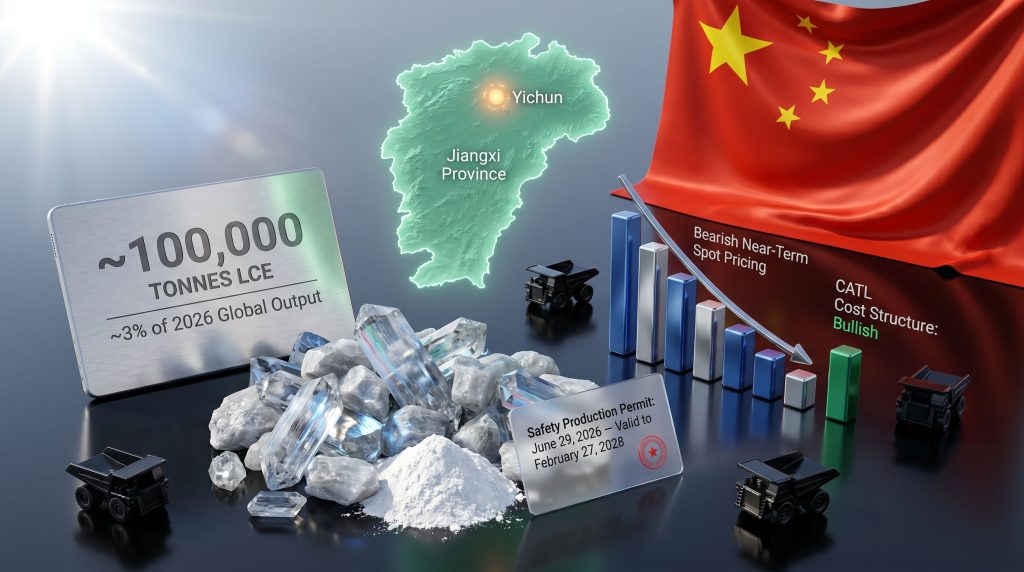
Situated in Yichun city, Jiangxi Province, the Jianxiawo mine sits at the centre of one of China's most mineralogically significant lithium belts. Jiangxi has long been recognised as a critical source of hard-rock lithium, particularly lepidolite-type ore, which differs meaningfully from the spodumene lithium extraction methods more common in Australia and the brine-based resources found across South America's Lithium Triangle.
Lepidolite ore, while lower in lithium grade than spodumene, is far more abundant in Jiangxi and has become commercially viable due to advances in processing technology. This is a detail that often escapes mainstream coverage: the Jianxiawo operation is not simply a large mine, it is a technically demanding one that requires sophisticated beneficiation to convert relatively lower-grade ore into battery-ready lithium carbonate. CATL's capacity to manage this processing efficiently is itself a competitive advantage.
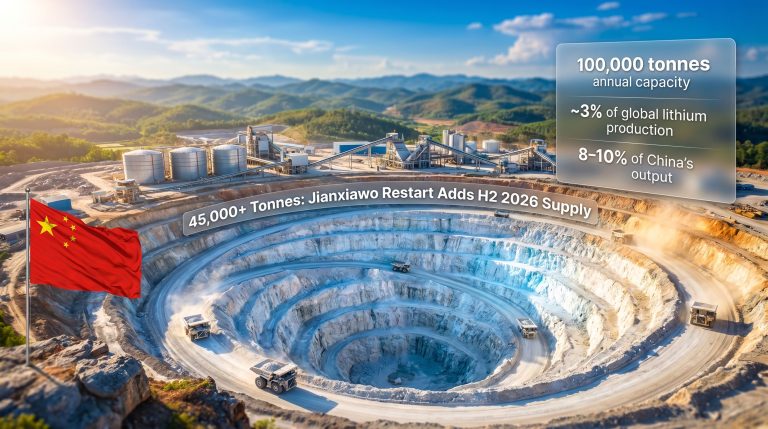
At full operational capacity, the mine produces the equivalent of approximately 46,000 metric tonnes of lithium carbonate per year, according to Australian government data, which frames that figure as representing roughly 3% of 2025 global lithium output. That may not sound immediately dramatic, but in a commodity market where marginal supply shifts drive disproportionate price movements, 3% of global production returning or disappearing from the market can reframe consensus forecasts almost overnight.
CATL's Vertical Integration Strategy and Why It Matters
CATL is not simply a mining company that happens to make batteries. It is the world's largest electric vehicle battery manufacturer by installed capacity, and Jianxiawo functions as a direct feedstock source within a deliberately constructed vertical supply chain. This upstream-to-cathode integration strategy is a central pillar of how CATL manages input cost volatility, shields its margins from spot market disruptions, and maintains competitive pricing for its battery cells.
When Jianxiawo went offline, that internal feedstock pipeline was severed. CATL was consequently compelled to purchase lithium ore from third-party suppliers at prevailing market rates, a situation that introduces both cost uncertainty and supply reliability risk. The commercial pressure created by this dependency on external sourcing underscores why restoring the mine's operational status carried urgency well beyond regulatory compliance.
The Regulatory Event That Triggered a 10-Month Shutdown
On August 10, 2025, Jianxiawo's existing mining license reached its scheduled expiration date. This was not an emergency closure triggered by a safety incident, environmental violation, or enforcement action. It was a permit renewal failure — a procedural gap between the expiry of one license and the issuance of its replacement.
This distinction matters significantly for how investors and analysts should interpret the event. A shutdown caused by a regulatory penalty signals operational or compliance dysfunction. A shutdown caused by license timing delays speaks instead to the structural complexity of China's multi-agency mining approval system.
China's Layered Mining Compliance Architecture
To understand why a renewal could take over ten months, it helps to appreciate the regulatory stack any Chinese mine must navigate:
- Mining Rights License grants the legal right to extract minerals from a defined geographic area.
- Safety Production Permit (安全生产许可证) is the critical operational authorisation, mandatory for all non-coal and coal mines, issued by provincial-level safety supervision bureaus following physical inspections.
- Environmental Impact Assessment Approvals must remain current across both pre-operational and ongoing phases.
- Land Use and Reclamation Approvals are governed separately by natural resources authorities.
Without a valid Safety Production Permit, no extraction can legally proceed, even if every other approval remains active. This is the precise permit that expired in August 2025 and was ultimately reissued on June 29, 2026, with validity extending to February 27, 2028.
The permit's reissuance was confirmed through Credit China, the state-run enterprise compliance tracking platform introduced under China's social credit framework for corporations. This transparency mechanism allows market participants to independently verify permit status without depending entirely on company disclosures — a feature that proved particularly valuable during the months of uncertainty surrounding the CATL Jianxiawo lithium mine restart permit.
| Permit Type | Issuing Authority | Operational Impact if Expired |
|---|---|---|
| Mining Rights License | Ministry of Natural Resources | No legal right to extract |
| Safety Production Permit | Provincial Safety Bureau | Complete operational halt |
| Environmental Approval | Ecology and Environment Ministry | Risk of enforcement action |
| Land Use Approval | Natural Resources Authority | Potential site access restrictions |
Market Reactions and the Speculation That Followed
The immediate market response to the August 2025 suspension was instructive. Lithium futures recorded a temporary upward price spike, and lithium-focused mining equities across the ASX and other exchanges logged short-term gains. This reaction reflected the market's reflexive interpretation of supply removal as price-supportive, even though the shutdown was regulatory rather than demand-driven.
Furthermore, the suspension coincided with an already well-documented period of global lithium oversupply challenges, which prompted a separate and more complex debate among market participants about whether China's regulatory machinery was being used informally to reduce upstream output and stabilise domestic lithium prices.
This theory, while never confirmed by Chinese authorities, had a logic worth examining. China's dual carbon commitments and its strategic interest in maintaining a competitive domestic battery industry create occasionally contradictory policy pressures: the state wants abundant, low-cost lithium for its battery manufacturers, but also wants to prevent the chronic oversupply conditions that have devastated margins for domestic lithium producers since 2023.
The eventual permit issuance through standard regulatory channels suggests the prolonged timeline was procedural in nature rather than a deliberate supply management mechanism. However, the episode has brought renewed attention to how licensing timelines in China's mining sector can function as de facto supply controls, even without explicit policy intent.
How Comparable Jurisdictions Approach Permit Renewal
| Jurisdiction | Typical Permit Renewal Timeline | Public Transparency Tool |
|---|---|---|
| China | Variable; 3 to 12+ months | Credit China platform |
| Australia | 6 to 18 months (state-dependent) | State mining registers |
| Chile | 12 to 24 months | SERNAGEOMIN public records |
| Canada | 12 to 36 months | Federal and provincial dual process |
China's timelines are not unusually long by international standards, but the opacity of the process and the market size of the affected operations can amplify their impact considerably.
Operational Signals Before the Permit Was Official
One detail that received relatively little attention was the observable pre-positioning of equipment at the Jianxiawo site on June 28, 2026, a full day before the Safety Production Permit was formally issued. Electric mining trucks were reported parked at the mine entrance, suggesting that CATL had received sufficient assurance from regulators about the approval timeline to begin staging equipment ahead of the official announcement.
This kind of pre-positioning is a recognised signal in the mining industry. Operators with insider knowledge of imminent permit approvals routinely begin mobilising equipment, workforce, and logistics infrastructure to minimise the lag between regulatory clearance and first ore production. For a mine of Jianxiawo's scale, even a few weeks of accelerated ramp-up translates into meaningful volume recovery.
Supply and Pricing Implications for H2 2026
The return of Jianxiawo's capacity arrives into a global lithium market still working through the consequences of the 2022 to 2023 price supercycle collapse. Understanding the broader lithium carbonate supply dynamics is essential here, as battery-grade lithium carbonate prices remain well below their historical peaks, and new supply from projects in Argentina, Chile, and Australia has continued to enter the market progressively throughout 2025 and 2026.
The restoration of approximately 46,000 metric tonnes LCE annually from a single asset adds meaningful volume to an already well-supplied market. The near-term pricing implication is broadly bearish for lithium carbonate spot rates, as the market must now absorb supply that had been absent for nearly a year without a corresponding demand acceleration to offset it.
For CATL specifically, the calculus runs in the opposite direction. Restoring internal feedstock supply eliminates the cost premium associated with third-party spot procurement and resets the company's upstream margin position toward its pre-suspension baseline.
| Market Factor | Near-Term Impact | Medium-Term Consideration |
|---|---|---|
| Global lithium oversupply | Restart adds bearish price pressure | Demand growth could rebalance |
| CATL procurement costs | Reduced, internal feedstock restored | Margin improvement expected |
| Permit validity to Feb 2028 | Operational certainty for ~20 months | Renewal risk re-emerges in 2027 |
| Speculation on supply curtailment | Effectively closed by permit approval | Regulatory risk lens remains relevant |
The next major ASX story will hit our subscribers first
The February 2028 Deadline and What It Means for Investors
A detail worth flagging for investors tracking the lithium sector is that the newly issued Safety Production Permit carries an expiration date of February 27, 2028. This creates a known, dated regulatory event on the forward calendar. Markets will begin pricing in renewal risk as that date approaches, particularly if the next renewal cycle falls during a period of price volatility or elevated regulatory scrutiny of China's mining sector.
The 10.5-month gap between license expiry and reissuance in the current cycle provides a reference point for how long the market might need to price in operational disruption risk in a worst-case scenario. In addition, innovations such as direct lithium extraction technology are increasingly relevant to how quickly disrupted supply can be offset elsewhere. Investors monitoring CATL's upstream supply chain should, however, mark February 2028 as a forward risk date, even if today's approval resolves the immediate uncertainty.
Frequently Asked Questions: CATL Jianxiawo Lithium Mine Restart
What is the Jianxiawo lithium mine?
Jianxiawo is CATL's flagship upstream lithium mining operation, located in Yichun, Jiangxi Province, China. The mine primarily processes lepidolite-type lithium ore and operates at an annual capacity equivalent to approximately 46,000 metric tonnes of lithium carbonate, representing around 3% of 2025 global lithium output.
Why was the mine suspended?
The suspension began on August 10, 2025, when the mine's existing Safety Production Permit expired. The halt was procedural rather than the result of any safety incident or regulatory enforcement action.
When was the restart permit issued?
The CATL Jianxiawo lithium mine restart permit was reissued on June 29, 2026, with validity through February 27, 2028. The permit status was publicly confirmed via Credit China.
What does the restart mean for lithium prices?
The return of Jianxiawo's production capacity into an already oversupplied global lithium market is expected to exert modest downward pressure on near-term lithium carbonate spot prices. Furthermore, understanding lithium brines explained as a competing supply source illustrates how multiple factors simultaneously influence global pricing dynamics while reducing CATL's input procurement costs.
Was the delay deliberately engineered by Chinese authorities?
No confirmed evidence supports that interpretation. The standard regulatory process that produced the permit approval suggests the extended timeline was procedural. Whether the episode reveals structural vulnerabilities in China's mining licensing system, however, remains an open analytical question.
This article is intended for informational purposes only and does not constitute financial or investment advice. Forecasts, price projections, and market assessments discussed herein involve inherent uncertainty. Readers should conduct independent research before making any investment decisions. For ongoing coverage of global lithium market dynamics and mining sector developments, Kitco News provides regular reporting across commodity asset classes.
Want to Stay Ahead of the Next Major ASX Mineral Discovery?
Discovery Alert's proprietary Discovery IQ model delivers real-time alerts on significant ASX mineral discoveries — cutting through market complexity to surface actionable opportunities before the broader market reacts. Explore historic examples of exceptional discovery returns and begin your 14-day free trial at Discovery Alert to position yourself at the forefront of the next major find.