May 18, 2026
Understanding CBAM and Brazilian Aluminum in the Global Trade Landscape
Carbon-intensive industries worldwide face unprecedented transformation as climate regulations reshape international trade patterns. The aluminum sector, characterized by its exceptional energy requirements and complex supply chains, exemplifies how environmental policies can fundamentally alter competitive dynamics across different regions. CBAM and Brazilian aluminum interactions demonstrate the complexity of implementing carbon border adjustments whilst recognising legitimate environmental advantages that producers have developed through renewable energy solutions and clean technology investments.
Brazil's aluminum industry operates within this evolving landscape from a unique position, leveraging one of the world's cleanest energy matrices while serving both domestic and international markets. However, recent regulatory developments in Europe have introduced methodological complexities that may not fully recognise the environmental advantages Brazilian producers have cultivated through decades of renewable energy investment.
When big ASX news breaks, our subscribers know first
The Carbon Border Adjustment Mechanism Framework and Its Industrial Scope
The European Union's Carbon Border Adjustment Mechanism represents a comprehensive approach to preventing carbon leakage whilst maintaining industrial competitiveness within EU borders. CBAM became operational in January 2026, targeting specific sectors including aluminum, steel, cement, fertilisers, and electricity imports from non-EU countries.
The mechanism operates by calculating embedded emissions in covered products and applying costs equivalent to those faced under the EU Emissions Trading System (ETS). This carbon pricing adjustment occurs at the border, creating a level playing field between EU producers subject to carbon costs and international competitors who may operate under different regulatory frameworks.
Key CBAM Implementation Details:
- Enforcement began January 2026 following a transitional reporting period
- Covers imports worth approximately €50 billion annually across all sectors
- Applies carbon pricing based on embedded emissions calculations
- Requires extensive documentation and verification procedures
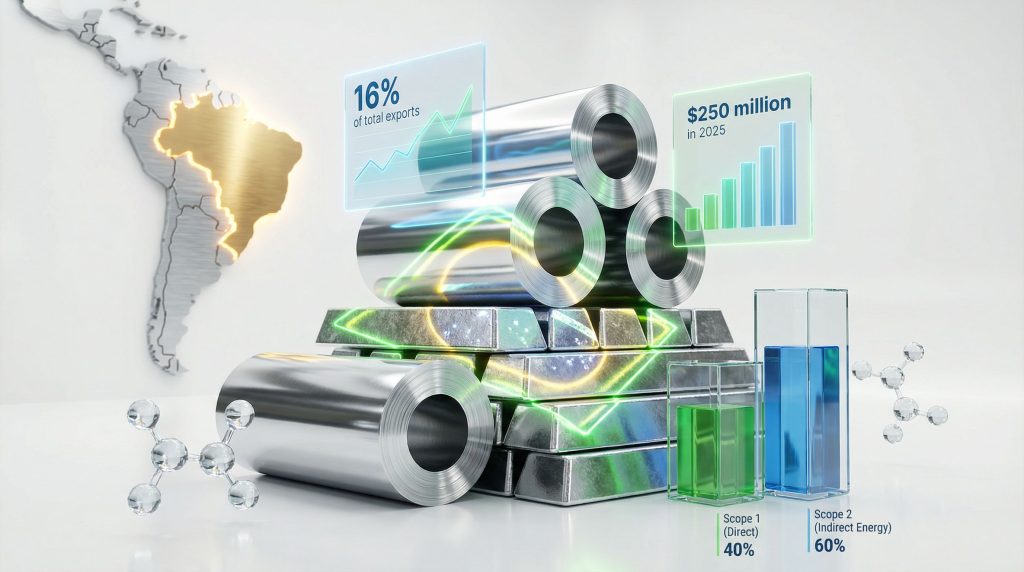
For Brazilian aluminum exports specifically, CBAM affects trade flows representing $250 million in 2025, accounting for 14.3% of Brazil's aluminum product exports. This volume totals 88,700 tonnes, representing approximately 16% of Brazil's total aluminum export tonnage. While significant, these figures indicate that Brazil's aluminum sector maintains strong domestic market orientation, with over 90% of major producers' sales focused on local consumption.
The relationship between CBAM and Brazilian aluminum reflects Europe's strategy to achieve carbon neutrality by 2050 whilst preventing production shifts to jurisdictions with less stringent environmental regulations. This approach aims to maintain World Trade Organization compliance by avoiding discriminatory treatment whilst incentivising global decarbonisation through comprehensive energy transition strategies.
Methodological Limitations in Carbon Accounting for Aluminum Production
CBAM's current design focuses exclusively on Scope 1 emissions under the Greenhouse Gas Protocol classification system, encompassing direct emissions from owned or controlled sources. For aluminum production, this includes emissions from the electrolytic reduction process that transforms alumina into metallic aluminum.
However, this methodology excludes Scope 2 emissions associated with purchased electricity, steam, heating, and cooling. According to International Aluminium Institute data, Scope 2 emissions represent 60% of total emissions in aluminum production chains, creating a substantial measurement gap in CBAM's carbon intensity calculations.
Emissions Distribution in Aluminum Production:
| Emissions Category | Percentage of Total | CBAM Recognition | Brazilian Energy Advantage |
|---|---|---|---|
| Scope 1 (Direct Process) | 40% | ✓ Included | Moderate differentiation |
| Scope 2 (Electricity) | 60% | ✗ Excluded | Significant advantage lost |
Primary aluminum smelting requires approximately 12,000-15,000 kilowatt-hours of electricity per tonne of aluminum produced, making it one of the most energy-intensive industrial processes globally. Brazil's aluminum sector benefits from predominantly hydroelectric power generation, with renewable energy comprising approximately 65% of the national energy matrix.
Major Brazilian producers including Companhia Brasileira de Alumínio (CBA) with ~455,000 tonnes/year capacity, Albras producing ~460,000 tonnes/year, and Alumar with ~447,000 tonnes/year source electrical power primarily from renewable hydroelectric facilities. Furthermore, these sustainable production methods represent decades of strategic investment in clean energy sourcing.
Brazil's aluminum production benefits from hydroelectric power generating approximately 24-48 grams CO2-equivalent per kilowatt-hour, compared to coal-fired generation producing 820-1350 grams CO2-equivalent per kilowatt-hour, creating substantial but unrecognised advantages under current CBAM methodology.
Competitive Distortions in Secondary Aluminum and Clean Energy Recognition
CBAM's regulatory framework creates significant distortions in how recycled aluminum and clean energy investments are recognised within carbon intensity calculations. Secondary aluminum production, which involves melting and refining aluminum scrap, requires only 600-700 kilowatt-hours per tonne compared to primary smelting's energy requirements.
This process efficiency translates to 95% fewer greenhouse gas emissions for recycled aluminum compared to primary aluminum production. However, CBAM regulations currently classify recycled aluminum identically to primary aluminum without differentiation based on production route or material origin.
Technical Comparison: Primary vs. Secondary Aluminum
- Primary aluminum energy requirement: 12,000-15,000 kWh per tonne
- Secondary aluminum energy requirement: 600-700 kWh per tonne
- Emissions reduction through recycling: 95%
- CBAM recognition of recycling advantage: None under current methodology
Brazil's circular economy initiatives, including the Recircula Brasil platform expansion announced in November 2025, position the country as a potential leader in secondary aluminum production. However, under CBAM's current design, aluminum produced through circular economy initiatives faces identical carbon cost calculations to energy-intensive primary production.
The exclusion of Scope 2 emissions creates additional competitive distortions for clean energy producers. In addition, this measurement gap undermines the environmental benefits that Brazilian producers achieve through decarbonisation benefits they have implemented over decades of renewable energy investment.
A hypothetical comparison illustrates this measurement gap: Brazilian aluminum produced using hydroelectric power might generate 4 tonnes CO2-equivalent per tonne in direct Scope 1 emissions, with minimal Scope 2 emissions adding perhaps 2 tonnes CO2-equivalent for a total of 6 tonnes per tonne of product.
In contrast, aluminum produced in coal-dependent regions might show similar Scope 1 emissions of 4 tonnes but Scope 2 emissions of 10 tonnes CO2-equivalent, totalling 14 tonnes per tonne of product. Under CBAM's current methodology, both producers face identical assessments based solely on Scope 1 emissions, despite the Brazilian producer's 8-tonne-per-tonne advantage in total carbon footprint.
Economic Impact Assessment on Brazil's Aluminum Trade
Brazil's aluminum export relationship with the European Union encompasses the entire aluminum value chain, generating $391 million in total exports during 2025. This represents 6.8% of Brazil's total aluminum exports valued at $5.78 billion, establishing the EU as a significant but not dominant destination for Brazilian aluminum products.
When analysing CBAM and Brazilian aluminum trade impacts specifically, the affected product categories totalled $250 million in EU-bound exports, representing 14.3% of Brazil's aluminum product exports by value. The corresponding volume of 88,700 tonnes accounts for approximately 16% of Brazil's total aluminum export tonnage.
Brazilian Aluminum Export Distribution (2025):
- Total aluminum chain exports globally: $5.78 billion
- EU market share by value: 6.8% ($391 million)
- CBAM-affected products to EU: $250 million (14.3% of product exports)
- CBAM-affected volume: 88,700 tonnes (16% of export tonnage)
The economic stakes extend beyond immediate export revenues to encompass long-term competitiveness in global markets increasingly influenced by carbon pricing mechanisms. Brazil's aluminum sector demonstrates natural resilience against international trade disruptions due to its strong domestic market orientation, with major producers maintaining over 90% domestic sales focus.
This domestic market concentration provided strategic protection during previous trade policy disruptions, including US tariffs' market impact on aluminum imports. The same structural characteristic offers insulation against potential CBAM-related trade impacts, allowing producers flexibility to adjust export strategies based on evolving regulatory requirements.
Technical Solutions for Comprehensive Carbon Accounting
Addressing CBAM's methodological limitations requires alignment with internationally recognised standards including the ISO 14000 series and GHG Protocol Corporate Standard. These frameworks provide comprehensive methodologies for Scope 1, Scope 2, and Scope 3 emissions accounting used by approximately 92% of Fortune 500 companies in sustainability reporting.
Implementing Scope 2 emissions in CBAM calculations would require establishing standardised conversion factors for different electricity grid compositions. Brazilian hydroelectric power could be assigned carbon intensity factors of approximately 30-50 grams CO2-equivalent per kilowatt-hour, whilst European grid averages (380-420 grams CO2-equivalent per kilowatt-hour) would reflect their respective generation mixes.
Proposed Technical Improvements:
- Comprehensive emissions accounting including Scope 1 and Scope 2 calculations
- Life-cycle assessment integration following ISO 14040 standards
- Renewable energy certificate recognition in carbon intensity calculations
- Independent verification protocols for emissions documentation
- Geographic grid factor differentiation reflecting regional energy matrices
The verification and accreditation infrastructure requires development of authorised service providers within Brazilian territory to minimise jurisdictional barriers. This includes establishing independent verification capabilities and third-party certification protocols that align with both Brazilian regulatory frameworks and EU requirements.
Carbon accounting standardisation should incorporate renewable energy certificates and power purchase agreements that demonstrate clean energy sourcing. Furthermore, this technical infrastructure would enable accurate measurement of the environmental advantages Brazilian producers achieve through renewable energy investments.
The next major ASX story will hit our subscribers first
Industry Response Strategies and Adaptation Measures
The Associação Brasileira do Alumínio (ABAL) maintains constructive engagement with Brazilian and European authorities regarding CBAM implementation, emphasising the mechanism's potential to incentivise global decarbonisation whilst promoting climate responsibility in international trade. However, the association identifies fundamental concerns about methodological limitations that prevent CBAM from achieving its stated objectives.
ABAL emphasises that including Scope 2 emissions is essential for CBAM to fulfil its central purpose of differentiating producers based on actual climate performance. The current design fails to recognise investments in renewable energy transition that Brazilian producers have undertaken, thereby weakening incentives for energy decarbonisation.
ABAL's Strategic Priorities:
- Technical methodology contributions for Scope 2 inclusion
- Circular economy recognition for secondary aluminum production
- WTO compliance advocacy to prevent discriminatory treatment
- Verification infrastructure development within Brazilian territory
- Bilateral dialogue facilitation between Brazilian and European authorities
Industry adaptation strategies focus on comprehensive carbon footprint documentation, supply chain transparency enhancement, and renewable energy sourcing verification. Producers are developing capabilities to demonstrate their environmental advantages through standardised reporting protocols that align with international accounting frameworks.
The association advocates for reciprocal regulatory frameworks that avoid distortions in bilateral trade relationships. For instance, this includes ensuring that climate mechanisms maintain alignment with World Trade Organization principles regarding non-discriminatory treatment between countries and producers.
Long-term Implications for Global Aluminum Trade Patterns
CBAM's implementation signals a fundamental shift toward carbon-conscious trade policies that may reshape global aluminum supply chains over the coming decade. Producers with genuine environmental advantages, particularly those utilising renewable energy sources, seek recognition for their sustainability investments through reformed carbon accounting methodologies.
The mechanism creates potential for supply chain reconfiguration as importers increasingly prioritise low-carbon aluminum sourcing. This trend could generate premium pricing opportunities for verified sustainable production, providing economic incentives for renewable energy adoption across the global aluminum sector.
Long-term Market Implications:
- Premium pricing development for verified low-carbon aluminum
- Geographic trade pattern shifts toward sustainable producers
- Investment acceleration in renewable energy infrastructure
- Technology transfer opportunities for carbon reduction technologies
- Market differentiation strategies based on carbon intensity
First-mover advantages may emerge for clean energy aluminum producers once comprehensive carbon accounting recognises their environmental investments. This could position Brazil's hydroelectric-powered aluminum sector favourably in carbon-constrained markets, provided methodological improvements capture Scope 2 emissions.
The circular economy aspects of aluminum production offer additional competitive positioning opportunities. Secondary aluminum's 95% emissions reduction advantage represents a significant differentiator that comprehensive carbon accounting should recognise through appropriate regulatory frameworks.
Strategic Positioning for Carbon-Constrained Markets
Investment opportunities in carbon verification infrastructure present strategic pathways for Brazilian aluminum sector development. This includes technology development for emissions monitoring, certification service provider establishment, and carbon accounting software systems that meet international standards.
Policy advocacy priorities encompass bilateral trade agreement negotiations, multilateral climate policy coordination, and technical standard harmonisation initiatives. These efforts aim to ensure that climate mechanisms like CBAM and Brazilian aluminum producers achieve their environmental objectives whilst maintaining fair competitive conditions for producers with genuine sustainability advantages.
Strategic Development Areas:
- Verification technology investment for emissions monitoring capabilities
- Certification infrastructure development within Brazilian territory
- Carbon accounting system enhancement aligned with international standards
- Renewable energy documentation through power purchase agreements
- Circular economy platform expansion for secondary aluminum production
The convergence of climate policy and trade regulation creates both challenges and opportunities for Brazil's aluminum sector. Producers with established renewable energy advantages require regulatory recognition of their environmental investments to maintain competitiveness in carbon-priced markets.
Disclaimer: This analysis is based on current regulatory frameworks and industry data available as of January 2026. CBAM implementation and methodology may evolve through ongoing stakeholder consultation processes. Export figures and trade relationships are subject to market volatility and regulatory changes. Readers should consult current regulatory guidance and professional advisors for specific trade and compliance decisions.
Ready to Discover the Next Major Aluminum Investment Opportunity?
Discovery Alert's proprietary Discovery IQ model delivers real-time alerts on significant ASX mineral discoveries across aluminium, bauxite, and other critical metals sectors, instantly empowering subscribers to identify actionable opportunities ahead of the broader market. Understand why historic discoveries can generate substantial returns by visiting Discovery Alert's dedicated discoveries page and begin your 30-day free trial today to position yourself ahead of the market.