June 18, 2026
Understanding CBAM's Framework for Global Trade Transformation
The evolution of international trade now hinges on a fundamental shift toward environmental accountability. Carbon pricing mechanisms have emerged as powerful tools reshaping competitive dynamics across industries, with steel manufacturing standing at the epicenter of this transformation. The Europe and India's steel industry carbon tax landscape represents more than a policy innovation; it signals the dawn of carbon-conscious commerce that will define the next decade of global industrial strategy.
Traditional trade advantages based solely on production costs are becoming obsolete as environmental performance gains equal importance in determining market access and profitability. This paradigm shift creates both unprecedented challenges for carbon-intensive industries and extraordinary opportunities for companies positioned at the forefront of clean technology adoption.
When big ASX news breaks, our subscribers know first
CBAM's Revolutionary Approach to Carbon Accountability
The Mechanism Behind Carbon Border Adjustments
The Carbon Border Adjustment Mechanism operates through a sophisticated certificate system that directly links import costs to embedded carbon emissions. Companies importing covered goods must purchase CBAM certificates equivalent to the carbon content of their products, creating immediate financial consequences for high-emission production methods.
The system targets six critical sectors representing approximately 50% of EU industrial greenhouse gas emissions: cement, steel, aluminum, fertilizers, electricity, and hydrogen. This strategic focus maximises environmental impact while addressing the most carbon-intensive segments of international trade. Furthermore, these sectors are critical to the energy transition insights that governments worldwide are pursuing.
Implementation follows a carefully structured timeline:
• 2023-2025: Transitional reporting phase with monitoring requirements but no financial penalties
• 2026: Full compliance begins with mandatory certificate purchases
• 2030: Complete system maturity with potential expansion to additional sectors
During the transitional phase, importers must track and report embedded emissions using either actual production data or conservative default values set 10-15% above best-available-technology benchmarks to incentivise transparency.
Carbon Pricing Dynamics and Market Impact
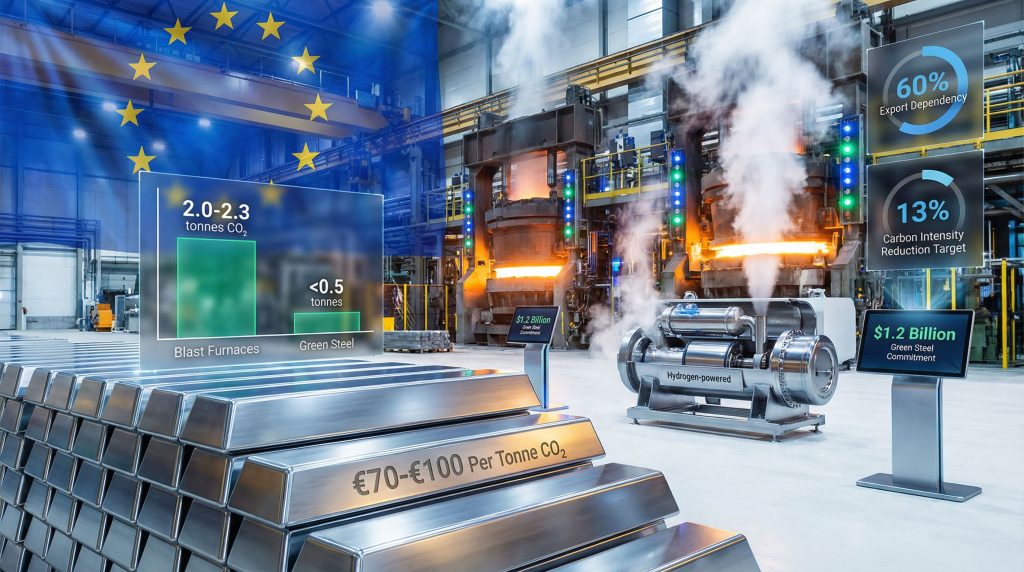
CBAM certificate pricing directly shadows EU Emissions Trading System rates, creating seamless integration between domestic and international carbon costs. Current market conditions place carbon prices in the €70-€100 per tonne CO₂ range, with significant implications for trade competitiveness.
The mechanism addresses carbon leakage prevention by ensuring imported goods face equivalent carbon costs to those produced domestically within the EU. This levelling effect protects European manufacturers whilst incentivising global emissions reductions through market forces rather than regulatory mandates.
Technical calculation methodology:
• Default emission values are established for each sector using conservative industry averages
• Actual emission data receives preferential treatment with lower certificate requirements
• Third-party verification ensures accuracy and prevents gaming of the system
Financial Implications for Indian Steel Exporters
Production Method Cost Analysis
India's steel industry faces differentiated CBAM exposure based on production technology choices. The financial impact varies dramatically between blast furnace-basic oxygen furnace operations and electric arc furnace facilities. However, these challenges also present significant decarbonisation benefits for companies willing to invest in cleaner technologies.
| Production Method | CO₂ Emissions (tonnes/tonne steel) | CBAM Cost Range (€/tonne) | Impact on Profit Margins |
|---|---|---|---|
| Blast Furnace-BOF | 2.0-2.3 | €140-€230 | 25-30% of product value |
| Electric Arc Furnace | 0.5-1.2 | €35-€120 | 6-15% of product value |
| Green Steel (Target) | <0.5 | <€50 | <6% of product value |
These cost differentials create powerful incentives for technological transition, particularly for producers heavily dependent on European markets. Traditional blast furnace operations, representing approximately 40-45% of Indian crude steel production, face the most severe financial pressure under CBAM implementation.
Export Dependency and Market Vulnerability
Indian steel exports to EU markets have historically absorbed 35-45% of the country's total steel exports, with variations based on market conditions and specific product categories. This substantial exposure creates significant vulnerability to CBAM-induced cost increases. In addition, broader global trade tension analysis shows how geopolitical factors compound these challenges.
The Ministry of Steel's production targets of 300 million tonnes annually by fiscal year 2030-31 intensify the urgency of addressing carbon competitiveness. Without technological adaptation, a substantial portion of this expanded capacity could face reduced profitability in European markets.
Alternative market considerations:
• Redirecting exports to Southeast Asia, Middle East, and Africa involves additional logistics costs
• Non-EU markets may implement similar carbon border mechanisms following European precedent
• Product quality specifications in alternative markets may require production adjustments
Technology Pathways and Competitive Positioning
Coal-Dependent Production Under Pressure
Traditional blast furnace-BOF facilities require capital investments of $1.2-1.8 billion for new installations with 40-60 year operational lifespans. CBAM creates accelerated stranding risk for facilities 20-30 years into their lifecycle, particularly those with below-average thermal efficiency.
India's coal-dominated electricity grid, comprising approximately 72-75% fossil fuels, compounds the carbon intensity challenge for electric arc furnace operations. Without dedicated renewable energy procurement, EAF steel production remains substantially carbon-intensive compared to Nordic producers utilising hydroelectric power. Consequently, renewable energy transformations become essential for industry competitiveness.
Retrofit limitations:
• Most efficiency improvements capture only 10-15% additional carbon reductions
• Required capital investment ranges from €200-400 million per facility
• Technical constraints limit the effectiveness of incremental improvements
Electric Arc Furnace Transition Dynamics
Electric arc furnace technology offers a transitional pathway toward lower emissions, contingent on renewable energy access. Indian producers can secure clean electricity through renewable energy certificates or power purchase agreements, though premium renewable energy costs 25-40% above conventional grid prices.
At 2000 kWh per tonne of steel production, certified renewable-powered EAF operations face additional costs of €80-160 per tonne compared to grid-powered facilities. This premium becomes economically viable when weighed against CBAM certificate costs for high-emission alternatives.
Scrap steel availability constraints:
• India recycles approximately 15-18 million tonnes annually
• EAF expansion would require 25-35 million tonnes by 2030
• Limited domestic scrap availability may necessitate imports, affecting cost structures
Direct Reduced Iron and Hydrogen Pathways
India's coal-based Direct Reduced Iron production yields approximately 0.8-1.2 tonnes CO₂ per tonne of DRI, compared to 0.4-0.6 tonnes for natural gas-based operations common globally. This gap reflects natural gas's hydrogen content advantage and superior thermal efficiency. Moreover, the transition parallels broader lithium industry innovations happening across critical mineral sectors.
Hydrogen-based steel production represents the ultimate decarbonisation pathway, though commercial viability remains at demonstration scale. Current operational facilities exist only as pilot projects, with commercial deployment timelines extending through the 2030s.
Technology maturity assessment:
• HISARNA technology combines iron ore reduction with carbon capture, achieving 20-30% emissions reduction
• EASyMelt technology reduces coke consumption by 15-25% through synthetic gas substitution
• Full hydrogen-based production requires coordinated infrastructure development across the supply chain
Strategic Policy Responses and Investment Frameworks
Government Classification and Support Systems
India's Ministry of Steel published a comprehensive 420-page roadmap in September 2024 outlining emissions reduction pathways and establishing classification criteria for green steel. The framework sets <2.2 mtCO₂e/tonne finished steel as the baseline for green classification, with percentage-based scoring reflecting achievement below this threshold.
The classification system enables market differentiation, allowing steel achieving 1.5 tonnes CO₂/tonne to score 32% below the threshold, creating potential for premium pricing in CBAM-conscious markets. This framework provides Indian producers with clear targets for technological investment decisions.
Policy integration elements:
• Renewable energy capacity expansion targets aligned with steel sector requirements
• Hydrogen production infrastructure development within broader energy transition plans
• Carbon credit and verification service development to support international trade compliance
Private Sector Investment Leadership
Tata Steel's Strategic Technology Commitment
Tata Steel's $1.2 billion investment in Jharkhand represents India's most significant private commitment to green steel technology, targeting 1 million tonnes annual capacity by 2030 through advanced HISARNA and EASyMelt technologies developed through successful pilot operations in the Netherlands.
This investment signals broader industry recognition that technological transition represents both necessity and opportunity. The commitment encompasses facility construction, technology licensing, and supply chain integration required for commercial-scale clean steel production.
Technology deployment strategy:
• HISARNA pilot experience from Ijmuiden facility since 2020 provides operational insights
• EASyMelt technology addresses coke consumption reduction through proven synthetic gas substitution
• Integrated approach combines emissions reduction with raw material efficiency improvements
Global Trade Pattern Transformation
Market Redirection and Cost Implications
CBAM implementation creates 8-14% cost increases for carbon-intensive Indian steel exports to EU markets, forcing strategic decisions about market focus and production methods. This cost differential drives exploration of alternative export destinations whilst European domestic producers gain protected market advantages. According to recent analysis, India's steel exports to Europe are set to drop as the EU carbon tax looms.
Regional competitive repositioning:
| Region | Current Position | CBAM Impact | Strategic Response |
|---|---|---|---|
| EU Producers | High costs, advanced technology | Market protection | Premium positioning |
| Indian Exporters | Low costs, high emissions | Cost penalties | Forced modernisation |
| Chinese Steel | Mixed emission profile | Selective impact | Technology differentiation |
| Recycled Steel | Lower emissions baseline | Competitive advantage | Market share expansion |
Emerging Trade Hub Opportunities
Carbon border adjustments create opportunities for regions positioned as low-emission steel production centres or transit hubs. The Middle East's potential as a processing and export centre leverages abundant renewable energy resources and strategic geographic positioning.
Southeast Asia's role in redirected trade flows offers alternatives for Indian producers, though transportation costs and potential future carbon measures in these markets require careful evaluation. Additionally, experts note that Europe's carbon tax is rewriting the economics of Indian steel, creating ripple effects across global supply chains.
Long-term trade evolution patterns:
• Carbon-intensive production concentration in domestic-focused markets
• Premium clean steel production for environmentally conscious export markets
• Specialised regional hubs serving specific geographic and technological niches
The next major ASX story will hit our subscribers first
Investment Opportunities in the Carbon-Conscious Steel Era
Clean Technology Development Prospects
The transition toward carbon-conscious steel production creates substantial investment opportunities across the technology development spectrum. Carbon capture and storage integration projects offer immediate emissions reduction potential for existing facilities, while hydrogen production and distribution infrastructure represents longer-term transformation opportunities.
High-growth investment themes:
• Clean steel technology companies and equipment manufacturers positioned for rapid scaling
• Renewable energy developers specialising in industrial client applications
• Carbon credit verification and certification service providers supporting international trade compliance
• Advanced electric arc furnace efficiency improvement technologies
Verification and Compliance Services
CBAM implementation creates demand for ISO 14065-compliant emissions verification services, digital monitoring and reporting systems, and third-party auditing capabilities. This supporting infrastructure becomes essential for international trade participation under carbon border adjustment regimes.
The complexity of embedded carbon calculations across global supply chains requires sophisticated tracking and verification capabilities. Companies developing these solutions benefit from first-mover advantages in a rapidly expanding market.
Renewable Energy Infrastructure for Industry
Steel production's energy-intensive nature creates opportunities for dedicated renewable energy infrastructure development. Grid-scale battery storage for industrial applications and green hydrogen production facilities become critical components of the clean steel ecosystem.
Regional advantages for infrastructure development:
• Rajasthan and Gujarat's solar resource potential for steel sector applications
• Tamil Nadu's wind resources supporting renewable energy procurement
• Coastal locations offering advantages for hydrogen production and export infrastructure
Regional Winners and Market Dynamics
Competitive Advantage Shifts
Carbon border adjustments fundamentally alter competitive dynamics by incorporating environmental performance into trade economics. Countries with clean electricity grids, advanced recycling infrastructure, or abundant renewable energy resources gain structural advantages in global markets.
Nordic countries leveraging hydroelectric power for steel production maintain significant competitive advantages, while recycled steel producers benefit from inherently lower emission profiles. Japan and South Korea's advanced technology segments position these nations for premium market positioning.
Emerging opportunity regions:
• Middle Eastern nations with abundant solar resources and strategic locations
• Countries with established hydroelectric infrastructure supporting clean industrial production
• Regions with advanced circular economy frameworks enabling efficient recycling operations
Technology Transfer and Development Patterns
The urgency of carbon compliance accelerates technology transfer and development partnerships between advanced and developing economies. Joint ventures, licensing agreements, and technical cooperation programmes become vehicles for rapid capability building.
This acceleration creates opportunities for countries willing to adopt advanced technologies quickly, whilst potentially disadvantaging those resistant to change or lacking necessary infrastructure foundations.
Long-Term Scenarios for Steel Decarbonisation
Rapid Technology Adoption Pathway (2026-2030)
Accelerated hydrogen steel development supported by coordinated government and private investment could achieve 50%+ reduction in global steel emissions intensity within this timeframe. This scenario requires sustained carbon pricing, technology breakthrough acceleration, and international cooperation on standards harmonisation.
CBAM expansion to additional countries and sectors creates global momentum toward carbon-conscious trade policies, reinforcing incentives for clean technology adoption across industries.
Gradual Transition with Trade Tensions (2026-2035)
A protracted technology adoption timeline coupled with trade dispute escalation could fragment global carbon pricing systems and create competing regulatory frameworks. This scenario involves retaliatory measures, bilateral exemptions, and technological nationalism affecting international cooperation.
Regional blocs may emerge with different carbon standards, creating complexity for multinational companies and potentially reducing overall effectiveness of global emissions reduction efforts.
Carbon Border Tax Proliferation (2030+)
Implementation of similar mechanisms by the United States, United Kingdom, and other developed nations creates global convergence on carbon pricing standards. This scenario involves complete restructuring of international trade rules based on environmental performance metrics.
Implications for global trade architecture:
• World Trade Organisation rules adaptation to accommodate carbon border measures
• Bilateral and multilateral trade agreement modification to include environmental standards
• Development of international carbon accounting and verification standards
Investment Positioning Strategies
Portfolio Construction for the Carbon Transition
Investors positioning for CBAM-driven transformation should consider diversified approaches spanning technology development, infrastructure deployment, and market transition opportunities. Geographic exposure balancing across carbon pricing regimes provides protection against regulatory uncertainty whilst capturing growth opportunities.
Strategic investment themes:
• Clean steel technology companies with scalable solutions and proven performance
• Renewable energy developers serving industrial clients with long-term contract capabilities
• Carbon credit and verification service providers with international accreditation
• Advanced materials companies enabling steel production efficiency improvements
Risk Management Considerations
Stranded asset exposure in coal-dependent steel facilities represents a primary risk factor requiring careful evaluation. Regulatory uncertainty and policy change risks demand diversified approaches that remain viable across multiple scenarios.
Currency and commodity price volatility impacts create additional complexity for international steel trade, particularly as carbon costs become significant components of total production expenses. Hedging strategies must account for both traditional market factors and evolving carbon pricing dynamics.
Portfolio diversification strategies:
• Technology-agnostic approaches to steel sector investment reducing dependence on specific solutions
• Geographic exposure balancing to capture opportunities across different regulatory environments
• ESG integration and carbon footprint optimisation as fundamental investment criteria
The New Paradigm of Environmental Competitiveness
Europe and India's steel industry carbon tax implementation represents a fundamental transformation in how international trade operates. Environmental performance has become as critical as traditional cost factors in determining market access and profitability. This shift creates both existential challenges for carbon-intensive producers and extraordinary opportunities for companies leading clean technology adoption.
The success stories will emerge from organisations that recognise this transition as an opportunity for competitive differentiation rather than merely a compliance burden. Tata Steel's $1.2 billion commitment exemplifies the scale of investment required, whilst government policy frameworks provide the regulatory foundation for industry-wide transformation.
By 2030, global steel markets will operate under fundamentally different rules where carbon intensity determines market access as much as production quality. Companies positioned at the forefront of this transition will capture not only compliance advantages but premium positioning in increasingly carbon-conscious global markets. The convergence of policy pressure, technological capability, and market demand creates unprecedented momentum for the most significant transformation in steel industry history.
Looking for Your Next Investment Edge in the ASX Steel and Mining Sector?
Discovery Alert's proprietary Discovery IQ model delivers real-time alerts on significant mineral discoveries, instantly empowering subscribers to identify actionable opportunities ahead of the broader market as the steel industry undergoes carbon-driven transformation. Explore historic examples of exceptional returns from major mineral discoveries and begin your 14-day free trial today to position yourself ahead of evolving market dynamics.