July 30, 2026
The Carbon Price of Entry: Why Indian Aluminium Exporters Can No Longer Ignore Embedded Emissions
Global trade has always operated on the principle that competitiveness is determined by cost, quality, and speed. For decades, carbon emissions remained invisible on an exporter's balance sheet, an externality absorbed by the atmosphere rather than priced into contracts. That era is ending. The European Union's Carbon Border Adjustment Mechanism has introduced a new variable into every aluminium shipment crossing its borders: the verifiable carbon cost embedded in production. The CBAM impact on Indian aluminium exports is now measurable, with India — a country where nearly 27% of total exports flow to EU markets — facing a shift that is already reshaping trade volumes, contract terms, and long-term commercial viability across one of the country's most energy-intensive industries.
When big ASX news breaks, our subscribers know first
Understanding How CBAM Rewrites the Rules of Aluminium Trade
The Carbon Border Adjustment Mechanism is best understood not as a tariff in the traditional sense, but as a carbon pricing equalisation tool. The EU's domestic producers already pay for their emissions through the EU Emissions Trading System (EU ETS), where allowances must be purchased for every tonne of CO₂ emitted. Without an equivalent obligation on imported goods, foreign producers with lower or no domestic carbon pricing would enjoy an unfair cost advantage, potentially shifting production offshore while EU emissions targets remain unmet.
CBAM closes this gap by requiring EU importers to purchase CBAM certificates corresponding to the embedded emissions in goods they import from countries without comparable carbon pricing. The certificate price is tied to the weekly average price of EU ETS allowances, meaning that as the carbon price in Europe rises, the cost of importing carbon-intensive goods from unregulated markets rises proportionally.
Alberto Monje Gama, Sustainability Policy Manager at TIC Council, has described CBAM as a layered mechanism that works alongside the EU ETS rather than independently of it. As EU free allowances are phased out under the ETS reform schedule, European producers face a progressively stronger carbon price signal. CBAM ensures that foreign competitors cannot sidestep this cost reality, preserving a commercially level playing field across the EU's import base.
For Indian aluminium exporters, this mechanism transforms what was previously a sustainability talking point into a direct line-item cost affecting every shipment. Carbon is no longer a background compliance consideration. It has become an explicit price variable embedded in contract negotiations, margins, and market access decisions. Furthermore, the broader EU metals policy landscape is evolving rapidly in ways that compound these pressures for non-EU exporters.
The 41.7% Volume Collapse: CBAM Impact on Indian Aluminium Exports Quantified
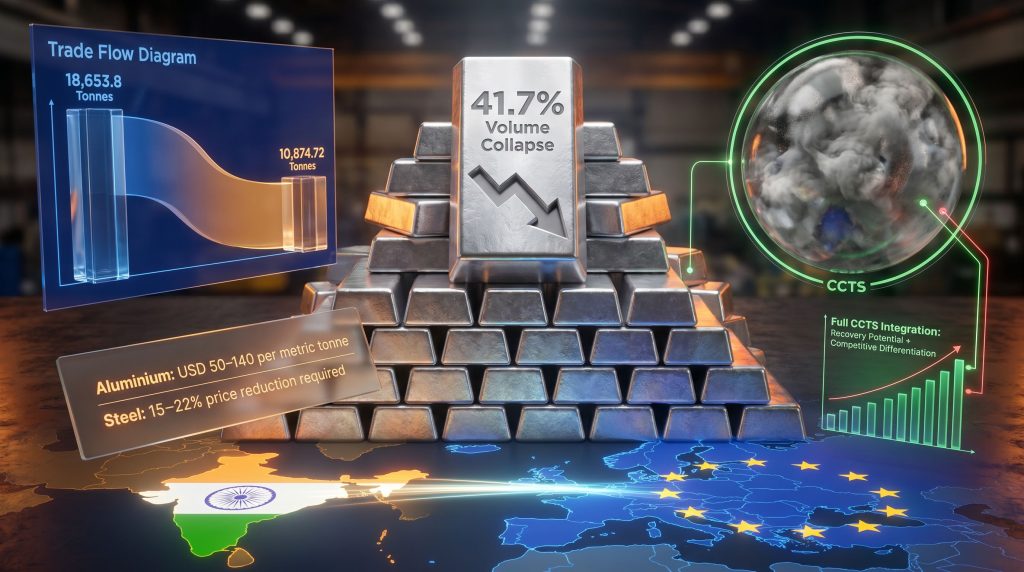
The most direct measure of CBAM's commercial impact on Indian aluminium is found in the export volume data. India shipped 18,653.8 tonnes of unwrought aluminium to the EU in the year-to-date period ending January 2025. By the equivalent period ending January 2026, that figure had dropped to 10,874.72 tonnes, a decline of 41.7% within a single calendar year.
This is not a modest correction or seasonal fluctuation. It represents the disappearance of nearly 7,779 tonnes of aluminium trade flow in a single year-over-year comparison, occurring precisely as CBAM transitioned from its transitional reporting phase into active financial enforcement.
The 41.7% decline in unwrought aluminium exports to the EU is not merely a volume statistic. It represents a structural repricing of Indian aluminium's competitive position in the EU market, driven directly by the carbon costs that CBAM now makes visible and mandatory.
The broader context is equally significant. India's total CBAM-exposed exports to the EU exceed EUR 6 billion (approximately USD 7.05 billion), with iron and steel representing the largest component and aluminium following closely behind. Research from the Global Trade Research Initiative (GTRI) has estimated that Indian exporters of metals including aluminium and steel may need to reduce their export prices by between 15% and 22% to allow EU buyers to absorb the carbon compliance costs within their own margins.
The following table summarises the relative vulnerability of India's two most CBAM-exposed sectors:
| Sector | Estimated CBAM Cost (Direct Emissions) | Potential EU Export Decline | Primary Vulnerability Factor |
|---|---|---|---|
| Aluminium | USD 50-140 per metric tonne | 10-15% to EU market | Electricity-intensive production; MSME verification burden |
| Steel | 15-22% price reduction required | 8-23% to EU market | Coal-based blast furnace emissions |
It is worth noting that the 41.7% measured decline in unwrought aluminium exports already exceeds the upper-end projections in some pre-CBAM modelling exercises, suggesting that the mechanism's commercial impact may be more severe than earlier estimates anticipated. In addition, shifting aluminum and alumina markets globally are intensifying the pressure on Indian producers to act decisively.
Why Indian Aluminium Carries a Disproportionately High Carbon Burden
Not all aluminium is created equal in carbon terms. The primary aluminium smelting process, which uses the Hall-Héroult electrolytic cell to convert alumina into metal, is one of the most electricity-intensive industrial processes in existence. Each tonne of primary aluminium typically requires between 13,000 and 16,000 kilowatt-hours of electricity to produce.
The carbon intensity of that electricity is therefore the single largest determinant of an aluminium producer's carbon footprint. In Norway, Iceland, and Canada, where major smelters operate on hydroelectric grids, the resulting aluminium carries dramatically lower embedded carbon. In India, however, where approximately 70-75% of grid electricity is still generated from coal-fired power stations, the carbon arithmetic is fundamentally different.
This structural dependence on coal-based power creates what can be termed an embedded emissions gap between Indian and European-benchmark production. Indian aluminium plants already emit roughly 30% more than the EU's benchmark emission values used for CBAM calculations, meaning that even a competitively priced Indian product carries a carbon cost premium before a single CBAM certificate is purchased.
The situation becomes more acute when considering the distinction between direct and indirect emissions:
- Direct (Scope 1) emissions arise from the smelting process itself, including perfluorocarbon (PFC) gases released during anode effects
- Indirect (Scope 2) emissions arise from the electricity consumed in the smelting process
- Indirect emissions account for approximately 80% of aluminium's total carbon footprint
Under the current CBAM framework, indirect emissions are not yet factored into certificate calculations. Industry analysts have projected that if Scope 2 emissions are incorporated into future CBAM revisions, compliance costs for Indian aluminium producers could escalate to an estimated USD 600-700 per metric tonne, representing approximately 27-30% of prevailing aluminium prices. This remains a critical forward-looking risk that the current export volume data does not yet fully reflect.
Disclaimer: The USD 600-700 per metric tonne projection for indirect emissions inclusion represents an analytical estimate based on current EU ETS pricing trajectories and Indian grid carbon intensity assumptions. Actual costs will depend on future EU ETS price levels, CBAM regulatory evolution, and India's grid decarbonisation progress.
The MSME Verification Problem
India's aluminium export sector is not dominated exclusively by large integrated producers. A significant share of finished and semi-finished aluminium products flows through micro, small, and medium enterprises (MSMEs) that lack the internal technical capacity or financial resources to conduct plant-level ISO 14065-compliant emissions verification.
For these smaller exporters, the CBAM compliance burden is disproportionate. Verification audits, monitoring system installation, and ongoing reporting infrastructure represent costs that, as a percentage of export revenue, fall far more heavily on a small fabricator than on a large smelter. Without verified emissions data, EU importers default to conservative worst-case emissions estimates, which translate into higher CBAM certificate costs and stronger pressure for price reductions.
How CBAM Certificate Costs Flow Through an Export Transaction
Understanding how CBAM compliance costs actually move through a trade transaction helps explain why the commercial impact on Indian exporters is more severe than the headline certificate costs might initially suggest.
The mechanics unfold in a sequential chain:
- Embedded emissions are calculated by the EU importer using verified plant-level data from the Indian supplier, expressed in tonnes of CO₂ equivalent per tonne of aluminium
- CBAM certificates are purchased by the EU importer at the weekly average EU ETS price, which in 2025-2026 has implied a certificate cost in the range of USD 50-140 per metric tonne of aluminium for direct emissions alone
- Contractual price renegotiation is initiated as EU buyers seek to offset certificate acquisition costs by demanding lower supplier prices, transferring the compliance burden upstream
- Indian exporters face a binary choice between absorbing margin compression or losing the contract to lower-carbon competitors from countries with renewable-powered smelting infrastructure
- Verified emissions documentation becomes a contractual prerequisite from January 2026 onwards, with ISO 14065-compliant verification required to support CBAM declarations
The critical insight here is that CBAM certificate costs and the price reductions demanded by EU buyers are not equivalent. Research from GTRI suggests EU buyers are demanding 15-22% price reductions from Indian metal suppliers, a figure that substantially exceeds the direct CBAM certificate cost as a percentage of aluminium's market price. This gap reflects not only carbon cost transfer but also the broader repricing of perceived supply chain risk, compliance uncertainty, and the availability of lower-carbon alternative sources.
India's Carbon Credit Trading Scheme: The Domestic Instrument That Could Change the Equation
India's response to the CBAM challenge is not purely defensive. The Carbon Credit Trading Scheme (CCTS), established under the Energy Conservation (Amendment) Act 2022 and operationalised through the Bureau of Energy Efficiency's Detailed Procedure for Compliance Mechanism (BEE, 2023), creates the architecture for a domestic carbon market that could directly reduce India's CBAM liability.
The CCTS is designed to align with India's Paris Agreement commitments, including a 45% reduction in emissions intensity relative to 2005 levels by 2030 and the broader ambition of achieving net-zero by 2070. Under this framework, energy-intensive industries including aluminium, steel, cement, power, fertilisers, refineries, and petrochemicals are subject to emissions intensity targets enforced through market-based mechanisms.
The key instrument within the CCTS is the Carbon Credit Certificate (CCC). Producers that exceed their emissions reduction targets generate CCCs that can be traded on platforms such as the Indian Energy Exchange. This converts superior decarbonisation performance into a tangible financial asset, providing a direct economic incentive for aluminium producers to invest in lower-carbon production methods beyond pure regulatory compliance.
The CBAM-CCTS Connection
The strategic significance of the CCTS extends well beyond domestic climate policy. Under CBAM's regulatory architecture, exporters from countries with credible domestic carbon pricing systems may receive partial recognition of domestically paid carbon costs against EU certificate obligations. This means that an Indian aluminium producer paying a domestic carbon price under a robust, internationally verified CCTS framework could reduce the effective CBAM cost imposed on its EU exports.
As Alberto Monje Gama of TIC Council has observed, the current environment creates a strong incentive for Indian producers to improve emissions monitoring, invest in lower-carbon production methods, and strengthen their competitive position in markets where carbon performance is an increasingly important purchasing criterion. Establishing a credible domestic pricing system is therefore not merely a climate policy obligation — it is a direct trade competitiveness instrument.
The next major ASX story will hit our subscribers first
The MRV Framework: Why Verification Standards Are the Foundation of Export Competitiveness
Neither the CCTS nor a CBAM offset claim can function without a robust Monitoring, Reporting and Verification (MRV) system. TIC Council India has provided detailed recommendations for the standards framework required to give India's carbon accounting credibility in international trade contexts.
The recommended alignment includes:
- ISO 14065: Requirements for greenhouse gas validation and verification bodies
- ISO 14066: Competence requirements for GHG validators and verifiers
- ISO/IEC 17029: General principles and requirements for validation and verification bodies
- UNFCCC accreditation principles: Ensuring compatibility with international climate treaty frameworks
- ISO 14064: GHG accounting and verification at the organisational level
For the aluminium sector specifically, TIC Council has identified the competencies that verification bodies must demonstrate:
- Chemical or metallurgical engineering expertise relevant to aluminium production processes
- GHG accounting capability aligned with ISO 14064 methodology
- Technical understanding of process-related emissions, including perfluorocarbon (PFC) emissions from anode effects during electrolytic smelting
- Accreditation under ISO/IEC 17029 for validation and verification functions
- Independent legal accountability, enabling verification agencies to operate as contractually responsible entities
The independence and legal accountability requirements are particularly significant. For CBAM purposes, EU importers require verified emissions data that will withstand regulatory scrutiny. Verification bodies that lack independent legal standing cannot provide the level of assurance that CBAM declarations demand.
The Broader Strategic Case for CCTS Adoption
Beyond direct CBAM exposure reduction, the CCTS offers Indian industry a set of strategic benefits that extend across trade, investment, and technology:
- EU market access retention: By paying a domestic carbon price rather than a border tariff, Indian exporters preserve their cost competitiveness in the EU without surrendering margin to certificate costs
- ESG-aligned investment attraction: International capital increasingly flows toward companies with credible sustainability frameworks. A CCTS-registered aluminium producer with verified emissions data and CCC generation capability presents a fundamentally more attractive investment profile to ESG-mandated funds
- Technology transition enablement: The CCTS creates financial incentives for investment in carbon capture, utilisation and storage (CCUS) and green hydrogen technologies that can structurally reduce embedded carbon in aluminium production
- Paris Agreement credibility: Demonstrable progress through a market-based domestic carbon mechanism strengthens India's position in international climate negotiations and trade diplomacy
Consequently, the pressure created by the CBAM impact on Indian aluminium exports may ultimately accelerate a transition that would have taken far longer under voluntary industry initiatives alone. For context, the evolving green metals pricing environment globally illustrates how carbon performance is becoming a core pricing variable across all metals sectors.
Scope Expansion: The 2028 CBAM Frontier That Exporters Must Prepare For Now
The current CBAM framework covers primarily unwrought aluminium and a defined set of downstream categories. However, the European Parliament's Committee on the Environment, Climate and Food Safety has recommended an expansion of CBAM's scope that would dramatically widen coverage.
Approximately 180 additional aluminium- and steel-based product categories could be brought under CBAM's scope from January 1, 2028, according to European Parliament committee recommendations currently under evaluation. If implemented, this expansion would extend compliance obligations to a far broader range of downstream processors and fabricators currently outside CBAM's direct perimeter.
This 2028 timeline creates an urgent preparatory imperative. Indian aluminium manufacturers producing extruded profiles, rolled products, foil, and other semi-fabricated categories should not assume their current CBAM exemption is permanent. The window for building verified emissions accounting systems, aligning with CCTS requirements, and positioning for CCC generation is narrowing. Furthermore, the aluminium tariff impacts already being felt from other trade policy shifts make this a particularly complex moment for Indian producers to navigate simultaneously.
Three Scenarios for India's Aluminium Export Trajectory
The following scenario framework maps India's potential EU aluminium export trajectory against the pace and completeness of domestic carbon market adoption:
| Policy Scenario | Projected EU Export Trajectory | CBAM Cost Exposure | Investment Attractiveness |
|---|---|---|---|
| No domestic carbon market | Continued volume decline beyond 41.7% | Full certificate cost passed to exporters | Low; ESG non-alignment disqualifies green capital |
| Partial MRV adoption only | Stabilisation, limited recovery | Reduced but not fully offset | Moderate; improved data quality without pricing credit |
| Full CCTS with ISO/UNFCCC alignment | Recovery potential with competitive differentiation | Minimised via domestic pricing credit | High; green capital eligible and ESG-aligned |
Frequently Asked Questions: CBAM and Indian Aluminium Exports
What is CBAM and when did it become fully enforceable?
CBAM is the EU's Carbon Border Adjustment Mechanism, which entered its transitional phase in October 2023 (reporting obligations only) and moved to full financial enforcement from October 2025, requiring EU importers to purchase carbon certificates for embedded emissions in covered goods.
How much has CBAM already reduced India's aluminium exports to the EU?
India's unwrought aluminium shipments to the EU fell 41.7% between year-to-date January 2025 and year-to-date January 2026, dropping from 18,653.8 tonnes to 10,874.72 tonnes.
What is the difference between direct and indirect emissions under CBAM for aluminium?
Direct emissions (Scope 1) arise from the smelting process itself. Indirect emissions (Scope 2) arise from the electricity used in smelting and represent approximately 80% of aluminium's total carbon footprint. Currently only direct emissions are included in CBAM calculations, but future incorporation of indirect emissions could raise compliance costs to an estimated USD 600-700 per metric tonne.
How does India's Carbon Credit Trading Scheme connect to CBAM compliance?
The CCTS creates a domestic carbon pricing and verification framework. Countries with credible domestic carbon pricing may receive recognition under CBAM architecture, potentially reducing the certificate costs imposed on their exporters at the EU border.
Which Indian industries are most exposed to CBAM regulations?
Iron and steel represent the largest CBAM exposure by value, followed by aluminium. Other covered sectors include cement, fertilisers, and electricity. India's total CBAM-exposed exports to the EU exceed EUR 6 billion annually.
Will CBAM expand to cover more aluminium products after 2026?
The European Parliament's environment committee has recommended expanding CBAM's scope to cover approximately 180 additional aluminium- and steel-based product categories from January 1, 2028.
What steps can Indian aluminium exporters take right now to reduce CBAM exposure?
Three priority actions are available:
- Commission plant-level ISO 14065-compliant verified emissions audits to generate credible data for EU importer negotiations
- Engage with India's CCTS framework to establish internal carbon accounting systems and position for Carbon Credit Certificate generation
- Evaluate investment pathways in green hydrogen and CCUS-enabled production to structurally reduce embedded carbon intensity
The New Price of Entry to EU Markets
A 41.7% export volume decline in twelve months is not a warning signal. It is confirmation that a structural transition has already occurred. The CBAM impact on Indian aluminium exports has moved from theoretical policy modelling into measurable trade disruption, and the mechanism's scope is still expanding.
The aluminium sector's particular exposure — driven by coal-dependent electricity grids, high indirect emissions intensity, and a fragmented MSME exporter base — means that incremental compliance adjustments are unlikely to be sufficient. The trajectory from here is shaped by three forces acting simultaneously: the rising EU ETS carbon price flowing directly into CBAM certificate costs, the potential 2028 scope expansion covering 180 additional product categories, and the eventual incorporation of indirect emissions that could multiply compliance costs by a factor of five or more.
India's Carbon Credit Trading Scheme offers a credible pathway through this challenge, but only if it is implemented with the verification rigour, international standards alignment, and market integrity that CBAM's architecture demands. For Indian aluminium industry leaders, carbon performance has ceased to be a sustainability aspiration. It has become the new price of entry to one of the world's largest and highest-value import markets.
This article is intended for informational purposes only and does not constitute financial or investment advice. Forward-looking projections regarding CBAM cost escalation, scope expansion, and export volume recovery are based on currently available policy proposals and analytical estimates and are subject to regulatory change. Readers should seek independent professional advice before making commercial or investment decisions based on the information presented here.
For further context on India's evolving carbon market policy and its intersection with global aluminium trade, ongoing analysis is available through AL Circle's CBAM and sustainability coverage.
Want to Capitalise on the Shifts Reshaping Global Aluminium Markets?
As carbon compliance costs restructure trade flows and compress margins across the aluminium sector, Discovery Alert's proprietary Discovery IQ model scans ASX announcements in real time, delivering actionable alerts on significant mineral discoveries — including aluminium and bauxite — before the broader market reacts. Explore how historic mineral discoveries have generated exceptional returns and begin your 14-day free trial today to position yourself ahead of the next major opportunity.