May 12, 2026
The Execution Gap: Why Signing Agreements Is Only Half the Battle in Critical Minerals Diplomacy
Global critical minerals diplomacy has entered a paradoxical phase. The India Russia critical minerals pact is emerging as one of the most closely watched bilateral agreements in this landscape. Governments around the world are racing to sign bilateral agreements, memoranda of understanding, and strategic frameworks at an unprecedented pace, yet the translation of these diplomatic gestures into functioning supply chains remains stubbornly elusive.
For most major economies outside China, the challenge is not identifying which minerals matter or which countries hold them. The challenge is converting political intent into operational reality before energy transition timelines run out.
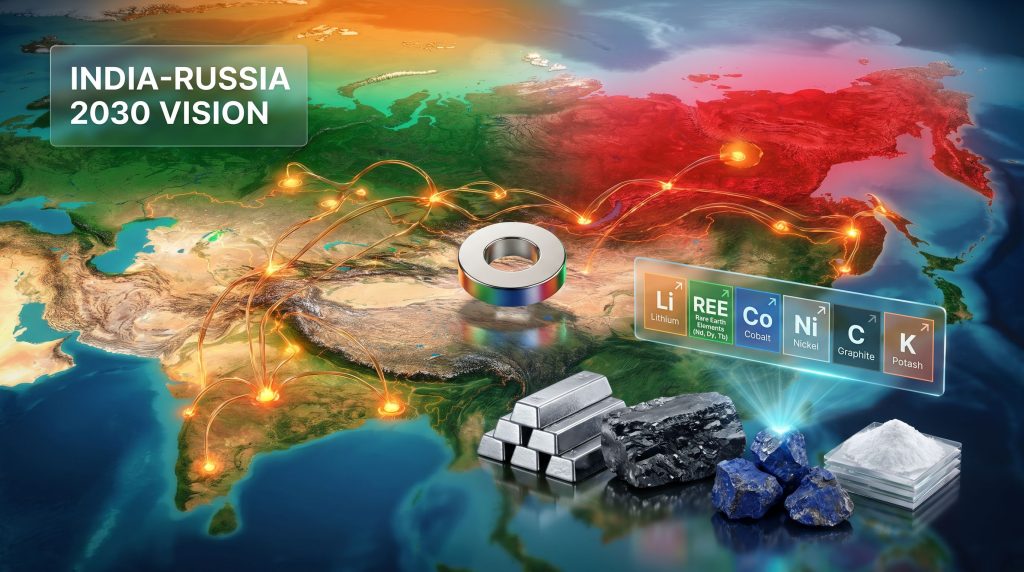
India sits at the centre of this tension more acutely than almost any other nation. With over 20 minerals formally designated as critical to its industrial and energy transition agenda as of 2023, including lithium, rare earth elements, cobalt, nickel, graphite, and potash, New Delhi has assembled one of the most geographically diverse minerals diplomacy portfolios of any emerging market economy. However, according to Reuters reporting from May 2026, India has converted that portfolio into exactly one operational project: a lithium exploration agreement covering five blocks in Argentina, signed in 2024.
The India Russia critical minerals pact, currently in advanced negotiation stages, represents India's most structurally complex attempt yet to close that execution gap. Understanding why this particular agreement matters, and why it carries both greater promise and greater risk than India's other partnerships, requires examining the architecture of the global rare earth and battery metals markets from first principles.
When big ASX news breaks, our subscribers know first
Why India's Mineral Vulnerability Is Structural, Not Cyclical
India's critical minerals deficit is not simply a function of insufficient domestic exploration. It reflects a deeper structural reality: the country's geological endowment, while substantial in certain categories such as iron ore and coal, is materially deficient in the battery metals and rare earth elements that underpin modern clean energy infrastructure and advanced defence electronics.
Furthermore, China's rare earth strategy has compounded this vulnerability. While China's share of global rare earth mining has declined modestly as projects in Australia, the United States, and Myanmar have ramped up output, its grip on the downstream processing and separation stages of the supply chain remains overwhelming.
Ore extracted from deposits outside China frequently travels to Chinese facilities for beneficiation, separation into individual rare earth oxides, and conversion into the metals and alloys that manufacturers actually require. This means that even nations with rare earth mining capacity often remain dependent on Chinese processing infrastructure to deliver usable material to end markets.
For India, this creates a layered vulnerability. Not only does the country lack sufficient domestic raw material production for key battery and magnet metals, it also lacks the processing and refining infrastructure to convert ore into usable industrial inputs. The government's 2023 critical minerals designation formally acknowledged this reality, signalling that securing overseas supply was no longer optional for India's development trajectory.
The specific minerals on India's critical list reflect the full spectrum of its industrial ambitions:
- Lithium and cobalt: Essential for lithium-ion battery cathodes underpinning India's electric vehicle manufacturing sector
- Nickel: Required for both battery anodes and stainless steel production supporting infrastructure development
- Graphite: A critical battery anode material in which China controls the dominant share of both mining and processing
- Neodymium, dysprosium, and terbium: Rare earth elements central to the production of neodymium-iron-boron (Nd-Fe-B) permanent magnets used in EV motors, wind turbines, and defence electronics
- Potash: A fertiliser input critical to India's agricultural sector and food security agenda
Domestic production of virtually all of these minerals falls far short of projected consumption requirements for India's energy transition and industrial growth scenarios through 2030 and beyond. In addition, the growing critical minerals demand driven by the global energy transition continues to intensify these pressures year on year.
What the India-Russia Critical Minerals Pact Actually Proposes
The agreement taking shape between India and Russia is not a simple trade deal or commodity purchase arrangement. According to Reuters sources familiar with the negotiations, reported in May 2026, the framework is structured around three interconnected operational domains:
- Geological exploration of Russian territory
- Processing and refining technology transfer
- Facilitation of corporate investment by Indian entities in Russian mineral assets
The primary mineral focus is expected to cover lithium and rare earth elements, with the two governments aiming to enable both state-owned enterprises and private sector participants to co-invest in Russian deposits. A preliminary agreement was anticipated to be formalised within approximately two months of the May 2026 announcement of advanced-stage talks.
What Does Russia's Mineral Endowment Look Like?
Russia's mineral endowment relevant to this agreement spans several strategically significant categories:
| Mineral | India's Strategic Need | Russia's Supply Position |
|---|---|---|
| Lithium | EV batteries, grid-scale storage | Emerging Far East and Siberian reserves |
| Neodymium (Nd) | Permanent magnets, EV motors | Significant rare earth geological endowment |
| Dysprosium (Dy) | High-temperature magnet performance | Available through rare earth complex deposits |
| Terbium (Tb) | Magnet efficiency enhancement | Present in rare earth deposits |
| Cobalt | Battery cathodes | Secondary output from nickel operations |
| Nickel | Battery anodes, stainless steel | Top-five global producer |
| Graphite | Battery anodes | Substantial Siberian deposits |
| Potash | Fertilisers, food security | World's largest potash producer |
The institutional architecture supporting this commercial framework is equally significant. The India-Russia 2030 Vision roadmap, produced at the December 2025 Annual Summit between Prime Minister Narendra Modi and President Vladimir Putin, elevated critical minerals alongside energy, nuclear cooperation, and connectivity infrastructure as priority collaboration domains.
Specific mechanisms include a joint research collaboration between CSIR-IMMT and Giredmet covering advanced mineral processing and rare earth metallurgy. Furthermore, a MoU signed between TEXMiN and GIREDMET at IIT(ISM) Dhanbad in 2026 targets the full value chain from ore beneficiation through to Nd-Fe-B permanent magnet production and pilot-scale validation. A further partnership with NUST MISIS focuses on process metallurgy and capacity building.
The Chennai-Vladivostok maritime corridor and Russia's Northern Sea Route are identified as the primary logistics pathways enabling mineral shipments from Russian resource regions to Indian industrial zones, providing an alternative to traditional shipping routes and reducing transit dependency on potentially contested chokepoints.
India's Global Minerals Network: Partnership Breadth Without Operational Depth
To properly contextualise the Russia pact, it is necessary to map India's existing critical minerals diplomacy network and understand where its structural weaknesses lie. India has pursued bilateral agreements across multiple continents with considerable diplomatic energy:
- Argentina (2024): Five lithium exploration and mining blocks representing India's sole confirmed operational overseas minerals project
- Australia: A broad-based critical minerals partnership covering supply chain integration and technology cooperation, building on India's lithium supply strategy in the region
- Japan: A technology-focused collaboration targeting processing and refining capabilities
- Germany, Brazil, and Canada (2026): A series of agreements focused on technology access and strategic partnership development
- Peru and Chile: Active negotiations incorporating critical minerals within wider bilateral frameworks
- Mali: India withdrew from a Rosatom-led lithium exploration project earlier in 2026 due to security concerns, though sources indicate the possibility of revisiting the arrangement if political stability in the West African nation improves
The pattern is revealing. India has demonstrated considerable capacity to negotiate agreements but very limited capacity to operationalise them. The Argentina lithium project remains the sole example of an agreement progressing to the project development stage, and even that arrangement has not yet produced commercial mineral output.
This execution gap is arguably the most critical strategic challenge the India Russia critical minerals pact must navigate. The institutional frameworks, MoUs, and technology transfer agreements mean little unless Indian entities can deploy capital, access Russian deposits, and deliver processed material to Indian industrial facilities within commercially viable timeframes.
Russia's Motivation: Sanctions, Revenue, and Strategic Repositioning
Understanding why Russia is an enthusiastic partner in this arrangement requires examining the constraints Western sanctions have imposed on Russian mineral export strategies since 2022. With European and North American markets largely closed to direct Russian commodity exports, Moscow has systematically pursued resource relationships with non-Western economies capable of absorbing Russian output and providing investment without secondary sanctions risk.
India represents an attractive partner for multiple reasons. It is a large, rapidly growing economy with genuine demand for the minerals Russia holds. It maintains a tradition of strategic autonomy in foreign policy, making it resistant to Western pressure to curtail Russian engagement.
It possesses sufficient financial infrastructure to conduct bilateral transactions outside Western capital market systems. Consequently, its industrial development trajectory ensures that demand for battery metals and rare earth materials will intensify substantially over the coming decade.
Russia's Far East and Arctic territories contain vast geological endowments that remain largely underexplored due to infrastructure limitations, capital constraints following sanctions, and the logistical complexity of operating in extreme environments. A partnership with India provides both capital access and a committed offtake market that could justify the infrastructure investment required to develop these resources.
The Rare Earth Technology Transfer Dimension: Why It May Outlast Physical Supply Agreements
Perhaps the most durable and strategically significant component of the India-Russia framework is not the raw material access it promises but the technology transfer it enables, specifically in rare earth processing and permanent magnet production.
Nd-Fe-B permanent magnets occupy a uniquely critical position in clean energy and defence technology. These magnets, composed primarily of neodymium, iron, and boron with dysprosium and terbium added to maintain performance at elevated operating temperatures, are the highest-energy-density permanent magnets known to science. They are irreplaceable in the motors that drive electric vehicles, the generators at the heart of wind turbines, and the precision actuators used in defence electronics.
India currently has no commercial-scale capability to produce these magnets domestically from ore through to finished product. The TEXMiN-GIREDMET MoU signed in 2026 targets precisely this gap, committing to collaboration across the entire value chain from ore beneficiation through rare earth oxide separation, high-purity metal production, alloy manufacture, and finally pilot-scale Nd-Fe-B magnet production with industry demonstration.
This is significant because processing and refining technology is substantially more difficult to replicate than raw material access. Physical mineral supply can theoretically be sourced from multiple geographies if geopolitical conditions change. Processing technology, once transferred and embedded in domestic facilities and human capital, creates a durable and self-reinforcing industrial capability.
If the TEXMiN-GIREDMET collaboration produces genuine technology transfer rather than simply academic exchange, India could emerge from this partnership with a rare earth processing capability that reduces its dependence on Chinese beneficiation infrastructure. This would benefit India regardless of what subsequently happens to physical mineral trade flows with Russia, particularly given the complexities of rare earth supply chains at a global level.
The next major ASX story will hit our subscribers first
The Sanctions Risk: Secondary Exposure and the Financing Problem
The India Russia critical minerals pact carries material risks that distinguish it fundamentally from India's partnerships with Australia, Japan, Canada, and Germany.
Indian companies engaging in investment or technology transfer with Russian entities face potential exposure to secondary sanctions from Western jurisdictions. This exposure is not hypothetical. It represents a concrete constraint on the participation of internationally listed Indian corporations with significant Western revenue streams, and it limits access to Western multilateral and commercial project financing infrastructure.
The structural solutions proposed to bridge this financing gap include:
- Bilateral rupee-rouble settlement mechanisms that bypass dollar-denominated transaction infrastructure
- State-to-state financing arrangements using sovereign development funds from both governments
- Engagement with non-Western multilateral financial institutions
- Export credit facilities provided by Indian government agencies rather than commercial lenders
None of these mechanisms is without limitation. Rupee-rouble settlement has faced friction due to Russia's difficulty spending accumulated rupee balances. Sovereign development fund financing constrains the scale of investment relative to commercial capital markets. Non-Western multilateral institutions have limited capacity relative to the World Bank or Asian Development Bank.
The Mali withdrawal provides a cautionary case study. India's decision to exit the Rosatom lithium project in Mali earlier in 2026 demonstrates that when geopolitical risk becomes unmanageable, India will prioritise security over resource access. However, the same calculus applies to the Russia partnership, where critical minerals tariff risks and sanctions exposure play the role that security instability played in Mali.
Scenario Analysis: Three Trajectories for the India-Russia Minerals Pact
The ultimate impact of the India-Russia critical minerals pact on global supply chains depends heavily on which of several plausible implementation scenarios materialises. Each carries distinct implications for mineral markets and India's strategic positioning.
| Scenario | Key Conditions | Probable Market Impact |
|---|---|---|
| Full Implementation | Sanctions workarounds secured; logistics infrastructure built; corporate participation achieved | Meaningful rare earth and lithium supply diversification; reduced Chinese pricing power in specific segments |
| Partial Execution | Sanctions limit corporate scale; logistics gaps persist; technology transfer proceeds | Incremental processing capability development; limited physical supply impact on global markets |
| Stalled Agreement | Secondary sanctions enforcement intensifies; geopolitical deterioration; corporate risk appetite collapses | Return to status quo; India deepens Western-aligned minerals partnerships |
The partial execution scenario is arguably the most probable in the near term. Technology transfer and institutional research collaboration face fewer sanctions constraints than direct corporate investment in Russian mineral assets. India may therefore derive greater near-term benefit from the processing technology components of the agreement than from the physical supply components, even if commercial-scale Russian mineral imports remain constrained.
What This Means for China's Rare Earth Processing Dominance
The India-Russia pact contributes to a broader pattern of supply chain fragmentation that could, over a decade or more, meaningfully erode China's structural advantages in rare earth processing. If Russia's Far East develops as an alternative rare earth processing hub with Indian investment and technical collaboration drawing on Giredmet's expertise, it would represent the first significant non-Chinese rare earth processing infrastructure built outside the Western G7 framework.
This matters for global mineral markets beyond the bilateral India-Russia relationship. A functioning alternative processing pathway reduces the leverage that Chinese export controls and quota adjustments can exercise over global rare earth prices and availability. China's use of rare earth export restrictions as a geopolitical instrument, most recently demonstrated through restrictions targeting specific Western markets, has underscored the systemic risk of processing concentration.
India's dual-track strategy, maintaining Western-aligned mineral partnerships alongside the Russia engagement, also signals a sophisticated reading of non-alignment doctrine adapted for the resource age. Rather than choosing between geopolitical blocs, India is structuring its minerals portfolio to extract maximum optionality from multiple partnership networks simultaneously, reducing dependence on any single counterparty, including China, the West, and Russia itself.
Disclaimer: This article is intended for informational purposes only and does not constitute financial, investment, or legal advice. Forward-looking statements regarding the India-Russia critical minerals pact, mineral market projections, and geopolitical scenarios involve uncertainty and should not be relied upon as predictions of future outcomes. Readers should conduct independent research and consult qualified advisers before making investment decisions related to critical minerals sectors.
Frequently Asked Questions: India Russia Critical Minerals Pact
What minerals does the India-Russia critical minerals pact cover?
The agreement is expected to prioritise lithium and rare earth elements, including neodymium, dysprosium, and terbium, alongside cobalt, nickel, graphite, and potash. These minerals appear on both nations' formal critical minerals lists and are central to battery technology, permanent magnet production, and food security applications.
When is the India-Russia critical minerals agreement expected to be formalised?
Based on Reuters reporting from May 12, 2026, the preliminary agreement was anticipated to be signed within approximately two months of the announcement that advanced-stage negotiations were underway.
How does the India-Russia pact differ from India's agreements with Western partners?
Agreements with Australia, Japan, Canada, and Germany benefit from Western financing infrastructure, lower geopolitical risk, and simpler corporate participation frameworks. The Russia pact, however, introduces secondary sanctions exposure but offers access to large, underexplored geological reserves and processing technology developed outside Western supply chains, creating a structurally different risk-reward profile.
What role does Rosatom play in the India-Russia minerals partnership?
Russia's state nuclear corporation was previously associated with a lithium exploration project in Mali from which India withdrew in early 2026 due to security concerns. Sources familiar with the India-Russia negotiations have indicated the possibility of revisiting Rosatom's Mali involvement if the political situation in that country stabilises.
Is the India-Russia critical minerals deal part of a broader geopolitical realignment?
The pact reflects India's strategic doctrine of multi-alignment, maintaining partnerships across geopolitical blocs to maximise resource security without formal alliance commitments. It complements rather than replaces India's Western-oriented mineral diplomacy and is consistent with India's longstanding practice of preserving strategic autonomy across major power relationships.
What is the connection between this agreement and India's self-reliance policy?
India's Atmanirbhar Bharat policy framework drives domestic processing and manufacturing ambitions. Securing overseas raw material supply through agreements like the Russia pact supports the broader goal of building Indian refining and permanent magnet production capacity, reducing dependence on imported processed materials rather than simply substituting one foreign supply source for another.
Want to Track the Next Major Mineral Discovery Before the Market Does?
Discovery Alert's proprietary Discovery IQ model delivers real-time ASX mineral alerts — cutting through the complexity of critical minerals like rare earths, lithium, and nickel to surface actionable opportunities the moment they are announced — explore historic discoveries and their extraordinary returns to understand what's at stake, then begin your 14-day free trial at Discovery Alert to position yourself ahead of the market.