June 15, 2026
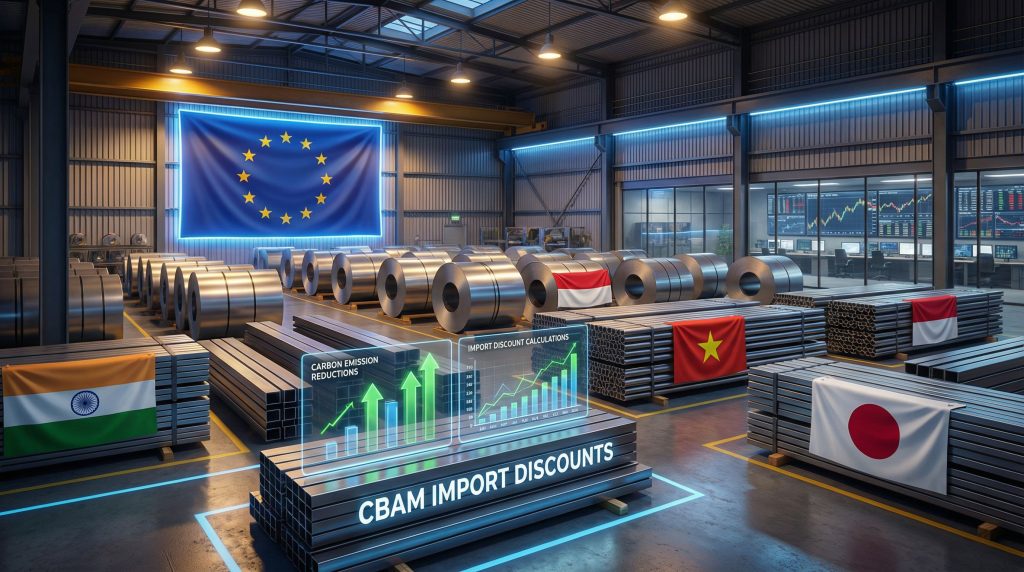
The European steel import landscape has undergone a fundamental shift as carbon border adjustment mechanisms reshape traditional trading patterns. The Carbon Border Adjustment Mechanism represents more than regulatory compliance; it introduces a sophisticated pricing framework where emission verification status determines competitive positioning. This transformation creates distinct market segments based on carbon intensity documentation, fundamentally altering how traders approach cbam paid import discount opportunities.
Steel importing strategies now require deep understanding of emission verification processes, default value applications, and the complex interaction between carbon pricing and trade finance. Market participants who successfully navigate these requirements gain significant competitive advantages, while those relying on traditional pricing models face increasing margin pressure.
Understanding CBAM's Carbon Credit Mechanism for Importers
The Discount Structure for Verified Carbon Payments
The CBAM framework establishes a tiered compliance system where importers can significantly reduce their carbon cost burden through proper emissions verification. This mechanism creates substantial financial incentives for demonstrating actual carbon intensity below default values.
Default Emission Values vs. Verified Emissions:
| Country | Default Value (t CO₂/t) | Benchmark (t CO₂/t) | CBAM Cost at €80/t | Verified Emissions (t CO₂/t) | Potential Savings |
|---|---|---|---|---|---|
| India | 4.7 | 1.37 | €270/t | ~2.0-2.5 | €150-200/t |
| Indonesia | 9.0+ | 1.37 | €617/t | ~1.2 | €624/t |
| Vietnam | 6.2 | 1.37 | €387/t | ~2.8-3.2 | €160-190/t |
| Turkey | 3.8 | 1.37 | €194/t | ~1.8-2.2 | €128-162/t |
Source: European Commission CBAM Regulation (EU) 2023/956; Argus Media market analysis, December 2025
The verification process requires third-party auditing under ISO 14065:2013 standards, with emissions data following ISO 14064-2:2019 methodologies. This creates a two-tier market where verified suppliers command premium access while unverified material faces prohibitive default penalties.
Furthermore, the Carbon Border Adjustment Mechanism represents a groundbreaking policy initiative that will significantly reshape global trade dynamics.
Quarterly Reporting and Certificate Obligations
CBAM compliance operates through a structured quarterly reporting system during the transitional phase (2023-2025), transitioning to financial obligations starting January 2026. The progression follows these key stages:
1. Transitional Phase Requirements (October 2023 – December 2025):
- Quarterly emissions reporting without financial penalties
- Documentation of carbon pricing paid in origin countries
- Verification status declaration for imported materials
2. Financial Implementation Phase (January 2026 onwards):
- CBAM certificate purchases required for all covered imports
- Certificate surrender obligations tied to embedded carbon content
- Full integration with EU ETS pricing mechanisms
3. Expanded Coverage (January 2026):
- Addition of 180 downstream steel and aluminum products
- Enhanced supply chain transparency requirements
- Broader industrial sector coverage including machinery components
The certificate calculation methodology follows the formula:
CBAM Certificates Required = (Embedded Emissions – Carbon Price Paid in Origin) ÷ EU ETS Reference Price
Where embedded emissions default to regulatory values unless verified through accredited processes, creating powerful incentives for emission transparency initiatives. However, the global implications of this policy extend far beyond European borders, as detailed in this comprehensive analysis of how Europe's new carbon tax will transform global trade patterns.
When big ASX news breaks, our subscribers know first
Why Are Traders Offering Steel Below EU Benchmark Prices?
Market Arbitrage Opportunities in CBAM Implementation
Steel traders are exploiting a complex arbitrage opportunity that combines physical commodity positions with regulatory compliance risk management. This strategy involves taking substantial financial exposure based on emissions verification outcomes.
Recent market activity demonstrates this dynamic clearly. Indian hot-rolled coil offers at €10/t discounts to European benchmark prices reflect trader confidence in verification success. With Indian cfr prices around €470/t and CBAM default costs potentially reaching €270/t, the mathematics only work if actual emissions fall significantly below the 4.7 t CO₂/t default value.
Trading Strategy Breakdown:
-
Physical Long Position: Purchase third-country steel at discount prices
- Indian HRC: €470/t cfr (€195/t below CME April contract at €665/t)
- Indonesian material: Similar deep discounts with higher verification upside
-
Regulatory Risk Management: Absorb CBAM compliance through DDP pricing
- November 2025 DDP offers: €570/t
- December 2025 (post-document leaks): €600-620/t
- Recent spot offer: €585/t ex-Antwerp for April-May delivery
-
Verification Arbitrage: Profit margin dependent on emission documentation success
- Base case scenario: Losses absorbed if default values apply
- Upside scenario: €150-300/t profit margin if verified emissions meet expectations
Source: Argus Media, "Traders Offer CBAM Paid Import at Discount to NW EU HRC," 18 December 2025
The Economics of Delivered Duty Paid (DDP) Terms
The shift toward Delivered Duty Paid arrangements represents a fundamental restructuring of import risk allocation. Under DDP terms, traders absorb all regulatory compliance costs, including:
- CBAM certificate obligations and surrender requirements
- Safeguard duty calculations and quota management
- Port charges, VAT, and administrative costs for import clearance
- Documentation and verification expenses for emissions reporting
This consolidation creates economies of scale in regulatory management while transferring complexity from industrial buyers to specialised trading firms. The trend accelerated following leaked CBAM documentation in early December 2025, with DDP pricing rising €30-50/t to reflect enhanced regulatory cost understanding.
Market participants expect this shift to permanently alter European steel procurement patterns, with smaller buyers increasingly relying on DDP terms while larger industrial consumers develop internal CBAM compliance capabilities.
Regional Variations in CBAM Compliance Costs
Asian Steel Producers' Emission Profiles
Carbon intensity varies dramatically across Asian steel-producing regions, creating distinct competitive tiers under CBAM implementation. These variations reflect different production technologies, energy sources, and environmental regulations in origin countries.
Emission Intensity Analysis by Production Method:
Integrated Steel Mills (Blast Furnace/Basic Oxygen Furnace):
- China: 2.8-3.5 t CO₂/t (coal-dependent but improving efficiency)
- India: 3.2-4.2 t CO₂/t (variable coal quality, older equipment)
- Indonesia: 4.5-6.0 t CO₂/t (coal-heavy, limited efficiency upgrades)
Electric Arc Furnace Operations:
- India (EAF-based mills): 1.2-1.8 t CO₂/t (grid electricity dependency)
- Vietnam: 2.0-2.5 t CO₂/t (mixed energy sources)
- Turkey: 1.5-2.2 t CO₂/t (natural gas availability)
Source: International Energy Agency, Steel Technology Roadmap 2023; Regional mill reporting data
These differences create substantial CBAM cost variations. Indonesian integrated mills face potential carbon costs exceeding €600/t under default values, while Indian EAF operations may achieve compliance for under €100/t with proper verification. Furthermore, these developments align with broader global efforts towards green iron production, which represents a crucial component of the industry's decarbonisation strategy.
EU Domestic Steel Premium Dynamics
European steel producers are positioned to capture increased market premiums as CBAM implementation reduces import competitiveness. This premium structure reflects both carbon cost protection and reduced supply competition.
Domestic Premium Development Factors:
1. Carbon Cost Neutralisation:
- EU producers already pay ETS carbon costs (~€80/t in Q4 2025)
- CBAM equalises carbon burden for imports, removing cost disadvantage
- Free ETS allocation phase-out (2026-2034) maintains competitive balance
2. Supply Chain Reliability:
- Domestic production eliminates CBAM verification risks
- Reduced regulatory compliance complexity for buyers
- Shorter supply chains with enhanced security of supply
3. Quality and Service Differentiation:
- Technical specification consistency and quality assurance
- Just-in-time delivery capabilities and inventory management
- Customer service and application engineering support
Market analysts project European mills may command €50-100/t premiums over CBAM-compliant imports as buyers value regulatory certainty and supply chain simplification. This trend is part of a broader energy transition strategy that encompasses the entire industrial ecosystem.
What Does the 50-Tonne Exemption Mean for Small Importers?
Threshold Analysis and Market Segmentation
The 50-tonne annual import threshold creates a two-tier compliance system that fundamentally alters market participation patterns. This exemption provision recognises administrative burden concerns while maintaining environmental integrity for significant import volumes.
Market Segmentation Impact:
Small-Scale Importers (Under 50t annually):
- Complete CBAM exemption for covered products
- Simplified customs documentation requirements
- Reduced administrative and verification costs
- Potential for supply chain fragmentation as larger importers structure shipments through multiple small entities
Commercial-Scale Operations (Above 50t annually):
- Full CBAM compliance obligations including quarterly reporting
- Mandatory emissions verification for competitive positioning
- Investment requirements in compliance infrastructure and expertise
- Economies of scale advantages in regulatory management
This threshold creates incentives for import aggregation services where specialised firms consolidate small buyer requirements to achieve compliance economies while maintaining individual import thresholds below exemption limits.
Expansion to Downstream Products in 2026
The January 2026 expansion will bring 180 additional steel and aluminium products under CBAM coverage, significantly broadening the regulatory scope beyond primary metal imports.
Newly Covered Product Categories:
- Fabricated steel structures and architectural components
- Industrial machinery components with significant steel content
- Automotive parts and assemblies including castings and forgings
- Appliance components and white goods subassemblies
- Construction materials including reinforcing bars and structural sections
This expansion creates supply chain transparency obligations extending upstream from final manufacturers to component suppliers, requiring comprehensive carbon accounting across multiple production stages. Moreover, these changes coincide with ongoing steel market challenges that are reshaping global trade dynamics.
Compliance challenges for downstream manufacturers include:
- Embedded carbon calculation across complex supply chains
- Supplier verification requirements and documentation management
- Product redesign considerations to optimise carbon content
- Cost allocation methodologies for multi-component assemblies
Trading Strategy Adaptations Under CBAM
Futures Market Response to Regulatory Uncertainty
CME Group north EU HRC futures have become the primary price discovery mechanism for CBAM-compliant steel, with trading volumes responding directly to regulatory developments and import flow expectations.
Recent Trading Activity Patterns:
Weekly Volume Analysis (December 2025):
- First 3 days of reporting week: 36,700t traded
- Previous complete week: 41,000t total volume
- Week prior: 11,260t (baseline comparison)
- Q4 2026 block trade: 15,000t executed at €684/t on 16 December
Source: Argus Media, CME Group trading data, December 2025
The significant volume increase correlates with heightened DDP offer activity and CBAM documentation releases. Traders use futures contracts to hedge regulatory compliance risk while maintaining physical import positions. In addition, market insights from recent innovation expo insights suggest that technological advances will play a crucial role in future trading strategies.
Hedging Strategy Evolution:
1. Basis Trading:
- Long physical imports, short futures to lock in processing margins
- Risk management for CBAM cost uncertainty through price fixing
2. Calendar Spreads:
- Exploit seasonal import patterns and quota timing
- Position for Q1 2026 price strength as full CBAM implementation approaches
3. Cross-Commodity Arbitrage:
- EU ETS carbon futures vs. steel futures correlation trading
- Regional basis differentials between CME and domestic European pricing
Origin Premium Development and Price Discovery
Country-specific pricing differentials are emerging as CBAM implementation creates transparent carbon cost differentiation between supply origins. This development represents a fundamental shift from traditional quality and logistics-based premiums to regulatory compliance advantages.
Emerging Origin Premium Structure:
| Origin | Traditional Discount | CBAM-Adjusted Premium | Net Position Change |
|---|---|---|---|
| Low-Carbon Producers (Turkey, India EAF) | -€20 to €0/t | +€30 to €50/t | +€50 to €70/t |
| Medium-Carbon Producers (Vietnam, Brazil) | -€15 to -€5/t | +€10 to €25/t | +€25 to €40/t |
| High-Carbon Producers (Indonesia, Ukraine) | -€30 to -€10/t | -€50 to -€100/t | -€20 to -€90/t |
Market makers are developing sophisticated pricing models that incorporate:
- Verification probability assessments based on mill transparency and historical compliance
- Carbon price volatility and its impact on CBAM cost calculations
- Quota availability and safeguard duty interaction effects
- Logistics and financing costs for different supply chain configurations
This pricing evolution creates new opportunities for steel producers to differentiate through carbon performance rather than solely competing on production costs. Furthermore, these developments are occurring alongside broader tariff impact analysis affecting global trade patterns.
Global Carbon Price Recognition and Equivalence Rules
Third-Country Carbon Pricing Integration
The mutual recognition framework for third-country carbon pricing systems represents a critical component of CBAM implementation, potentially reducing compliance costs for exporters from countries with established carbon pricing mechanisms.
Recognition Criteria Framework:
1. System Equivalence Requirements:
- Mandatory participation for covered industrial sectors
- Price transparency and market-based mechanisms similar to EU ETS
- Monitoring, reporting, and verification standards meeting international criteria
- Enforcement mechanisms ensuring compliance and penalty structures
2. Administrative Integration:
- Mutual recognition agreements between EU and third-country authorities
- Technical cooperation on emissions monitoring and verification
- Information sharing protocols for compliance verification
- Dispute resolution mechanisms for recognition disagreements
Current Status and Future Development:
As of December 2025, no third-country carbon pricing systems have achieved full CBAM equivalence recognition. However, several major steel exporters are developing enhanced carbon pricing mechanisms specifically to achieve EU recognition:
- India: Expanding its Perform, Achieve and Trade (PAT) scheme with enhanced steel sector coverage
- Turkey: Implementing ETS-compatible carbon pricing for industrial sectors
- South Korea: Strengthening K-ETS with steel sector-specific provisions
- California/Quebec: Evaluating linkage mechanisms for aluminium exports
Verification and Accreditation Framework
The third-party verification system forms the backbone of CBAM credibility, requiring sophisticated quality assurance mechanisms to ensure emission data accuracy and prevent compliance gaming.
Accreditation Requirements:
Verifier Qualifications:
- ISO 14065:2013 accreditation for greenhouse gas verification bodies
- Steel sector-specific competency in production process emissions
- Independence requirements preventing conflicts of interest with steel producers
- Ongoing training and competency maintenance for changing methodologies
Verification Process Standards:
- Site visits and physical inspection requirements for major emissions sources
- Data quality assessment including measurement accuracy and completeness
- Management system evaluation for ongoing emissions monitoring capabilities
- Reporting standardisation ensuring consistent documentation across verifiers
Quality Assurance Mechanisms:
- Competent authority oversight of verification body performance
- Peer review processes for complex or high-value verification assignments
- Appeals and dispute resolution procedures for verification disagreements
- Continuous improvement protocols based on implementation experience
This framework creates substantial barriers to entry for low-quality verification services while establishing trust in the emissions data underlying CBAM calculations.
The next major ASX story will hit our subscribers first
Long-Term Market Structure Implications
Supply Chain Reconfiguration Trends
CBAM implementation is driving fundamental restructuring of global steel supply chains as market participants optimise for carbon compliance rather than purely cost-based considerations.
Geographic Sourcing Pattern Evolution:
1. Regional Hub Development:
- Turkey and Egypt emerging as Mediterranean steel processing centres
- Vietnam and Thailand developing low-carbon production capabilities for EU access
- Mexico and Brazil positioning for both EU and potential US carbon border policies
- North African countries exploring steel finishing operations with European market access
2. Investment Flow Redirection:
- €15+ billion in announced low-carbon steel investments across developing countries (2024-2026)
- Technology transfer accelerating from European producers to third-country partners
- Joint venture structures combining European carbon expertise with regional production advantages
- Financial sector engagement through green bonds and carbon-linked financing mechanisms
3. Supply Chain Integration:
- Vertical integration strategies to control carbon accounting across production stages
- Long-term supply agreements incorporating carbon performance requirements
- Digital supply chain platforms enabling real-time emissions tracking and verification
- Logistics optimisation reducing transportation-related carbon intensity
Technology Transfer and Decarbonisation Incentives
The CBAM framework creates powerful incentives for global steel industry decarbonisation through technology transfer and investment in clean production processes.
Technology Transfer Mechanisms:
1. Direct Investment and Joint Ventures:
- European steel producers partnering with third-country mills to transfer clean technology
- Licensing arrangements for advanced production processes and emission reduction systems
- Technical service agreements providing ongoing optimisation and performance improvement
- Knowledge sharing platforms facilitating best practice dissemination
2. Financial Innovation:
- Carbon-linked financing where loan terms improve with emission performance
- Green bonds specifically targeting steel sector decarbonisation projects
- Insurance products covering carbon performance risks and verification costs
- Investment funds dedicated to emerging market steel industry transformation
3. Policy Coordination:
- International cooperation agreements on steel sector decarbonisation
- Technical assistance programmes supporting capacity building in developing countries
- Standardisation initiatives harmonising emissions measurement and reporting methodologies
- Research collaboration on breakthrough technologies like hydrogen-based steel production
Investment Impact Analysis:
Market analysts estimate that CBAM incentives could drive $50+ billion in global steel industry decarbonisation investments over the next decade, fundamentally altering the competitive landscape and emissions profile of international steel trade.
FAQ: Navigating CBAM Import Discount Calculations
Common Compliance Scenarios
Scenario 1: Indian EAF Mill with Verification
Given:
- CFR price: €470/t
- Default emission value: 4.7 t CO₂/t
- Verified emissions: 2.1 t CO₂/t
- EU ETS carbon price: €80/t
- Benchmark: 1.37 t CO₂/t
CBAM Cost Calculation:
- Default scenario: (4.7 – 1.37) × €80 = €266/t
- Verified scenario: (2.1 – 1.37) × €80 = €58/t
- Verification savings: €208/t
Total Landed Cost:
- With default values: €470 + €266 = €736/t
- With verification: €470 + €58 = €528/t
Scenario 2: Indonesian Integrated Mill Documentation
Given:
- CFR price: €450/t
- Default emission value: 9.2 t CO₂/t
- Mill-reported emissions: 1.2 t CO₂/t (direct)
- Verification success probability: 70%
Risk-Adjusted CBAM Cost:
- Default cost: (9.2 – 1.37) × €80 = €626/t
- Verified cost: (1.2 – 1.37) × €80 = €0/t (minimum threshold)
- Expected cost: 0.3 × €626 + 0.7 × €0 = €188/t
Strategic Planning for 2026 Implementation
Pre-Implementation Checklist (Q4 2025 – Q1 2026):
For Importers:
1. Supplier Qualification:
- ✓ Verify emission reporting capabilities of current suppliers
- ✓ Assess verification body relationships and documentation quality
- ✓ Evaluate alternative suppliers with superior carbon profiles
- ✓ Negotiate CBAM compliance terms in supply agreements
2. Internal Capacity Building:
- ✓ Train procurement teams on CBAM calculation methodologies
- ✓ Develop supplier scorecards incorporating carbon performance metrics
- ✓ Establish verification cost budgets and supplier support programmes
- ✓ Create compliance documentation systems for quarterly reporting
3. Financial Risk Management:
- ✓ Budget for CBAM certificate purchases across product categories
- ✓ Evaluate hedging strategies for carbon price volatility
- ✓ Assess working capital impacts of compliance costs
- ✓ Consider insurance options for verification failure risks
For Exporters:
1. Emissions Documentation:
- ✓ Complete ISO 14064-2 compliant emissions assessments for all EU-destined products
- ✓ Engage accredited verification bodies for third-party validation
- ✓ Establish continuous monitoring systems for ongoing compliance
- ✓ Document carbon pricing paid in domestic jurisdictions
2. Market Positioning:
- ✓ Communicate carbon performance advantages to potential EU buyers
- ✓ Develop carbon-optimised product specifications for EU market requirements
- ✓ Invest in emission reduction projects to improve competitive positioning
- ✓ Explore joint venture opportunities with EU partners for market access
The New Economics of Carbon-Conscious Trade
CBAM implementation fundamentally transforms European steel import dynamics by introducing carbon intensity as a primary competitive factor. The mechanism creates distinct market tiers based on emission verification status, with compliant suppliers gaining substantial competitive advantages while high-carbon producers face prohibitive cost barriers.
The discount pricing strategies observed in late 2025 represent sophisticated arbitrage plays where traders accept significant regulatory risk in exchange for potential verification savings. Successful navigation requires deep understanding of emissions data quality, verification processes, and carbon price dynamics rather than traditional commodity trading expertise. Consequently, these cbam paid import discount opportunities are reshaping how market participants approach European steel procurement strategies.
Key strategic implications for market participants:
- Supply chain restructuring toward verified low-carbon producers creates new geographic trade patterns
- Technology transfer acceleration drives global steel industry decarbonisation investments
- Premium development for regulatory certainty and carbon performance documentation
- Financial innovation in carbon-linked trade finance and risk management products
As the mechanism transitions to full financial implementation in 2026, pricing convergence between domestic and import steel will likely occur through import cost increases rather than domestic price reductions. This convergence creates opportunities for European producers to capture market share while maintaining pricing discipline.
The success of CBAM as both an environmental policy and trade instrument depends on effective verification infrastructure development and third-country carbon pricing system recognition. Market participants who invest early in compliance capabilities and low-carbon supply relationships will be positioned to capitalise on the new regulatory landscape's competitive advantages through strategic cbam paid import discount optimisation.
Disclaimer: This analysis is based on current regulatory frameworks and market conditions as of December 2025. CBAM implementation involves complex regulatory requirements that may change. Market participants should consult with qualified legal and compliance advisors for specific import planning and risk management decisions.
Want to Capitalise on Major Mineral Discoveries Before They Transform Markets?
Discovery Alert's proprietary Discovery IQ model identifies significant ASX mineral discoveries the moment they're announced, providing subscribers with immediate market advantages through real-time alerts and actionable insights. Just as carbon border adjustments are reshaping global steel markets, major mineral discoveries can dramatically alter commodity valuations – explore Discovery Alert's discoveries page to understand how historic finds have generated substantial returns, then begin your 30-day free trial to position yourself ahead of the next transformative announcement.