
August 9, 2026
The Hidden Design Flaw That Could Unravel Europe's Circular Aluminium Economy
Carbon border policy was never supposed to penalise the cleanest producers in the room. Yet as the EU's Carbon Border Adjustment Mechanism moves from regulatory blueprint into live market force, a structural contradiction is emerging at the heart of European aluminium trade. The mechanism designed to reward low-carbon production is, under certain conditions, doing the opposite for recycled aluminium — and the consequences are beginning to ripple through global supply chains in ways that few analysts anticipated.
Understanding why requires looking not at the policy's intentions, but at the technical accounting decisions buried within its implementation framework. Those decisions, specifically around how post-consumer aluminium scrap is classified and priced for carbon purposes, are now generating market distortions with real financial consequences for European recyclers, non-EU exporters, and ultimately the circular economy itself.
When big ASX news breaks, our subscribers know first
Why the Scrap Accounting Methodology Is the Critical Fault Line
The CBAM and recycled aluminium supply shocks now reshaping global trade are inseparable from one technical decision: the treatment of post-consumer scrap as a zero-emissions input under CBAM's carbon accounting framework. On the surface, this seems reasonable. Post-consumer scrap is, by definition, a recovered material with no primary extraction footprint. Assigning it a zero-carbon value reflects standard lifecycle thinking.
The problem emerges when this logic is applied asymmetrically across borders.
EU-based aluminium recyclers operate within the EU Emissions Trading System, which assigns real compliance costs to their operations regardless of the scrap feedstock they process. Non-EU producers who manufacture aluminium products using post-consumer scrap and then export into European markets face no equivalent obligation under CBAM's current design. The result is a structural cost asymmetry that advantages foreign producers over domestic European recyclers — precisely the outcome CBAM was engineered to prevent.
Industry groups representing European aluminium producers have flagged this inconsistency as one of the most consequential design gaps in the mechanism's current form. Their proposed remedy is straightforward in principle: apply a single unified default carbon value to all scrap categories, eliminating the distinction between pre-consumer and post-consumer material and closing the arbitrage channel that currently disadvantages EU-based operations. Furthermore, Europe's critical minerals supply chain governance challenges compound these concerns, adding further pressure on policymakers to act decisively.
The financial stakes are substantial:
| Metric | Estimated Scale |
|---|---|
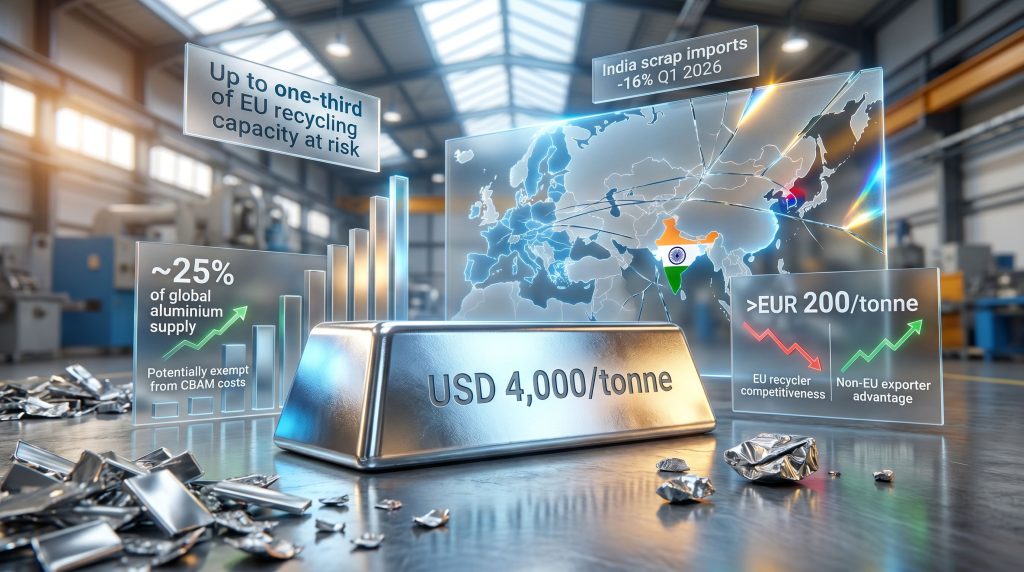
| Global aluminium supply potentially exempt from CBAM | ~25% |
| EU recycling capacity at risk if loophole persists | Up to one-third |
| Projected cost disadvantage for EU recyclers by 2035 | More than 10% vs. non-EU peers |
| Estimated financial gap per tonne produced | More than EUR 200/tonne |
The Carbon Leakage Paradox at the Core of CBAM's Design
There is a deeper irony worth naming directly. CBAM was architected specifically to prevent carbon leakage — the process by which emissions-intensive industrial activity migrates from regulated markets to unregulated ones, undermining the environmental integrity of the original policy. If the post-consumer scrap loophole remains unresolved, it creates precisely this outcome in the recycled aluminium sector.
Capital that would otherwise flow into European circular economy infrastructure may be redirected toward non-EU processing locations where CBAM obligations do not apply, producing the opposite outcome to what CBAM's circular economy objectives intend.
This is not a fringe concern. If imported scrap-based aluminium products continue entering European markets at a structural cost advantage, the investment calculus for new European recycling capacity deteriorates materially. The gap between policy intent and policy design risks becoming a self-fulfilling disincentive for the very industrial transformation Europe is trying to accelerate.
A further systemic risk is that CBAM's design choices are being watched closely by policymakers in the United Kingdom, Canada, and several Asia-Pacific jurisdictions considering their own carbon border adjustment frameworks. If the post-consumer scrap exemption becomes a standard feature of global carbon border policy, it could permanently distort scrap pricing signals, shift recycling investment concentration away from regulated markets, and undermine the emissions accounting integrity of circular economy claims across industrial sectors. The OECD's analysis on carbon border adjustments highlights precisely these systemic risks for globally integrated supply chains.
How Global Supply Chains Are Already Responding
The policy pressure is not arriving in isolation. CBAM and recycled aluminium supply shocks are compounding simultaneously with a separate set of physical supply constraints that are tightening aluminium availability across the global value chain.
The converging pressure points shaping the 2026 market environment include:
- China's 45 million tonne production cap has effectively ended the era of surplus-driven global pricing, removing the historical buffer that absorbed demand spikes
- Guinea's tightening control over bauxite export flows is introducing upstream raw material uncertainty for smelters heavily dependent on Chinese-sourced alumina
- Indonesia's downstream expansion programme is encountering power and resource constraints that limit its ability to compensate for supply gaps elsewhere
- Operational disruptions in Mozambique and Iceland have tightened primary aluminium availability across Atlantic and Indo-Pacific supply corridors
- Fire damage to Novelis' US downstream operations has created additional processing constraints in the North American fabricated aluminium market
With inventories contracting across major trading hubs and structural demand from electric vehicle manufacturing, solar energy infrastructure, and grid expansion programmes remaining firm, market analysts are projecting a meaningful global aluminium deficit in 2026. Price forecasts now point toward USD 4,000 per tonne as a credible near-term ceiling, representing a significant repricing of aluminium's structural value. In addition, battery raw materials demand pressures are intensifying competition for the same upstream inputs, further straining availability.
India's Scrap Import Collapse as a Leading Indicator
One of the clearest early signals of tightening global scrap availability is visible in India's import data. India's aluminium scrap imports fell 16% year-on-year in Q1 2026, declining from approximately 0.42 million tonnes to 0.35 million tonnes. Given that India sources close to 85% of its scrap requirements from overseas markets, this contraction directly compresses the feedstock available to domestic secondary producers.
The trajectory is particularly telling. Import arrivals peaked at 0.2 million tonnes in October 2025 before declining steadily and then dropping sharply to 0.1 million tonnes by March 2026. This is not a demand-side story. The decline reflects tightening global scrap availability rather than reduced appetite from Indian secondary producers, who remain among the most scrap-dependent aluminium manufacturers in the world.
Separately, trade data between Libya and Brazil illustrates how broader disruptions are reshaping bilateral commodity flows. Total Libya-Brazil commerce fell 56.5% year-on-year in Q1 2026 to USD 95.9 million, though Libya's exports to Brazil actually spiked higher, driven by increased aluminium scrap shipments. This divergence signals that scrap is increasingly being rerouted across non-traditional trade corridors as conventional supply chains tighten.
India's longer-term response runs through its Carbon Credit Trading Scheme (CCTS), which targets a 45% reduction in greenhouse gas emission intensity by 2030 and net-zero by 2070, grounded in the Energy Conservation (Amendment) Act 2022. However, the gap between India's current carbon intensity and EU CBAM thresholds represents a near-term structural risk that the CCTS alone cannot bridge quickly. Industry analysts have documented a 41% impact on Indian aluminium export competitiveness from CBAM-related trade friction.
National Policy Responses Creating a Multi-Speed Compliance Landscape
The divergence in how different economies are responding to CBAM exposure is creating an increasingly fragmented global compliance environment.
South Korea has mobilised a dedicated research and development initiative under its 2026 Carbon Reduction R&D programme for core export items, coordinated through the Ministry of SMEs and Startups in collaboration with the Korea Technology and Information Promotion Agency for SMEs (TIPA). The programme targets carbon-reduction technology development specifically calibrated to CBAM thresholds, with aluminium and steel as priority sectors. This positions South Korean exporters to maintain market access as EU carbon border costs escalate, reflecting a notably proactive industrial policy posture relative to peer exporters.
India, by contrast, faces a more difficult near-term path. Its CCTS framework is still in early implementation phases, and the alignment between domestic carbon market mechanisms and EU CBAM compliance standards remains incomplete. The practical consequence for Indian secondary aluminium producers is elevated export cost exposure precisely when global scrap availability is also tightening.
European recyclers face a compounding challenge from within. Proposed reforms to the EU ETS are expected to inflate operating costs across the region's recycling and refining sectors. Industry groups have flagged that the combination of rising internal carbon costs under ETS reform and competitive pressure from CBAM-exempt imports could accelerate capacity rationalisation across European secondary aluminium production. The aluminium tariff impacts emerging from broader trade policy shifts are, furthermore, adding yet another layer of cost pressure for producers navigating this environment.
The next major ASX story will hit our subscribers first
How Major Producers Are Repositioning Around Low-Carbon Recycling
Capital allocation decisions from the industry's largest operators reveal a consistent strategic logic: recycled content and carbon compliance are being treated as inseparable competitive requirements, not separate objectives.
Alcoa Corporation has committed USD 65 million to enhance foundry production capabilities at its Mosjøen smelter in Norway, incorporating post-consumer recycled aluminium into the casting process for the first time. This investment simultaneously addresses CBAM compliance positioning, customer demand for verified low-carbon products, and the competitive dynamics of the European market. The decision signals that post-consumer material integration is moving from aspiration to operational reality at the primary producer level.
Emirates Global Aluminium (EGA) is executing a dual-track strategy: renewing bauxite sourcing agreements from Guinea to stabilise upstream raw material access while accelerating completion of its Al Taweelah recycling facility. This parallel approach — diversifying raw material origins while expanding low-carbon recycling capacity — reflects industry recognition that supply resilience and carbon compliance have converged into a single strategic challenge.
Norsk Hydro is advancing its market positioning through Hydro CIRCAL 100R, an aluminium material produced exclusively from post-consumer waste. The product is being showcased through a curated design exhibition in Styria, Austria, running through May 2026. However, as noted by Hydro itself, greenwashing via CBAM loopholes threatens the credibility of verified green products in the European market — a risk that reinforces the urgency of closing the scrap accounting gap. This approach signals a deliberate strategy to build brand differentiation and premium market positioning around verified recycled content.
Midal Cables has documented a 13% reduction in greenhouse gas emission intensity alongside an expansion of renewable energy capacity to 4.491 MWp in its third Sustainability Report. These metrics translate directly into reduced CBAM exposure for the company's aluminium cable products entering European markets, illustrating how ESG operational transformation is increasingly functioning as a trade competitiveness tool rather than purely a reputational one.
Consequently, the aluminium industry leaders most likely to emerge competitively from this transition are those already embedding recycled content and carbon compliance into their core capital strategies.
What Tighter CBAM Rules Would Mean for Trade Flows
The European Commission has indicated its intention to extend CBAM coverage into downstream aluminium-intensive products and to introduce anti-circumvention provisions. The timing of this extension, however, introduces its own distortion risk. A transitional gap between current and future coverage creates an arbitrage window during which manufacturers may accelerate imports of finished or semi-finished aluminium products before downstream rules take effect.
| Policy Scenario | Impact on EU Recyclers | Impact on Non-EU Exporters | Net Carbon Outcome |
|---|---|---|---|
| Status quo: scrap loophole retained | Competitive disadvantage vs. imports | Cost advantage maintained | Carbon leakage risk elevated |
| Unified default scrap carbon value applied | Level competitive field restored | Increased compliance cost exposure | Leakage risk reduced |
| Full downstream CBAM extension | Broader protection for EU value chain | Wider export cost exposure | Strongest emissions outcome |
| Delayed downstream implementation | Transitional arbitrage window opens | Front-loading incentive created | Short-term leakage spike |
The establishment of a critical raw materials facility at the European level could, furthermore, provide a complementary mechanism to support domestic secondary aluminium processing and reduce dependency on scrap imports subject to CBAM distortions.
FAQ: Understanding CBAM and Recycled Aluminium Supply Shocks
What makes post-consumer scrap treatment the central issue in CBAM's aluminium framework?
Post-consumer scrap is assigned a zero-carbon value under CBAM methodology, but EU recyclers processing the same material still incur EU ETS compliance costs. This asymmetry means non-EU producers using scrap can undercut EU-based recyclers on a carbon-adjusted cost basis, even when producing equivalent products with comparable actual emissions profiles.
Which economies face the greatest near-term CBAM exposure on aluminium exports?
India has documented a 41% impact on aluminium export competitiveness from CBAM-related friction. South Korea has launched dedicated government programmes targeting carbon reduction in aluminium and steel exports specifically in response to CBAM. Both represent instructive case studies in how export-dependent aluminium economies are adapting to carbon border compliance requirements.
How does the physical supply shock interact with CBAM-driven trade distortions?
The two forces are compounding. Primary aluminium supply is tightening due to China's production cap, Guinea's bauxite restrictions, and multiple smelter disruptions, pushing buyers toward secondary and recycled material. Simultaneously, CBAM and recycled aluminium supply shocks are distorting the economics of recycled aluminium trade, creating pricing and sourcing complexity at precisely the moment when recycled material's strategic importance is highest.
What is the timeline risk for European recycling capacity?
Industry participants have warned that up to one-third of Europe's aluminium recycling capacity could be placed at structural risk if the post-consumer scrap loophole in CBAM's design remains unaddressed, particularly as EU ETS reform simultaneously inflates domestic operating costs.
The Strategic Outlook: What Markets Are Pricing In
The resolution of the post-consumer scrap loophole within CBAM is now the single most consequential near-term policy variable for European recycled aluminium economics. It will determine whether European circular economy infrastructure attracts or repels the capital needed to expand domestic recycling capacity through the decade.
Downstream CBAM extension timing will determine whether transitional arbitrage flows create a secondary supply shock in fabricated aluminium products. India and South Korea represent the clearest real-world case studies of divergent adaptation strategies. And major producer capital allocation — from Alcoa's Mosjøen commitment to EGA's Al Taweelah recycling facility — confirms that industry leaders are already pricing in a world where recycled content and carbon compliance are inseparable competitive requirements.
CBAM is not merely a compliance cost applied at the border. It is actively reshaping where recycled aluminium capacity is built, how scrap is priced globally, and which producers can sustain competitive positions in the world's largest carbon-regulated market. The decisions made about scrap accounting in the next 12 to 18 months will reverberate through global supply chains for a generation.
This article contains forward-looking statements and market projections based on publicly available industry data and analysis. Forecasts regarding aluminium prices, capacity outcomes, and policy impacts are inherently uncertain and should not be construed as investment advice. Readers are encouraged to conduct independent research and consult qualified financial advisers before making investment decisions.
Want to Track the Next Major Mineral Discovery Before the Broader Market Does?
Discovery Alert's proprietary Discovery IQ model delivers real-time alerts on significant ASX mineral discoveries across more than 30 commodities — including those integral to the energy transition and circular economy reshaping global aluminium supply chains — turning complex data into actionable investment insights. Explore Discovery Alert's dedicated discoveries page to understand how historic mineral discoveries have generated substantial returns, and begin your 14-day free trial today to position yourself ahead of the market.