June 19, 2026
The Long-Cycle Trap: Why Capital Allocation in Oil Sands Is a Policy Story, Not a Commodity Story
Long-cycle energy assets behave differently from almost every other capital investment class. Unlike shale wells that can be drilled and producing within months, oil sands projects require multi-year development timelines, enormous upfront capital commitments, and regulatory certainty that stretches across decades of projected production life. When investors model the economics of a greenfield oil sands project, they are not pricing today's barrel. They are pricing the policy environment of 2035, 2040, and beyond. That fundamental distinction is what makes the current Canadian policy landscape so consequential, and why the Cenovus oil sands growth warning delivered during the company's Q1 2026 earnings call deserves serious analytical attention.
The tension at the heart of Canada's energy sector is not about whether the resource exists. It does, on a massive scale. The tension is about whether the policy architecture surrounding that resource is compatible with attracting the capital needed to extract it competitively.
When big ASX news breaks, our subscribers know first
Record Results, Constrained Horizon
Cenovus Energy (TSX/NYSE: CVE) reported one of its strongest quarterly performances on record when it released Q1 2026 results in early May. The headline figures were striking across every major metric:
| Metric | Q1 2026 Result | Year-Over-Year Change |
|---|---|---|
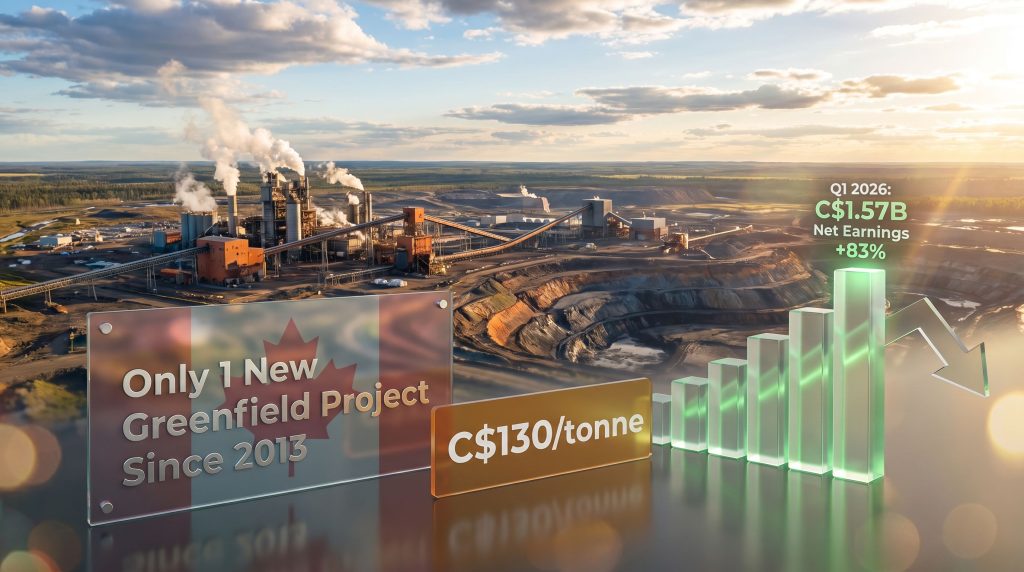
| Net Earnings | C$1.57 billion | +83% |
| Upstream Production | 972,100 BOE/d | +19% |
| Adjusted Funds Flow | C$3.4 billion | Record quarter |
| Total Revenues | C$12.4 billion | Significant growth |
| Downstream Utilization | 97% | Near-maximum capacity |
| Base Quarterly Dividend | C$0.22/share | +10% increase |
| Shareholder Returns (Q1) | C$1.0 billion | Dividends + buybacks |
By any conventional measure, these are the numbers of a company firing on all cylinders. Yet Cenovus CEO Jon McKenzie used the earnings call not to celebrate, but to issue a pointed warning about the structural conditions underpinning those results, and the barriers preventing them from being sustained over the long term.
Where the Growth Actually Came From
The analytical detail that separates informed interpretation from surface-level reading is understanding what drove the 19% production increase. It was not new greenfield development. It was not the result of capital being deployed into new oil sands construction. The growth came from three specific, finite sources:
- Full-quarter contribution from the MEG Energy acquisition, which provided production volumes not captured in the prior year's comparable period
- Asset optimisation across existing infrastructure, extracting incremental barrels from facilities already built and operating
- Downstream refining performance, with operations running at 97% utilisation and benefiting from favourable refining margins
McKenzie was explicit that greenfield development carries fundamentally higher costs and break-even thresholds than the growth reflected in these results. The distinction is not semantic. Acquisition-driven and optimisation-driven growth has a defined ceiling. Once an acquisition is fully integrated and existing assets are running at peak efficiency, the only path to continued production growth is new capital deployed into new projects. That pathway is currently obstructed.
Cenovus shares reflected some of this complexity. Despite the earnings beat, shares closed down 1.7% at C$38.84 on the day of reporting, though they had touched an all-time high of C$42.01 earlier in the week.
Thirteen Years Without a New Greenfield Project
The statistic that anchors the entire Cenovus oil sands growth warning is stark: only one new greenfield oil sands project has been approved and built in Canada since 2013. This is not a cyclical pause triggered by a commodity downturn. It is a structural freeze that has persisted through periods of both low and high oil prices, spanning more than a decade of continued global oil demand growth.
The absence of new greenfield approvals over thirteen years means Canada's long-term production profile has become increasingly dependent on ageing infrastructure, with no new capacity pipeline to replace declining assets in the decade ahead.
The compounding factors behind this standstill are interconnected rather than isolated:
- Elevated break-even economics for new construction — Greenfield oil sands development requires substantially greater upfront capital than brownfield optimisation, and the risk-adjusted return profile must compete against alternative jurisdictions that offer lower costs and faster approvals.
- Extended regulatory assessment timelines — Environmental review processes in Canada have lengthened considerably over the past decade, introducing multi-year delays that erode project economics before a shovel enters the ground.
- A carbon cost structure unique to Canada — Industrial carbon pricing applicable to the energy sector has no direct equivalent among the world's major competing oil-producing nations. In a commodity business where marginal cost competitiveness determines investment allocation, this differential matters enormously.
- Capital redirection to more hospitable jurisdictions — Investment dollars that might otherwise fund new Canadian oil sands construction have been flowing toward U.S. shale plays and Middle Eastern projects, where approval timelines are compressed and operating cost structures are more competitive.
The implication for supply projections extends well beyond current earnings reports. Oil sands assets, once built, are characterised by long productive lives and relatively low natural decline rates compared to conventional reservoirs or shale wells. The absence of new project construction today creates supply gaps in the 2030s that cannot be quickly remedied, given the multi-year lead times inherent in bringing a new greenfield project online.
The Ottawa-Alberta Standoff and Its Cascading Effects
The regulatory uncertainty gripping new investment decisions is crystallised in one unresolved negotiation. In November 2025, Prime Minister Mark Carney's energy superpower plan outlined ambitious targets, including a memorandum of understanding with Alberta Premier Danielle Smith committing to a new pipeline and an industrial carbon price of C$130 per metric ton. An April 1, 2026 deadline was set to finalise the arrangement. That deadline passed without resolution, and as of early May 2026, talks remain ongoing.
The C$130 per metric ton target represents one of the highest proposed industrial carbon cost structures among major oil-producing jurisdictions globally. For long-duration, capital-intensive projects where investors must model operating costs across thirty to forty years of production life, this level of uncertainty is sufficient to freeze decision-making entirely, regardless of prevailing oil prices.
McKenzie was direct on this point, describing the industrial carbon tax as unique to Canada and arguing that it strengthens the incentive for companies to direct capital investment abroad. This is not a theoretical argument. It is a description of capital allocation behaviour already occurring. Furthermore, Canada's energy transition challenges are compounding these pressures, making the path to resolution increasingly complex.
The consequences of the unresolved standoff are already visible in specific project decisions:
- Canadian Natural Resources deferred its US$6 billion Jackpine carbon capture expansion at its Albian oil sands site, explicitly citing the absence of finalised government policies on carbon pricing and methane regulations as the reason for the deferral.
- The project is not a conventional production expansion. It is emissions reduction infrastructure — the precise category of investment that climate policy ostensibly aims to encourage. Its deferral due to regulatory ambiguity represents a policy paradox with significant implications.
The Jackpine deferral illustrates a compounding irony embedded in Canada's current regulatory architecture. The policy designed to incentivise emissions reduction is creating enough uncertainty that the infrastructure required to achieve those reductions cannot move forward.
Carney has described the global oil and gas context as highly attractive and has emphasised Canada's need to access non-U.S. export markets to compete long-term. Alberta currently ships roughly 95% to 97% of its crude to American buyers, a concentration that limits pricing power and exposes producers to bilateral trade dynamics. Diversifying that export base requires new pipeline infrastructure, and new pipeline infrastructure requires the production volumes to justify construction. The circularity is not incidental. In addition, Canadian energy export tariffs are adding further complexity to an already constrained market access picture.
The Pipeline-Production-Policy Circular Dependency
Perhaps the most analytically important dimension of the current situation is what might be called a structural logic trap — a self-reinforcing cycle that prevents any single component from moving without the others:
- Canada needs new pipeline infrastructure to access Asian and other non-U.S. export markets
- Justifying new pipeline construction economically requires sufficient production volumes to fill that capacity on commercially viable terms
- Generating sufficient new production volumes requires greenfield oil sands development
- Greenfield development requires stable, competitive policy and regulatory certainty across a multi-decade planning horizon
- That certainty does not currently exist, which weakens the production growth case, which weakens pipeline economics, which reduces the incentive to resolve the policy standoff
McKenzie framed this directly, noting that Canada must be thoughtful about policy environments that genuinely allow the sector to grow and fill a pipeline. The federal government's own pipeline ambitions depend on the same production growth that the current regulatory framework is suppressing. Consequently, the trade war impact on oil markets is further eroding confidence in the near-term investment case for new Canadian capacity.
How Canada's Policy Environment Compares to Competing Jurisdictions
The competitiveness gap between Canada and its primary rivals for long-cycle energy investment is not merely a matter of perception. It reflects structural differences in cost architecture, approval timelines, and regulatory certainty.
| Factor | Canada (Oil Sands) | United States (Shale) | Middle East (Gulf States) |
|---|---|---|---|
| Industrial Carbon Tax | Yes, C$130/tonne proposed | No federal equivalent | None |
| Regulatory Approval Timeline | Multi-year | Months to two years | Weeks to months |
| Greenfield Development Activity | Near-zero since 2013 | Active and expanding | Active and expanding |
| Export Market Concentration | 95-97% U.S.-dependent | Globally diversified | Globally diversified |
| Capital Inflow Trend (new projects) | Declining | Growing | Growing |
The contrast is particularly sharp when considering U.S. shale development. American shale operators benefit from shorter approval cycles, no equivalent federal industrial carbon levy, and an increasingly diversified export infrastructure following LNG terminal expansions on the Gulf Coast. Capital that might otherwise deploy into Canadian oil sands construction finds a more competitive risk-return profile in the Permian Basin or Bakken formations.
The Geological Dimension That Compounds the Policy Problem
Oil sands have unique geological characteristics that make policy certainty even more critical than it would be for conventional or shale reservoirs. The resource consists of bitumen — an extremely viscous form of crude oil mixed with sand, clay, and water — which requires either surface mining for shallow deposits or steam-assisted gravity drainage (SAGD) techniques for deeper formations.
These extraction methods are energy-intensive and carry higher operating costs per barrel than conventional production. They also require substantial upfront capital before a single barrel is produced. When a greenfield oil sands investor commits capital, they are locking in assumptions about operating costs, regulatory costs, and market access over a multi-decade horizon. Carbon price uncertainty of the magnitude currently present in Canada makes that commitment extraordinarily difficult to justify.
The next major ASX story will hit our subscribers first
What a Competitive Policy Framework Would Actually Require
The sector's path forward is not a question of resource availability. Canada's oil sands hold proven reserves on a scale that positions the country among the world's top reserve holders. However, the question is whether the policy environment can be restructured to make those reserves investable on competitive terms.
A framework capable of restoring greenfield investment confidence would need to address several specific structural requirements:
- Defined, time-bounded regulatory approval processes that allow project economics to be modelled without open-ended timeline risk
- A finalised, long-term industrial carbon price that provides a fixed cost input for multi-decade project planning, rather than an unresolved number that could move in any direction
- Credible pipeline infrastructure commitments that reduce the 95-97% U.S. export dependency and establish commercially viable access to Asian markets
- Finalised methane regulations that allow carbon capture and emissions reduction investments to proceed without waiting for rules that remain in draft
- Policy design that accounts for competitive benchmarking against the U.S. and Gulf state jurisdictions actively competing for the same pool of global energy capital
The consolidation trend visible in recent Canadian oil sands activity — including acquisition-driven growth strategies like the MEG Energy deal — is itself a signal worth reading carefully. When an industry concentrates rather than expands, it is typically a sign of capital discipline under constraint, not strategic confidence in the operating environment. The Canadian oil price shock of recent months has further reinforced the case for caution among major operators weighing new commitments.
The Supply Gap Already Being Written for the 2030s
The deferred investment decisions of today are tomorrow's supply gaps. Oil sands projects have lead times measured in years from regulatory approval to first production, meaning the greenfield projects that are not being approved and constructed now will not be available to add supply in five or ten years.
Industry voices beyond Cenovus are making the same assessment. Cenovus has warned publicly that oil sands growth is drying up as policy uncertainty mounts, a view that Canadian Natural Resources has independently reinforced by raising pipeline dependency concerns. When multiple major operators across the same industry are delivering identical strategic warnings in the same earnings cycle, the signal is not noise. It reflects a systemic condition.
The path forward requires deliberate, coordinated resolution of the policy standstill. The circular dependency between pipeline economics, production growth, and regulatory certainty will not resolve through market forces alone. It requires a policy architecture that treats long-cycle, capital-intensive investment with the same strategic seriousness that competing jurisdictions apply to attracting that capital.
Record quarterly earnings are not evidence that the constraints are acceptable. They are evidence that the industry is performing well within those constraints — for now. The window to prevent structural supply underinvestment from becoming a permanent feature of Canada's energy landscape is narrowing as capital continues to find more competitive destinations elsewhere.
This article is intended for informational purposes only and does not constitute financial or investment advice. Forecasts, projections, and policy scenarios discussed herein involve uncertainty and should not be relied upon as predictions of future outcomes. Investors should conduct independent due diligence before making investment decisions.
Want To Catch The Next Major Mineral Discovery Before The Market Does?
While Canada's long-cycle energy sector grapples with policy paralysis and capital flight, Discovery Alert's proprietary Discovery IQ model scans the ASX daily to deliver real-time alerts on significant mineral discoveries — instantly translating complex data into actionable investment opportunities for traders and long-term investors alike. Explore how historic discoveries have generated extraordinary returns and begin your 14-day free trial today to position yourself ahead of the broader market.