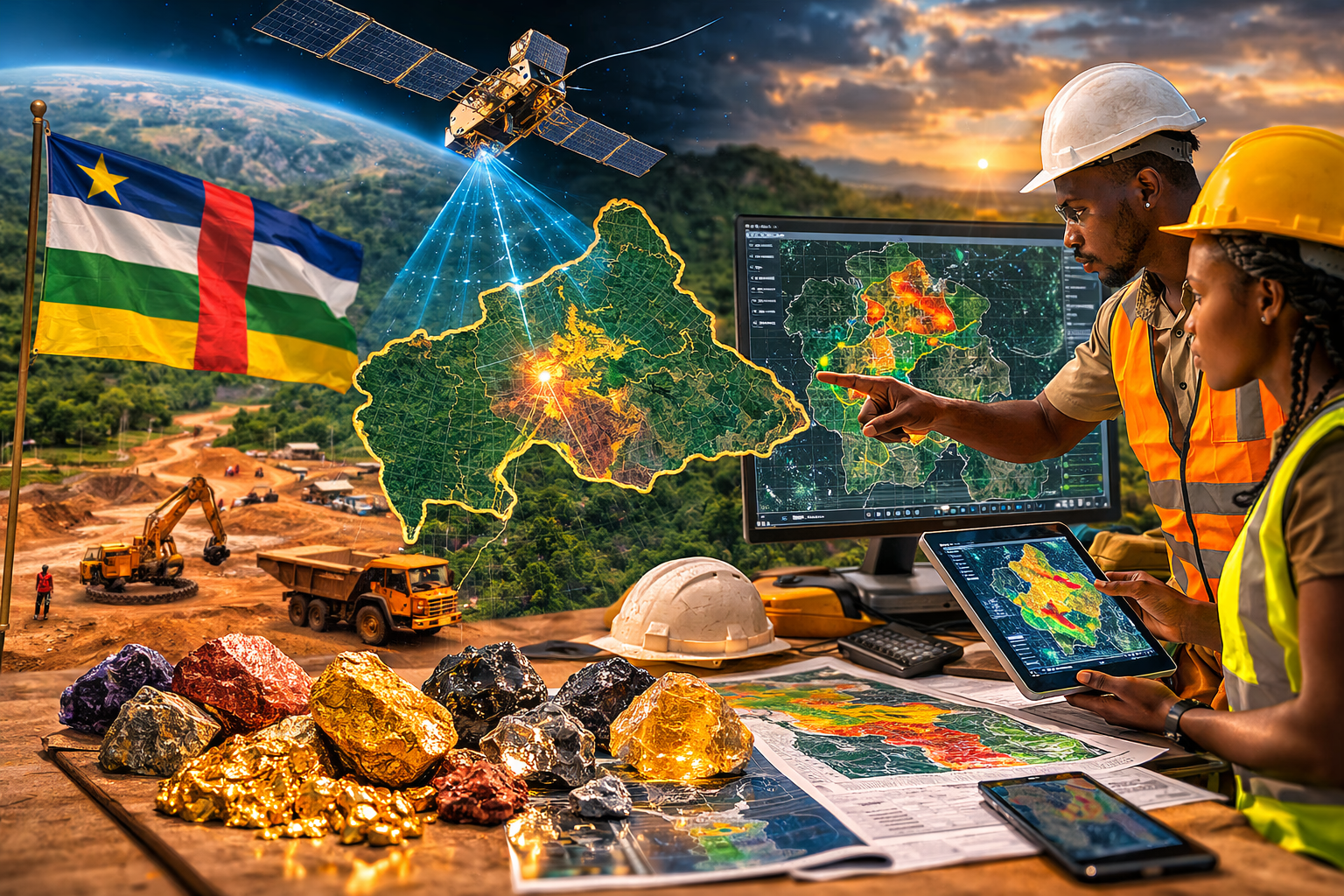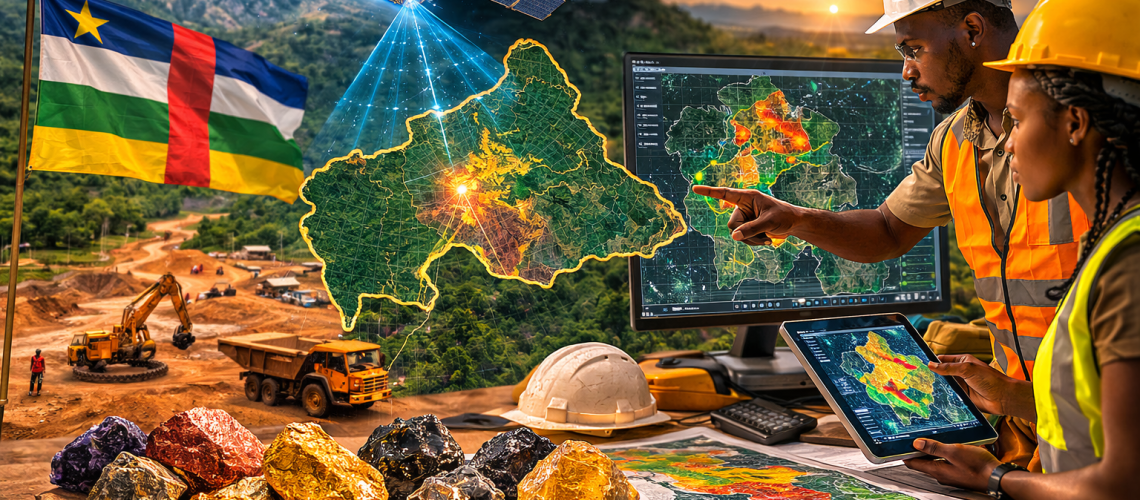
The Central African Republic is positioning itself to unlock the economic potential of its mineral resources through a strategic partnership with Canadian technology firms specialising in satellite-based geological exploration. By integrating advanced remote sensing technologies with national resource planning, the country is taking early steps toward transforming its largely unexplored mineral landscape into a structured development program.
For a nation long believed to hold significant deposits of uranium, gold, nickel, copper, and rare metals, the introduction of satellite-based mineral mapping represents more than a technological upgrade. It reflects a broader effort by resource-rich developing economies to modernise exploration strategies, attract international investment, and establish the foundations of a domestic mining industry capable of participating in global supply chains.
Satellite Exploration as the First Stage of Mineral Development
In December 2025, the Ministry of National Defense and the Reconstruction of the Army of the Central African Republic issued formal authorization allowing Canadian Advanced Satellite Imaging (CASI) Ltd. to conduct satellite-based geoscientific exploration on behalf of CVMR Corporation. The authorization permits the use of satellite imaging technologies to conduct geological surveys and mineral cartography under a memorandum of understanding between the government and CVMR.
The program focuses on generating high-resolution geological data through multispectral satellite imaging and remote sensing analysis. These technologies allow scientists to detect geological formations, mineral signatures, and structural features across large geographic regions without requiring immediate ground-based exploration.
For developing countries with limited geological datasets, satellite-based exploration offers a cost-effective method for establishing national mineral inventories. Accurate geological information is often the critical first step in attracting mining investment, as companies require reliable resource assessments before committing to expensive drilling and feasibility studies.
Remote sensing technologies can identify key geological indicators such as lithological variations, alteration zones, and structural faults that may host mineral deposits. These early-stage assessments allow governments and exploration companies to prioritize specific regions for more detailed investigation.
Remote Sensing Technologies Transforming Exploration Methods
The satellite exploration program will rely on advanced remote sensing techniques that analyse multiple wavelengths beyond the visible spectrum. Multispectral imaging systems carried by earth observation satellites capture data in near-infrared, short-wave infrared, and thermal infrared bands, each revealing different characteristics of the Earth’s surface.
These technologies allow geologists to identify mineral alteration patterns, clay deposits, oxide zones, and variations in soil composition that often accompany mineralization. Radar-based imaging systems complement multispectral data by mapping surface topography and structural features, even in areas covered by vegetation.
Such capabilities represent a major evolution in exploration methodology. Traditional mineral exploration typically involves large-scale geological fieldwork, drilling campaigns, and geophysical surveys that can take years and require significant capital investment.
Satellite-based exploration dramatically reduces the cost and environmental impact of early-stage resource assessment. Large areas can be analysed rapidly, enabling governments to identify potential resource zones before launching more intensive exploration programs.
Remote sensing data is also widely used to support infrastructure planning and environmental monitoring in mining regions. Satellite imagery can assist in route planning for transport corridors, environmental baseline studies, and land-use management—factors that are critical when developing large-scale mining projects.
Strategic Minerals and Economic Development Potential
The Central African Republic is widely believed to possess significant deposits of strategic minerals that are increasingly important to global industrial supply chains. The government’s partnership with CVMR includes exploration and development potential for minerals such as uranium, tantalum, niobium, copper, antimony, nickel, and gold.
Many of these materials are considered critical minerals because of their importance in modern technologies. Nickel and copper play essential roles in electric vehicle batteries and renewable energy systems. Tantalum and niobium are widely used in electronics, aerospace components, and advanced alloys.
Uranium represents another strategic resource. As global interest in nuclear energy grows as part of low-carbon energy strategies, demand for uranium is expected to remain strong in the coming decades.
For countries such as the Central African Republic, the development of these resources offers a potential pathway to economic diversification and industrial growth. However, the challenge for many resource-rich nations has historically been the inability to capture value beyond raw mineral extraction.
Mining industries in developing countries often export unprocessed ores or concentrates, while refining, manufacturing, and high-value industrial processing take place in other parts of the world. This structure limits economic benefits for producing countries and reduces opportunities for job creation and industrial development.
Building Domestic Processing and Industrial Capacity
The agreement between the Central African Republic and CVMR includes plans to develop domestic mineral processing and refining facilities, a move that could significantly alter the country’s role in global mineral markets.
By moving further along the mineral value chain, resource-producing nations can capture a larger share of the economic value generated by their natural resources. Smelting, refining, and downstream processing activities generate significantly higher revenues than raw material exports.
Processing industries also create employment opportunities across a wide range of sectors including engineering, logistics, manufacturing, and technical services. Mining projects that incorporate local processing facilities can therefore have broader economic impacts than extraction-focused operations.
The partnership also includes commitments to technology transfer and workforce development. Training programs and collaborations with universities and technical institutions are expected to help build local expertise in fields such as geology, mining engineering, and metallurgical processing.
Such initiatives are particularly important for the Central African Republic, where a large share of the population consists of young people seeking economic opportunities. The development of a modern mining sector could therefore play a role in addressing employment challenges while strengthening national technical capabilities.
Financing Mechanisms for Mining Sector Development
Another key component of the partnership involves the creation of a dedicated financial mechanism to support mining sector investment. Access to financing remains one of the largest obstacles for mining development in emerging economies, particularly for projects that require significant infrastructure investment.
Mining operations depend on reliable transportation networks, energy supply systems, and processing facilities. These infrastructure requirements often represent a major portion of project costs.
By establishing a specialised financial platform to support mining development, the Central African Republic aims to attract both domestic and international investors to participate in the sector. Transparent financial structures and regulatory frameworks are critical for building investor confidence and ensuring responsible resource management.
International financial institutions and private investors have shown increasing interest in projects involving critical minerals due to growing global demand driven by energy transition technologies. Countries able to demonstrate geological potential, regulatory stability, and clear investment frameworks may therefore be able to attract substantial capital into their mining sectors.
Geopolitical Implications for Global Mineral Supply Chains
The development of new mining regions in Central Africa also carries geopolitical significance. Global supply chains for many critical minerals are currently concentrated in a small number of countries, creating strategic vulnerabilities for industries that depend on reliable access to raw materials.
For example, China currently dominates processing capacity for many battery-related metals and rare earth elements. As demand for these materials continues to grow, governments and companies around the world are seeking to diversify supply sources and reduce dependence on a single region.
Emerging mineral producers in Africa could play an increasingly important role in this diversification. The successful development of mining projects in countries such as the Central African Republic could contribute to broader efforts to build more resilient global supply chains for critical materials.
At the same time, such developments must be accompanied by strong governance frameworks, environmental safeguards, and transparent regulatory systems to ensure that mineral wealth contributes to sustainable economic development.
A New Chapter for Central Africa’s Mineral Frontier
The satellite exploration initiative represents an early but significant step toward unlocking the mineral potential of the Central African Republic. By combining advanced remote sensing technologies with international partnerships and plans for domestic processing capacity, the country is seeking to reposition itself within the global mining landscape.
While the path toward large-scale mining development remains complex, the integration of modern exploration technologies, investment frameworks, and industrial planning could help transform the country’s natural resources into long-term economic opportunities.
As global demand for critical minerals continues to rise, nations able to develop their resource sectors responsibly and strategically may find themselves playing increasingly important roles in the evolving global energy and technology economy.