How Samsung’s Ag–C Anode Technology Could Reshape Global Silver Demand
What Is Driving Renewed Attention on Silver in Battery Technology?
Solid-state batteries have long been viewed as the next major evolution beyond conventional lithium-ion systems. Their promise—higher energy density, faster charging, and improved safety—has attracted sustained research investment from major automotive and electronics manufacturers.
Recent disclosures from Samsung SDI suggest that progress in this field has accelerated, particularly through the use of a silver–carbon (Ag–C) composite anode layer. While media coverage has focused on headline performance metrics such as extended driving range and reduced charging times, the material implications of this design choice have received comparatively limited attention.
Specifically, Samsung’s approach positions silver as an active electrochemical material, rather than a marginal conductive input. This distinction has meaningful consequences for long-term silver demand and supply dynamics.
How Does the Silver–Carbon Anode Improve Battery Performance?
The Technical Function of Silver
In lithium-based batteries, one of the principal challenges is dendrite formation—needle-like lithium structures that grow during repeated or rapid charging cycles. These dendrites can pierce separators, causing short circuits, thermal runaway, and in extreme cases, fires.
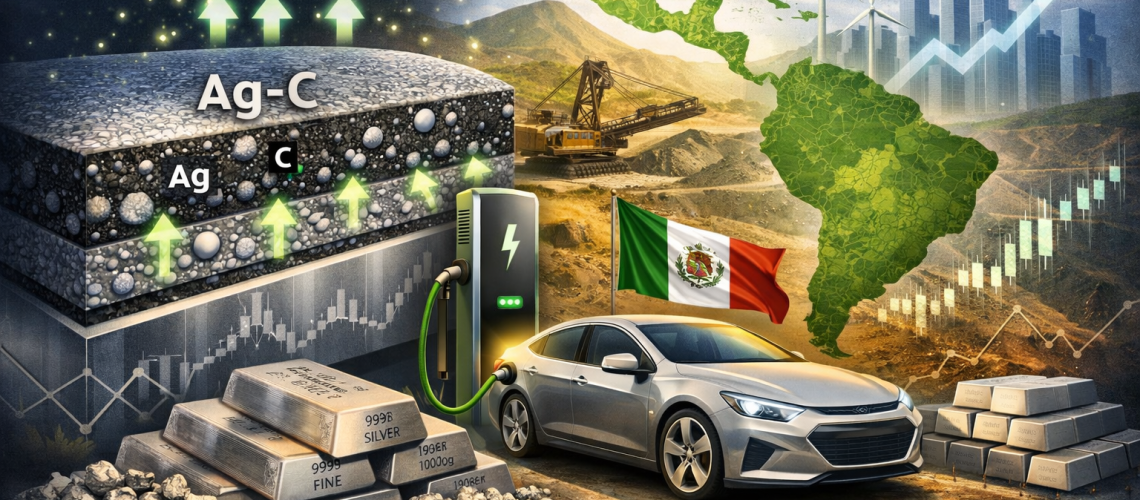
Samsung’s Ag–C composite layer functions as a lithium host matrix:
- Silver’s high electrical conductivity facilitates rapid electron transport
- The carbon component provides structural stability
- Together, the composite promotes uniform lithium deposition, suppressing dendrite growth
This architecture enables faster charging while maintaining mechanical and thermal stability. Unlike earlier solutions that attempted to manage dendrites through electrolyte chemistry alone, the Ag–C layer directly addresses lithium behavior at the anode interface.
Why This Matters for Silver Consumption
From Trace Use to Structural Input
Historically, silver usage in vehicles has been relatively modest. Internal combustion vehicles typically contain 15–20 grams, while electric vehicles use 30–50 grams, primarily in electronics, power management systems, and connectors.
Solid-state battery designs incorporating Ag–C anodes change this profile. Instead of milligram-scale dispersion, silver is deployed in gram-scale quantities per cell, making it a structural component of the battery system.
Even under conservative assumptions, partial adoption of solid-state batteries could introduce tens of millions of ounces of incremental annual silver demand by the late 2020s. Under more aggressive adoption scenarios, the impact would be materially larger.
Supply Constraints and Limited Elasticity
Mining and Recycling Considerations
Global silver supply remains structurally constrained:
- Annual mine production is approximately 830 million ounces
- More than 70% of silver is produced as a by-product of lead, zinc, and copper mining
- Average ore grades have declined significantly over the past two decades
- New primary silver mines typically require 10–15 years from discovery to production
Recycling provides some offset, but recovery rates for industrial silver remain low due to its dispersed use across consumer electronics and industrial applications. Silver embedded in vehicle batteries is also effectively removed from the supply pool for the full lifespan of the vehicle, delaying any recycling response.
Why Latin America Matters in a Silver-Constrained Future
As silver’s role expands from industrial input to strategic energy material, jurisdictional stability and resource quality become increasingly important. Battery manufacturers and automakers require long-term supply assurance, favoring regions with established mining frameworks and large, high-grade deposits.
Latin America—particularly Mexico—plays a central role in this context.
Mexico consistently ranks as the world’s largest silver producer, supported by extensive epithermal vein systems and a long mining history. However, much of its future supply growth depends on the development of new, high-grade primary silver projects rather than incremental by-product output.
As the demand for silver increases, there will be increased pressure on the top 10 producers , especially Mexico, to find new district scale silver systems. This will likely increase the exploration activity that we have recently seen in numerous exploration companies listed on the TSX Venture and the CSE in Canada.
Market Implications
Demand Becomes Less Price Elastic
As silver is integrated into safety-critical battery components, substitution becomes more difficult. This reduces demand elasticity and increases the likelihood that industrial procurement will compete directly with investment and traditional industrial uses.
Regional Premiums and Strategic Sourcing
Battery supply chains are increasingly shaped by regulatory and geopolitical considerations. Silver sourced from stable, allied jurisdictions may command pricing premiums as manufacturers seek to minimize political and compliance risk.
Longer-Term Repricing Risk
The transition from linear to step-function demand growth suggests that historical pricing models may underestimate future volatility. As with previous material shifts in palladium and rare earths, price discovery often lags technological adoption.
Conclusion
Samsung’s silver–carbon anode technology highlights a broader shift in how materials are used within advanced energy systems. By embedding silver directly into the electrochemical architecture of solid-state batteries, the technology repositions silver from a peripheral industrial metal to a strategic component of the energy transition.
For the silver market, this implies tighter supply-demand balances, reduced elasticity, and greater emphasis on high-quality primary silver assets—particularly in established mining regions such as Latin America.
While adoption timelines and exact material loadings remain subject to further disclosure, the directional implications are increasingly clear: silver’s role in next-generation batteries is no longer speculative, but structural.