June 18, 2026
Central Asian Gas Fields Drive Strategic Energy Competition Across Multiple Corridors
Global energy infrastructure development increasingly reflects sophisticated geopolitical positioning rather than simple resource extraction economics. As major powers compete for influence across energy-rich regions, large-scale natural gas projects represent critical nodes in emerging supply chain networks that will define energy security for decades ahead.
The systematic expansion of extraction capabilities across Central Asia demonstrates how resource-rich nations leverage geological advantages to build strategic partnerships while maintaining operational flexibility. This approach enables producing countries to balance immediate revenue needs against long-term geopolitical positioning in an increasingly multipolar energy landscape.
Strategic Infrastructure Investment Patterns:
• Technology Transfer Mechanisms: Advanced extraction capabilities flow through international partnerships
• Pipeline Network Development: Multi-directional infrastructure reduces single-market dependencies
• Financing Structure Innovation: Host country capital control paired with foreign technical expertise
• Market Access Diversification: Multiple export routes provide strategic negotiating leverage
When big ASX news breaks, our subscribers know first
Strategic Infrastructure Development Across Central Asian Energy Networks
Central Asian energy development occurs within complex webs of international partnerships that extend far beyond bilateral resource agreements. The region's strategic position between major consuming markets creates opportunities for sophisticated infrastructure projects that reshape global supply dynamics.
Modern energy corridor development requires coordination across multiple technical, financial, and diplomatic dimensions. Success depends on balancing immediate production requirements with long-term strategic positioning across evolving geopolitical relationships.
Current Regional Production Capacity Analysis:
| Production Zone | Annual Capacity (BCM) | Operational Status | Primary Markets |
|---|---|---|---|
| Eastern Fields | 70+ | Expanding | Asia-Pacific |
| Western Networks | 45+ | Operational | European Corridors |
| Trans-Caspian Routes | 35+ (projected) | Development Phase | Multiple Destinations |
The phased development approach enables controlled capacity expansion while managing technical complexity and financial risk exposure. This methodology provides predictable growth patterns for both producers and consuming markets.
Technical Architecture of Major Gas Field Development Programs
Large-scale gas field operations require sophisticated technical coordination across multiple developmental phases. The systematic approach to capacity expansion demonstrates how complex geological formations can support sustained high-volume production over extended timeframes.
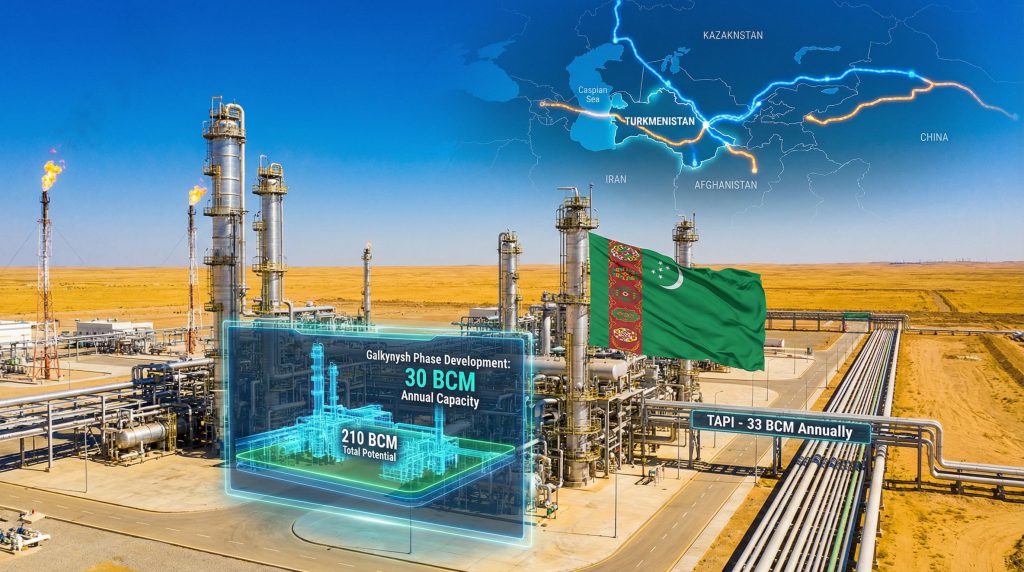
Galkynysh Field System Specifications:
• Total Estimated Reserves: 27.4 trillion cubic metres across interconnected formations
• Current Operational Capacity: 30 billion cubic metres annually from initial development phase
• Maximum Theoretical Output: 210 billion cubic metres annually at full seven-phase development
• Reserve-to-Production Ratio: Approximately 130+ years at maximum extraction rates
The field architecture indicates differentiated reservoir compartments requiring sequential development rather than simultaneous exploitation. This geological complexity necessitates advanced extraction technologies and sophisticated operational management systems.
Independent geological assessments confirm that the broader Galkynysh system, including nearby Garakol and Yashlar formations, represents one of the world's most significant untapped natural gas reserves. The scale positions Central Asian production as a major factor in global gas market dynamics.
Phase Development Structure:
-
Phase One: Operational at 30 BCM annually under Chinese technical management
-
Phase Two & Three: 60 BCM combined capacity under joint venture negotiations
-
Phase Four: 30 BCM capacity beginning development in 2026 with full Turkmen financing
-
Phases Five-Seven: 90 BCM projected capacity awaiting future development agreements
Chinese Energy Security Strategy and Central Asian Partnership Models
China's approach to Central Asian energy relationships reflects sophisticated long-term strategic planning that extends beyond immediate resource acquisition. The partnership framework demonstrates systematic integration of energy supply chains with broader geopolitical objectives.
Current bilateral trade flows indicate the strategic importance of Central Asian gas in Chinese energy security planning. Turkmenistan supplies approximately 40 billion cubic metres annually to China, representing roughly 12 percent of China's total natural gas consumption and establishing Central Asia as a critical supply source.
Furthermore, China moves deeper into Turkmenistan's Galkynysh gas field development through China's National Petroleum Corporation's involvement in multiple phases demonstrates the strategic value of these partnerships for both nations.
Chinese Partnership Framework Components:
• Technical Capability Integration: Advanced extraction and processing technology deployment
• Infrastructure Network Development: Pipeline systems connecting production zones to consumption centres
• Financial Risk Management: Project financing structures that optimise capital allocation
• Market Integration Systems: Connecting Central Asian production to Chinese industrial demand patterns
The Central Asia Gas Pipeline system represents the physical infrastructure enabling high-volume bilateral trade. This network originates in Turkmenistan's eastern gas regions, transits through Uzbekistan, and enters China via Xinjiang province, connecting to Chinese industrial and power generation centres.
Strategic Analysis: The consistent selection of Chinese National Petroleum Corporation across multiple development phases suggests established operational relationships and recognised technical capabilities, despite stated policies emphasising export diversification.
Evolving Financing Models:
Phase Four development represents a significant shift in partnership structure, with Turkmenistan providing 100 percent project financing while engaging Chinese technical expertise. This approach demonstrates increased confidence in field management capabilities and revenue projections while maintaining control over strategic energy assets.
Export Route Diversification and Regional Energy Security Dynamics
Turkmenistan's emphasis on export diversification reflects sophisticated risk management approaches in an increasingly complex geopolitical environment. Multiple pipeline options provide strategic flexibility whilst reducing dependence on single-market relationships.
Trans-Afghan Pipeline Initiative (TAPI) Development:
• Projected Annual Capacity: 33 billion cubic metres
• Target Markets: South Asian demand centres (India, Pakistan)
• Current Status: Construction progressing slowly through Afghanistan
• Strategic Significance: Direct access to rapidly growing South Asian gas markets
The TAPI project faces significant implementation challenges related to security requirements and regional stability concerns. However, successful completion would provide Turkmenistan with access to South Asian markets consuming over 150 BCM annually and growing rapidly.
Trans-Caspian Pipeline Concept:
The proposed trans-Caspian pipeline would enable direct access to European markets consuming approximately 320 billion cubic metres annually. This route would require complex underwater infrastructure across the Caspian Sea, involving approximately 300+ kilometres of submarine pipeline construction across varying water depths.
Technical Requirements:
• Underwater pipeline infrastructure across complex Caspian maritime zones
• Pressure management systems for extended routing distances
• Connection to existing European pipeline networks via Azerbaijan or Georgia
• Environmental impact management in sensitive Caspian ecosystems
The trans-Caspian route represents westward energy flow diversification that would directly compete with existing pipeline supplies to European markets. Implementation requires navigation of complex international maritime law frameworks and multi-national approval processes.
Production Scaling and Global Supply Chain Impact Analysis
The structured seven-phase development approach enables systematic capacity expansion whilst managing operational complexity and market integration challenges. This methodology provides both producers and consumers with predictable supply growth patterns over extended timeframes.
Conservative Development Scenario:
• Annual production increases of 30 BCM per developmental phase
• Total potential capacity reaching 210 BCM annually
• Development timeline spanning 15-20 years for complete implementation
• Gradual market integration minimising supply shock risks
Accelerated Development Scenario:
• Parallel phase development reducing implementation timeframes
• Compressed timeline of 10-12 years for major capacity expansion
• Enhanced regional energy security through rapid supply diversification
• Increased technical coordination requirements across multiple phases
At full development capacity of 210 BCM annually, the Galkynysh system would represent a significant factor in global natural gas supply dynamics. This volume equals approximately two-thirds of current European Union gas consumption, positioning Central Asian production as a major supply source.
For instance, understanding the broader implications of these developments is crucial when considering the US natural gas forecast and global energy price dynamics.
The next major ASX story will hit our subscribers first
Investment Architecture and Financial Risk Distribution
The evolving financing structures across different development phases demonstrate sophisticated approaches to capital allocation and risk management in large-scale energy infrastructure projects.
Investment Framework Analysis:
| Financing Model | Capital Source | Risk Profile | Technical Management |
|---|---|---|---|
| Joint Venture | Shared international | Distributed | Foreign partnership |
| Host Country Funded | Domestic capital | Concentrated | Foreign technical |
| Hybrid Structures | Mixed sources | Balanced | Shared management |
Phase Four development represents an important evolution in financing methodology, with Turkmenistan providing complete project funding whilst engaging international technical expertise. This approach maintains strategic asset control whilst accessing advanced operational capabilities.
Capital Requirements and Revenue Projections:
Large-scale gas field development requires multi-billion dollar infrastructure investments per developmental phase. However, long-term supply contracts provide stable revenue streams that support extended capital recovery periods.
The financing approach reduces foreign investment exposure whilst ensuring access to advanced extraction technologies and operational expertise. This model may influence future Central Asian energy project structures across the region.
Regional Energy Corridor Integration and Market Dynamics
Central Asian gas development occurs within broader regional infrastructure networks that connect production zones to multiple consuming markets. Understanding these integration patterns provides context for individual project significance within global energy systems.
East-West Energy Integration Trends:
• Asian Market Access: High-volume pipeline networks connecting to Chinese industrial demand
• European Route Development: Trans-Caspian infrastructure enabling westward gas flows
• South Asian Connections: TAPI pipeline targeting rapidly growing regional markets
• Infrastructure Redundancy: Multiple route options reducing single-point-of-failure risks
The systematic development of multiple export corridors provides Turkmenistan with enhanced negotiating leverage across different markets whilst reducing geopolitical vulnerability through export concentration.
However, the expanding Chinese presence in Central Asia's energy sector raises questions about regional energy autonomy and future market dynamics.
Technology Modernisation Requirements:
Advanced extraction capabilities require sophisticated processing and transportation infrastructure. The integration of modern technologies enables sustained high-volume production from complex geological formations whilst meeting international environmental standards.
How Do Global Trade Tensions Affect Regional Energy Projects?
International trade tensions significantly impact energy infrastructure development through financing restrictions and market access limitations. Moreover, tariffs' impact on investments affects long-term project viability and partnership structures.
Additionally, US-China trade impacts create ripple effects throughout global energy markets, influencing pricing mechanisms and supply chain relationships.
Implementation Challenges and Risk Management Frameworks
Large-scale energy infrastructure development faces multiple categories of risk that require sophisticated management approaches across technical, operational, and geopolitical dimensions.
Technical and Operational Risk Factors:
• Geological Complexity: Sophisticated extraction techniques required for optimal production
• Environmental Conditions: Harsh operational environments affecting year-round production capabilities
• Infrastructure Maintenance: Extended pipeline networks requiring continuous monitoring and upkeep
• Workforce Development: Skilled technical personnel requirements in remote operational locations
Geopolitical and Market Risk Considerations:
• Regional Stability Requirements: Secure pipeline corridors essential for sustained operations
• International Trade Dynamics: Sanctions and trade restrictions affecting market access
• Currency and Pricing Volatility: Economic fluctuations impacting project financial performance
• Demand Pattern Evolution: Changing global energy consumption affecting long-term revenue projections
Successful risk management requires diversified approaches across multiple operational and strategic dimensions. The emphasis on export route diversification represents one element of comprehensive risk mitigation strategies.
Future Outlook and Strategic Market Positioning
The systematic expansion of Central Asian gas production capabilities represents a fundamental shift in global energy supply geography. As traditional supply relationships evolve, new partnership models and infrastructure networks will reshape energy flows between producing and consuming regions.
Long-term Strategic Implications:
• Supply Chain Diversification: Multiple production sources reducing market concentration risks
• Geopolitical Balance: Enhanced negotiating leverage for both producers and consumers
• Technology Integration: Advanced extraction capabilities enabling sustained production growth
• Market Flexibility: Multiple export routes providing pricing optimisation opportunities
The success of phased development approaches will significantly influence Central Asia's role in global energy security frameworks over the coming decades. Controlled capacity expansion enables market integration whilst maintaining operational flexibility across changing geopolitical environments.
Investment and Partnership Evolution:
The evolution from joint venture financing to host country capital control demonstrates increasing confidence in domestic project management capabilities. This trend may influence future energy development models across resource-rich regions globally.
Additionally, the implications of Canada energy transition policies demonstrate how developed nations are adapting to changing energy landscapes.
Market Integration Scenarios:
Successful completion of multiple export corridor projects would position Central Asian production as a flexible supply source capable of serving Asian, European, and South Asian markets simultaneously. This geographic positioning provides unique strategic advantages in global energy markets.
Consequently, effective energy security strategy development becomes crucial for maintaining competitive advantages in evolving global markets.
The development of large-scale Central Asian gas infrastructure represents more than regional energy projects; these initiatives will influence global supply chain resilience and energy security frameworks for decades ahead. Understanding these dynamics provides essential insight into evolving energy geopolitics and market structures.
Disclaimer: This analysis contains forward-looking assessments based on current project announcements and geological estimates. Actual development timelines, production capacities, and market conditions may differ significantly from projections. Energy infrastructure projects involve substantial technical, financial, and geopolitical risks that could affect outcomes materially.
Want to Stay Ahead of Energy Market Developments?
Discovery Alert's proprietary Discovery IQ model provides instant notifications on significant ASX mineral and energy discoveries, empowering subscribers to identify actionable opportunities ahead of the broader market. Explore how major mineral discoveries can lead to exceptional returns and begin your 30-day free trial today to position yourself strategically in evolving energy markets.