
August 26, 2026
The Invisible Architecture Behind Sovereign Reserve Decisions
Most conversations about gold focus on its price. Central bank reserve managers are not having that conversation. Their mandate operates in an entirely different dimension, one governed by institutional frameworks built over decades, stress-tested against monetary crises, and reviewed by economists who think in generational terms rather than quarterly cycles.
Understanding how central banks decide how much gold to hold is not merely an academic exercise. It reveals a systematic, evidence-based logic that has been quietly reshaping the composition of global official reserves, and the conclusions these institutions are reaching carry implications that extend well beyond their balance sheets.
When big ASX news breaks, our subscribers know first
Gold's Position Within the Reserve Management Hierarchy
Why Safety, Liquidity, and Return Are Ranked in That Exact Order
Reserve management operates on a sequential priority framework that most retail investors never encounter. The objectives are structured deliberately, and the ranking is non-negotiable.
Capital preservation is not one of several equally weighted goals. It is the foundational requirement against which every other asset characteristic is measured.
Tier 1: Safety. An asset must carry zero counterparty default risk. It cannot be seized by a foreign government, devalued by a third party's monetary decision, or frozen through sanctions. Physical gold satisfies this criterion completely. It is no government's liability and no institution's obligation.
Tier 2: Liquidity. The asset must be convertible at institutional scale, under any market condition, without creating adverse price movement in the process. Gold trades around the clock in a deep over-the-counter market centred in London. The Bank for International Settlements accepts it as collateral. Very few assets outside the deepest sovereign bond markets can match its institutional liquidity profile.
Tier 3: Return. Purchasing power protection over the long run takes precedence over short-term yield generation. Reserve managers are not measuring performance against a benchmark. They are asking whether the portfolio will hold real value across decades.
How Gold Compares Against Other Reserve Assets Across All Three Tiers
| Reserve Asset | Counterparty Risk | 24-Hour Institutional Liquidity | Inflation Protection | Seizure/Sanctions Exposure |
|---|---|---|---|---|
| Physical Gold | None | High (OTC, global) | Strong (multi-century track record) | None |
| US Treasuries | Sovereign credit | High | Moderate | Moderate |
| Agency Bonds | Quasi-sovereign | Moderate | Low | Moderate |
| Foreign Currency Holdings | Counterparty issuer | Variable | Currency-dependent | High |
The table above illustrates a structural reality that no amount of financial engineering can resolve: gold is the only widely held reserve asset that scores well across all four risk dimensions simultaneously. Furthermore, understanding gold as a strategic asset helps clarify why institutional frameworks consistently favour it over alternatives that offer higher short-term yields but greater systemic risk.
The 2022 Inflection Point That Transformed Reserve Policy Globally
One geopolitical event accelerated what might otherwise have taken a decade. When Russia's foreign currency reserves were frozen in 2022, counterparty risk moved from a theoretical construct to an active policy variable. Reserve managers in emerging market and developing economies in particular were compelled to reconsider their entire reserve composition framework.
The consequence was immediate and structural. Central banks began accelerating gold accumulation programmes, and the philosophical shift from passive inheritance to active portfolio management compressed into a two-to-three year window. The 2022 event did not create this trend; it catalysed it. According to UNSW Business Think, this pivot has been one of the defining forces behind the gold price surge in recent years.
How Central Banks Actually Determine Their Gold Allocation Size
The Three Methodologies That Govern the Sizing Decision
When central banks are asked directly how they determine how much gold to hold, three methodologies dominate the responses, according to the World Gold Council's 2026 Central Bank Gold Reserves Survey, which drew participation from 76 institutions at a 51% response rate.
Method 1: Executive Board Mandate (59% of central banks)
- Strategic reserve parameters are established at governor or senior leadership level
- Gold receives a defined allocation within the broader policy framework
- Decisions are top-down and policy-driven rather than output from quantitative optimisation models
- Most common in institutions where reserve management is embedded in national monetary policy objectives
Method 2: Strategic Asset Allocation (SAA) Modelling (46% of central banks)
- Gold is evaluated in direct competition with sovereign bonds, foreign currency instruments, and other reserve assets
- Quantitative inputs include correlation coefficients, volatility measures, drawdown characteristics, and liquidity depth metrics
- Gold's low-to-negative correlation with equities and bonds during stress events is a critical SAA input
- Institutions using this method apply the same analytical rigour to gold as they do to their fixed-income portfolios
Method 3: Historical Position Benchmarking (37% of central banks)
- Gold is held at levels inherited from prior monetary regimes, including Bretton Woods-era accumulations
- This methodology is declining sharply: in 2021, 58% of central banks cited legacy positioning as their primary rationale
- By 2026, that proportion had fallen to 37%, representing a structural shift in how gold is understood institutionally
The Strategic Shift: From Passive Inheritance to Deliberate Allocation
The movement away from legacy framing is arguably the most significant qualitative development in the survey data. An asset that is simply inherited sits passively on a balance sheet. An asset that is deliberately chosen gets sized, reviewed, and rebalanced with purpose.
| Year | Classifying Gold as a Strategic Asset (%) | Citing Legacy or Historical Positioning (%) |
|---|---|---|
| 2021 | ~42% | 58% |
| 2025 | 64% | ~44% |
| 2026 | 75% | 37% |
Source: World Gold Council Central Bank Gold Reserves Survey, 2021–2026
This trajectory has a compounding effect. As more institutions reclassify their gold holdings from inherited artefacts to strategic positions, the governance around those positions changes. Active sizing decisions invite regular review, and regular review tends to produce upward revisions when the underlying rationale for holding the asset is strengthening rather than weakening.
What Share of Global Reserves Does Gold Actually Represent?
A Milestone That Received Less Attention Than It Deserved
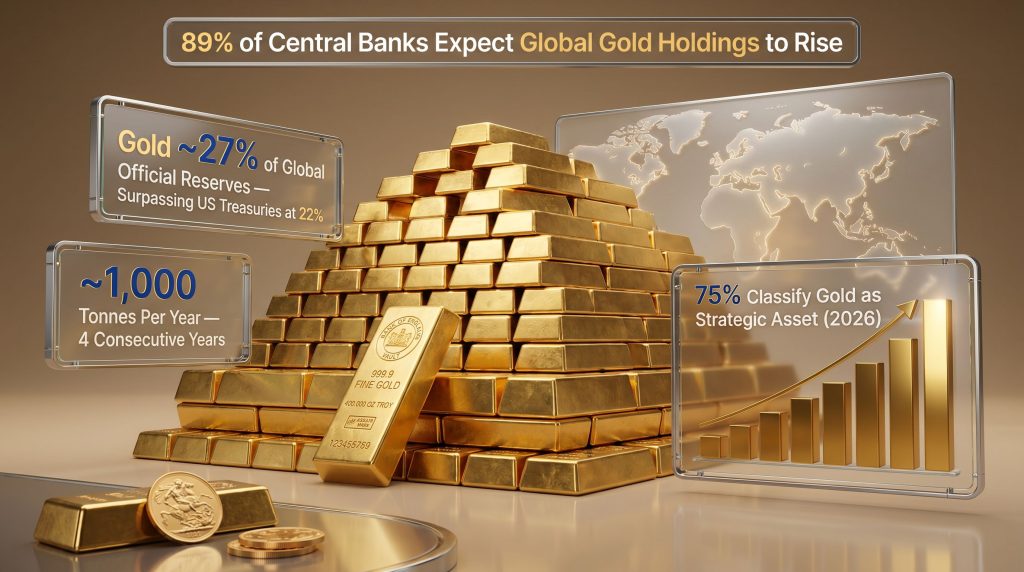
Gold now accounts for approximately 27% of total global official reserves by market value, surpassing US Treasuries at 22% for the first time since the mid-1990s, according to the European Central Bank's June 2026 report on the international role of the euro. IMF COFER data from Q3 2025 places gold at 26% of total reported reserves when foreign exchange and gold are measured together.
Dollar-denominated assets retain the largest single-currency share at approximately 42% of total reserves, but this figure has been on a declining trajectory. The dollar's reserve share is being reduced by both deliberate diversification decisions and a shift in the volume of holdings being accumulated. In this context, central bank gold reserves have become a closely watched indicator of broader shifts in the international monetary order.
The Volume Behind the Valuation Shift
Gold's price appreciation of roughly 60% during 2025 mechanically elevated its reserve share through valuation effects alone. However, valuation is not the complete explanation. Central banks have collectively purchased approximately 1,000 tonnes of gold per year over the four years to 2026, which is double the roughly 500-tonne annual average recorded during the preceding decade, according to the World Gold Council.
This is the distinction between a price-driven trend and a structural one. Valuation effects reverse when prices fall. Volume accumulation at this pace reflects institutional decision-making that is policy-driven and unlikely to reverse with a quarterly price correction.
Forward Expectations Among 76 Reserve Managers
| Expectation | Share of Survey Respondents |
|---|---|
| Global central bank gold holdings will continue rising | 89% |
| Own institution plans to increase gold allocation in next 12 months | 45% (record high) |
| Gold's reserve share will be higher in five years | 84% |
| US dollar's reserve share will be lower in five years | 74% |
Source: World Gold Council Central Bank Gold Reserves Survey 2026
Why Reserve Managers Hold Gold: The Ranked Motivations
Institutional Due Diligence Produces a Consistent Answer
The World Gold Council's 2026 survey asked 76 reserve managers to identify the primary reasons for holding gold. The results reveal a clear hierarchy of motivations, and several of the figures represent record highs.
- Resilience during financial market stress – cited by 90% as highly or somewhat relevant (a record)
- Long-term store of value and inflation hedge – 84%
- Portfolio diversification – 83%
- Geopolitical risk hedge – cited by 85% of emerging market and developing economy central banks, compared with 56% among advanced economy institutions
- Return enhancement – 37% now actively managing gold for its return contribution, up from predominantly passive stances in prior years
- Risk management – 42% cite this as a primary objective, sharply higher than the 22% recorded in 2025
The stress resilience figure deserves particular attention. Gold's correlation with equities and bonds is low under normal conditions. During acute market stress, that relationship can invert. When asset classes that are normally uncorrelated begin moving together during a crisis, gold has historically moved in the opposite direction, reinforcing its safe-haven role of gold precisely when portfolios need it most.
The EMDE and Advanced Economy Divergence
Emerging market and developing economy central banks are approximately 40% more likely than their advanced economy counterparts to identify geopolitical instability as a top reserve management concern, at 95% versus 67% among advanced economy institutions. This divergence explains why EMDE institutions are driving the majority of global accumulation volume.
The behavioural evidence supports this: 53% of EMDE central banks plan to increase their gold holdings within the next twelve months. Countries with the greatest concentration of dollar-system exposure have demonstrated the most aggressive accumulation behaviour over the past four years.
Recent notable accumulation patterns underscore this dynamic. Poland added over 100 tonnes in 2025 alone, bringing its total to approximately 550 tonnes. China has added more than 350 tonnes since 2022. India and Turkey have also been significant buyers, although Turkey sold or loaned back roughly 130 tonnes in early 2026, illustrating that not all accumulation programmes proceed in a straight line.
How Central Banks Finance and Execute Gold Purchases
The Three Funding Pathways
The mechanics of how central banks pay for gold purchases reveal important strategic logic that goes beyond the asset allocation decision itself.
| Funding Method | Share of Central Banks Using This Approach |
|---|---|
| Domestic programmes denominated in local currency | 50% |
| Sale of existing reserve assets | 38% |
| Newly accumulated reserve inflows | 32% |
Source: World Gold Council Central Bank Gold Reserves Survey 2026
The domestic local-currency programme deserves closer examination. When a central bank acquires gold from domestic producers using its own currency, it obtains a non-dollar reserve asset without engaging the US dollar settlement system at any stage of the transaction. The reserve diversification objective and the de-dollarisation objective are consequently achieved simultaneously through a single operational decision.
Operational Standards: How Gold Is Acquired and Stored
Purchase Format
- 62% of central banks specify London Good Delivery bars as their preferred acquisition format
- These are the LBMA-standardised 400-troy-ounce bars that form the backbone of institutional gold trading
- Most transactions are executed through the over-the-counter market centred in London
Vaulting Location Preferences (2026 Survey)
| Storage Location | Share of Central Banks |
|---|---|
| Bank of England, London | 57% |
| Domestic storage | 49% |
| Bank for International Settlements | 16% |
| Federal Reserve Bank of New York | 14% |
| Swiss National Bank | 6% (down from 12% in 2025) |
Source: World Gold Council Central Bank Gold Reserves Survey 2026
The Accelerating Trend Toward Custody Diversification
The same logic that drives reserve asset diversification is now being applied to physical custody arrangements. Concentrating gold in a single vault location creates a form of operational counterparty risk that reserve managers are increasingly unwilling to accept.
- In 2025, just 2% of central banks had diversified their overseas vaulting locations
- By 2026, 10% had completed such diversification
- A further 9% plan to diversify their custody arrangements within the next twelve months
The sharp decline in Swiss National Bank vaulting preferences, from 12% to 6% in a single year, reflects this rebalancing in action. Meanwhile, 76% of central banks now manage gold as a distinct, separately administered asset class rather than folding it into a broader reserve pool, reinforcing the shift from passive holding to active portfolio management.
The next major ASX story will hit our subscribers first
What the Institutional Framework Reveals for Long-Term Investors
Applying Reserve Management Logic at Any Scale
The safety-liquidity-return hierarchy does not require institutional scale to be conceptually valid or practically applicable. The underlying logic is the same regardless of portfolio size. In addition, decisions around physical gold vs ETFs mirror the same institutional considerations around counterparty risk and accessibility that central banks weigh when structuring their own positions.
The most significant data point in the 2026 survey is not the volume of purchases, but the qualitative shift: three in four central banks now classify their gold position as a deliberate strategic choice rather than an inherited legacy holding. When institutions with the deepest analytical resources and the longest investment horizons reach a consistent conclusion, the signal extends beyond any single market cycle.
| Reserve Management Principle | Institutional Application | Individual Investor Equivalent |
|---|---|---|
| Safety (no counterparty risk) | Physical gold with no foreign sovereign exposure | Physical bullion held outright, not paper claims or ETF shares |
| Liquidity (convertible at scale, any time) | OTC market access, BIS collateral eligibility | Holding sufficient quantity to avoid forced selling at inopportune moments |
| Return (purchasing power preservation) | Long-run real value focus, not yield optimisation | Owning gold for decade-scale protection, not short-term price speculation |
A Signal Worth Understanding
Seventy-six reserve management institutions, collectively operating with hundreds of economists and multi-generational mandates, conducted formal analytical review in 2026 and the direction of their conclusions was consistent. The record-high 45% planning to increase their own allocations, combined with the 89% expecting global holdings to keep rising, represents an institutional consensus that is rarely this clear in financial markets.
Furthermore, central bank gold demand at this sustained level provides an important structural underpinning to the broader market that individual investors would do well to understand. For the individual investor seeking a framework rather than a forecast, the reserve management model offers a durable starting point: prioritise assets that cannot default, ensure access without being forced to sell, and measure success in decades rather than quarters.
Key Statistics: Central Bank Gold Reserves Survey 2026
| Metric | Data Point |
|---|---|
| Survey respondents | 76 central banks |
| Participation rate | 51% |
| Plan to increase gold allocation in next 12 months | 45% (record high) |
| Expect global central bank gold holdings to continue rising | 89% |
| Classify gold as a deliberate strategic asset | 75% (up from 64% in 2025) |
| Cite market stress resilience as a key reason for holding gold | 90% |
| Cite long-term store of value and inflation hedge | 84% |
| Cite portfolio diversification | 83% |
| Gold's current share of global official reserves | ~27% (surpassing US Treasuries at 22%) |
| Average annual central bank gold purchases over the past four years | ~1,000 tonnes |
| EMDE central banks planning to increase holdings | 53% |
| Prefer Bank of England for primary vaulting | 57% |
| Use domestic storage | 49% |
Sources: World Gold Council Central Bank Gold Reserves Survey 2026; ECB International Role of the Euro, June 2026; IMF Currency Composition of Official Foreign Exchange Reserves (COFER) database
Frequently Asked Questions: How Central Banks Decide How Much Gold to Hold
Why do central banks prefer gold over simply holding more foreign currency?
Foreign currency reserves are, at their core, claims on the issuing sovereign. They are exposed to that government's monetary policy decisions, subject to sanctions mechanisms, and carry the credit risk of the issuing institution. Physical gold carries none of these liabilities. It exists outside any nation's financial system and satisfies the primary reserve management criterion — unconditional safety — in a way no currency can replicate. The Brookings Institution has examined this distinction at length, concluding that gold's unique position outside the sovereign credit framework makes it structurally irreplaceable as a reserve asset.
Is there a universal standard for how much gold a central bank should hold?
No universal formula governs gold allocation size. Each institution determines its own target based on policy objectives, existing reserve composition, currency exposure profile, and geopolitical risk assessment. The trend across methodologies is clearly toward larger and more deliberately sized positions, however the specific allocation varies widely across institutions and regions.
Does gold's absence of yield make it less competitive as a reserve asset?
Reserve managers consistently rank return as the third priority, behind safety and liquidity. Gold's lack of a coupon payment is a well-understood characteristic within the reserve management framework, accepted because its primary function is capital preservation and crisis-period protection rather than income generation. The growing minority of central banks now actively managing gold for return contribution treat that as a secondary benefit, not the primary justification.
Which regions are generating the most significant increases in gold reserves?
Emerging market and developing economy central banks are the primary drivers of accumulation growth. Institutions in countries with the highest concentration of dollar-system exposure, and therefore the greatest sensitivity to geopolitical reserve risk, have been the most consistent buyers over the past four years. EMDE central banks report a 53% likelihood of increasing their holdings within the next twelve months, materially higher than the equivalent figure among advanced economy institutions.
What does sustained central bank demand at this level mean for the gold market?
With approximately 1,000 tonnes of annual net purchases sustained over four consecutive years, and with 89% of surveyed institutions expecting global holdings to continue rising, the structural demand base beneath the gold market remains substantially elevated relative to the prior decade. This is a market factor independent of any price forecast. Central bank demand at double the historical average pace is a material input into supply and demand dynamics, though past purchasing patterns are not a guarantee of future price outcomes.
This article is for informational and educational purposes only. It does not constitute financial or investment advice. All data is sourced from the World Gold Council Central Bank Gold Reserves Survey 2026, the European Central Bank's International Role of the Euro report (June 2026), and the IMF Currency Composition of Official Foreign Exchange Reserves (COFER) database. Investors should conduct their own due diligence and consult a qualified financial adviser before making investment decisions. Past performance is not indicative of future results.
Want to Know Which ASX Mineral Discoveries Are Attracting Institutional-Scale Attention Right Now?
Discovery Alert's proprietary Discovery IQ model delivers real-time alerts on significant ASX mineral discoveries, instantly converting complex geological data into actionable investment insights for both short-term traders and long-term investors — explore historic discovery returns that illustrate just how transformative major finds can be, then begin your 14-day free trial at Discovery Alert to position yourself ahead of the broader market.