June 18, 2026
When Price Does the Heavy Lifting: South Africa's External Balance in a New Commodity Era
There is a phenomenon in resource economics that rarely receives the attention it deserves: the capacity of price to outperform volume. For most commodities, conventional wisdom links export revenue growth to production expansion. More tonnes mined, more barrels pumped, more revenue earned. Yet gold has long defied this logic, and South Africa's Q1 2026 current account data offers one of the clearest modern illustrations of how the South Africa current account surplus and gold exports can reshape a nation's external financial position without a single additional gram being pulled from the ground.
Understanding this dynamic matters well beyond South Africa's borders. It touches on how emerging markets with mineral-intensive export profiles manage macroeconomic volatility, how refinery architecture concentrates export leverage, and what the interplay between geopolitical risk and commodity pricing means for sovereign financial health.
When big ASX news breaks, our subscribers know first
South Africa's Q1 2026 Current Account Surplus: The Headline Numbers in Context
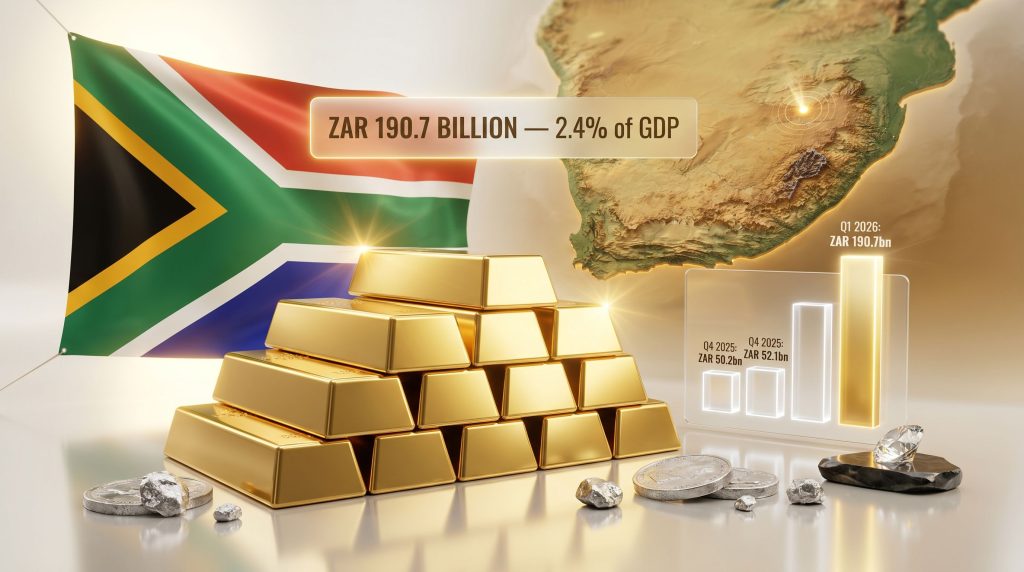
South Africa recorded a current account surplus of ZAR 190.7 billion in the first quarter of 2026, equivalent to approximately USD 11.53 billion and representing 2.4% of GDP. That figure marks the strongest external balance position the country has achieved in more than four years, eclipsing the modest ZAR 50.2 billion surplus (0.6% of GDP) reported in Q4 2025 by a factor of nearly four. According to data from the South African Reserve Bank, this represents a significant structural shift in the nation's external accounts.
To appreciate the scale of this shift, consider the recent trajectory:
| Quarter | Current Account Balance (ZAR) | % of GDP |
|---|---|---|
| Q4 2025 | ZAR 50.2 billion | 0.6% |
| Q1 2026 | ZAR 190.7 billion | 2.4% |
For an emerging market economy navigating persistent infrastructure constraints, energy supply challenges, and global demand uncertainty, a swing of this magnitude carries material implications. A current account surplus reduces dependence on volatile capital inflows to finance external obligations, supports the domestic currency, and improves sovereign credit perception in international debt markets.
Breaking Down the Components
The current account encompasses three primary components: the trade balance in goods and services, net primary income (investment income flows), and net secondary income (transfer payments such as remittances). In Q1 2026, the dominant driver was unambiguously the goods trade balance, specifically the surge in net gold exports amplified by elevated global precious metal prices.
Combined exports of gold, platinum, diamonds, and jewellery reached ZAR 40.7 billion in March 2026 alone, a figure that illustrates just how concentrated South Africa's export earning power remains within the precious metals complex.
The Production Paradox: Less Gold Mined, More Export Value Captured
One of the most counterintuitive features of South Africa's gold sector is the inverse relationship between its historical output trajectory and its continued relevance to global bullion markets. At its 1970 peak, South Africa produced approximately 1,000 metric tons of gold annually, accounting for roughly 70% of global non-communist world output at the time. Today, annual production has compressed to approximately 90 metric tons, a decline exceeding 90% from peak levels.
| Era | Approximate Annual Gold Output |
|---|---|
| Peak (1970) | ~1,000 metric tons |
| Current (2025-2026) | ~90 metric tons |
Yet this dramatic volume reduction has not reduced South Africa to a peripheral player in global gold trade. Several structural factors explain why.
The Rand Refinery's Strategic Role
The Rand Refinery, located in Germiston near Johannesburg, is one of the largest and most technically sophisticated gold refining operations in the world. It processes virtually all domestically mined gold as well as significant volumes of imported doré from across the African continent. Critically, an estimated 98 to 99% of refined output is directed to export markets, making it one of the most export-intensive refining facilities globally.
This architecture means that South Africa functions not merely as a gold mining nation but as a regional refining hub. Doré bars from operations across sub-Saharan Africa travel to Germiston for processing into London Good Delivery bars before entering global bullion markets. The value-added nature of this activity means South Africa captures refining margin on metal it did not mine, inflating export revenue beyond what domestic production volumes alone would suggest.
This is a lesser-known but commercially significant dimension of South Africa's gold export story. The country's export statistics reflect refined gold output, not just domestically mined gold, which consistently overstates the connection between local production levels and export earnings.
Why Grade Matters in South Africa's Remaining Deposits
South Africa's surviving gold mines are among the deepest in the world, with operations at mines such as Mponeng extending beyond 4 kilometres below surface. At these depths, orebody grades, while historically rich by global standards, become increasingly expensive to access due to elevated rock temperatures (sometimes exceeding 60 degrees Celsius at face), high seismic activity, and the energy intensity of ventilation and cooling systems.
The Witwatersrand Basin, which hosts virtually all of South Africa's remaining gold endowment, produces ore from ancient Archaean-age conglomerate reefs. These reefs are characterised by their placer-style gold concentration within carbon leader and vaal reef horizons. While grades can reach 8 to 15 grams per tonne in higher-quality zones, the depth and structural complexity of extraction makes all-in sustaining costs among the highest globally, typically ranging between USD 1,400 and USD 1,800 per ounce for deep-level operations.
This cost structure creates a leverage dynamic that is particularly relevant in high-price environments. Furthermore, gold price leverage becomes especially pronounced when gold trades above USD 2,500 per ounce, as deep-level South African operations generate meaningful margins that would be entirely absent at USD 1,200 per ounce prices. Elevated global prices therefore do not merely increase revenue linearly; they convert previously marginal tonnes into viable production, potentially extending mine life and supporting capital investment decisions.
What External Forces Elevated Precious Metal Prices in Early 2026?
The macro backdrop driving precious metal valuations into Q1 2026 combined several reinforcing forces:
-
Geopolitical risk premiums stemming from ongoing conflicts and supply chain disruptions elevated gold safe-haven demand for gold across institutional and retail investor categories globally.
-
Central bank accumulation continued at pace, with central bank gold demand maintaining or expanding gold reserve positions as a hedge against US dollar concentration risk in reserve portfolios.
-
Platinum group metal (PGM) supply concerns linked to South African energy disruptions and labour disputes supported platinum pricing independently of gold movements, adding to the combined precious metals export revenue pool.
-
Currency dynamics played a compounding role: rand weakness relative to the US dollar amplifies the rand-denominated value of gold exports even when USD gold prices are stable, creating a natural hedge for South Africa's resource export sector against domestic economic pressures.
When geopolitical shocks compress global risk appetite and elevate uncertainty premiums across financial markets, resource-exporting nations with significant precious metal exposure can experience disproportionate current account improvements even without any increase in domestic production capacity. South Africa's Q1 2026 data is a live case study in this mechanism.
Precious Metals Concentration: Strength and Structural Vulnerability
The degree to which South Africa's export profile depends on precious metals creates a risk profile that demands careful analytical attention. In 2025, precious metals including gold, platinum, and diamonds accounted for 44.7% of South Africa's exports to the United States, a concentration that would be considered extreme by the standards of most diversified economies.
| Export Category | Share of Total Exports to the US (2025) |
|---|---|
| Precious metals (gold, platinum, diamonds) | 44.7% |
| Other export categories | 55.3% |
This concentration is simultaneously South Africa's greatest external balance asset and its most significant source of macroeconomic vulnerability. When commodity prices rise, the current account improves rapidly and forex earnings support the rand. When prices fall, however, the reverse dynamic can be equally swift and brutal.
Peer emerging market economies with comparable commodity concentration profiles illustrate the risk. For instance, Chile copper price cycles expose Chile's current account in a structurally similar way, while Indonesia's reliance on nickel and palm oil creates analogous boom-bust external balance dynamics. In each case, the medium-term lesson is consistent: commodity price windfalls rarely translate into durable current account improvement unless accompanied by structural economic diversification.
Currency Transmission and Sovereign Perception
The relationship between South Africa's current account surplus and the South African rand operates through several channels simultaneously. A widening trade surplus generates increased demand for rand as foreign buyers convert their currencies to settle South African export invoices. This demand supports the currency, which in turn reduces imported inflation pressure and lowers the cost of servicing rand-denominated external debt.
Beyond currency mechanics, a current account surplus also signals to sovereign credit analysts and ratings agencies that an economy is generating sufficient export revenue to service its external obligations without drawing down reserves or increasing external borrowing. For South Africa, which has faced persistent scrutiny over its fiscal deficit and state-owned enterprise liabilities, a Q1 2026 surplus of this magnitude provides a meaningful, if potentially temporary, improvement in the external dimension of the sovereign credit narrative.
The next major ASX story will hit our subscribers first
Is the Q1 2026 Surplus Sustainable? Structural vs. Cyclical Drivers
This is the critical question confronting analysts assessing the macro significance of the Q1 2026 data. The honest answer is that the surplus almost certainly contains a substantial cyclical component driven by elevated precious metal prices, which may or may not persist. The gold price record highs observed through this period have been a key catalyst, and their continuation remains uncertain.
Scenario Modelling: Three Trajectories
| Scenario | Key Assumption | Likely Current Account Outcome |
|---|---|---|
| Bullish | Precious metal prices remain elevated; refinery throughput increases | Sustained surplus above 2% of GDP |
| Base Case | Prices moderate; domestic output stable at ~90 tons | Surplus narrows to 0.8-1.2% of GDP |
| Bearish | Price correction; energy disruptions reduce refinery capacity | Return to deficit conditions |
Several structural constraints limit the upside scenario:
-
Energy supply reliability remains a persistent challenge for deep-level mining operations, with load curtailment events directly reducing hoisting capacity and processing throughput.
-
Labour dynamics in the mining sector involve complex multi-union bargaining processes that periodically disrupt production schedules at critical operations.
-
Capital investment cycles in deep-level mining operate over decade-long horizons, meaning any recovery in output volumes would require sustained price incentives before triggering meaningful new investment.
-
Tailings and surface mining opportunities represent a potentially underappreciated upside: several South African operators are advancing projects to reprocess historical mine dumps using modern extraction technology, which could add incremental volume at relatively low capital intensity.
Implications for African Mining Investment and Regional Spillover
South Africa's Q1 2026 current account data carries analytical relevance beyond its own borders. As the continent's most developed mining jurisdiction and the anchor economy for Southern African regional trade, South Africa's export performance influences investor sentiment toward the broader African minerals sector.
Strong South African precious metals export data reinforces narratives around African resource wealth and the continent's capacity to generate significant foreign exchange earnings from its mineral endowment. For neighbouring jurisdictions including Zimbabwe, Zambia, and Tanzania, which are advancing their own gold and platinum development pipelines, South Africa's refinery infrastructure represents both a processing destination and a benchmark for value-chain positioning.
The broader lesson for African resource economies seeking to replicate this dynamic is that value-added processing, not raw ore export, is where export revenue leverage is maximised. South Africa's Rand Refinery model, capturing refining margin on both domestic and imported metal, represents a template that other African nations with developing mining sectors could study carefully.
Frequently Asked Questions: South Africa Current Account Surplus and Gold Exports
What caused South Africa's current account surplus to reach a four-year high in Q1 2026?
The surplus was driven primarily by elevated global precious metal prices amplifying the rand value of net gold exports. The improvement reflected price dynamics rather than a recovery in domestic production volumes. Consequently, the South Africa current account surplus and gold exports relationship has once again demonstrated how price-driven revenue can outperform volume-driven growth.
How do gold exports influence South Africa's GDP and foreign exchange reserves?
Gold export revenues increase the supply of foreign currency entering the South African economy, supporting rand stability and contributing to gross domestic product through export income. The South African Reserve Bank holds gold as part of its official reserves, which provides a buffer against external payment obligations.
Is South Africa still one of the world's major gold producers?
South Africa has declined significantly from its historic dominance. At approximately 90 metric tons annually, it no longer ranks among the top three global producers, with China, Australia, and Russia now leading by volume. However, through the Rand Refinery's regional processing role, South Africa remains highly relevant to global bullion supply chains.
What percentage of South Africa's exports are precious metals?
Precious metals including gold, platinum, and diamonds accounted for approximately 44.7% of South Africa's exports to the United States in 2025, reflecting a high degree of commodity concentration in the export basket.
How does the Rand Refinery contribute to South Africa's gold export volumes?
The Rand Refinery processes an estimated 98 to 99% of its refined output for export, and handles not only domestically mined gold but also imported doré from across sub-Saharan Africa. This regional processing role inflates South Africa's export revenue beyond what its own mine production volumes would generate independently.
Could the current account surplus reverse if gold prices decline?
Yes. Given the high concentration of precious metals in the export basket, a sustained decline in gold and platinum prices would compress export revenues materially, narrowing or eliminating the surplus. The Q1 2026 position reflects favourable cyclical conditions that are not guaranteed to persist. Indeed, broader coverage of the surplus has similarly cautioned against interpreting the result as a structural shift without further evidence.
Key Takeaways
-
South Africa's Q1 2026 current account surplus of ZAR 190.7 billion (2.4% of GDP) is the strongest external balance outcome in over four years.
-
The improvement was driven by elevated precious metal prices amplifying net gold export values, not by any recovery in domestic production.
-
Annual gold output has fallen from approximately 1,000 metric tons at its 1970 peak to roughly 90 metric tons today, yet the Rand Refinery's regional processing role keeps South Africa central to global bullion trade.
-
Precious metals represented 44.7% of South Africa's US-bound exports in 2025, underscoring structural commodity concentration.
-
Deep-level mine grades of 8 to 15 grams per tonne in the Witwatersrand Basin create significant price leverage, converting marginal tonnes into viable production during high-price environments.
-
The sustainability of the South Africa current account surplus and gold exports dynamic depends heavily on whether current price conditions reflect durable geopolitical premiums or a temporary cyclical spike.
-
Value-added refining, not raw ore export, is where South Africa captures its greatest export revenue leverage, a model with broader instructive relevance for African resource economies.
This article contains forward-looking analysis and scenario modelling based on current available data. Macroeconomic conditions, commodity prices, and production volumes are subject to change. This content is intended for informational purposes only and does not constitute financial or investment advice. Readers seeking investment guidance should consult a qualified financial adviser.
Readers seeking additional context on South Africa's trade dynamics and mining sector performance can explore related industry coverage at miningandengreview.com, where ongoing reporting on Southern African resource sector developments offers complementary perspectives on the region's evolving export landscape.
Want to Track the Next Major Mineral Discovery Before the Broader Market Does?
Discovery Alert's proprietary Discovery IQ model delivers real-time alerts on significant ASX mineral discoveries, converting complex geological and commodity data into clear, actionable insights for both short-term traders and long-term investors — explore historic discoveries and their returns to understand the scale of opportunity, then begin your 14-day free trial to position yourself ahead of the market.