July 12, 2026
The Quiet Engine Behind Gold Prices: Understanding the Macro Architecture
Few financial relationships are as structurally important, yet as frequently misunderstood, as the one between central bank monetary policy and the price of gold. Most investors assume the connection is simple: rates go up, gold goes down. Rates fall, gold rises. In practice, the transmission mechanism is far more nuanced, and the investors who navigate it successfully are those who understand the layers of cause and effect operating beneath the surface.
The fed interest rates and gold outlook is not a single variable equation. It is a multi-channel dynamic involving real yields, dollar strength, inflation expectations, sovereign demand, and perhaps most critically, forward guidance from the Federal Reserve itself.
When big ASX news breaks, our subscribers know first
Why Forward Guidance Moves Gold More Than the Rate Decision Itself
The Mechanics Behind the Fed-Gold Relationship
Gold does not pay interest, dividends, or coupons. This single characteristic shapes everything about how it behaves in a rising-rate environment. When interest-bearing assets deliver meaningful real returns, capital naturally migrates toward them, reducing the relative attractiveness of holding a non-yielding store of value. This is the opportunity cost argument against gold, and it is well-founded in theory.
However, the opportunity cost framework breaks down when investors begin pricing in a deterioration of growth expectations, a fiscal crisis scenario, or persistent above-target inflation. In those environments, the yield on a Treasury bond provides little comfort if the purchasing power of the principal is being quietly eroded. Furthermore, the gold safe-haven role becomes increasingly prominent during such periods of financial stress.
How Interest Rate Expectations Shape Gold's Valuation
The gold market does not wait for the Federal Reserve to act. It prices in anticipated policy moves months in advance. This is why Fed meeting days often produce counterintuitive reactions: a rate hold that was fully priced in by markets may produce no movement at all in gold, while an unexpected shift in the tone of the accompanying press conference can trigger a significant repricing within minutes.
The most market-sensitive outputs from any Federal Open Market Committee meeting are not the rate decision itself but the dot plot projections showing where committee members expect rates to be in future periods, any revision to the statement language around future policy direction, and the tone of the Chair's press conference responses to journalist questions.
The Role of Real Yields in Gold's Price Discovery
Real yields, calculated as nominal Treasury yields minus prevailing inflation expectations, function as the single most reliable short-to-medium-term driver of gold prices. When real yields are deeply negative, as they were during much of 2020 and 2021, gold thrives because holding cash or short-duration bonds means accepting a guaranteed loss of purchasing power in real terms. When real yields turn positive and climb higher, gold faces structural headwinds.
The critical insight here is that the direction of travel matters more than the absolute level. Gold can perform well even in a nominally high-rate environment if inflation is rising faster than interest rates, keeping real yields suppressed or negative. Consequently, understanding gold and bond dynamics across economic cycles is essential for informed positioning.
What "Higher for Longer" Actually Does to the Gold Market
Understanding the Transmission Channels: Treasury Yields and the U.S. Dollar
A sustained higher-for-longer rate environment creates a dual headwind for gold through two interconnected channels. First, elevated Treasury yields increase the opportunity cost of holding gold, as discussed above. Second, and often more immediately impactful, higher U.S. rates attract global capital flows into dollar-denominated assets, strengthening the U.S. Dollar Index (DXY). Because gold is priced in dollars globally, a stronger dollar mechanically makes gold more expensive in other currencies, reducing international demand and adding downward pressure to prices.
These two forces can compound each other, creating sharp corrective phases in gold even during structurally bullish long-term periods.
Historical Precedent: How Gold Has Performed in Past Rate-Hold Cycles
History does not provide a clean template, but it does offer useful patterns. During the 1994 to 1995 rate-tightening cycle, gold remained largely range-bound before resuming its longer-term trajectory. The 2004 to 2006 hiking cycle saw gold actually appreciate meaningfully as fiscal concerns and dollar weakness offset the rate headwinds. The post-2022 rate cycle produced a period of consolidation followed by a significant breakout, demonstrating that structural demand drivers can overwhelm cyclical headwinds over time.
"The gold market consistently rewards investors who focus on the underlying demand architecture rather than reacting to each individual rate decision in isolation."
Why Gold's Non-Yielding Nature Matters More in This Cycle
The current environment differs from prior cycles in one important respect: short-term cash instruments are yielding genuine real returns for the first time in roughly fifteen years. This creates a legitimate competing alternative to gold that did not exist during the near-zero rate era, making the opportunity cost argument more powerful than it has been in recent memory.
However, this dynamic can shift rapidly. The moment growth expectations deteriorate meaningfully, or the Federal Reserve signals a credible pivot toward easing, the attractiveness of cash instruments collapses quickly, and capital that had rotated away from gold can return with considerable velocity.
Three Critical Questions Gold Investors Should Ask After Every Fed Meeting
Question 1: Did the Fed Sound More Hawkish Than Markets Expected?
If the Federal Reserve's communication is more hawkish than the market had priced in, gold typically faces immediate selling pressure as traders reprice the duration of the high-rate environment. The key is not whether the Fed is hawkish in absolute terms, but whether it is more hawkish than the consensus expectation heading into the meeting. According to recent analysis from Reuters, gold's reaction to Fed decisions is frequently driven by this divergence between expectation and outcome.
Question 2: Did Treasury Yields and the Dollar Rise Further After the Decision?
The post-meeting reaction in the Treasury market and the currency market provides a real-time calibration tool. If the 10-year yield and the DXY both push higher in the hours following a Fed decision, the dual headwind for gold is intensifying. If they reverse despite a nominally hawkish decision, that divergence can be a meaningful signal that the market believes the rate cycle is near its terminal phase.
Question 3: Has the Fed Kept the Door Open to Rate Cuts?
Forward guidance language that preserves optionality around rate cuts provides gold with a medium-term support layer, even if no cut is imminent. Conversely, if the Fed removes language that previously suggested cuts were possible, the signal is meaningfully bearish for near-term gold positioning. The broader fed interest rates and gold outlook therefore hinges heavily on how this language evolves from meeting to meeting.
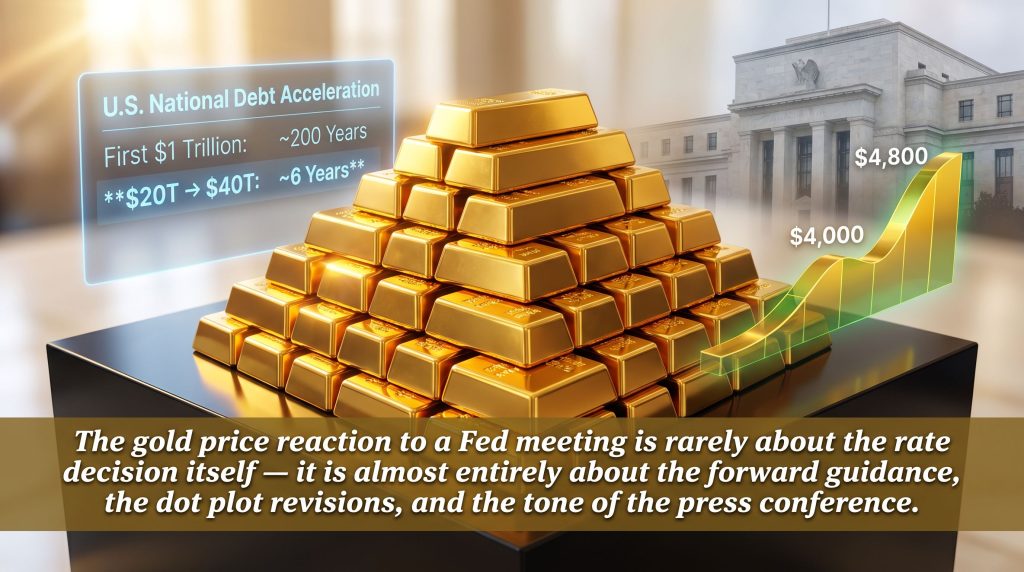
"The gold price reaction to a Fed meeting is rarely determined by the rate decision itself. The market moves on forward guidance revisions, dot plot changes, and the qualitative tone of the Chair's communication."
How Sentiment Cycles Work in Precious Metals Markets
Understanding the Sentiment Pendulum
One of the most reliable and underutilised frameworks for gold market analysis involves tracking the extremes of investor sentiment rather than the direction of price. The precious metals market, perhaps more than any other asset class, oscillates between euphoric optimism and deep pessimism with a regularity that creates identifiable entry and exit signals for contrarian investors.
A meaningful corrective phase in gold often produces a complete sentiment reversal. Commentators who were previously projecting prices of $10,000 within a short timeframe shift rapidly to declaring the bull market over, targets of $3,000 or lower emerge in financial media, and institutional allocation to gold mining equities collapses. This dynamic was observable during gold's recent corrective period, which followed a run of triple-digit percentage gains over the prior multi-year cycle.
A particularly striking sentiment signal emerged during this recent correction: the gold mining index bullish percentage reading fell to zero, a level that veteran precious metals investors note had not been observed even during the most severe prior bear markets. For contrarian analysts, this type of extreme reading carries significant weight.
The Sentiment Table: Reading the Market's Emotional State
| Sentiment Indicator | Bullish Phase Signal | Bearish Phase Signal | Contrarian Interpretation |
|---|---|---|---|
| Gold Mining Index Bullish % | Near 80-100% | Near 0% | Extreme lows often precede reversals |
| Retail Investor Positioning | Heavy accumulation | Mass capitulation | Capitulation zones may mark bottoms |
| Media Coverage Tone | Gold to $10,000 headlines | Bull market is over narratives | Narrative extremes signal turning points |
| Central Bank Buying Activity | Sustained accumulation | Reduction in activity | Institutional demand provides price floor |
The core insight embedded in this framework is that when virtually every market participant has shifted to a bearish posture, the sellers have largely already acted. The incremental selling pressure diminishes, and even modest positive catalysts can produce disproportionately sharp recoveries.
Bull Case vs. Bear Case: A Structured Comparison
Mapping the Scenario Matrix for Gold
Understanding both the bull and bear cases with equal rigour is essential for informed gold positioning. Each scenario carries its own transmission mechanism and its own set of observable leading indicators.
| Factor | Bull Case for Gold | Bear Case for Gold |
|---|---|---|
| Fed Policy Direction | Dovish pivot or rate cuts materialise | Higher-for-longer, no cuts in 2025 |
| U.S. Dollar Trajectory | Weakening DXY | Sustained dollar strength |
| Treasury Yields | Declining real yields | Rising or sticky real yields |
| Inflation Dynamics | Persistent above-target inflation | Rapid disinflation |
| Equity Market Conditions | Risk-off correction | Continued melt-up rally |
| Central Bank Demand | Sustained sovereign accumulation | Reduction in reserve diversification |
| Geopolitical Risk | Elevated global tensions | De-escalation and stability |
Scenario A: The Fed Pivots More Dovish Than Expected
A faster-than-anticipated shift toward easing would compress real yields rapidly, weaken the dollar, and potentially trigger a sharp rerating of gold prices. This scenario tends to produce the most violent upside moves in precious metals, as positioning shifts dramatically in a short period. In addition, reviewing the current gold price outlook suggests that geopolitical tailwinds could amplify any Fed-driven repricing.
Scenario B: Growth Slows and Risk Assets Come Under Pressure
If the equity market's extended melt-up eventually reverses, gold's safe-haven characteristics re-emerge as a primary driver of demand. In prior cycles, meaningful equity corrections have produced gold buying that more than offset the headwinds from the rate environment.
Scenario C: Persistent Inflation Keeps Real Yields Suppressed
Energy prices remain a critical variable in this scenario. The relationship between oil supply dynamics and headline inflation readings is direct and mathematically significant. If geopolitical factors sustain energy prices above prior cycle levels, the pathway back to the Fed's inflation target becomes considerably more challenging.
The transmission chain operates as follows:
- Geopolitical instability constrains global oil supply expectations
- Energy prices remain structurally elevated above prior cycle lows
- Gasoline costs sustain headline inflation readings above Fed targets
- The Fed maintains a restrictive stance or delays any rate cut timeline
- Gold faces near-term headwinds from elevated nominal yields
- However, persistent inflation simultaneously reinforces gold's long-run store-of-value thesis
The next major ASX story will hit our subscribers first
Why Central Bank Gold Buying Is the Most Underappreciated Market Dynamic
The Scale of Sovereign Accumulation
Central bank gold demand became the dominant marginal force in gold markets beginning in 2022, and that accumulation has continued at a pace that represents a structural shift in the demand architecture of the market. According to World Gold Council data, central banks purchased over 1,000 tonnes of gold in both 2022 and 2023, representing the highest sustained buying pace in decades.
This demand is not interest-rate sensitive in the way that retail or institutional investment demand is. Sovereign buyers are motivated by reserve diversification, reduction of U.S. dollar dependency, geopolitical risk management, and the long-term stability characteristics of physical gold. These motivations persist regardless of whether the Federal Reserve is hiking, holding, or cutting.
Gold Repatriation as a Signal of Structural Conviction
An often-overlooked dimension of central bank gold activity is the repatriation of reserves held in foreign custody. Multiple sovereign nations have moved to bring gold reserves stored in the U.S. or European financial system back into domestic custody. Furthermore, central bank gold reserves data indicates this trend is accelerating across multiple jurisdictions.
This action carries a qualitative signal that goes beyond the purchase volume figures: it reflects a desire for direct possession and control, suggesting these buyers view their gold holdings as a long-term strategic asset rather than a financial instrument that might be sold in response to short-term market conditions.
"When the largest institutional actors in the global financial system are consistent net buyers and are actively repatriating reserves, it establishes a structural demand baseline that short-term rate dynamics cannot easily override."
The Speculative Dimension: Gold-Backed Treasury Instruments
One potential policy development worth monitoring, though firmly in the speculative category at this stage, is the prospect of U.S. Treasury instruments with some form of gold backing. Proposals along these lines have been discussed in policy circles by figures including economist Judy Shelton. If such an instrument were ever formally introduced, it would represent a structural increase in sovereign demand for gold reserves and could provide a powerful long-term price catalyst. However, this remains an unconfirmed and speculative scenario, and investors should treat it accordingly.
The U.S. Debt Trajectory and Gold's Structural Long-Term Case
Understanding the Exponential Debt Accumulation Problem
The long-term structural argument for gold ownership is perhaps best illustrated through the lens of U.S. fiscal dynamics. The acceleration in debt accumulation has followed a compressing timeline that carries significant implications for the long-term purchasing power of the dollar.
| Time Period | U.S. National Debt Milestone | Approximate Time Taken |
|---|---|---|
| Republic founding to 1981 | Reached $1 trillion | ~200 years |
| 1981 to approximately 2008 | $1 trillion to $10 trillion | ~27 years |
| 2008 to approximately 2020 | $10 trillion to $20 trillion | ~12 years |
| 2020 to approximately 2026 | $20 trillion to $40 trillion | ~6 years |
The compression of the doubling timeline from centuries to decades to years represents a structural argument for holding assets outside the fiat monetary system. Whether or not any individual rate decision favours gold in the short term, the cumulative trajectory of sovereign debt issuance provides a durable long-run case for gold as a reserve asset.
Why Fiscal Sustainability Concerns Provide Multi-Year Support
Fiscal sustainability concerns operate on a different timescale than monetary policy cycles, but they ultimately feed into the same price discovery mechanism for gold. As debt levels grow and the cost of servicing that debt consumes an increasing share of government revenue, the pressure to inflate away the real value of outstanding obligations grows correspondingly. Gold's historical role as a hedge against currency debasement becomes more relevant, not less, as these dynamics intensify.
How to Structure a Gold Portfolio Across the Risk Spectrum
The Risk-Return Gradient From Bullion to Explorers
One of the most practically valuable frameworks for gold investors is understanding the spectrum of risk and return across different categories of gold exposure. Physical gold and gold ETFs provide approximately one-to-one participation in spot price movements, with high liquidity and low counterparty risk. Mining equities introduce operational and jurisdictional risk but also offer meaningful operating leverage to the gold price. According to J.P. Morgan's commodities research, this leverage dynamic remains a key consideration for portfolio construction across market cycles.
| Investment Category | Risk Level | Leverage to Gold Price | Liquidity | Suitable For |
|---|---|---|---|---|
| Physical Gold / ETFs | Low | 1:1 | High | Capital preservation, financial insurance |
| Senior Producers (e.g., Newmont, Barrick) | Low-Medium | 2:1 to 3:1 | High | Core portfolio exposure |
| Mid-Tier Producers | Medium | 3:1 to 5:1 | Medium | Growth-oriented investors |
| Development-Stage Companies | High | 5:1 to 10:1+ | Low-Medium | Speculative allocation |
| Pure Exploration Companies | Very High | Uncapped upside / full loss risk | Low | Small position sizing only |
Why Development-Stage Companies With Established Resources Offer a Middle Ground
For investors seeking leveraged exposure without the binary risk of pure exploration, development-stage companies that have progressed to a preliminary economic assessment or have an established resource estimate represent a middle category. These companies have demonstrated that a mineralised system exists and that it carries sufficient scale to potentially support an economic operation, while still offering the operational leverage and re-rating potential that is absent from senior producers.
The important distinction for due diligence purposes is between companies with a genuine, independently estimated mineral resource and those with only historical or informal data. The former carries a substantially different risk profile. Pure exploration, by contrast, remains a high-risk, binary proposition where position sizing discipline is essential.
Gold as Financial Insurance, Not Just Speculation
A perspective worth separating from the capital appreciation argument is the role of gold as portfolio insurance. Investors who held physical gold prior to periods of acute financial stress, currency crises, or sovereign defaults in affected economies found that their gold holdings provided liquidity and purchasing power preservation precisely when other assets became difficult to value or sell. This insurance function operates independently of whether gold is expected to appreciate in price terms in the near term.
Key Price Levels and Technical Context
Understanding the $4,800 Resistance Zone
From a technical perspective, market participants have identified the $4,800 level as a structurally significant resistance zone. A sustained move above this level would, in the view of experienced precious metals analysts, remove any credible near-term bear case from consideration. Conversely, a temporary breach below $4,000, while psychologically significant, would not necessarily invalidate the longer-term bull thesis if accompanied by the broader demand drivers discussed throughout this analysis.
"In any asset class that has delivered triple-digit percentage gains over a multi-year period, a corrective and consolidation phase is not a sign of structural failure. It is a mathematical prerequisite for the next sustainable advance."
The corrective phase that followed gold's extended run represented a healthy technical development for the longer-term bull case. A market that advances in a straight line without consolidation accumulates excessive speculative positioning that ultimately becomes unstable.
The Political Dimension: Midterm Elections and Market Implications
Why Political Uncertainty Functions as a Macro Variable
U.S. midterm elections carry implications for markets that extend well beyond the domestic political narrative. The composition of Congress directly affects fiscal trajectory through its control over spending authorisation, debt ceiling negotiations, and tax legislation. A scenario involving meaningful political division in the legislative branch could produce budgetary gridlock, which historically has increased uncertainty across equity, bond, and currency markets.
For gold specifically, legislative uncertainty that complicates the government's ability to manage its fiscal trajectory reinforces the structural arguments for gold ownership outlined earlier in this analysis. A political environment that makes deficit reduction less achievable strengthens, rather than weakens, the long-run case for assets that operate outside the sovereign debt system. Consequently, the fed interest rates and gold outlook must always be evaluated alongside these broader political and fiscal variables.
FAQ: Fed Interest Rates and Gold Outlook
Does a Fed rate hold automatically mean gold prices will rise?
Not necessarily. The gold market responds primarily to changes in expectations rather than the rate decision itself. If a hold was fully anticipated and priced in by markets, gold may not move significantly unless the accompanying guidance contains a meaningful surprise.
What is the most important signal to watch from a Fed meeting?
The dot plot projections, the language around forward guidance, and the qualitative tone of the Chair's press conference are typically more market-moving than the rate decision itself. These outputs shape expectations for the path of rates over the following twelve to twenty-four months.
Why do central banks keep buying gold even when rates are high?
Central bank motivations for gold accumulation include reserve diversification, reduction of dollar dependency, geopolitical risk management, and long-term store-of-value considerations. These motivations are largely independent of short-term interest rate levels.
Is gold a reliable hedge against inflation?
Gold has historically performed well during periods of sustained above-target inflation, particularly when real interest rates are negative or declining. Its effectiveness as a short-term inflation hedge in any given quarter can vary significantly based on prevailing rate conditions.
How does the U.S. dollar affect gold prices?
Gold is priced in U.S. dollars in global markets. Dollar strength makes gold more expensive in other currencies, reducing international demand and applying downward pressure to prices. A weakening dollar reverses this dynamic.
What would gold-backed Treasury instruments mean for gold prices?
If the U.S. government were to issue Treasury instruments with gold backing, it would represent a structural increase in sovereign demand for gold reserves and could provide a significant long-term price catalyst. This remains speculative and unconfirmed policy at this stage.
Navigating Gold in a Fed-Driven Macro Environment
Synthesising the Bull and Bear Cases Into a Practical Framework
The most intellectually honest position on the fed interest rates and gold outlook acknowledges both the genuine near-term headwinds and the powerful structural tailwinds operating simultaneously. Elevated real yields and a strong dollar create legitimate cyclical pressure. Accelerating sovereign debt, persistent inflation risk, central bank accumulation, and potential currency diversification flows create a structural underpinning that is unlikely to resolve in a single rate cycle.
The three-tier approach to gold exposure, allocating to physical gold or ETFs for insurance and capital preservation, senior producers for core portfolio exposure with income characteristics, and a measured allocation to development-stage companies for leveraged appreciation, provides a framework that captures multiple dimensions of the gold story without concentrating risk in any single category.
The most important discipline in this environment is separating the short-term noise of each Fed meeting from the multi-year structural dynamics that will ultimately drive gold's longer-term price trajectory. Those structural drivers, from sovereign debt acceleration to central bank reserve diversification, remain firmly intact regardless of what any individual FOMC meeting produces.
This article is intended for informational and educational purposes only and does not constitute financial or investment advice. Past performance of any asset class is not indicative of future results. Forecasts, price targets, and scenario analyses discussed herein involve significant uncertainty. Readers should conduct their own research and consult with a qualified financial adviser before making any investment decisions.
Want to Know When the Next Major Gold Discovery Hits the ASX?
Discovery Alert's proprietary Discovery IQ model scans ASX announcements in real time, instantly identifying significant mineral discoveries and turning complex data into actionable insights for both short-term traders and long-term investors — start your 14-day free trial today and see why historic discoveries have generated extraordinary returns.