June 17, 2026
Why Monetary Policy Leadership Moves Gold More Than Rates Alone
The relationship between central bank leadership and precious metals pricing is frequently misunderstood. Most investors fixate on rate decisions as discrete events, treating each FOMC meeting as a standalone catalyst. The more durable reality is that the Kevin Warsh Fed and gold prices dynamic does not simply hinge on where rates are set today. It responds to what kind of institution the Federal Reserve is perceived to be, who is steering it, and what philosophical framework will govern decisions for years ahead.
When a new Fed chair takes office, markets do not merely reprice the probability of a rate cut or hike. They reprice the entire policy architecture, including communication style, institutional credibility, and the long-run trajectory of real yields. Furthermore, that repricing process is often volatile, frequently overcorrects, and almost always misread in the short term.
That is precisely the environment gold investors are navigating right now.
When big ASX news breaks, our subscribers know first
The Three Channels Through Which Fed Policy Moves Gold
Understanding how central bank decisions transmit into precious metals prices requires mapping the actual mechanics, not just watching price charts. In addition, recognising gold and bond dynamics helps investors appreciate the full transmission picture.
There are three primary transmission channels:
- Real yield dynamics: Gold pays no interest or dividend. When inflation-adjusted returns on U.S. Treasuries rise, the opportunity cost of holding gold increases proportionally. This is historically the most powerful single driver of gold prices over the medium term.
- U.S. dollar direction: A hawkish Fed posture typically strengthens the dollar, creating a structural headwind for dollar-denominated commodities including gold. A weaker dollar does the opposite, reducing the cost of gold for international buyers and expanding global demand.
- Institutional trust and safe-haven demand: When confidence in the Fed's ability to manage inflation erodes, demand for alternative stores of value increases. Gold has functioned as a monetary insurance policy for centuries precisely because it exists outside the control of any single institution.
"Gold is not simply a hedge against inflation. It is a hedge against monetary policy uncertainty itself. A change in Fed leadership introduces a fresh layer of that uncertainty, independent of whether the incoming chair is perceived as hawkish or dovish."
Kevin Warsh: The Intellectual Profile Behind the Appointment
A Governor Who Left on Principle
Kevin Warsh served as a Federal Reserve Governor from 2006 through 2011. His resignation was not routine. He had supported the emergency interventions deployed during the 2008 financial crisis, but became a vocal critic of the institution's failure to unwind those extraordinary measures once the acute phase of the crisis had passed.
His stated intellectual influences include Milton Friedman and George Shultz, both associated with monetary discipline, limited central bank overreach, and rules-based frameworks. During his nomination hearings, Warsh explicitly stated that inflation remains above target and that further work is required to address it. He has consistently rejected the narrative that inflation can be attributed to external shocks rather than monetary policy failures.
Rules-Based vs. Discretionary: Why the Distinction Matters to Gold
The most consequential philosophical divide at the Fed is not between hawks and doves. It is between those who favour structured, rules-based decision-making and those who prefer discretionary, data-dependent judgment. Every Fed chair since Bernanke has operated in the discretionary camp, using forward guidance, dot plots, and conditional language to manage market expectations.
Warsh, however, is aligned with the rules-based camp. One specific tool associated with this approach is the Taylor Rule, a formula that prescribes a target interest rate based on the deviation of actual inflation from the 2% target and the deviation of actual unemployment from its natural rate.
| Policy Approach | Communication Style | Rate Predictability | Gold Market Implication |
|---|---|---|---|
| Discretionary (Powell era) | Forward guidance, dot plots, conditional language | Moderate | Reacts to guidance shifts and press conference tone |
| Rules-Based (Warsh philosophy) | Structured explainers, less forward guidance | Higher | Reacts to incoming inflation and employment data |
The shift from one framework to the other is not merely procedural. It fundamentally changes how gold investors must interpret Fed communications entirely.
What Actually Happened to Gold When Warsh Was Confirmed
The Initial Selloff and Its Limitations as a Signal
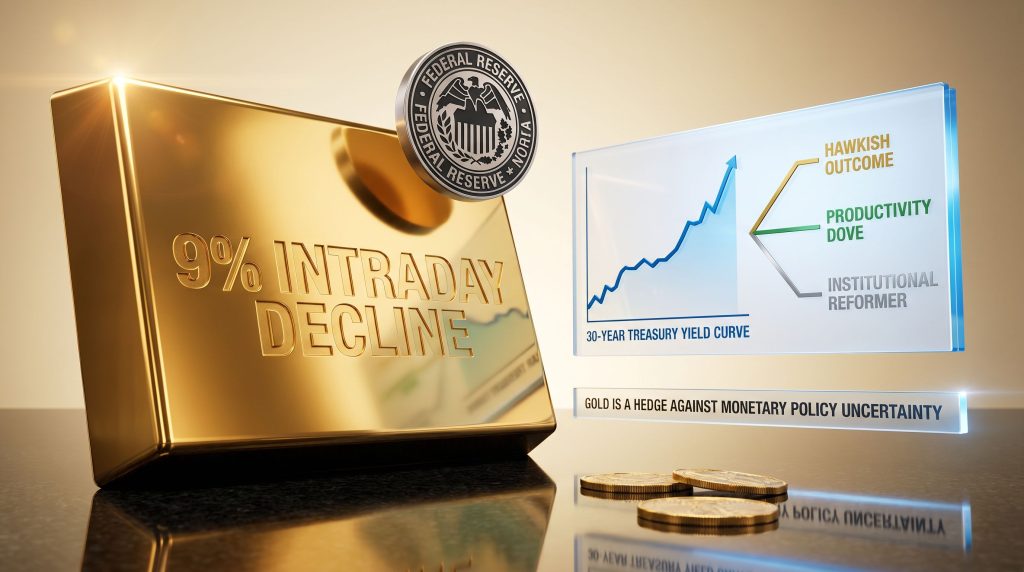
Gold experienced an approximate 9% intraday decline following confirmation of Warsh's appointment. Silver sold off in sympathy, though both markets subsequently recovered a portion of those losses. The market's initial read was straightforward: a more hawkish Fed chair implies higher real yields, a stronger dollar, and therefore weaker gold.
That interpretation is not wrong. It is, however, simply incomplete. Consequently, investors who anchor their positioning to the initial reaction risk misreading the structural picture entirely. For broader context on how these gold safe-haven dynamics play out during periods of institutional uncertainty, the pattern is well established.
Warsh has also expressed support for allowing the economy to pursue productivity-driven growth, which is not inherently rate-restrictive. His concern about inflation does not automatically translate into a prolonged period of elevated real yields if economic productivity accelerates faster than price pressures. The actual policy path will depend on which version of Warsh governs in practice.
"A single intraday price move does not establish a new structural trend. Investors who anchor their positioning to the initial reaction are pricing in a conclusion that the evidence does not yet support."
Three Scenarios for Gold Under Warsh's Fed Tenure
Scenario 1: The Hawkish Outcome
If Warsh prioritises inflation reduction above all else and holds rates higher for longer, real yields will rise and the dollar will likely strengthen. This creates a direct headwind for gold. The opportunity cost of holding a non-yielding asset increases, and the structural tailwind from a weak dollar disappears.
Likely gold trajectory: Consolidation or moderate decline from current levels, with recovery dependent on a subsequent pivot.
Scenario 2: The Productivity Dove
There is a credible argument that the only sustainable path through the United States' structural debt burden is to outgrow it, not to impose fiscal austerity. If Warsh concludes that productivity-driven growth justifies more accommodative conditions, rate cuts could follow sooner than the market currently expects.
Likely gold trajectory: Renewed upside, potentially toward new all-time highs.
Scenario 3: The Institutional Reformer
If Warsh successfully restores credibility to the Federal Reserve as an independent institution focused solely on monetary policy, the fear premium embedded in gold prices could compress. Markets that genuinely trust the Fed to manage inflation do not need gold as a monetary insurance policy to the same degree.
Likely gold trajectory: Short-term softness as the risk premium deflates, followed by longer-term price stability anchored to real yield levels.
"Each scenario carries fundamentally different implications for portfolio positioning. The analytical discipline required is scenario awareness, not prediction."
Reading the First Warsh Press Conference: A Monitoring Framework
What to Watch in the FOMC Statement
For experienced Fed watchers, the most significant signals in Warsh's first press conference will not be rate decisions. No major rate move is expected at this stage. His immediate objective is credibility establishment, not policy action.
The following structural signals carry the most analytical weight:
- Elimination of forward guidance language: Phrases like "additional cuts" or conditional future commitments are inconsistent with Warsh's philosophy. Their removal would confirm a clean philosophical break from the Powell era.
- Introduction of rules-based framing: References to structured frameworks, including the Taylor Rule or explicit deviation explanations, would signal a shift toward more mechanistic policy communication.
- Shortened or simplified FOMC statement: A significantly leaner statement would reflect Warsh's preference for reducing the Fed's role in managing market expectations through verbal intervention.
- Tone on inflation: Warsh will almost certainly deliver hawkish rhetoric on inflation. Investors should interpret stern language cautiously, as his stated priority of building FOMC consensus means his stated tone may not immediately translate into actual policy tightening.
The Microstructure Signal Worth Knowing
There is a technical dynamic in gold-backed ETF markets that most investors are unaware of. These instruments typically trade with spreads of approximately one cent under normal conditions because market makers, through exchange rebate structures and authorised participant mechanisms, can hedge their exposure with exceptional precision in liquid conditions.
In the minutes preceding major economic releases, including FOMC announcements, those spreads widen measurably. Investors watching gold ETF spreads around FOMC events are observing a quantitative measure of market anxiety that precedes the broader price reaction.
The next major ASX story will hit our subscribers first
The Geopolitical Overlay: What the Iran MOU Did to Gold's Risk Premium
On June 15, gold rallied more than 3% in a single session following the announcement of a U.S.-Iran memorandum of understanding. Oil prices simultaneously declined sharply. The gold rally illustrated that geopolitical risk premiums are a distinct and independent component of gold pricing, operating separately from monetary policy dynamics.
The oil price decline carries a secondary implication for Warsh. Lower oil prices reduce near-term inflation pressure, which could provide the new Fed chair with greater flexibility on rates without abandoning his inflation-fighting credibility. According to Fortune's analysis of recent market reactions, the interplay between geopolitical events and monetary policy signals has amplified gold's short-term volatility considerably.
However, geopolitical risk premiums are by definition temporary. As tensions de-escalate, the fear component embedded in gold prices compresses, creating a short-term headwind even when the macro fundamentals remain structurally supportive.
The Macro Dashboard: Variables Driving Gold's Structural Direction
| Macro Variable | Current Direction | Implication for Gold |
|---|---|---|
| U.S. Inflation | Above 2%, moderating gradually | Mildly supportive |
| Real Yields (30-year) | Declining from recent highs | Structurally supportive |
| U.S. Dollar | Sensitive to Warsh policy signals | Uncertain, scenario-dependent |
| Geopolitical Risk Premium | Compressing post-Iran MOU | Short-term headwind |
| Oil Prices | Declining | Disinflationary, mixed implications |
| FOMC Internal Politics | Divided and contested | Adds policy uncertainty premium |
The Long Bond as the Primary Leading Indicator
The 30-year Treasury yield deserves particular attention as a leading indicator for gold, more so than short-term rate decisions. The long bond reflects the market's aggregate assessment of long-term inflation expectations and real yields over a multi-decade horizon.
During the most intense phases of the Iran conflict, the 30-year yield approached 5.20%. As the MOU was announced, it pulled back toward 4.96%. That directional shift alone provided meaningful support for gold pricing, independent of any Fed action. Furthermore, if Warsh's reforms succeed in anchoring long-run inflation expectations more credibly, the structural effect could be lower long-term yields over time.
The K-Shaped Economy and Its Monetary Policy Consequences
One dimension of the inflation debate that gold investors rarely price directly, but should understand, is the distributional asymmetry of inflation across income groups. At the upper end of the wealth spectrum, elevated equity and property values have more than offset consumer price increases. At the lower end, persistent cost pressures in housing insurance, vehicle insurance, and transportation continue to compound financial stress.
This K-shaped dynamic matters for monetary policy because it creates political pressure that operates independently of macroeconomic aggregates. This political dimension of inflation is a secondary variable in gold's long-run structural case, less visible than real yields but potentially more durable.
Is Gold's Structural Bull Case Still Intact?
What Would Genuinely Threaten the Bull Case
The structural argument for gold as a strategic investment is built on three durable foundations: persistent U.S. fiscal deficits, long-term inflation uncertainty, and declining confidence in fiat monetary systems. None of these have been resolved by a change in Fed leadership.
The conditions that would genuinely threaten gold's structural bull case are specific and currently absent:
- A sustained period of positive real yields above 2% across the entire yield curve
- A credible, durable reduction in U.S. fiscal deficits over multiple budget cycles
- Full restoration of market confidence in the Fed's inflation-fighting credibility over several years
What Would Accelerate the Bull Case
Conversely, several conditions could accelerate gold's upside trajectory:
- A pivot toward productivity-supportive rate cuts under Warsh
- Continued or renewed geopolitical instability in the Middle East or elsewhere
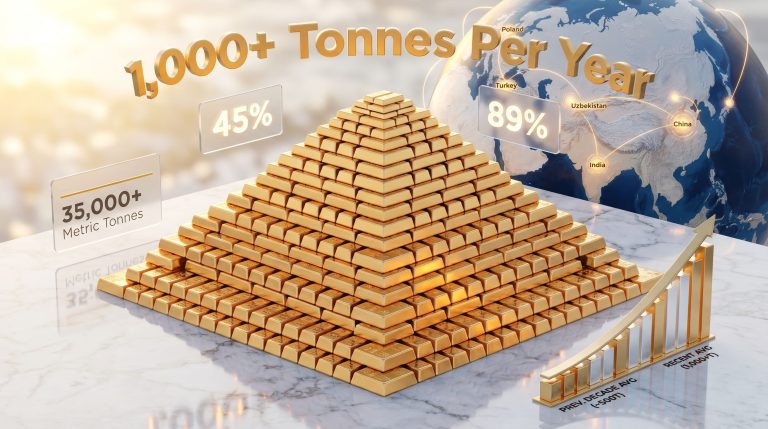
- Further evidence of sovereign central bank gold accumulation, with central banks influencing gold through continued non-Western buying
- Structural dollar weakness driven by ongoing fiscal deterioration
Gold competes with the real value of money over the long run. The gold price outlook does not fundamentally change because a new sheriff has taken office at the Federal Reserve. What changes is the probability distribution of outcomes across the scenarios described above.
FAQ: Kevin Warsh Fed and Gold Prices
Is Kevin Warsh a hawk or a dove on interest rates?
Warsh is broadly classified as a monetary hawk with a consistent anti-inflation track record. However, his support for productivity-driven growth means the hawk label alone is insufficient. His actual rate path will be determined by incoming data and FOMC dynamics, not his philosophical reputation.
Why did gold fall approximately 9% when Warsh was confirmed?
Markets interpreted the appointment as signalling tighter monetary conditions, higher real yields, and a stronger dollar. All three are headwinds for gold. The reaction reflected the market's initial repricing of policy philosophy, not a verdict on gold's long-run direction.
What is the Taylor Rule and why should gold investors care?
The Taylor Rule prescribes an interest rate target based on inflation's deviation from 2% and unemployment's deviation from its natural rate. If Warsh adopts this framework, rate decisions become more mechanically predictable and anchored to observable data, which changes how gold investors must model Fed sensitivity.
Will Warsh cut rates in 2025?
No near-term rate cut is expected at his first FOMC meeting. His stated priority is establishing credibility on inflation, which argues strongly against premature easing. Longer-term decisions will depend on how inflation and employment data evolve.
What is the single most important indicator to watch for gold under Warsh?
The 30-year Treasury yield. It reflects the market's long-run assessment of inflation expectations and real yields, the two variables most directly connected to gold's structural valuation. Short-term rate decisions create noise. The long bond provides signal.
Does the Iran peace agreement change the long-term gold outlook?
The MOU reduced the near-term geopolitical risk premium in gold prices. However, the structural macro drivers, including real yields, dollar direction, and fiscal conditions, remain the dominant long-term factors. Geopolitical relief creates short-term headwinds but does not alter the fundamental case.
This article is intended for informational purposes only and does not constitute financial advice. Forecasts, scenario projections, and analytical frameworks discussed herein involve inherent uncertainty. Past price behaviour is not indicative of future results. Investors should conduct independent research and consult qualified financial professionals before making investment decisions.
Want To Stay Ahead of Gold's Next Major Move?
Discovery Alert's proprietary Discovery IQ model delivers real-time alerts on significant ASX mineral discoveries, cutting through the complexity of monetary policy shifts, geopolitical risk premiums, and commodity market volatility to surface actionable investment opportunities the moment they emerge — explore the historic returns major discoveries have generated and begin your 14-day free trial today to position yourself ahead of the broader market.