June 14, 2026
Central Bank Independence in Times of Political Pressure
Central banking institutions worldwide face mounting challenges as political pressures intensify and economic uncertainties persist. The appointment process for Federal Reserve leadership represents one of the most significant monetary policy decisions affecting global financial markets. When political administrations seek to influence interest rate policies, the delicate balance between democratic accountability and technocratic independence becomes critical for maintaining market confidence and currency stability.
The recent nomination of Trump picks Kevin Warsh for Fed chair illustrates this complex dynamic. Markets responded with immediate volatility across precious metals, equities, and currency markets as investors attempted to interpret the policy implications of this leadership transition.
When big ASX news breaks, our subscribers know first
Understanding Federal Reserve Leadership Transitions
The Federal Reserve Chair nomination process involves multiple institutional safeguards designed to preserve monetary policy independence. Presidential nominees must undergo extensive Senate Banking Committee hearings followed by full Senate confirmation votes. This process typically requires 2-3 months, during which the incumbent chair maintains complete authority over interest rate decisions and monetary policy implementation.
The current timeline places particular significance on this nomination, as Jerome Powell's term concludes in May 2026. The Federal Reserve's structure provides additional protection through 14-year terms for governors and independent voting rights for regional Fed presidents, creating institutional continuity beyond any single appointment.
Key Institutional Protections:
- Extended 14-year terms for Fed governors ensure continuity across political cycles
- Regional Federal Reserve presidents maintain independent policy voting authority
- Dual mandate framework (employment and price stability) provides clear policy objectives
- Congressional oversight ensures accountability without operational interference
Kevin Warsh's Background and Policy Evolution
Kevin Warsh brings an unusual combination of Wall Street experience and central banking expertise to this nomination. His educational foundation includes economics training at Stanford University and legal education at Harvard Law School, providing analytical frameworks for both market dynamics and regulatory structures.
His early career in Morgan Stanley's mergers and acquisitions division exposed him to complex financial instruments and systemic risk mechanisms that would later inform his regulatory perspectives. This private sector experience positioned him uniquely when he joined the Federal Reserve Board as the youngest governor in Fed history at age 35.
Career Timeline:
| Period | Position | Key Responsibilities |
|---|---|---|
| Early Career | Morgan Stanley M&A | Complex financial structures, market analysis |
| 2006-2011 | Fed Governor | Crisis management, regulatory framework development |
| Post-2011 | Stanford Hoover Institution | Academic research, policy independence |
During the 2008 financial crisis, Warsh served as a crucial liaison between Wall Street and Washington, providing market intelligence during the most severe financial disruption since the Great Depression. His role involved communication with financial institutions while participating in unprecedented emergency lending facilities including the Term Asset-Backed Securities Loan Facility and Primary Dealer Credit Facility.
Philosophical Transformation
Warsh's monetary policy philosophy has undergone significant evolution. Historically positioned as an inflation hawk during his 2009-2011 Fed tenure, he consistently warned about long-term consequences of excessive monetary accommodation even during periods of high unemployment reaching 10%.
Recent statements suggest a fundamental shift toward more accommodative monetary policy. His argument that tariffs do not constitute traditional inflation pressures represents a departure from conventional economic thinking, particularly relevant given current US‑China trade tensions and broader U.S. economic pressures.
Factors Driving Policy Evolution:
- Global deflationary pressures from technological advancement
- Structural changes in international trade dynamics
- Recognition of post-pandemic economic shifts
- Understanding of modern inflation transmission mechanisms
Market Response and Precious Metals Impact
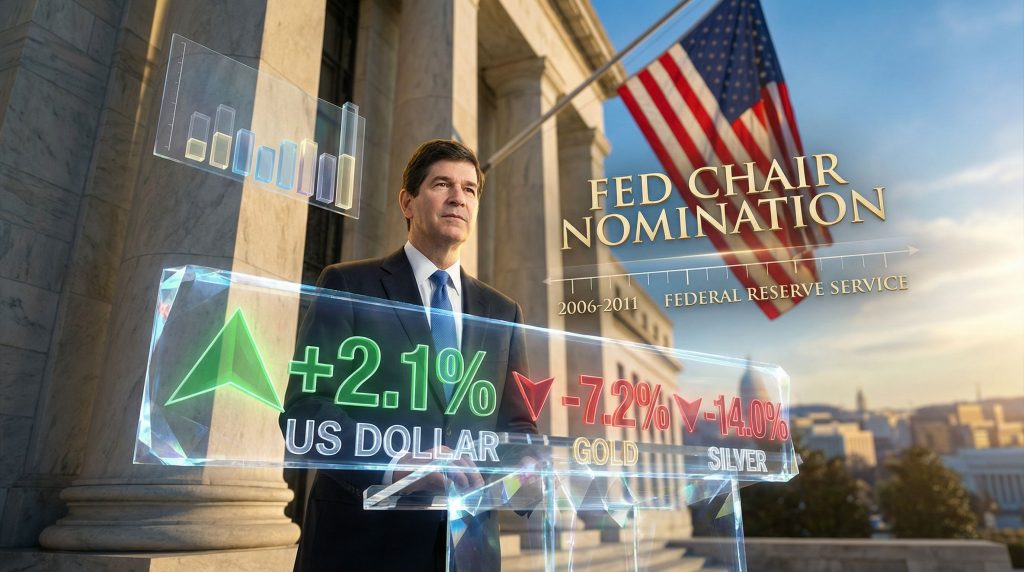
The announcement of Trump picks Kevin Warsh for Fed chair triggered immediate and dramatic market responses across multiple asset classes. Gold experienced a sharp 7% decline on January 30, 2026, breaking below the $5,000 mark after reaching a record high of $5,594 the previous day.
Market Reactions on January 30, 2026:
| Asset Class | Movement | Magnitude | Market Interpretation |
|---|---|---|---|
| Gold | Decline | -7.2% | Reduced monetary uncertainty |
| Silver | Decline | -14.0% | Risk sentiment shift |
| US Dollar | Strengthened | +2.1% | Fed independence confidence |
| Treasury Yields | Rose | +15 basis points | Policy normalization expectations |
Despite this volatility, gold maintained its position for the best monthly performance since 1999, with January 2026 gains of 15%. Furthermore, these movements must be viewed within the context of ongoing record-high gold prices and the broader gold price forecast for 2025.
Extraordinary Market Volatility
Thursday's trading session preceding the nomination announcement delivered unprecedented market turbulence. An estimated $9 trillion in market capitalisation swung across gold, silver, and US equities in just 6.5 hours.
Thursday's Market Swings:
- Gold erased nearly $3 trillion in value at market open
- Silver lost $750 billion before recovering $500 billion
- Gold recovered $2 trillion by market close
- Technology stocks experienced significant declines
This volatility pattern reflects typical behaviour following parabolic price movements, where heavy leverage amplifies both advances and declines. When prices reverse quickly, margin calls force traders to liquidate positions, accelerating the decline through mechanical selling pressure. These dynamics are central to understanding what is gold driving highs in current markets.
Wall Street's Long-Term Precious Metals Outlook
Despite short-term volatility, major financial institutions maintain bullish long-term perspectives on precious metals. Goldman Sachs recently raised its year-end gold target to $5,400, which gold promptly exceeded by reaching record levels near $5,600.
JPMorgan analysts have developed scenarios projecting gold prices reaching $8,000 to $8,500 by the end of the decade, representing potential gains exceeding 40% from current levels. This projection assumes private investors increase gold allocation from 3% to 4.6% of portfolios, whilst central banks continue purchasing over 1,000 tonnes annually.
Structural Demand Drivers:
- Central bank diversification away from dollar reserves
- Institutional portfolio insurance allocation increases
- Private investor safe-haven demand expansion
- Geopolitical risk premium considerations
Market Insight: JPMorgan strategists note that allocations to gold by both private investors and central banks continue grinding higher, representing a structural shift in global asset allocation patterns.
Asian Physical Markets and Premium Dynamics
Physical precious metals markets in Asia demonstrate extraordinary demand despite record price levels. Indian gold dealers charged premiums of $121 per ounce during the week of January 30, 2026, representing the highest levels in over a decade, compared to $112 the previous week.
This premium surge reflects investors anticipating potential duty increases when India's finance minister presents the 2026 budget on February 1. Having reduced import duties from 15% to 6% in July 2024, market participants expect potential policy reversal.
Asian Market Dynamics:
- India premiums: $121 per ounce (decade-high levels)
- China premiums: Jumped from $8 to $32 per ounce in one week
- Physical dealer activity: Surging across Shanghai and Hong Kong
- Buying motivation: Front-running anticipated policy changes
Peter Fung, head of dealing at Wing Fung Precious Metals, explained the dynamic: Small investors continue purchasing because the trajectory for gold and silver appears bullish after breaking above $5,000.
The next major ASX story will hit our subscribers first
Monetary Policy Implications Under Warsh Leadership
Warsh's potential Fed leadership suggests several policy framework modifications. His recent alignment with accommodative monetary policy, despite historical hawkish positions, indicates possible approaches that could significantly impact global markets. According to leading market analysts, this represents a surprising departure from traditional expectations.
Expected Policy Characteristics:
- Data-dependent decisions with increased employment metric weighting
- Gradual policy adjustments rather than aggressive rate changes
- Enhanced communication regarding policy rationale and forward guidance
- Coordination considerations with fiscal policy whilst maintaining independence
Interest rate trajectory implications suggest more accommodative monetary conditions, potentially leading to lower borrowing costs for businesses and consumers, increased financial market liquidity, and enhanced economic growth prospects over the medium term.
How Will Warsh's Appointment Affect Different Sectors?
Different economic sectors face varying impacts from potential monetary policy shifts under Warsh's leadership. Banking institutions may experience compressed net interest margins from lower rates but could benefit from increased loan demand stimulation.
Sectoral Impact Analysis:
- Real Estate: Reduced borrowing costs typically support property valuations
- Technology: Lower discount rates benefit high-growth, future-cash-flow dependent companies
- Commodities: Potential dollar weakness could support commodity prices over time
- Financial Services: Mixed impacts from rate compression versus volume increases
Confirmation Process Challenges and Timeline
Senate Banking Committee scrutiny will likely focus on several key areas reflecting both institutional concerns and political considerations. Senators will probe Warsh's recent shift toward accommodative policies, seeking clarification on the analytical framework driving this evolution. However, as reported by the White House, the nomination has received considerable support.
Expected Confirmation Focus Areas:
- Monetary Policy Philosophy: Detailed questioning about accommodative policy shift rationale
- Financial Stability: Approach to banking regulation and systemic risk management
- Political Independence: Specific assurances regarding resistance to external pressure
- Communication Strategy: Plans for Fed transparency and market guidance enhancement
Warsh's previous bipartisan confirmation as Fed governor provides some advantage, though his recent alignment with Trump picks Kevin Warsh for Fed chair policies may generate Democratic opposition focused on Fed independence preservation.
International Central Banking Divergence
Warsh's appointment signals potential divergence from other major central banks' monetary policies. If global central banks maintain restrictive policies whilst the US pursues accommodation, currency and commodity market dynamics could experience significant shifts.
This divergence might affect international capital flows, emerging market stability, and global trade patterns. Currency volatility could increase as interest rate differentials widen between major economies.
What Are the Key Risks and Uncertainties?
Several risk factors could complicate Warsh's potential Fed tenure. Political pressure for aggressive rate cuts might conflict with economic data suggesting different approaches. Market expectations for accommodation could create challenges if inflation resurges or financial stability concerns emerge.
Key Risk Considerations:
- Political pressure versus data-dependent decision making
- Inflation resurgence possibilities requiring policy reversal
- Financial market stability during policy transition periods
- International coordination challenges with other central banks
Future Policy Framework Development
Warsh's background suggests potential innovations in Fed communication and policy implementation. His Wall Street experience might inform more sophisticated market interaction approaches, whilst his academic affiliation could bring research-based policy development methods.
The combination of private sector understanding and central banking experience positions him to navigate complex financial market conditions whilst maintaining institutional credibility and independence. Consequently, the Trump picks Kevin Warsh for Fed chair decision represents both continuity and potential transformation in monetary policy approaches.
Disclaimer: This analysis contains forward-looking statements and speculative assessments regarding monetary policy, market movements, and economic conditions. Actual outcomes may differ significantly from projections. Investment decisions should not be based solely on policy speculation, and professional financial advice should be sought for individual circumstances. Precious metals investments carry inherent risks including price volatility and market liquidity considerations.
Ready to Identify the Next Market-Moving Discovery?
Discovery Alert's proprietary Discovery IQ model delivers instant notifications on significant ASX mineral discoveries, helping subscribers identify actionable opportunities ahead of market shifts like those seen in precious metals volatility. Begin your 14-day free trial today and position yourself to capitalise on the next major discovery before the broader market catches on.