
May 22, 2026
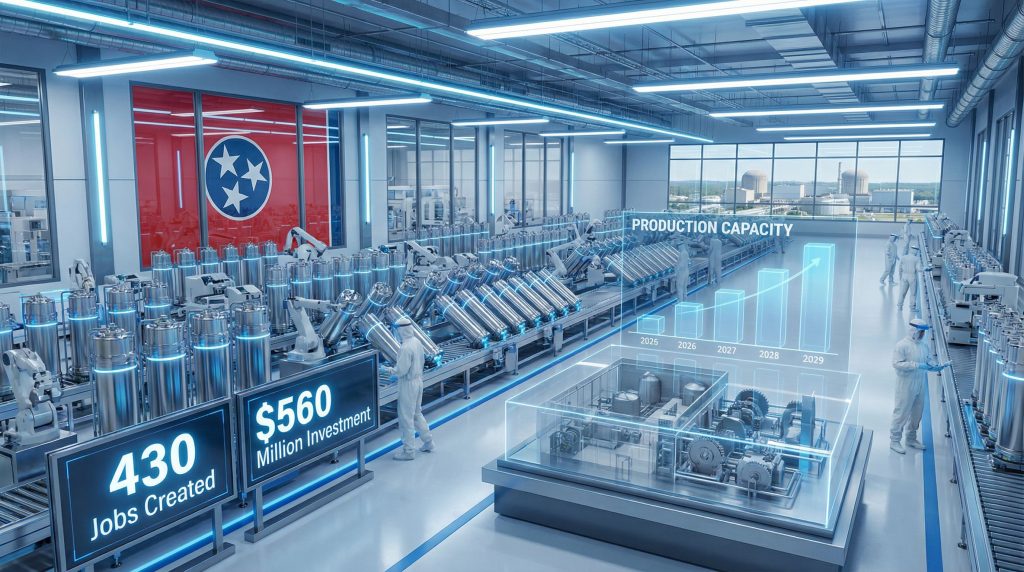
The global nuclear energy landscape sits at a transformative juncture where fuel supply chains determine deployment timelines and strategic autonomy. While conventional uranium enrichment services have historically operated through established international networks, the emergence of Small Modular Reactors (SMRs) and advanced reactor technologies creates entirely new supply chain requirements. Centrus to expand Oak Ridge facility represents a cornerstone initiative addressing strategic gaps in domestic uranium production, particularly as the U.S. uranium import ban intensifies focus on domestic capabilities. These next-generation systems demand High-Assay Low-Enriched Uranium (HALEU) at enrichment levels between 5-19.75%, compared to conventional reactors operating at 3-5% enrichment levels.
This technological shift coincides with geopolitical tensions around energy security, creating unprecedented urgency around domestic fuel production capabilities. The strategic calculus extends beyond economic considerations to encompass national security positioning, technological sovereignty, and long-term competitive advantages in nuclear export markets.
What Makes Centrus's Manufacturing Strategy Critical for U.S. Energy Security?
Addressing America's Uranium Enrichment Dependency
The United States currently faces significant vulnerabilities in uranium enrichment capacity, with domestic production capabilities insufficient to meet projected advanced reactor demand. Furthermore, understanding uranium volatility insights becomes crucial when evaluating long-term supply security strategies. Centrus to expand Oak Ridge facility represents a cornerstone initiative addressing these strategic gaps through integrated manufacturing and enrichment operations.
The expansion centres on a $560 million investment across Anderson County, Tennessee, creating 430 direct manufacturing and technical positions specifically focused on centrifuge production. This workforce development occurs alongside operational commitments under Centrus's Phase III Department of Energy contract, which mandates production and delivery of HALEU at minimum rates of 900 kilograms of HALEU UF6 annually.
The contract structure encompasses three renewable three-year periods beginning in 2025, with all produced HALEU remaining under DOE ownership and control. This arrangement reflects federal strategic stockpiling priorities rather than commercial market dynamics, indicating government recognition of supply chain vulnerabilities requiring immediate intervention.
Advanced Centrifuge Technology Integration
Centrifuge manufacturing at the Oak Ridge Technology and Manufacturing Centre involves sophisticated isotope separation technology engineered specifically for uranium enrichment applications. These systems must meet exacting specifications for deployment at the American Centrifuge Plant in Piketon, Ohio, creating integrated production workflows spanning multiple states.
The manufacturing strategy addresses current operational constraints where existing infrastructure limits HALEU production scaling. The $900 million DOE award enables expanded enrichment operations at Piketon, but these operations require new centrifuges that existing supply chains cannot provide at required volumes and technical specifications.
Quality control protocols ensure equipment manufactured in Tennessee meets operational requirements for both HALEU and Low-Enriched Uranium (LEU) production processes, each demanding different performance parameters and reliability standards.
Economic Multiplier Effects Analysis
The Oak Ridge expansion creates economic impacts extending far beyond direct employment generation. Regional economic modelling projects substantial multiplier effects across East Tennessee's manufacturing ecosystem:
| Impact Category | Direct Effects | Indirect/Induced Effects | Total Projected |
|---|---|---|---|
| Job Creation | 430 positions | 600-800 additional | 1,030-1,230 |
| Investment Value | $560 million | $200-300 million | $760-860 million |
| Annual Payroll | $35-45 million | $25-35 million | $60-80 million |
These projections reflect the specialised nature of centrifuge manufacturing, which requires technical suppliers, transportation services, testing laboratories, and engineering support functions. The economic development extends beyond commodity manufacturing to encompass high-skilled technical roles requiring vocational training or engineering education.
When big ASX news breaks, our subscribers know first
What Economic Impact Will the $560 Million Oak Ridge Investment Generate?
Regional Workforce Development Strategy
The expansion timeline spanning 2026 through 2029 enables phased workforce development alongside facility construction. Manufacturing positions require specialised training in centrifuge production, quality assurance protocols for sensitive nuclear equipment, and technical expertise in uranium enrichment technology.
Average annual capital deployment of approximately $140 million across the four-year timeline supports sustained employment generation beyond initial construction phases. This phasing strategy allows for supply chain establishment and workforce preparation, creating sustainable employment patterns rather than temporary construction impacts.
Employment characteristics reflect the advanced manufacturing nature of centrifuge production. These positions demand technical competencies in precision manufacturing, nuclear regulatory compliance, and quality control procedures for sensitive equipment destined for uranium enrichment facilities.
Anderson County Economic Integration
The investment occurs within an established nuclear manufacturing ecosystem centred around Oak Ridge National Laboratory and existing Centrus operations. This clustering effect reduces infrastructure development requirements while amplifying economic multiplier impacts through existing supplier networks and technical expertise.
Anderson County benefits from established nuclear industry familiarity, regulatory expertise, and workforce pipelines from regional universities and technical schools. These existing advantages reduce operational risks while accelerating employment absorption capacity for the 430 new positions.
Supply Chain Development Opportunities
Centrifuge manufacturing requires sophisticated supply chains encompassing:
- Precision components: High-specification materials for rotating equipment
- Testing equipment: Quality assurance systems for nuclear applications
- Transportation services: Secure logistics for sensitive equipment
- Professional services: Engineering, regulatory compliance, and project management
- Facility management: Specialised infrastructure for nuclear manufacturing
Regional vendors positioned to support these supply chain requirements benefit from sustained demand generation across the multi-year expansion timeline. This creates secondary economic development opportunities extending throughout East Tennessee's manufacturing base.
How Does Tennessee's Nuclear Energy Fund Enable This Expansion?
State Strategic Investment Framework
Tennessee's $50 million Nuclear Energy Fund represents targeted state government commitment to nuclear industry development as a defining economic strategy. Centrus's expansion announcement demonstrates how state funding catalyses private investment in critical infrastructure. Governor Bill Lee proposed the fund in 2023, with subsequent Tennessee General Assembly approval reflecting bipartisan recognition of nuclear manufacturing's strategic importance.
The fund's charter explicitly defines its purpose: expanding Tennessee's nuclear development and manufacturing ecosystem through grants and assistance supporting nuclear energy business investment, workforce development programmes, and site development across the state.
Fund allocation methodology emphasises competitive evaluation of nuclear industry projects, with Centrus's expansion selected based on economic development potential, strategic alignment with state objectives, and technical feasibility assessments.
Public-Private Partnership Structure
The $50 million state allocation represents approximately 9% of the total $560 million expansion investment, with federal funding and private capital providing remaining resources. This leverage ratio demonstrates state government's strategic use of targeted incentives to attract substantially larger private and federal investment commitments.
Risk-sharing mechanisms between state funding and private investment create aligned incentives for project success while protecting taxpayer resources through performance-based disbursement protocols. State support complements rather than substitutes for private capital commitments and federal strategic investments.
Competitive Positioning Analysis
Tennessee's nuclear industry support strategy occurs within broader interstate competition for advanced manufacturing investments. The Nuclear Energy Fund's comprehensive approach addressing capital investment, workforce development, and site preparation creates integrated competitive advantages versus states offering only traditional tax incentives.
The fund's coordination with existing Oak Ridge National Laboratory presence creates ecosystem advantages difficult for other states to replicate. This clustering effect amplifies both private investment attraction and technical expertise development across the nuclear manufacturing supply chain.
What Role Does Federal DOE Funding Play in the Expansion Strategy?
National Security Investment Rationale
The $900 million DOE award supporting uranium enrichment expansion reflects federal assessment that domestic production capabilities require immediate strategic intervention. In addition, the US production executive order emphasises mineral security as a national priority. This investment scale indicates government recognition that advanced reactor deployment timelines depend critically on reliable HALEU supply chain development.
Federal funding enables HALEU production at enrichment levels required by Small Modular Reactors and advanced reactor designs, addressing technical capabilities beyond conventional commercial enrichment services. The strategic stockpiling approach, with all HALEU production remaining under DOE ownership, indicates priority on supply security rather than immediate commercial market development.
Integration with Advanced Reactor Policy
HALEU production requirements align with broader federal advanced reactor commercialisation objectives. The minimum 900 kilograms per year production target represents initial capacity building toward anticipated SMR deployment demand, with contract renewal options through 2034 providing long-term supply certainty.
Federal investment strategy treats uranium enrichment as critical infrastructure requiring strategic autonomy from international suppliers. This approach reflects potential concerns about supply chain disruption risks, export control vulnerabilities, and strategic competition with other nuclear powers.
Export Control and Nonproliferation Considerations
Domestic HALEU production capabilities create strategic flexibility in nuclear fuel supply chains while maintaining stringent nonproliferation controls. The integrated Oak Ridge manufacturing and Piketon enrichment operations occur under comprehensive federal oversight ensuring technology security and regulatory compliance.
Advanced centrifuge technology manufactured in Tennessee incorporates proprietary designs and operational parameters subject to export controls, creating competitive advantages for U.S. nuclear technology while preventing unauthorised technology transfer.
How Will the Oak Ridge-Piketon Manufacturing Network Function?
Integrated Production System Design
The manufacturing network establishes specialised production workflows connecting Tennessee centrifuge production with Ohio enrichment operations. Quality control protocols ensure equipment manufactured at Oak Ridge meets operational specifications for deployment at the American Centrifuge Plant in Piketon.
Production capacity targets encompass thousands of centrifuges manufactured across the 2026-2029 timeline, with initial operational deployment at Piketon beginning in 2029. This scaling timeline enables workforce development and supply chain establishment alongside facility expansion and equipment testing.
Logistics coordination between Tennessee manufacturing and Ohio deployment requires specialised transportation protocols for sensitive nuclear equipment. Security considerations and regulatory compliance create additional operational requirements beyond conventional manufacturing logistics.
Operational Timeline Milestones
The integrated network development follows phased implementation:
- 2026-2028: Oak Ridge facility expansion and equipment installation
- 2028-2029: Centrifuge production ramp-up and quality validation
- 2029: Initial new centrifuge deployment at Piketon operations
- 2030+: Full-scale production capacity achievement across both facilities
Timeline coordination between manufacturing and deployment phases requires careful synchronisation to prevent production bottlenecks while maintaining quality standards for sensitive uranium enrichment equipment.
Technology Innovation Opportunities
The Oak Ridge-Piketon network creates opportunities for continuous improvement in centrifuge design, manufacturing processes, and enrichment operations. Technical feedback between manufacturing and operational facilities enables optimisation of equipment performance and reliability.
Innovation potential extends to next-generation enrichment technologies, advanced materials applications, and process optimisation techniques that could enhance U.S. competitive positioning in global nuclear technology markets.
What Competitive Advantages Does This Create for U.S. Nuclear Industry?
Supply Chain Resilience Benefits
Domestic centrifuge manufacturing eliminates critical supply chain vulnerabilities in uranium enrichment operations. The integrated Tennessee-Ohio production network provides strategic autonomy from international suppliers while maintaining technical competitiveness with global alternatives.
Reliable HALEU supply chains accelerate advanced reactor deployment timelines by removing fuel supply uncertainties that previously constrained commercial development. This supply security enables utility companies and reactor developers to commit to deployment schedules with greater confidence.
Strategic Stockpile Development
Federal ownership of HALEU production creates strategic stockpile capabilities supporting national security objectives and energy security resilience. Stockpile development provides buffer capacity against supply disruptions while enabling rapid response to increased demand scenarios.
The stockpiling approach also creates negotiating leverage in international nuclear cooperation agreements and export markets, positioning the United States as a reliable nuclear fuel supplier for allied nations pursuing nuclear energy development.
Technology Leadership Positioning
American Centrifuge technology represents competitive advantages in efficiency, reliability, and operational flexibility compared to international alternatives. The Oak Ridge expansion enables technology refinement and scaling that strengthens U.S. leadership in uranium enrichment capabilities.
Intellectual property development through manufacturing experience and operational optimisation creates export potential for U.S. nuclear technology while maintaining nonproliferation controls and strategic technology advantages.
The next major ASX story will hit our subscribers first
How Does This Fit Tennessee's Broader Nuclear Manufacturing Strategy?
Regional Nuclear Industry Cluster Development
The Centrus expansion occurs within broader nuclear industry clustering around East Tennessee's research and manufacturing ecosystem. Oak Ridge National Laboratory's research capabilities create synergies with commercial manufacturing operations while providing workforce development pipelines.
Concurrent investments by other nuclear companies amplify clustering effects. However, these developments must be evaluated within broader uranium market strategies to understand their full competitive impact. Laser Isotope Separation Technologies announced $1.38 billion in Oak Ridge expansion on January 21, 2026, demonstrating sustained private sector commitment to Tennessee's nuclear manufacturing ecosystem.
Regional clustering creates competitive advantages through:
- Shared workforce development: Technical education and training programmes
- Supply chain density: Concentrated supplier networks reducing costs
- Regulatory expertise: Established nuclear compliance capabilities
- Infrastructure advantages: Transportation, utilities, and security systems
Workforce Development Pipeline Integration
Tennessee's technical education system aligns with nuclear manufacturing workforce requirements through partnerships with regional universities and community colleges. These programmes develop specialised skills in nuclear engineering, precision manufacturing, and regulatory compliance essential for centrifuge production.
The University of Tennessee system provides engineering talent while technical schools offer specialised manufacturing training. This educational infrastructure supports sustainable workforce development beyond immediate expansion requirements.
What Are the Long-Term Implications for Nuclear Energy Markets?
Market Structure Evolution Scenarios
Domestic uranium enrichment capacity development could fundamentally alter nuclear fuel market dynamics over the next decade. Three primary scenarios emerge from the Oak Ridge expansion and broader HALEU production scaling:
Accelerated Nuclear Renaissance Scenario: Reliable domestic fuel supply chains remove deployment barriers for advanced reactors, enabling rapid SMR commercialisation and nuclear capacity expansion. Utilities gain confidence in nuclear project timelines through supply security, driving increased nuclear energy investment.
Steady Growth with Energy Security Benefits: Domestic enrichment provides strategic resilience while international market integration continues. HALEU production supports gradual advanced reactor deployment without dramatically altering overall energy market dynamics.
Technology Competition Intensification: Enhanced U.S. enrichment capabilities trigger competitive responses from international suppliers, potentially accelerating global nuclear technology development while maintaining strategic autonomy for participating nations.
International Trade and Export Implications
Domestic HALEU production creates export opportunities for U.S. nuclear technology and fuel services while maintaining nonproliferation controls. Allied nations pursuing nuclear energy development could access reliable fuel supplies through strategic partnerships.
Export potential extends beyond fuel supply to encompass enrichment technology, manufacturing expertise, and integrated nuclear fuel cycle capabilities. These opportunities could enhance U.S. economic competitiveness while supporting nonproliferation objectives.
Investment Market Considerations
Nuclear energy investment markets benefit from reduced regulatory and supply chain uncertainties created by domestic fuel production capabilities. Advanced reactor developers gain access to more predictable fuel costs and availability, improving project economics and investor confidence.
Utility companies evaluating nuclear capacity additions benefit from enhanced fuel supply security, potentially influencing generation planning decisions and nuclear plant life extension evaluations.
What Should Investors and Industry Stakeholders Monitor?
Critical Performance Indicators
Success metrics for the Oak Ridge expansion encompass multiple operational and strategic dimensions requiring ongoing monitoring:
- Manufacturing Milestones: Facility construction progress and equipment installation timelines
- Production Ramp-Up Rates: Centrifuge manufacturing volume achievement versus targets
- Employment Targets: Workforce development success and retention rates
- Quality Performance: Equipment reliability and operational specifications compliance
- Integration Effectiveness: Coordination between Tennessee manufacturing and Ohio deployment
Market Development Signals
Industry stakeholders should monitor broader market indicators demonstrating advanced reactor commercialisation progress and HALEU demand development. Furthermore, mining industry innovation trends will influence technological capabilities across the nuclear fuel supply chain:
- Advanced Reactor Deployment Announcements: SMR projects requiring HALEU fuel supply
- Utility Nuclear Investment Decisions: Capacity additions dependent on fuel supply security
- Federal Funding Commitments: Additional government support for nuclear fuel infrastructure
- International Cooperation Developments: Nuclear fuel supply agreements and technology partnerships
Risk Assessment Framework
Potential challenges requiring stakeholder attention include:
- Regulatory Approval Timelines: Permitting and compliance requirements for expanded operations
- Technology Performance Validation: Commercial-scale centrifuge reliability and efficiency
- Market Demand Uncertainty: Advanced reactor deployment timing and fuel requirements
- Competitive Response: International supplier reactions and technology development
- Supply Chain Resilience: Component availability and vendor capacity constraints
Investment and policy decisions should incorporate scenario analysis addressing these risk factors while recognising the strategic importance of domestic nuclear fuel capabilities for long-term energy security and economic competitiveness. The Tennessee economic development announcement highlights state commitment to nuclear infrastructure development.
Investment Disclaimer: This analysis contains forward-looking statements and projections based on current information and industry trends. Nuclear energy investments involve regulatory, technological, and market risks that may affect actual outcomes. Stakeholders should conduct independent due diligence and consult qualified professionals before making investment decisions.
Looking for Nuclear Energy Investment Opportunities?
Discovery Alert's proprietary Discovery IQ model delivers real-time alerts on significant ASX mineral discoveries, including uranium and energy metals that power nuclear technologies. With the nuclear sector experiencing unprecedented growth and strategic importance, subscribers gain instant access to actionable opportunities ahead of the broader market, positioning themselves to capitalise on the next transformative discovery in Australia's uranium exploration landscape.