May 22, 2026
The Geology of Asymmetry: When Reserves Don't Equal Refining Power
There is a peculiar paradox at the heart of global aluminum economics. The nations that sit atop the world's most valuable bauxite deposits are rarely the nations that profit most from turning that ore into useful metal. Understanding why this gap exists, and why it has proven so difficult to close, requires looking at how industrial value chains form, concentrate, and resist redistribution over time.
Africa controls approximately 29% of the world's total bauxite reserves yet accounts for less than 1% of global alumina refining capacity. This is not an accident of geology. It is a product of decades of infrastructure underinvestment, energy constraints, and a global trade architecture that has historically rewarded raw material exporters with modest returns while reserving the high-margin stages of processing for industrialised nations, and increasingly for China.
Guinea sits at the centre of this imbalance more acutely than any other country on the continent. Its bauxite deposits are not just Africa's largest. They are the largest in the world. Yet for all practical purposes, Guinea has functioned primarily as a raw material quarry, exporting ore at the bottom of the value ladder while the economic gains from refining, smelting, and fabrication accumulate elsewhere.
The announcement of the Chalco alumina refinery in Guinea, representing a $1 billion USD commitment by China's largest state-owned aluminum producer, marks the most significant attempt yet to close this structural gap. Whether it succeeds depends on a complex interplay of industrial policy, geopolitical incentives, capital deployment, and governance capacity that this analysis unpacks in detail.
When big ASX news breaks, our subscribers know first
The Bauxite-to-Aluminum Value Chain: Where Guinea Currently Stands
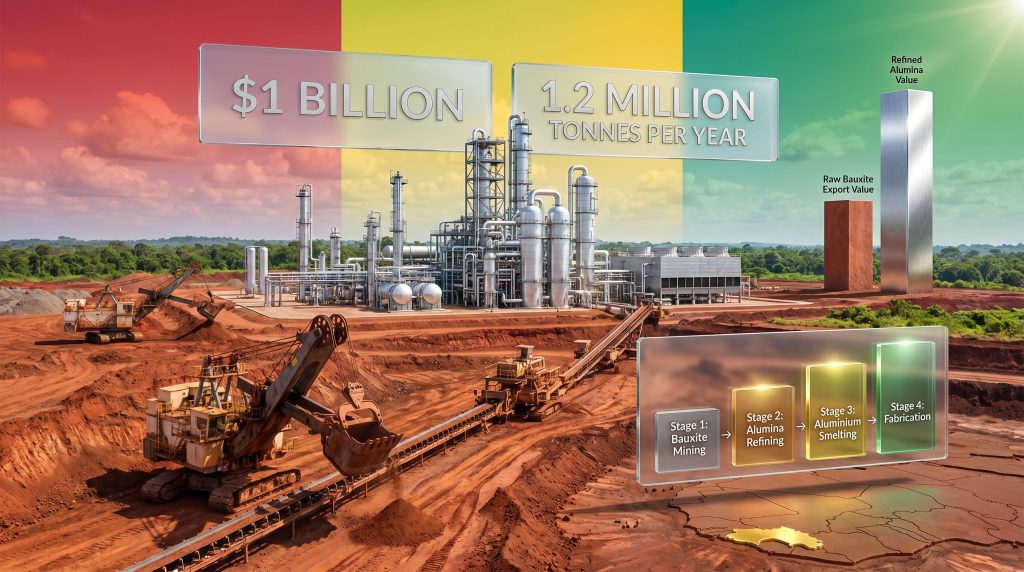
To appreciate the significance of the Chalco refinery project, it is useful to understand the full economic architecture of the aluminum production chain. The industry operates across four distinct processing stages, each capturing progressively more value:
| Stage | Activity | Approximate Value Per Tonne |
|---|---|---|
| Stage 1 | Raw bauxite mining | $50–$70 |
| Stage 2 | Alumina refining | $300–$400 |
| Stage 3 | Primary aluminum smelting | ~$2,000 |
| Stage 4 | Fabrication and finished products | $5,000+ |
Guinea currently operates almost entirely at Stage 1. Its bauxite deposits are geologically high quality, with aluminium oxide (Al₂O₃) content typically ranging from 52% to 62%, which places Guinean ore among the most attractive feedstock grades globally for refinery operators. High-grade bauxite with Al₂O₃ content above 50% requires approximately 2.5 to 2.8 tonnes of bauxite per tonne of alumina produced, compared to 3.0 to 3.5 tonnes for lower-grade material. This conversion efficiency advantage gives Guinea a meaningful competitive edge in the economics of alumina refining if the infrastructure to do so can be assembled.
Despite this geological advantage, Guinea has exported enormous volumes of unrefined ore. The country displaced Australia as a leading global bauxite supplier for several major markets in recent years, with export volumes exceeding 127 million tonnes annually as Chinese demand has pulled supply upward. Yet the revenue generated from those exports represents a fraction of what could be captured if even a portion of that material were refined domestically before shipment.
Furthermore, the global bauxite mining landscape makes this imbalance all the more striking. As one industry observer has noted:
"Each tonne of raw bauxite that departs Guinea without refining represents a dramatic underutilisation of the country's resource endowment. Moving a single tonne through Stage 2 processing before export would multiply its market value by a factor of five or more."
What Is the Chalco Alumina Refinery in Guinea, and Why Does It Matter?
Project Fundamentals: Scale, Structure, and Strategic Significance
The Chalco alumina refinery in Guinea represents a landmark industrial commitment by the Aluminum Corporation of China (Chalco), the country's largest state-owned aluminum producer and a globally significant player across the full value chain. The key project parameters are as follows:
- Developer: Aluminum Corporation of China (Chalco), headquartered in Beijing
- Project type: Greenfield alumina refinery, Chalco's first alumina refinery outside Chinese territory
- Planned annual production capacity: 1.2 million tonnes of alumina per year
- Total committed investment: $1 billion USD
- Project vehicle: A newly established dedicated entity created specifically to develop and operate the facility
- Regulatory status as of mid-2026: Announced and agreed in principle, pending shareholder approval and sign-off from Guinean regulatory authorities
What makes this project strategically distinctive is not simply its scale, significant as that is. It is the fact that Chalco is deploying its first offshore refinery here, choosing Guinea as the location where it will test and establish its international industrial processing model. This decision reflects accumulated operational confidence from Chalco's Boffa bauxite mine, which the company has operated in Guinea for over a decade. The Boffa experience has given Chalco established logistics networks, regulatory relationships, and granular operational intelligence about Guinea's industrial environment that new market entrants would not possess.
Ownership Architecture and Government Equity Participation
The equity structure of the refinery project has been deliberately designed to give Guinea's government meaningful economic participation without requiring the state to commit significant upfront capital. The framework operates as follows:
| Stakeholder | Initial Equity Position | Maximum Potential Stake |
|---|---|---|
| Chalco (majority developer) | Controlling interest | Subject to shareholder approval |
| Guinean Government | 5% at little or no cost | Up to 35% at market value |
The tiered ownership model is particularly notable for its optionality mechanism. Guinea receives an immediate 5% stake at minimal cost, establishing a financial stake from day one. The option to increase that holding to 35% at market value as the project matures creates a structured pathway for greater national ownership without the government being required to raise substantial capital before construction begins.
This design mirrors sovereign equity participation arrangements seen in other major African resource deals but is distinctive for the scale of the potential state stake and the explicit upfront commitment to that pathway. Whether Guinea's government has the fiscal capacity or access to external financing to exercise the 35% option at full scale remains an open and important question as the project develops.
The Chalco–GAC Partnership: How This Deal Was Built
The $1 billion refinery commitment did not emerge in isolation. It represents the commercial maturation of a multi-year partnership development process between Chalco and Guinea Alumina Corporation (GAC), a subsidiary of Emirates Global Aluminium (EGA). According to reporting on the GAC–Chalco agreement, the deal has attracted considerable interest from additional stakeholders since its initial announcement.
Development Timeline: Chalco's Guinea Refinery Path
- Pre-2024: Chalco operates the Boffa bauxite mine in Guinea with no formal refinery commitment
- March 2024: A foundational Memorandum of Understanding is signed between Chalco/Chinalco and GAC/EGA
- June 2024: A framework agreement is formalised in Beijing during a UAE-China business forum, committing both parties to joint feasibility studies and co-investment discussions
- May 2026: The $1 billion refinery investment is publicly announced, with 1.2 million tonnes per annum capacity confirmed
- Pending: Chalco shareholder approval and Guinean government regulatory authorisation
This timeline illustrates that the project reflects approximately two years of structured negotiation and technical collaboration rather than a spontaneous capital commitment. The gradual escalation from MOU to framework agreement to full investment announcement follows a deliberate project development sequence that reduces execution uncertainty at each stage.
How Does This Fit Into Guinea's Industrial Policy Framework?
Guinea's Mandate for In-Country Mineral Processing
Guinea holds the world's largest bauxite reserves, and this geological reality has historically defined its role in global aluminum markets as a raw material supplier. The Guinean government has grown increasingly determined to change this dynamic through an assertive beneficiation policy that requires mining operators to develop downstream processing capacity within national borders rather than exporting unprocessed ore indefinitely.
The rationale behind this policy agenda is driven by several converging imperatives:
- Revenue maximisation: Capturing higher-margin stages of the aluminum value chain generates substantially greater export revenue per unit of mineral extracted
- Employment generation: Industrial processing creates skilled manufacturing jobs that raw material extraction does not
- Fiscal diversification: Reducing dependence on low-value raw commodity export taxes and royalties, which fluctuate with global commodity prices
- Sovereign resource control: Asserting greater national authority over how strategic mineral assets are developed and monetised over time
This beneficiation agenda has been reinforced through Guinea's national mining code, which has progressively tightened local processing requirements and increased penalties for non-compliance. The policy direction has created a more demanding environment for foreign mining operators, who must now demonstrate credible downstream investment plans to maintain their operational licences.
The EGA Concession Revocation: A Policy Signal with Industry-Wide Implications
Guinea's commitment to its beneficiation mandate has not been purely aspirational. In a notable enforcement action, the government revoked a major bauxite concession previously held by a subsidiary of Emirates Global Aluminium (EGA), citing violations of the national mining code. EGA publicly characterised the decision as a breach of its contractual rights.
The significance of this episode for the broader industry cannot be overstated. Licence revocation against a major international operator demonstrated that Guinea's government was prepared to use the most consequential lever available to enforce compliance with local processing requirements. This was not a warning; it was an action.
"The EGA concession episode changed the calculus for every foreign operator in Guinea. It made clear that downstream investment commitments were no longer negotiable additions to mining agreements but rather operational requirements with enforceable consequences. The Chalco refinery project can be read, in substantial part, as a calculated response to this regulatory environment by a company that has too much invested in Guinea to risk a similar outcome."
The irony of the situation is not lost on industry observers. EGA, the same company whose subsidiary faced concession revocation for alleged mining code violations, is simultaneously the parent of GAC, which has co-developed the framework agreement that underpins the Chalco refinery partnership. This layered relationship between cooperation and confrontation is a reflection of the complex realities of resource development in emerging markets where commercial interests and regulatory enforcement must coexist.
What Is Driving Chinese Investment in African Bauxite Refining?
China's Structural Aluminum Dilemma
To understand why Chalco is making its first overseas alumina refinery investment in Guinea rather than expanding domestically in China, it is necessary to understand the structural constraints now governing the Chinese aluminum industry. Chinese smelters currently account for more than 50% of global primary aluminum production, a level of concentration that creates both enormous industrial power and significant systemic vulnerability.
China's central government has imposed a domestic production cap on primary aluminum as a component of its industrial emissions reduction strategy. This cap effectively creates a ceiling on how much aluminum can be produced within China's borders, regardless of how strong market demand may be. For Chalco and other top aluminium mining companies, this domestic constraint creates a compelling logic for overseas expansion: if you cannot grow production at home, you must secure raw material supply and processing capacity abroad.
Guinea's bauxite deposits represent the most geologically concentrated and commercially accessible source of high-quality feedstock for Chinese alumina refineries. The combination of world-class reserve grades, established Chinese operational presence, and a government eager for industrial investment creates conditions that are difficult to replicate elsewhere in the world.
The Broader Pattern of Chinese Industrial Expansion in Guinea
Chalco is not operating in isolation. A broader cohort of Chinese and Chinese-affiliated entities has been systematically deepening its industrial presence in Guinea's bauxite economy, reflecting coordinated strategic interest rather than coincidental investment. As reported by mining industry sources, Chalco has already shipped its first cargo from its Guinean bauxite project, demonstrating the operational maturity underpinning its refinery ambitions:
- China Hongqiao Group, the world's largest private aluminum producer, has expanded aggressively into bauxite-rich West African markets
- SMB Winning, a Sino-Guinean consortium, has announced alumina refinery projects in Guinea
- SPIC (State Power Investment Corporation) has been involved in refinery planning discussions
- TBEA (a Xinjiang-based energy and industrial group) has active project interests in Guinea's industrial sector
- CBG (Compagnie des Bauxites de Guinée), with Chinese participation, has expanded its operational footprint
This concentration of Chinese investment activity represents a deliberate strategy to secure what industry analysts have described as a new form of resource security, where access to offshore processing capacity supplements constrained domestic production rather than simply substituting for it.
The Dependency Concentration Risk
A critically underappreciated dimension of this investment wave is the risk it creates for Guinea through excessive dependence on a single foreign partner ecosystem. While Chinese capital brings undeniable advantages in terms of speed of deployment and scale, the concentration of strategic industrial assets in the hands of Chinese state-owned enterprises creates a structural vulnerability that Guinea's policymakers must navigate carefully.
If Guinea's alumina refining sector becomes predominantly Chinese-owned and operated, the country risks replicating at Stage 2 the same dependency relationship it currently has at Stage 1, just with a more sophisticated product. The equity participation mechanism in the Chalco deal, providing Guinea with an option to reach 35% ownership, is specifically designed to address this risk, but its effectiveness depends entirely on Guinea's capacity to finance and exercise that option in practice.
How Does Guinea Compare to Other African Nations Pursuing Alumina Refining?
The Continental Race Toward Downstream Processing
Guinea is not alone in its ambitions. Across Sub-Saharan Africa, a wave of refinery project announcements has created a competitive landscape of industrial aspiration that has few historical precedents in scale or geographic breadth:
| Country | Key Project | Approximate Investment | Current Status |
|---|---|---|---|
| Guinea | Chalco alumina refinery (1.2 Mtpa) | $1 billion | Announced, pending approvals |
| Nigeria | New alumina refinery deal | ~$1.3 billion | Under development |
| Ghana | Alumina refinery proposals | Various | Feasibility stage |
| Cameroon | Alumina and aluminum projects | Various | Planning stage |
The common thread across these initiatives is the application of government-led pressure to shift from raw ore export to value-added processing. Each country faces the same structural challenge: attracting capital-intensive industrial investment while managing the political economy of relationships with foreign operators who have historically benefited from the status quo of raw material exports.
What Distinguishes Guinea's Position
Despite the emergence of regional competitors, Guinea retains a set of structural advantages that make its refining potential qualitatively different from other African nations pursuing similar ambitions. In addition, the broader context of critical raw materials driving the green transition further reinforces Guinea's strategic importance:
- Reserve scale: Guinea's bauxite reserves are not merely the largest in Africa but the largest in the world, providing a feedstock base that can support multiple large-scale refineries operating simultaneously over decades
- Ore quality: The high Al₂O₃ content of Guinean deposits translates directly into superior conversion efficiency in the Bayer refining process, reducing the tonnage of ore required per tonne of alumina produced
- Established Chinese operational presence: Unlike many competing nations, Guinea already hosts multiple Chinese mining operations with developed logistics, regulatory experience, and established banking and financing relationships that reduce the risk premium for new industrial investment
- Export momentum: Guinea's emergence as a leading global bauxite exporter gives it demonstrated logistical capability and international commercial credibility that newer producers cannot match
The next major ASX story will hit our subscribers first
What Are the Key Risks and Uncertainties Surrounding the Chalco Refinery Project?
Approval and Execution Risks
Notwithstanding the significance of the announcement, the Chalco alumina refinery in Guinea remains an uncommenced project as of mid-2026. Two critical approvals must be secured before capital deployment begins:
- Chalco shareholder approval confirming the capital commitment and project governance structure
- Guinean government regulatory authorisation covering project licensing, environmental approvals, and construction permits
Beyond these gateway approvals, the execution challenges associated with building a 1.2 million tonne-per-annum greenfield refinery in West Africa are substantial. The Bayer process requires dedicated, reliable power supply estimated at 200 to 250 MW of capacity for a facility of this scale, significant water resources, specialised chemical handling infrastructure, covered port storage for alumina, and upgraded rail or road connections between mine sites and the refinery location.
Guinea's national electricity grid, with a total installed capacity of approximately 800 MW and significant seasonal variation from hydroelectric sources, would struggle to support a major industrial facility of this scale without dedicated power generation or substantial grid reinforcement. This infrastructure gap represents one of the most significant execution risks the project faces.
Political and Governance Uncertainty
Guinea has experienced meaningful political instability in recent years, including a military coup in September 2021 that brought a transitional government to power. This government has pursued a dual strategy of engagement and confrontation with foreign mining operators simultaneously, which creates inherent uncertainty about the regulatory environment for long-term industrial investment.
- The willingness to revoke the EGA concession demonstrates enforcement capability and political will
- However, the same political context that enables aggressive policy enforcement also creates risks of arbitrary regulatory change for project investors
- Infrastructure projects with 20-to-30-year operating horizons are particularly vulnerable to mid-cycle governance changes that can alter fiscal terms, ownership requirements, or operational conditions
Investors in the sector must weigh Guinea's demonstrated pro-industrialisation intent against the governance uncertainty inherent in a transitional political environment. The equity participation mechanism is structured to align Guinea's financial interests with project success, which should reduce the risk of destabilising policy interventions, but this alignment is imperfect and contingent. Consequently, this dynamic closely mirrors broader challenges observed in the China steel and iron ore market, where state-led investment and policy volatility intersect in complex ways.
The Environmental Dimension: Red Mud Management
One dimension of the project's risk profile that receives insufficient public attention is the challenge of managing refinery byproducts in Guinea's tropical environment. The Bayer process generates approximately 1.0 to 1.5 tonnes of red mud for every tonne of alumina produced. At 1.2 million tonnes of annual alumina output, the refinery would generate between 1.2 and 1.8 million tonnes of red mud per year that must be safely stored or repurposed.
Guinea's high annual rainfall in bauxite-producing regions, averaging approximately 2,500 mm per year, creates significant challenges for safe red mud pond management. Wet-pond storage systems, which are common in drier climates, carry heightened contamination risks in high-rainfall environments. This environmental engineering challenge requires specialised technical solutions that add to capital costs and need to be rigorously addressed in the project's environmental impact assessment before construction approval is granted.
What Does a 1.2 Million Tonne Alumina Refinery Actually Mean for Guinea's Economy?
From Value-Chain Theory to Measurable Economic Impact
The economic case for the Chalco refinery is grounded in a straightforward but powerful arithmetic. Every tonne of bauxite refined domestically into alumina before export captures approximately three to four times more value than exporting the raw ore. At 1.2 million tonnes of annual alumina output, and at prevailing alumina prices in the range of $300 to $400 per tonne, the refinery would generate approximately $360 million to $480 million in annual export revenue from a volume of bauxite that would have previously generated perhaps $70 to $100 million at raw ore prices.
The cumulative value uplift across a decade of full operations is potentially measured in billions of dollars, a transformative figure for an economy the size of Guinea's. Beyond direct export revenue, the refinery would also:
- Create direct industrial employment in refinery operations, maintenance, and technical management roles that require higher skill levels than open-cast mining
- Stimulate ancillary economic activity across energy, transport, chemicals, and services sectors that cluster around large industrial facilities
- Generate fiscal revenues through corporate taxes, royalties, and dividend income from the government's equity stake
- Reduce export revenue volatility by diversifying Guinea's industrial base beyond single-commodity raw ore sales that are directly exposed to global bauxite price fluctuations
The Multiplier Logic of Downstream Processing
The economic multiplier effects of industrial processing are well-documented in resource economics literature. A domestic alumina refinery does not simply generate export revenue; it creates a localised industrial ecosystem that attracts further investment, develops human capital, and establishes the technical infrastructure that makes subsequent downstream investments, such as smelting facilities, more feasible over time.
"Scenario Perspective: If Guinea successfully operationalises four to five alumina refineries of comparable scale to the Chalco facility over the next decade, the country's total alumina production capacity could approach 5 to 6 million tonnes per year. At that scale, Guinea would represent a meaningful share of global alumina supply, fundamentally repositioning its role in the international aluminum value chain from raw ore supplier to a significant intermediate processor. This is not a guaranteed outcome, but it represents the strategic trajectory that Guinea's industrial policy is designed to pursue."
This scenario projection is speculative and intended to illustrate the potential trajectory of Guinea's industrialisation agenda under optimistic assumptions. Actual outcomes depend on numerous factors including capital availability, energy infrastructure development, governance stability, and global alumina market conditions.
The Unresolved Question: Industrial Partnership or Sophisticated Extraction?
A Critical Assessment of the Partnership Model
The most substantive long-term question surrounding the Chalco alumina refinery in Guinea, and Chinese-backed refinery investments in Africa more broadly, is whether these projects represent genuine industrial partnerships that transfer capability and economic benefit to host nations, or whether they constitute a more sophisticated iteration of the same resource extraction model that has historically marginalised African mineral producers.
The case for genuine partnership rests on several observable features of the Chalco deal:
- The tiered equity structure giving Guinea a pathway to 35% ownership is meaningful and contractually embedded
- Building on an established decade-long operational relationship at Boffa suggests a longer-term commitment than pure extraction economics would require
- The greenfield refinery investment, rather than a simple acquisition of existing assets, involves genuine knowledge and technology transfer to Guinea's industrial environment
The counterargument, however, also has substance. When Chinese state-owned enterprises develop industrial assets in African nations, the technology, supply chains, operational management, and financing relationships tend to remain concentrated within Chinese corporate ecosystems. Local content requirements, workforce development, and technology transfer obligations are often implemented superficially rather than transformatively. The refinery may generate Guinea export revenue from alumina rather than bauxite, but if the operational and financial infrastructure remains primarily Chinese, Guinea's fundamental dependency relationship changes in form without changing in nature.
What Needs to Happen for the Project to Genuinely Succeed
For the Chalco refinery to deliver the transformative economic outcomes that Guinea's beneficiation policy envisions, the following steps must be executed with discipline and accountability:
- Regulatory approvals from Chalco's shareholders and Guinean authorities must be secured in a timely manner without conditions that fundamentally alter the commercial structure
- Dedicated energy infrastructure must be planned and committed alongside refinery construction, not treated as a later-stage problem
- Environmental impact assessments, particularly for red mud management in Guinea's high-rainfall environment, must be completed to internationally recognised standards
- Local content obligations covering skilled workforce development, procurement, and technical training must be embedded in project agreements with meaningful enforcement mechanisms
- Guinea's government capacity to exercise its equity option meaningfully must be developed in parallel with the project, including access to development finance institutions or sovereign funds that could support the capital required for stake increases
- Transparency mechanisms covering project finances, royalty payments, and environmental compliance must be established to build public confidence and reduce the risk of governance disputes over time
The Chalco alumina refinery in Guinea is, at its most optimistic reading, the beginning of a genuine industrial transformation for a country that has waited decades to capture the value it produces. At its most cautious reading, it is a large capital investment that will generate export revenue but leave the fundamental asymmetry of the global aluminum value chain intact. Which outcome materialises will depend less on the deal itself and more on the quality of governance, institutional capacity, and sustained political will that Guinea brings to managing it over the years ahead.
This article is intended for informational purposes only and does not constitute financial, investment, or legal advice. Forward-looking statements, scenario projections, and economic modelling referenced in this article involve inherent uncertainty and should not be relied upon as predictions of actual outcomes. Readers should conduct their own independent research before making any investment decisions related to topics covered in this analysis. Source: Business Insider Africa, May 2026.
Want To Stay Ahead of the Next Major Mineral Discovery on the ASX?
Discovery Alert's proprietary Discovery IQ model scans ASX announcements in real time, transforming complex mineral and commodity data into actionable investment insights across more than 30 commodities — so subscribers can identify high-potential opportunities the moment they emerge. Start your 14-day free trial at Discovery Alert today, or explore how historic mineral discoveries have generated exceptional market returns to understand what early positioning can really mean for your portfolio.