May 22, 2026
The Regulatory Void at the Heart of South Africa's Coal Country
Across extractive industries globally, the lifecycle of a mine is rarely discussed with the same intensity as its opening. Feasibility studies, capital raises, and production milestones dominate investor attention, while the question of what happens when operations cease is routinely deferred to the category of future problems. In South Africa's Mpumalanga province, that deferral has compounded into one of the most significant environmental governance failures on the African continent. The Mpumalanga mine closure crisis is not a singular event or a recent development — it is the accumulated consequence of decades in which the obligation to rehabilitate mined land was structurally underenforced, financially underprovisioned, and politically deprioritised.
Understanding why this crisis has reached its current severity requires examining not just the regulatory shortfalls, but the underlying mechanics of how mine closure governance is supposed to function, why it fails, and what the real cost of that failure looks like when measured in contaminated water sources, unrehabilitated pit walls, and communities living adjacent to hazardous abandoned sites. Furthermore, the broader context of mine reclamation importance makes the governance vacuum in Mpumalanga all the more striking.
When big ASX news breaks, our subscribers know first
Why Mpumalanga Has Become Ground Zero for South Africa's Mine Closure Reckoning
The Scale of the Problem: What the Numbers Reveal About Decades of Deferred Accountability
The numbers that define the Mpumalanga mine closure crisis are not disputed — they are simply staggering in their implications. According to the University of the Witwatersrand's Centre for Environmental Rights (CER) report titled No More Ghost Towns: Lessons from Mpumalanga's Mine Closure Crisis, authored by CER mining programme head Tarisai Mugunyani, South Africa currently carries an estimated 6,100 abandoned mines nationally, including at least 400 abandoned coal mines.
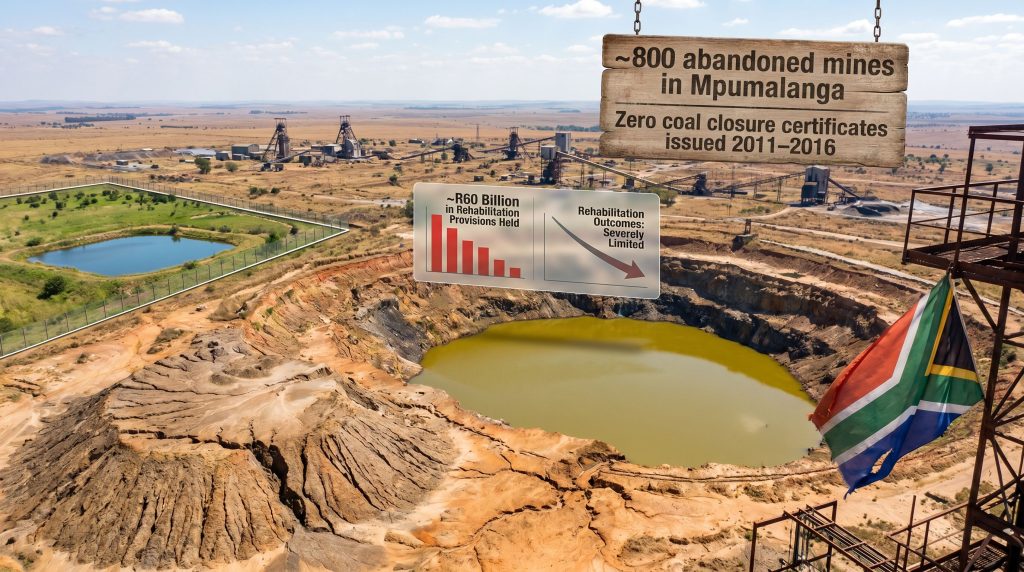
Mpumalanga, as the country's primary coal-producing province, sits at the centre of this figure. The province issued fewer than six closure certificates for all mine types between 2011 and 2016 — and critically, none of those certificates applied to coal operations during that entire five-year period. This is not an administrative anomaly. It is a structural indicator of a system that has allowed the most consequential category of mining activity in the province to operate without a credible exit mechanism.
A closure certificate represents the formal endpoint of a mine's regulatory lifecycle — the point at which environmental rehabilitation is deemed complete and the operator is released from ongoing liability. Its absence does not mean a mine is still productive. It means that environmental and financial liabilities remain legally unresolved, often indefinitely. With approximately 235 active coal mines recorded in Mpumalanga as recently as 2019, the gap between active operations and formal closure outcomes describes an entire industry operating without a functioning accountability endpoint.
The absence of a closure certificate is not simply a paperwork failure. It signals that rehabilitation has not occurred, that financial provisions remain locked in contested instruments, and that the environmental harm associated with that operation continues to accumulate — sometimes for decades after the last tonne of coal has been extracted.
The mathematics of deferred rehabilitation create what environmental economists describe as environmental debt: the longer rehabilitation is postponed, the more expensive and technically complex it becomes. Acid mine drainage, once initiated, becomes self-sustaining. Tailings facilities left unmanaged become structurally unstable. Underground workings left unflooded or unsupported become collapse risks. Each year of inaction increases both the cost of eventual remediation and the harm experienced by surrounding communities.
How the Coal Transition Is Accelerating the Crisis
South Africa's energy transition agenda adds a critical dimension of urgency to what might otherwise appear to be a longstanding but slow-moving governance problem. With coal-fired power stations facing projected closure timelines extending to 2030 and beyond, and the broader coal mining industry facing structural contraction over the same period, the number of mines requiring formal closure is set to increase substantially within a compressed timeframe.
This creates a compounded risk for Mpumalanga's communities that is rarely discussed with adequate specificity. The transition away from coal carries both an economic displacement effect — the loss of direct and indirect employment in communities where coal has been the primary economic driver for generations — and an environmental remediation obligation that grows with each new closure. If the current regulatory framework cannot manage the existing backlog of abandoned mines, it has no credible capacity to absorb the additional closure obligations that an accelerated transition will generate.
The communities of Mpumalanga therefore face a dual exposure: economic vulnerability from the energy transition and ongoing environmental harm from the accumulated failures of past mine closure governance. These are not separate problems requiring separate solutions. They are structurally linked, and any credible response to one must address the other. Consequently, mining sustainability transformation must be considered alongside any meaningful closure reform agenda.
What Happens When a Mine Closes Without a Plan? The Environmental Consequences Explained
Acid Mine Drainage: The Invisible Contamination Spreading Through Mpumalanga's Water Systems
Of all the environmental consequences of inadequate mine closure, acid mine drainage (AMD) is the most pervasive, the most chemically complex, and the most difficult to reverse once it has been initiated. AMD occurs when water — whether rainfall, groundwater, or surface runoff — comes into contact with sulphide minerals that have been exposed through excavation. The resulting oxidation reaction produces sulphuric acid and dissolves heavy metals including iron, manganese, arsenic, and lead into the leachate, which then migrates into surrounding groundwater and surface water systems.
In Mpumalanga's coal fields, the sulphide content of surrounding rock and coal waste creates optimal conditions for AMD generation across hundreds of unrehabilitated sites. The contamination pathway moves from pit walls and tailings storage facilities into shallow aquifers, then into rivers and streams that serve as water sources for communities that may be kilometres from the original mine site. South Africa's acid mine drainage crisis has been widely documented as one of the country's most pressing environmental emergencies.
The health consequences for communities reliant on contaminated water supplies are well-documented in the international literature on post-mining regions. Chronic exposure to heavy metals through drinking water is associated with neurological damage, renal impairment, and developmental impacts in children. Agricultural productivity is compromised when irrigation water carries elevated metal loads. The economic cost of water treatment for affected communities is rarely quantified or attributed to the mining operators whose inadequate closure practices caused the contamination.
AMD is uniquely dangerous from a governance perspective because it operates on geological timescales. Once the oxidation reaction is initiated and sulphide minerals are exposed, AMD generation continues for decades — sometimes centuries — without human intervention. The only effective countermeasure is preventive: rehabilitating pit walls, capping tailings, and controlling water ingress before the reaction becomes self-sustaining.
Toxic Tailings, Subsidence, and Spontaneous Combustion: The Physical Hazards Left Behind
Beyond AMD, unrehabilitated coal mines generate a range of acute physical hazards that pose direct risks to adjacent communities. Tailings storage facilities (TSFs) — the large impoundments used to store the fine-grained waste from coal washing processes — become structurally unstable when left unmanaged. Without regular maintenance of containment walls, vegetation cover to prevent erosion, and monitoring of internal water pressure, TSFs can fail catastrophically, releasing toxic slurry into surrounding land and waterways. Globally, TSF failures have caused some of the worst mining-related environmental disasters on record.
Land subsidence over abandoned underground coal workings represents a less dramatic but equally persistent hazard. As the timber or concrete supports within old workings decay, surface land above can subside unpredictably, damaging infrastructure, cracking building foundations, and creating sinkholes. In communities built on land underlain by legacy coal workings — a common spatial planning reality in Mpumalanga — this risk is not theoretical.
Spontaneous combustion in exposed coal seams and surface waste dumps is an underreported but ongoing hazard across Mpumalanga's abandoned mines. Coal left exposed at the surface or within unsupported waste piles can ignite through oxidation without external ignition sources, creating fires that are extremely difficult to extinguish, that emit toxic combustion gases, and that can persist for years. Communities living adjacent to spontaneously combusting waste dumps report respiratory impacts and persistent air quality degradation.
Comparing Environmental Outcomes: Rehabilitated vs. Unrehabilitated Sites
| Environmental Risk Factor | Properly Closed and Rehabilitated Site | Abandoned or Unrehabilitated Site |
|---|---|---|
| Acid Mine Drainage | Contained or neutralised through engineered closure | Ongoing, expanding, and self-sustaining |
| Water Quality | Monitored and within regulatory standards | Contaminated and largely unmonitored |
| Land Stability | Engineered backfill and surface stabilisation | Active subsidence and collapse risk |
| Public Access Safety | Secured, fenced, and signposted | Open, hazardous, and accessible to children |
| Tailings Management | Capped, revegetated, and structurally maintained | Exposed, erosion-prone, and structurally at risk |
| Spontaneous Combustion | Mitigated through burial or chemical treatment | Active and ongoing risk |
| Biodiversity Recovery | Progressive revegetation with native species | Barren, acid-scarred, or toxic surface conditions |
The Financial Provision Framework: Why the Money Exists But the Rehabilitation Doesn't Happen
How Financial Provisions for Mine Rehabilitation Are Supposed to Work
South Africa's legal framework for mine rehabilitation financing is built around the Mineral and Petroleum Resources Development Act (MPRDA), which requires every mining rights holder to establish a financial provision sufficient to fund the rehabilitation of environmental impacts associated with their operation. This provision must be in place before mining commences and must be maintained and updated throughout the life of the operation.
The MPRDA recognises three primary financial instrument types for meeting this obligation:
- Bank guarantees — issued by a financial institution, committing to pay the rehabilitation cost if the mining company defaults on its obligations.
- Trust funds — ring-fenced accounts held independently of the mining company, accumulating funds over the operational life of the mine.
- Cash deposits — direct deposits held by the state as security against rehabilitation obligations.
The Department of Mineral Resources and Energy (DMRE) is mandated to assess whether submitted financial provision amounts are adequate to cover rehabilitation costs and to approve or reject those submissions accordingly. In theory, this creates an accountability chain from mine operator through regulator to environmental outcome. In practice, that chain has multiple points of failure that the CER report documents in detail.
The R60 Billion Problem: Funds Held, Rehabilitation Stalled
As of 2017, an estimated R60 billion in financial provisions for mine rehabilitation had been accumulated across South Africa's mining sector. This figure represents a substantial pool of capital theoretically dedicated to undoing the environmental harm created by mining operations. Yet the correlation between accumulated provisions and actual rehabilitation outcomes has been negligible.
The reasons for this disconnect are both structural and institutional. Financial provisions held as bank guarantees cannot be drawn upon unless the mining company formally enters default and the regulatory authority initiates a drawdown process — a procedure that requires institutional capacity, legal action, and time that regulators frequently lack. Trust funds accumulate capital but are governed by trust deeds that may restrict access in ways that impede rapid deployment when a mine is abandoned. Cash deposits may be held in government accounts without clear mechanisms for their allocation to specific remediation projects.
The existence of a financial provision does not mean that rehabilitation will happen. It means that money has been set aside within an institutional framework that, in South Africa's current regulatory environment, has demonstrated a limited ability to convert that money into ground-level remediation outcomes.
When a mining company enters liquidation or simply abandons operations without formally applying for closure — a disturbingly common occurrence across Mpumalanga's smaller operators — the legal pathway to accessing financial provisions becomes contested, time-consuming, and often unresolvable within the timeframes that environmental urgency demands.
Shortfalls in Financial Provision Adequacy: A Structural Underestimation Problem
Beyond the accessibility problem, the adequacy of existing financial provisions is itself contested. The methodology used to calculate required provision amounts is frequently based on desktop assessments and standardised cost models that do not reflect site-specific rehabilitation complexity, current remediation technology costs, or the long-term management requirements of AMD-affected sites.
Several structural factors contribute to systematic underestimation:
- Rehabilitation cost models often exclude the ongoing treatment costs for AMD, which may need to continue indefinitely.
- Provision calculations are typically conducted by consultants engaged by the mining company rather than by independent third parties, creating an inherent conflict of interest.
- Inflation in construction, labour, and materials costs erodes the real value of provisions established years or decades earlier without corresponding adjustments.
- Evolving environmental standards mean that rehabilitation approaches considered acceptable when provisions were established may no longer meet current regulatory requirements.
- The concept of residual and latent environmental impacts — those that manifest after formal closure — is inconsistently defined in current legislation, creating legal ambiguity that operators exploit to exclude long-term liability from provision calculations.
Governance Failures and the Regulatory Framework: Who Is Responsible and Who Is Failing?
Mapping the Accountability Gap: State Capacity vs. Corporate Obligation
The CER report is direct in its characterisation of the governance failure: the South African state faces extreme capacity and other challenges in meeting its obligations, while mining companies continue to avoid or defer their rehabilitation responsibilities, leaving communities to bear the consequences of both failures simultaneously.
The DMRE carries primary responsibility for mine closure oversight at the national level, but its regulatory capacity is demonstrably insufficient relative to the scale of the compliance challenge. With hundreds of active mining operations and thousands of abandoned sites requiring monitoring, the department lacks the environmental engineers, hydrogeologists, and legal practitioners needed to conduct meaningful oversight of rehabilitation planning and financial provision adequacy.
Provincial environmental authorities in Mpumalanga are nominally responsible for coordinating with national regulators on environmental compliance, but the institutional relationship between provincial and national bodies has been characterised by coordination failures, overlapping jurisdictions, and unclear accountability for specific enforcement actions. Mining companies have learned to navigate this complexity by identifying jurisdictional grey areas where neither level of government takes clear ownership of enforcement.
Legal and Policy Framework Gaps: Where the Rules Break Down
The current legislative framework contains several structural ambiguities that undermine effective mine closure governance:
- The definition of final mine closure under South African law lacks precision, allowing operators to contest whether rehabilitation has been completed to the required standard.
- The "care and maintenance" classification allows mining companies to suspend operations without triggering formal closure obligations, potentially for unlimited periods.
- Environmental authorisation conditions are set at the time of project approval but are rarely updated to reflect changed environmental conditions, expanded operational footprints, or evolving scientific understanding of site-specific impacts.
- The requirement for independent verification of rehabilitation completion before closure certificates are issued is not consistently applied, allowing operators to self-certify rehabilitation outcomes.
Lessons from the Wesselton-Ermelo Case: A Decade of Community Harm Without Accountability
The CER report includes a detailed case study on the Imbabala coal mine in Wesselton, Ermelo, which was abandoned in 2011 and has remained unrehabilitated for more than thirteen years. This case illustrates the human cost of governance failure with particular clarity.
Since the mine's abandonment, the surrounding Wesselton community has lived with ongoing environmental hazards, compromised access to clean water, and safety risks associated with an unfenced and unmonitored site. Civil society legal engagement through the CER has attempted to compel both the responsible company and relevant government authorities to take remediation action, but neither has made substantive progress toward formal closure or rehabilitation as documented in the report.
The Imbabala case is not exceptional — it is representative. The CER's documentation reveals a pattern in which communities adjacent to abandoned mines in Mpumalanga carry the ongoing costs of regulatory failure without access to the financial provisions theoretically held for their protection.
The report also examined a 2021 Promotion of Access to Information Act (PAIA) request that revealed significant barriers to civil society's ability to access information about mine closure compliance and financial provision data held by government — further limiting communities' ability to hold operators and regulators accountable through legal channels. The Human Rights Watch report on unrehabilitated coal mines reinforces these findings with compelling evidence of the perpetual risks communities face in the absence of closure accountability.
The Human Cost: Socioeconomic Impacts on Mining Communities Facing Unmanaged Closures
From Economic Engine to Economic Void: How Mine Closures Reshape Local Economies
Coal mining communities in Mpumalanga have been structurally shaped by the industry across multiple generations. Employment patterns, infrastructure investment, and municipal revenue have all been oriented around the coal economy, creating a level of economic dependency that leaves communities with few viable transition pathways when mines close. When closure occurs without planning, the economic consequences are not gradual — they are immediate and cascading.
Direct job losses ripple outward through contractor networks and downstream service economies, collapsing the demand base that supports local retail, transport, and hospitality businesses. Municipal revenue derived from mining rates and taxes disappears, reducing the local government's capacity to maintain the services — roads, water, sanitation, health facilities — that communities depend on. Research on post-mining community trajectories in South Africa consistently documents accelerating poverty, youth unemployment, and population loss following unmanaged mine closures. In addition, the consideration of natural capital in mining decisions is increasingly recognised as essential to avoiding precisely these kinds of community impacts.
Health, Safety, and Environmental Justice: The Communities Left Behind
The spatial distribution of environmental harm from abandoned mines in Mpumalanga follows a pattern that is familiar from post-industrial regions globally: the communities most exposed to contamination and physical hazards are typically the poorest and least equipped to relocate or advocate for remediation. Historical spatial planning in South Africa placed residential areas for mineworkers in direct proximity to operations, meaning that the communities now most affected by unrehabilitated sites are those who contributed decades of labour to the operations that created the hazard.
Access to clean water is a constitutional right in South Africa. Where AMD contamination has compromised groundwater and surface water sources in Mpumalanga communities, that right is effectively suspended without legal remedy, remediation funding, or alternative supply infrastructure. The CER report emphasises that the lived experiences of people affected by these conditions must remain central to any policy discussion — a principle that is frequently acknowledged in regulatory language but rarely reflected in enforcement priorities.
The Just Transition Imperative: Connecting Mine Closure Governance to Broader Energy Policy
South Africa's just transition framework commits to managing the shift away from coal-dependent energy and industry in a manner that protects workers and communities from unacceptable social harm. Mine closure governance is not peripheral to this framework — it is foundational. A transition that accelerates coal mine closures without simultaneously addressing the rehabilitation backlog and community support gap will generate more harm than it prevents.
International models from post-industrial regions offer instructive comparisons. Germany's Ruhr Valley transformation involved decades of state investment in land repurposing, infrastructure adaptation, and workforce retraining, underwritten by sustained public funding at a scale that South Africa's current framework does not approach. The argument for a dedicated national mine closure and rehabilitation fund — capitalised through levies on active mining operations and managed through transparent governance structures — has gained increasing traction in South African policy discussions, though no such instrument currently exists. Furthermore, the mining decarbonisation benefits argument strengthens the case for embedding closure planning within the broader transition investment agenda.
The next major ASX story will hit our subscribers first
What Does Effective Mine Closure Actually Look Like? A Framework for Reform
The Five Pillars of Credible Mine Closure Governance
Synthesising lessons from South Africa's regulatory failures and international best practice, a credible mine closure governance framework requires five interdependent elements:
- Adequate and Dynamic Financial Provision — provisions calculated on full lifecycle rehabilitation costs, independently verified, and subject to mandatory review and adjustment on a defined periodic basis to reflect inflation, changed conditions, and evolving standards.
- Mandatory Progressive Rehabilitation — rehabilitation milestones built into operating permits from the outset, requiring operators to progressively rehabilitate disturbed land throughout the operational life of the mine rather than deferring all rehabilitation to end-of-life.
- Transparent Information Access — public disclosure requirements for financial provision amounts, rehabilitation plans, compliance status, and environmental monitoring data, enabling civil society and community oversight.
- Community Participation in Closure Planning — formal mechanisms for affected communities to participate in the development, monitoring, and verification of closure plans, rather than being passive recipients of decisions made by operators and regulators.
- Independent Regulatory Oversight — mandatory third-party verification of rehabilitation outcomes before closure certificates are issued, removing the self-certification dynamic that currently allows operators to define their own compliance standards.
International Benchmarks: How Other Jurisdictions Manage Mine Closure
| Jurisdiction | Key Mechanism | Notable Feature |
|---|---|---|
| Australia | State-based bonding and progressive rehabilitation requirements | Independent auditing of rehabilitation progress at defined milestones |
| Canada | Federal and provincial co-regulation with financial assurance requirements | Community consultation formally embedded in closure plan development |
| United States | Surface Mining Control and Reclamation Act bonding framework | Federal backstop fund for abandoned mine remediation |
| Germany (Ruhr) | State-funded post-industrial transition with comprehensive land repurposing | Long-term community economic diversification investment at significant scale |
| South Africa (current) | MPRDA financial provision framework with DMRE oversight | Significant enforcement gaps, capacity constraints, and provision adequacy shortfalls |
Policy Recommendations for Strengthening South Africa's Mine Closure Framework
Drawing on both the CER report's findings and comparative international analysis, the following policy interventions represent a coherent reform agenda:
- Establish an independent Mine Closure Inspectorate with dedicated technical capacity in environmental engineering, hydrogeology, and mine geotechnics.
- Introduce mandatory third-party auditing of rehabilitation financial provisions on a triennial cycle, with results published for public access.
- Legislate progressive rehabilitation milestones as conditions of continued operating licences, with automatic suspension mechanisms for non-compliance.
- Create a national abandoned mines remediation fund capitalised through levies on active operations, with transparent governance and community representation.
- Amend the PAIA framework to establish a presumption of disclosure for mine closure and rehabilitation data, reducing the information asymmetry that currently impedes community accountability efforts.
- Integrate mine closure planning requirements formally into municipal Integrated Development Plans in mining-dependent communities, ensuring that local government is a substantive participant in closure governance rather than a passive recipient of its consequences.
Moreover, the role of renewable energy in mining operations should be considered as part of any long-term transition strategy for Mpumalanga's mining communities, providing alternative economic anchors as coal operations wind down.
Frequently Asked Questions: Mpumalanga Mine Closure Crisis
How many abandoned mines are there in Mpumalanga?
Approximately 800 abandoned mines have been recorded in Mpumalanga, operating alongside roughly 235 active coal mines as of 2019. Nationally, South Africa carries an estimated 6,100 abandoned mines, of which at least 400 are former coal operations, according to the CER's No More Ghost Towns report.
Why are closure certificates so rarely issued for coal mines in Mpumalanga?
Between 2011 and 2016, fewer than six closure certificates were issued across all mine types in Mpumalanga, with none issued for coal mines during that period. This reflects a combination of regulatory capacity constraints within the DMRE, the technical complexity of coal mine rehabilitation, the prevalence of "care and maintenance" classifications that defer formal closure, and a regulatory culture that has not consistently prioritised enforcement of rehabilitation obligations.
What is acid mine drainage and why is it dangerous?
Acid mine drainage occurs when water interacts with sulphide minerals exposed through excavation, generating sulphuric acid and dissolving heavy metals into water that then contaminates groundwater and surface water systems. In Mpumalanga, AMD from unrehabilitated coal mines poses significant long-term risks to drinking water quality, agricultural productivity, and aquatic ecosystem health. Its particular danger lies in its self-sustaining nature once initiated — making prevention through early closure planning the only truly effective response.
How much money has been set aside for mine rehabilitation in South Africa?
Approximately R60 billion in financial provisions for mine rehabilitation was held across South Africa's mining sector as of 2017. Despite this substantial figure, structural constraints in the regulatory framework have significantly limited the deployment of these funds toward actual rehabilitation outcomes.
What is the just transition and how does it relate to mine closure?
South Africa's just transition agenda addresses the managed shift away from coal-dependent energy and industry in ways that protect workers and communities from economic and social harm. Mine closure governance is a central component: without rehabilitation investment and community support frameworks, an accelerated coal phase-out amplifies economic harm to mining communities rather than creating a foundation for long-term resilience.
What can communities do if a mine in their area has been abandoned without rehabilitation?
Communities can engage civil society legal organisations to pursue enforcement action through the courts, use PAIA mechanisms to access mine closure and financial provision data held by government, and participate formally in public comment processes for any new or amended environmental authorisations in their area. The CER's work with the Wesselton community in Ermelo demonstrates both the potential and the limitations of these legal avenues in the current regulatory environment.
The Path Forward: Turning the Mpumalanga Crisis into a Catalyst for National Reform
From Ghost Towns to Governed Transitions: What Political Will Could Achieve
The Mpumalanga mine closure crisis is, at its core, a governance failure that political will and institutional investment could substantially address. The technical knowledge to rehabilitate coal mining landscapes exists. The financial provisions to fund rehabilitation — imperfect as they are — have been partially accumulated. Civil society organisations, academic researchers, and affected communities have documented the problem with sufficient rigour to support comprehensive regulatory reform.
What has been absent is the combination of institutional capacity and political commitment needed to convert documented problems into implemented solutions. South Africa's broader mining sector reputation faces real risks if closure governance failures persist into the accelerated transition period. For investors evaluating ESG exposure in South African mining assets, the closure liability gap represents a material risk factor that is currently underpriced in most assessments.
Conversely, demonstrating credible progress on mine closure governance would strengthen the sector's social licence across the continent and position South Africa as a responsible steward of its extractive heritage — an outcome with real value for attracting the long-term capital that the energy transition itself requires.
Key Takeaways: What the Mpumalanga Mine Closure Crisis Tells Us About South Africa's Mining Governance
Critical findings from the CER's No More Ghost Towns report and supporting analysis:
- Approximately 6,100 abandoned mines nationally, with an estimated 800 in Mpumalanga alone.
- Fewer than six closure certificates issued in Mpumalanga between 2011 and 2016, with zero for coal operations.
- Roughly R60 billion in rehabilitation provisions accumulated nationally but largely undeployed due to structural and institutional constraints.
- Communities in areas like Wesselton-Ermelo have lived with unrehabilitated mine sites for more than thirteen years without substantive intervention.
- The regulatory framework contains significant gaps in enforcement capacity, financial provision adequacy, and information transparency.
- The just transition cannot succeed as a social or environmental project without concurrent mine closure governance reform.
- International comparators demonstrate that credible closure frameworks are achievable — but require institutional investment, legislative clarity, and genuine community participation.
This article draws on findings from the Centre for Environmental Rights report No More Ghost Towns: Lessons from Mpumalanga's Mine Closure Crisis, authored by CER mining programme head Tarisai Mugunyani, as reported by Mining Weekly on 22 May 2026. Readers seeking complementary analysis may also refer to Human Rights Watch's 2022 report The Forever Mines: Perpetual Rights Risks of Unrehabilitated Coal Mines in South Africa, available at hrw.org, and investigative coverage from Oxpeckers on coal mine closure legacies in Mpumalanga. This article contains forward-looking assessments based on current regulatory and environmental conditions. These should not be construed as legal, investment, or technical advice.
Want to Stay Ahead of the Next Major ASX Mineral Discovery?
While South Africa grapples with the consequences of unmanaged mine closures, savvy investors are focused on identifying well-governed exploration opportunities at the earliest possible stage — and Discovery Alert's proprietary Discovery IQ model delivers real-time alerts the moment significant ASX mineral discoveries are announced, turning complex data across 30-plus commodities into clear, actionable insights. Explore how major discoveries have historically generated substantial returns on Discovery Alert's dedicated discoveries page, and begin your 14-day free trial today to position yourself ahead of the broader market.