June 14, 2026
When Price Dominates Volume: Understanding Commodity Earnings Dynamics
In primary aluminium markets, the relationship between tonnes produced and revenue generated is rarely linear. Investors accustomed to volume-driven industries sometimes misread commodity earnings cycles, particularly during periods when metal prices are rising sharply. The core dynamic is straightforward in theory but frequently underestimated in practice: when realised prices per tonne increase faster than volumes decline, total revenue expands regardless of how many tonnes leave the smelter gates. Century Aluminum Q1 net sales Iceland shipment decline for early 2026 is a near-perfect case study of this mechanism playing out in real time across a bifurcated operational portfolio.
Understanding this earnings structure matters because it reframes how investors should interpret shipment data. A 12.4% sequential drop in shipped tonnes, viewed in isolation, would typically signal deteriorating commercial performance. Paired with a 2.4% increase in net sales, that same figure tells a fundamentally different story about pricing power, regional premium dynamics, and the composition of a producer's revenue base. Furthermore, this dynamic has broader relevance for understanding aluminum and alumina markets at large.
When big ASX news breaks, our subscribers know first
How Century Aluminum's Q1 2026 Net Sales Reached $649.2 Million
The Pricing Engine Behind the Revenue Expansion
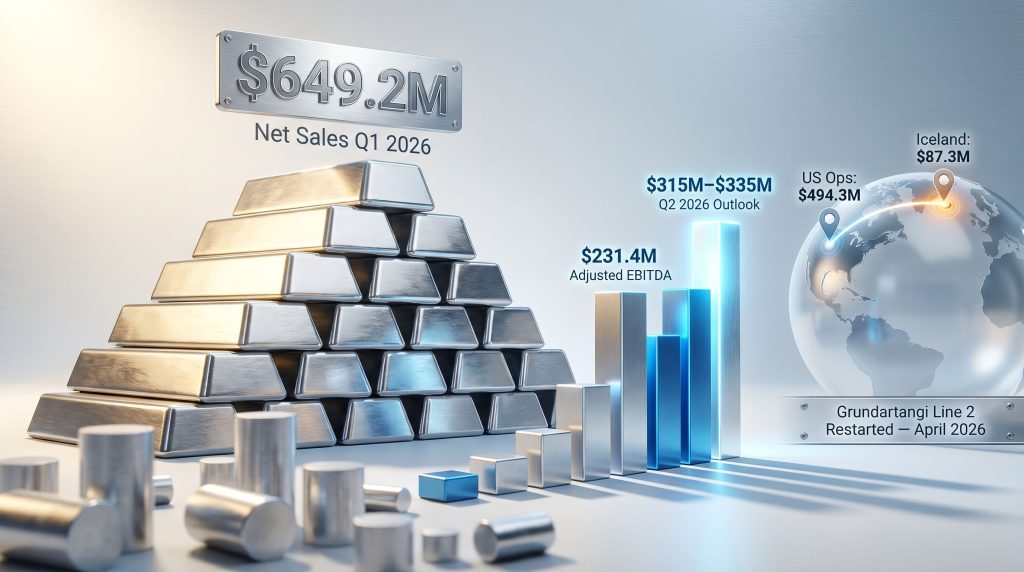
Total Q1 2026 net sales reached $649.2 million, rising from $633.7 million in Q4 2025 despite total primary aluminium shipments contracting 12.4% quarter-on-quarter to 122,865 tonnes from 140,257 tonnes. On a year-over-year basis, shipments fell even more steeply, declining 27.2% from 168,672 tonnes in Q1 2025, yet total sales still climbed 11% compared to the prior-year period.
The implied realised price per tonne illustrates the pricing dynamic with clarity:
| Period | Net Sales | Shipments (Tonnes) | Implied Realised Price/Tonne |
|---|---|---|---|
| Q1 2026 | $649.2M | 122,865 | ~$5,283 |
| Q4 2025 | $633.7M | 140,257 | ~$4,517 |
| Q1 2025 | $523.9M | 168,672 | ~$3,105 |
The sequential improvement in realised price per tonne of approximately 16.9% and the year-on-year improvement of roughly 70.2% quantify precisely why revenue grew despite physical output shrinking. London Metal Exchange aluminium price appreciation and stronger regional premiums, particularly in North American delivery markets, were the primary drivers behind this realised price expansion. In addition, the influence of US aluminium tariffs on domestic pricing dynamics has contributed meaningfully to this premium environment.
In commodity aluminium production, the realised price per tonne is often a more revealing performance indicator than shipment volumes, because it captures the combined effect of benchmark pricing, regional market premiums, and contract mix in a single figure.
Revenue Composition Across Segments
The Q1 2026 revenue structure reflected a significant regional imbalance driven by the Grundartangi outage in Iceland:
| Revenue Segment | Q1 2026 | Q4 2025 | Sequential Change |
|---|---|---|---|
| US Operations Sales | $494.3M | $413.1M | +19.7% |
| Iceland Operations Sales | $87.3M | $138.3M | -36.9% |
| Total Net Sales | $649.2M | $633.7M | +2.4% |
US operations contributed 76.1% of total Q1 2026 revenue, while Iceland accounted for just 13.4%, a significant departure from the portfolio balance that would exist under normal operating conditions. This concentration reflects the depth of the Iceland disruption rather than a strategic shift in geographic revenue weighting.
The Grundartangi Line 2 Transformer Failure and Its Full-Quarter Impact
How a Single Equipment Failure Reshaped Iceland's Contribution
A transformer failure at the Grundartangi smelter in Iceland during late October 2025 forced the idling of Line 2. While the outage began in Q4 2025, its complete production impact did not flow through the financial statements until Q1 2026, when the facility operated without Line 2 capacity for the full quarter.
The consequences were material and measurable:
- Iceland shipments fell 39.6% sequentially to 29,197 tonnes from 48,372 tonnes in Q4 2025
- Iceland-related sales collapsed 36.9% to $87.3 million from $138.3 million
- Century incurred $60 million in net costs directly attributable to the equipment failure
- Line 2 was restarted in April 2026, meaning Q1 2026 represented the full-quarter trough of the Iceland disruption
The engineering context is important here. Primary aluminium smelters require enormous, continuous electrical loads, typically in the range of tens of thousands of amperes per potline. Transformers at this industrial scale are not off-the-shelf components. Procurement lead times for utility-scale smelter transformers commonly extend to six months or more, which means the approximately six-month period between the failure in late October 2025 and the April 2026 restart aligns with normal industry replacement timelines. The Grundartangi outage was not a sign of operational mismanagement; it reflected the inherent procurement constraints of heavy industrial infrastructure.
The Insurance Recovery Framework
Century had received a cumulative $83 million in insurance proceeds related to the Grundartangi equipment failure as of the end of Q1 2026, including $33 million recognised within the quarter itself. This recovery programme is expected to continue into subsequent quarters.
The net cost of the Iceland equipment failure was $60 million, while cumulative insurance proceeds had already reached $83 million by the end of Q1 2026. This means the insurance programme has effectively more than offset the directly attributable exceptional costs, with the broader economic impact on lost production margins representing the more significant financial consideration.
The distinction matters for investors modelling Century's true operating economics. The $60 million in exceptional costs captures procurement, installation, and directly attributable losses. The lost contribution margin from approximately 19,000 tonnes of unproduced aluminium during the quarter represents a separate, and arguably larger, economic cost that does not appear as a discrete line item.
US Operations vs. Iceland: Diverging Regional Performance
American Smelter Resilience as a Portfolio Counterweight
The contrast between US and Iceland performance in Q1 2026 demonstrates how geographic diversification functions as a structural buffer against single-facility disruption risk:
| Metric | US Operations Q1 2026 | Iceland Operations Q1 2026 |
|---|---|---|
| Shipments (tonnes) | 93,668 | 29,197 |
| Sequential Shipment Change | +1.9% | -39.6% |
| Sales Revenue | $494.3M | $87.3M |
| Sequential Revenue Change | +19.7% | -36.9% |
| Implied Revenue/Tonne | ~$5,273 | ~$2,990 |
US operations demonstrated meaningful price-leverage benefits in Q1 2026. With shipments edging up just 1.9% sequentially yet revenue rising 19.7%, the US portfolio generated an implied realised price per tonne of approximately $5,273, significantly above the blended company average. This disparity reflects the strength of North American regional premiums relative to European delivery locations during the quarter. Consequently, understanding commodity price leverage is essential when evaluating these diverging outcomes.
Mt. Holly Expansion: Building Capacity for the Future
The Mt. Holly smelter expansion entered a critical phase in Q1 2026 with the initiation of the final 90 pot activations. In aluminium smelting terminology, pots (also called cells) are the individual electrolytic reduction units where aluminium oxide is converted into molten metal through the Hall-Heroult process. Each pot contributes a defined tonnage of annual production capacity, and a 90-pot addition at a modern facility typically adds between 50,000 and 80,000 tonnes of annualised output, depending on pot design and amperage configuration.
This expansion carries two important implications:
- Volume Recovery Pathway: As Line 2 at Grundartangi ramps back up through Q2 2026 and the Mt. Holly expansion reaches steady-state production, Century's total shipment volumes should progressively recover toward and ultimately exceed the 2025 baseline of 647,112 tonnes.
- Cost Structure Evolution: New pot installations generally operate at higher efficiency levels than legacy equipment, which may improve Mt. Holly's cost position within Century's portfolio over the medium term.
The expansion was not without near-term friction. $13.3 million in emergency energy charges at Mt. Holly during Q1 2026, attributable to severe winter weather that stressed regional power grids and elevated wholesale electricity prices, represented a short-term headwind that inflated the facility's operating costs during the quarter.
Q1 2026 Profitability: Separating Structural Performance from One-Time Items
Net Income Headline vs. Adjusted Earnings Reality
Net income attributable to Century surged from $1.8 million in Q4 2025 to $337.5 million in Q1 2026. This figure, however, is dominated by a $287.9 million pre-tax gain from the divestiture of the Hawesville smelter, a non-recurring transaction that has no bearing on Century's ongoing earnings power.
Stripping out non-recurring items provides a clearer picture of underlying performance:
| Profitability Metric | Q1 2026 | Q4 2025 | Sequential Change |
|---|---|---|---|
| Adjusted Net Income | $170.7M | $128.2M | +33.2% |
| Adjusted EPS (Common Share) | $1.63 | ~$1.25 | +30.4% |
| Adjusted EBITDA | $231.4M | $170.6M | +35.6% |
| Gross Profit (Mar 31) | $530.4M | $543.1M (Mar 31, 2025) | -2.3% YoY |
Adjusted EBITDA growth of 35.6% to $231.4 million was driven by three compounding factors: higher realised metal prices flowing through the revenue line, a more favourable sales mix weighted toward the US portfolio, and improved cost efficiency across operating facilities. The adjusted EPS of $1.63 represents the strongest sequential earnings-per-share performance in recent quarters on an underlying basis.
The headline net income figure of $337.5 million cannot be used as a baseline for ongoing earnings expectations. The $170.7 million adjusted net income figure, which excludes the Hawesville gain and other non-recurring items, is the appropriate reference point for assessing Century's recurring operational performance.
Exceptional Items and Structural Cost Pressures in Q1 2026
A Quarter Defined by Extraordinary Cost Events
Century's Q1 2026 results absorbed $166.8 million in net exceptional items, spanning an unusually broad range of event-driven disruptions. The breadth of these charges across multiple independent categories is itself analytically significant:
| Exceptional Item | Q1 2026 Cost |
|---|---|
| Unrealised losses on derivative instruments | $48.1M |
| Iceland equipment failure costs (net) | $60.0M |
| Emergency energy surcharges at Mt. Holly (winter weather) | $13.3M |
| Share-based compensation | $9.4M |
| Mt. Holly expansion capital costs | $7.5M |
| Hurricane Melissa impact on Jamalco operations | $5.9M |
| Hawesville inventory write-down | $3.3M |
The simultaneous occurrence of an Icelandic transformer failure, a severe North American winter weather event, and a hurricane affecting Jamaican bauxite operations in a single quarter illustrates the degree to which primary aluminium production remains exposed to geographically dispersed, non-market event risk. Furthermore, these disruptions highlight the importance of bauxite supply dynamics in assessing the vulnerability of integrated aluminium producers to upstream shocks. These items collectively suppressed what would otherwise have been a stronger adjusted earnings outcome.
The $48.1 million unrealised loss on derivative instruments warrants separate attention. Aluminium producers typically use derivative contracts to hedge future price exposure or lock in sales prices ahead of production. Unrealised losses on these positions arise when spot or forward prices move in the opposite direction to the hedge. This does not represent a cash loss in the period but does affect reported profitability and will ultimately reverse or be realised in future quarters as contracts settle.
Energy Cost Sensitivity: The Persistent Structural Headwind
Beyond one-time weather events, power costs and raw material price inflation partially offset the benefits of higher LME aluminium prices across the quarter. Energy cost sensitivity is a structural characteristic of primary aluminium production, which is among the most electricity-intensive industrial processes in existence. A tonne of primary aluminium typically requires 13,000 to 15,000 kilowatt-hours of electrical energy to produce, making power tariff movements one of the most consequential variables in the smelter cost curve.
This structural exposure means that periods of grid stress, as experienced at Mt. Holly during Q1 2026's winter weather event, can create disproportionate cost impacts even when the underlying disruption is temporary.
The next major ASX story will hit our subscribers first
Full-Year 2026 Shipment Guidance and the Iceland Recovery Timeline
What the 630,000-Tonne Target Reflects
Full-year 2026 consolidated shipment guidance is set at 630,000 tonnes, below the 647,112 tonnes delivered in 2025. The reduction directly reflects the prolonged impact of the Grundartangi Line 2 outage on first-half volumes, partially offset by the Mt. Holly expansion ramp-up.
The recovery trajectory is structured as follows:
- Q1 2026: Full-quarter trough. Line 2 offline for the entire period. Total shipments: 122,865 tonnes.
- April 2026: Line 2 restarted at Grundartangi. Production ramp-up begins in Q2.
- Q2-Q4 2026: Progressive volume recovery as Iceland output normalises and Mt. Holly expansion contributes incremental tonnes.
- Full-Year 2026: 630,000-tonne target, implying average quarterly shipments of approximately 169,000 tonnes across Q2-Q4, a significant step-up from Q1.
Q2 2026 EBITDA Guidance: A Step-Change in Earnings
Century has guided Q2 2026 adjusted EBITDA in the range of $315 million to $335 million, representing a projected 36% to 45% sequential increase from Q1's $231.4 million. The anticipated uplift rests on four converging factors:
- Higher realised LME aluminium prices flowing through the sales mix in Q2
- Stronger regional premiums, particularly in North American delivery markets
- Incremental volume recovery from the Grundartangi Line 2 restart in April
- Continued Mt. Holly capacity ramp-up contributing additional production tonnes
If the Q2 guidance midpoint of $325 million is achieved, it would represent the strongest single-quarter EBITDA performance in recent memory for Century, underscoring how the combination of pricing tailwinds and operational recovery can create material earnings leverage in commodity aluminium production.
The Hawesville Divestiture: Portfolio Rationalisation as Strategic Signal
What the $287.9 Million Gain Reveals About Capital Allocation Direction
The sale of the Hawesville smelter generated a $287.9 million pre-tax gain, making it the single largest contributor to Q1 2026 net income. A $3.3 million inventory write-down associated with the facility's closure was recorded as a partial offset.
Asset rationalisation in capital-intensive industrial sectors is rarely a straightforward story of capacity reduction. More commonly, it reflects a deliberate portfolio optimisation strategy aimed at concentrating production at facilities with the most favourable combinations of energy access, cost structure, and geographic positioning. In Century's case, the divestiture of Hawesville concentrates the operating portfolio around two core assets: Mt. Holly in South Carolina and Grundartangi in Iceland. For broader context, reviewing how top aluminium companies manage their asset portfolios reveals that this kind of rationalisation is increasingly common across the sector.
Capital released from the Hawesville transaction provides Century with strategic optionality across several dimensions:
- Funding the ongoing Mt. Holly expansion without incremental external financing
- Accelerating debt reduction to strengthen the balance sheet ahead of potential market volatility
- Creating capacity for shareholder returns if aluminium market conditions remain favourable
- Positioning the company for potential future strategic investments in higher-efficiency capacity
The Hawesville sale also simplifies Century's operational footprint, reducing the management overhead associated with maintaining and operating a third smelting location. In an environment where energy costs and operational complexity are primary cost drivers, a leaner geographic footprint can improve operational focus. The Century Aluminum Q1 net sales Iceland shipment decline narrative ultimately illustrates how a well-structured portfolio can absorb significant disruption while still delivering meaningful financial progress.
Disclaimer: This article is intended for informational purposes only and does not constitute financial advice, investment recommendations, or a solicitation to buy or sell any securities. Forward-looking statements, including guidance ranges and production forecasts referenced herein, involve risks and uncertainties, and actual outcomes may differ materially from those projected. Readers should conduct their own independent research and consult a qualified financial adviser before making investment decisions. Financial data presented is sourced from publicly available company disclosures and industry reports.
Want to Capitalise on the Next Major Commodity Discovery Before the Broader Market?
Discovery Alert's proprietary Discovery IQ model delivers real-time alerts on significant ASX mineral discoveries, transforming complex commodity data into actionable investment insights — just as price dynamics like those seen in aluminium markets can create outsised opportunities for well-positioned investors. Explore how historic mineral discoveries have generated substantial returns on Discovery Alert's dedicated discoveries page, and begin your 14-day free trial today to secure your market-leading edge.