
June 14, 2026
The Physics of Depletion: Why Every Open-Pit Mine Carries a Built-In Expiry Date
There is a mathematical certainty embedded in every open-pit mining operation that no amount of optimisation can overcome indefinitely. As an open pit deepens, the volume of waste rock that must be excavated to access each additional tonne of ore grows at an accelerating rate. This relationship, captured in the concept of the stripping ratio, eventually renders surface mining economically irrational regardless of ore quality. When that threshold is crossed, the only viable path forward is downward, literally.
This is not an edge case or a planning failure. It is the structural reality that has shaped the transition strategies of South Africa's most significant platinum group metals (PGM) producers for decades. And it is precisely the dynamic now playing out at one of the Bushveld Complex's most distinctive operations, where the Tharisa move to underground mining represents one of the most consequential production decisions in the South African PGM sector in a generation.
When big ASX news breaks, our subscribers know first
Understanding the Ore Body Geometry That Made This Transition Inevitable
The Tharisa Mine sits within the southern portion of the Bushveld Igneous Complex, the world's largest known repository of platinum group metals. What makes Tharisa unusual among its PGM peers is its dual-commodity profile: the operation produces both PGMs and chrome from the same ore body, a characteristic that significantly alters the economics of both surface and underground development.
The chrome-bearing reefs that Tharisa exploits extend vertically to depths well beyond the practical reach of open-pit extraction methods. As the pit has matured, the stripping ratio has climbed, meaning progressively more waste must be moved per unit of ore recovered. Furthermore, beyond a certain depth — typically considered to be in the range of 200 to 300 metres for most open-pit metalliferous operations — waste removal costs overwhelm the value extracted from ore.
The geometry of Tharisa's reef package makes underground transition not just attractive but operationally necessary. The deeper reefs carry mineralisation profiles that are broadly consistent with shallower material, which is an important distinction. Not all underground PGM deposits deliver grade improvement at depth, but where reef continuity is strong, the elimination of waste stripping costs creates a compelling economic argument for the transition even before grade uplift is factored in. Consequently, understanding cut-off grade economics becomes essential when evaluating the viability of such a shift.
Project Scope and the US$547 Million Capital Commitment
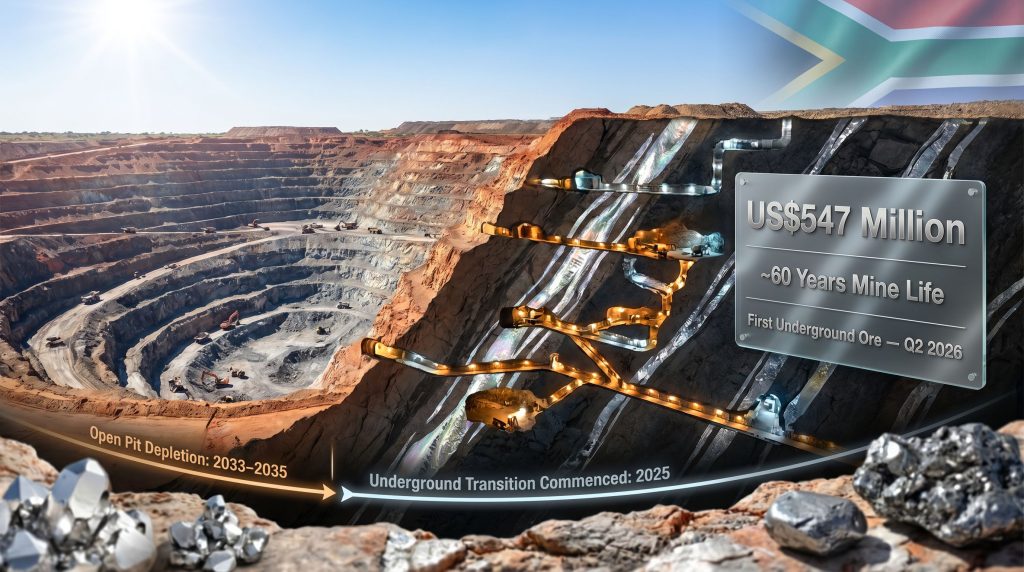
The scale of the Tharisa move to underground mining reflects both the ambition and the complexity of what is being attempted. The project involves approximately US$547 million in committed capital, deployed across roughly a decade of development activity. This is not a single construction event but a phased infrastructure build that must be executed while the existing open pit continues to operate.
The phased transition architecture serves a critical purpose: it prevents the production cliff that would occur if open-pit output were curtailed before underground volumes could replace it. Maintaining operational continuity during this window is arguably the most difficult aspect of the entire project, requiring precise coordination between surface and subsurface activities that are, in many respects, operationally incompatible. A definitive feasibility study underpins the capital deployment framework, ensuring technical and financial assumptions are rigorously validated before each phase of investment is committed.
Key Project Snapshot
| Metric | Detail |
|---|---|
| Capital Commitment | Approximately US$547 million |
| Deployment Period | Roughly 10 years |
| Transition Commencement | 2025 (phased) |
| First Underground Blast | Late March 2026 |
| First Underground Ore Target | Q2 2026 |
| Extended Mine Life | Approximately 60 years |
| Open Pit Depletion Estimate | 2033 to 2035 |
The first underground blast, recorded in late March 2026, marked the operational start of underground development activities. This milestone is distinct from first ore delivery, which is targeted for the second quarter of 2026. Development blasting establishes access infrastructure, while ore delivery marks the point at which the underground workings begin contributing to the production profile.
How the 60-Year Mine Life Extension Changes Everything
The headline figure from this project is the approximately 60-year extension to mine life that underground access enables. To appreciate what this means in practice, it helps to consider what the alternative looks like.
Without underground development, the open pit is estimated to reach economic depletion somewhere between 2033 and 2035. That would leave fewer than a decade of production from a mine that has taken considerable capital and decades of operational knowledge to build. From a valuation perspective, an asset approaching depletion trades very differently from one with a confirmed multi-decade resource horizon.
Mining operations with long-duration resource profiles attract structurally different capital. Project finance terms, royalty arrangements, offtake negotiations, and equity valuations all respond to resource horizon length. A 60-year underground resource transforms Tharisa from a maturing open-pit asset into what analysts sometimes describe as a long-duration, generational mining platform. That repositioning has implications well beyond the operational domain.
The comparison below illustrates the structural differences between the two production modes:
| Operational Factor | Open-Pit PGM Mining | Underground PGM Mining |
|---|---|---|
| Depth of Access | Surface to approximately 300m | 300m+ to 2,000m and beyond |
| Stripping Ratio Burden | High and escalating | Eliminated entirely |
| Capital Intensity | Lower initial expenditure | Higher upfront development cost |
| Mine Life Potential | Finite, geometry-limited | Multi-decade potential |
| Grade Consistency | Variable, diluted by waste | Typically higher and more consistent |
| Surface Footprint | Larger, expanding disturbance | Substantially reduced |
The Seven-Stage Engineering Process Behind a Phased Transition
Moving from open-pit to underground production is not a binary switch. It is a sequenced engineering programme that must balance development velocity with operational safety and ore continuity. The following steps outline how such a transition typically progresses:
-
Feasibility and resource delineation — Confirming the geometry, grade continuity, and structural characteristics of the underground ore body through drilling and modelling. In addition, 3D geological modelling plays an increasingly critical role in validating reef continuity before capital is committed.
-
Decline and portal development — Constructing the primary access ramp that connects surface infrastructure to underground workings, typically driven at a gradient of between 1:7 and 1:10.
-
Level development — Establishing horizontal drives at multiple depth intervals to create access corridors to ore zones.
-
Stoping method selection — Choosing the appropriate extraction technique based on reef dip, width, ground conditions, and grade distribution. In narrow reef PGM environments, breast mining and scattered stoping methods are common, though mechanised bord-and-pillar variants are increasingly evaluated.
-
Ventilation and services commissioning — Installing underground air circuits, water management systems, and electrical infrastructure capable of supporting a sustained workforce at depth.
-
First ore extraction — The transition from development rock (waste) to reef-bearing ore, the point at which the underground operation begins delivering value.
-
Ramp-up to steady-state production — Scaling underground output progressively to compensate for declining open-pit volumes as the two systems overlap during the transition window.
Chrome Co-Production: The Revenue Stream That Underground Access Preserves
One dimension of this transition that deserves specific attention is the chrome co-production element. Tharisa's ore body yields both PGMs and chromite from the same reefs, a geological characteristic that is relatively uncommon among South African PGM producers. Chrome revenues have historically provided a meaningful contribution to Tharisa's financial performance, acting as a partial buffer against PGM price volatility.
Underground access preserves this dual-commodity revenue stream. If the open pit were simply allowed to reach depletion without underground replacement, chrome production would terminate alongside PGM output. The underground transition therefore protects not just platinum and palladium revenues but the entire commodity mix that defines Tharisa's financial profile. Moreover, the broader context of PGM supply constraints makes preserving long-term production capacity at operations like Tharisa increasingly important for global market stability.
The dual-commodity nature of Tharisa's ore body means that underground development capital is effectively being deployed to protect two revenue streams simultaneously, a consideration that strengthens the investment case relative to single-commodity PGM operations facing similar transition decisions.
The next major ASX story will hit our subscribers first
Geotechnical Complexity: Mining Beneath an Active Open Pit
From a purely technical standpoint, the most demanding aspect of this project is the requirement to conduct underground development while the open pit above remains operational. This creates geotechnical conditions that are materially more complex than developing a standalone underground mine on greenfield ground.
The stress redistribution caused by open-pit excavation affects the rock mass surrounding and below the pit floor. Underground engineers must account for induced stress concentrations, potential for surface subsidence, and the dynamic loading created by open-pit blasting. Ground support designs, pillar dimensions, and stoping sequences must all be calibrated to these conditions rather than to the theoretical properties of undisturbed rock.
Ventilation requirements add further complexity. Underground mining engineering demands extensive primary and secondary ventilation circuits to manage heat, dust, and blast fume clearance. Designing these circuits in a geometry constrained by an overlying pit introduces engineering challenges that are rarely encountered in conventional greenfield underground development.
What This Transition Signals to the Broader PGM Investment Landscape
The Tharisa move to underground mining does not exist in isolation. It reflects a broader structural dynamic playing out across South Africa's PGM sector, where many of the country's historically significant open-pit and shallow underground operations are approaching the depth horizons at which conventional extraction methods become uneconomical.
For investors assessing PGM exposure, the distinction between operations approaching depletion and those executing credible life-extension strategies is increasingly material. An operation that can demonstrate a clear pathway from a maturing open pit to a confirmed underground resource, backed by committed capital and phased development milestones, occupies a fundamentally different risk-return position than one without that clarity.
The first underground blast at Tharisa in late March 2026 functions as precisely this kind of market signal. It is not a theoretical commitment but a physical demonstration that development has commenced and that the capital programme is being deployed as planned. For a detailed breakdown of the technical aspects of this transition, Tharisa's official project documentation provides comprehensive insight into the phased engineering approach and capital deployment schedule.
Disclaimer: This article contains forward-looking statements and projections regarding mine life extension, capital deployment, and production timelines. These are subject to geological, technical, financial, and regulatory risks. Readers should not rely on this content as investment advice and should conduct independent due diligence before making any investment decisions.
Frequently Asked Questions: Tharisa Underground Mining Transition
What is the Tharisa underground mining project?
Tharisa is executing a phased transition from open-pit to underground mining at its operation within the Bushveld Complex in South Africa. The project involves approximately US$547 million in capital investment deployed over roughly ten years, targeting deeper PGM and chrome-bearing reefs as the open pit approaches the limits of economic extraction.
When did the transition formally begin, and what has been achieved so far?
The phased transition commenced in 2025. The first underground blast was recorded in late March 2026, marking the operational start of underground development. First underground ore delivery is targeted for the second quarter of 2026, after which the operation will begin scaling underground output alongside continuing open-pit production.
When is the open pit expected to reach depletion?
Current project modelling estimates open-pit depletion occurring between 2033 and 2035. The variation in this range reflects evolving resource estimates and mine planning refinements rather than any fundamental uncertainty about the necessity of the underground transition.
Why is underground mining preferable to simply deepening the open pit?
As an open pit deepens, the volume of waste rock excavated per tonne of ore recovered grows exponentially. This stripping ratio increase eventually makes surface extraction financially unviable. Underground methods eliminate the stripping burden entirely, allowing access to deep, high-value ore without the escalating waste removal costs that ultimately defeat the economics of open-pit mining.
What metals does the underground operation target?
The underground project targets the same PGMs and chrome-bearing reefs that have characterised Tharisa's open-pit production. Deeper reef access is expected to maintain or improve grade profiles relative to the increasingly diluted material recovered from the maturing open pit.
How does a 60-year mine life affect how the operation is valued?
Long-duration resource horizons attract structurally different capital and valuation frameworks than assets approaching depletion. Project finance terms, offtake agreements, and equity market valuations all respond favourably to confirmed multi-decade resource profiles. The underground transition converts a finite open-pit asset into a generational mining platform. For further context on how the industry is responding to these dynamics, Mining Technology's coverage of the project offers additional technical and financial perspective.
Readers interested in broader African mining investment trends and operational developments can explore additional industry perspectives through the Mining Indaba Content Hub at miningindaba.com/articles, which features market news, digital content, and commentary from across the African mining sector.
Want to Catch the Next Major PGM or Mineral Discovery Before the Market Does?
Discovery Alert's proprietary Discovery IQ model scans ASX announcements in real time, delivering actionable alerts on significant mineral discoveries — including opportunities in the PGM and chrome sectors — so subscribers can position themselves ahead of the broader market. Start a 14-day free trial with Discovery Alert today, or explore historic discoveries and their returns to understand how early positioning in major finds has shaped investment outcomes.