August 7, 2026
When Smelter Economics Flip: Understanding the Conditions That Make Aluminium Restarts Viable
Primary aluminium smelting operates at the intersection of energy markets, commodity cycles, and long-term capital commitments. Unlike most manufacturing industries, smelters cannot be switched on and off without substantial cost and risk. The decision to idle a potline permanently destroys value; restarting one requires years of planning, tens of millions in capital, and a firm conviction that metal prices will remain elevated long enough to justify the investment. This makes the successful restart of idled capacity a rare and significant event, one that carries implications not just for the company involved, but for the entire domestic supply chain it serves.
Against this backdrop, the Century Aluminum Q2 profit and Mt Holly restart represent exactly the kind of structural inflection point that smelter economics rarely deliver. The financials tell one story. The operational milestones tell another. Together, they sketch an industry undergoing a meaningful recovery in US primary aluminium production capacity.
When big ASX news breaks, our subscribers know first
Breaking Down the Numbers: Century Aluminum Q2 2026 Financial Performance
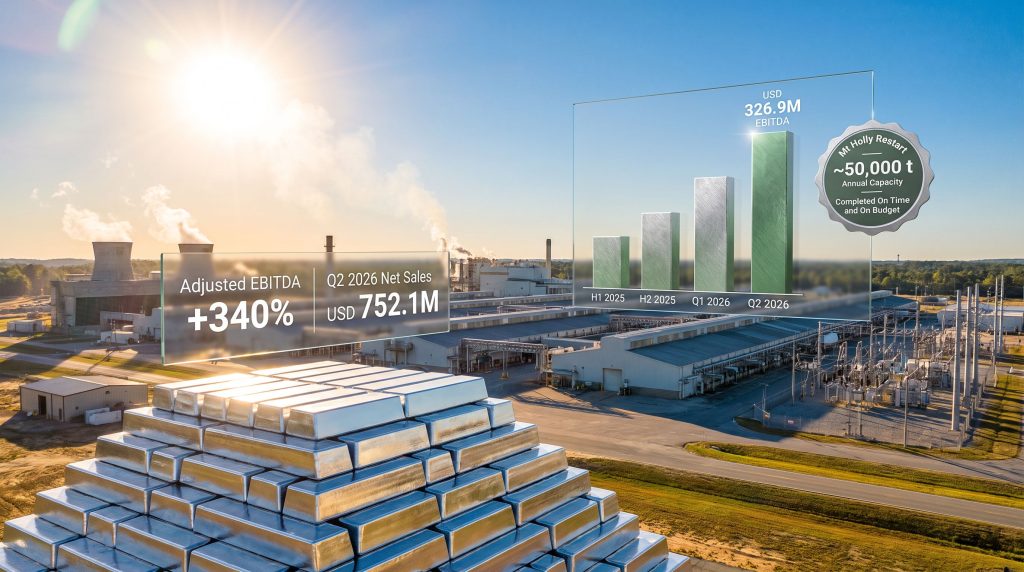
The headline figures from Century Aluminum's second quarter ended June 30, 2026, make for compelling reading. Net sales reached USD 752.1 million, up 34.76% year-on-year from USD 558.1 million in Q2 2025. Adjusted EBITDA attributable to Century reached USD 326.9 million, representing a 340% increase over the USD 74.3 million recorded in the same period last year.
The full quarterly comparison across key metrics is presented below:
| Financial Metric | Q2 2026 | Q2 2025 | Change (YoY) |
|---|---|---|---|
| Net Sales | USD 752.1M | USD 558.1M | +34.76% |
| Adjusted Net Income | USD 257.3M | USD 30.4M | +746.38% |
| Adjusted EBITDA | USD 326.9M | USD 74.3M | +340.24% |
| Diluted EPS | USD 2.39 | USD 0.30 | +696.67% |
| Adjusted EPS | USD 2.46 | USD 0.05 | +4,820% |
| Primary Al Shipments | 130,632 t | 175,741 t | -25.7% |
The most immediately striking feature of this table is the disconnect between shipment volumes and financial returns. Primary aluminium shipments fell 25.7% year-on-year, yet profits surged by nearly eightfold on an adjusted net income basis. This is not a paradox; it is the signature of a price-driven earnings cycle operating at full force.
Why Did Shipment Volumes Decline While Profits Surged?
The year-on-year decline in shipment volumes reflects the exceptionally high Iceland output recorded in Q2 2025, when Grundartangi was running at elevated capacity. With Line 2 at Grundartangi having been idled and subsequently restarted during the intervening period, the comparison base was unusually favourable for the prior year. What changed dramatically in Q2 2026 was not volume but the price per tonne realised on every shipment made.
Higher LME aluminium benchmarks combined with elevated US Midwest regional premiums created a pricing environment where fewer tonnes delivered materially greater revenue per unit. For investors accustomed to tracking volume as a proxy for performance in commodity businesses, this dynamic is a critical reminder that margin per tonne, not tonnes shipped, drives the actual earnings outcome when price cycles turn.
The Role of Realised LME Prices and US Regional Premiums
US regional premiums for primary aluminium have historically traded at modest levels above the LME cash price. However, the combination of domestic supply constraints, US aluminium tariffs reshaping trade flows, and growing downstream manufacturing demand pushed US Midwest premiums to levels that materially amplified the LME price signal for domestic producers. Century, as one of the few remaining US primary smelter operators, sits at the direct beneficiary end of this premium structure.
Q2 vs Q1 2026: Separating Operational Progress from One-Time Accounting Effects
The sequential comparison between Q1 and Q2 2026 requires careful handling because a major non-recurring item significantly distorts the headline Q1 figures.
| Financial Metric | Q2 2026 | Q1 2026 | Change (QoQ) |
|---|---|---|---|
| Net Sales | USD 752.1M | USD 649.2M | +15.85% |
| Adjusted Net Income | USD 257.3M | USD 170.7M | +50.73% |
| Adjusted EBITDA | USD 326.9M | USD 231.4M | +41.27% |
| Diluted EPS | USD 2.39 | USD 3.23 | -26.0% |
| Adjusted EPS | USD 2.46 | USD 1.63 | +50.9% |
| Primary Al Shipments | 130,632 t | 122,865 t | +6.32% |
The diluted EPS decline from USD 3.23 in Q1 to USD 2.39 in Q2 initially suggests deterioration. It does not. Q1 2026 included a USD 287.9 million one-time gain from the divestiture of the Hawesville smelter, which inflated reported net income and therefore reported diluted EPS for that quarter. Once this non-recurring item is stripped out, the underlying operational trajectory is firmly positive.
*When the Hawesville divestiture gain is excluded from Q1 figures, Century Aluminum's core operational performance improved sequentially across both quarters. Adjusted EBITDA grew 41.27% quarter-on-quarter, adjusted net income rose 50.73%, and shipment volumes increased 6.32%. The adjusted EPS comparison of USD 2.46 versus USD 1.63 confirms the direction of travel without distortion.*
This is a distinction that matters enormously for investors attempting to model recurring earnings power rather than reported income, which is subject to asset sale timing and accounting classifications.
The Mt Holly Restart: What It Is, What It Cost, and Why It Changes the Production Equation
The Mt Holly aluminium smelter in South Carolina holds a notable place in US industrial history. Originally constructed decades ago, the facility was progressively idled as power costs in the eastern US rendered it uneconomic against overseas competition. By 2015, Mt Holly had been placed on full care-and-maintenance status, representing a significant loss of domestic primary aluminium production capacity at a time when the US was already heavily import-dependent.
The decision to restart Mt Holly was not taken lightly. Restarting an aluminium reduction cell is a technically demanding process. Aluminium smelters use electrolytic reduction cells called pots, each of which must be carefully brought up to operating temperature before the cryolite bath chemistry stabilises and the cell can begin producing molten metal. Restart damage, in which a pot fails during the ramp-up phase, is a real risk that can set back restart timelines and add unexpected capital costs.
Mt Holly Restart: Key Facts
- Total restart investment: Approximately USD 50 million
- Annual production capacity added: Approximately 50,000 metric tonnes of primary aluminium
- Final phase completed: The last 90 pots were restarted in late June 2026
- Project outcome: Completed on time and within budget
- Full production benefit timing: Q3 2026 onward, as Q2 only captured a partial-quarter run rate
- Historical context: First time Mt Holly has operated at full capacity since 2015
The USD 50 million restart cost compares extremely favourably against the cost of building new greenfield smelting capacity, which in modern markets would require capital expenditure many times that figure per tonne of installed capacity. This makes idled brownfield smelter restarts the most capital-efficient path to adding domestic primary aluminium supply when market conditions justify the investment. Furthermore, the aluminium and steel tariffs currently reshaping US import economics provided a critical pricing backdrop that made the restart commercially compelling.
The 90-Pot Final Phase: What This Means Technically
In aluminium smelting terminology, a potline is a series of reduction cells connected in electrical series. The Mt Holly restart proceeded in phases, with the final 90 pots representing the last operating cell bank required to bring the facility to full nameplate capacity. The completion of this phase in late June 2026 means that Q2 results only reflected a partial contribution from the fully operational smelter. The complete quarterly production benefit from all restarted pots will flow through from Q3 2026 onward, providing a natural earnings tailwind even if metal prices remain flat.
H1 2026 vs H1 2025: The Half-Year Transformation in Numbers
Combining both quarters, the scale of Century Aluminum's earnings recovery over twelve months becomes fully apparent:
| Financial Metric | H1 2026 | H1 2025 | Change (YoY) |
|---|---|---|---|
| Net Sales | USD 1.40B | USD 1.19B | +17.65% |
| Adjusted Net Income | USD 586.8M | USD 67.0M | +775.8% |
| Adjusted EBITDA | USD 558.3M | USD 152.3M | +266.58% |
| Diluted EPS | USD 5.62 | USD 0.59 | +852.5% |
| Total Primary Al Shipments | 253,497 t | 344,413 t | -26.4% |
The data reinforces a consistent theme: the company generated 267% more EBITDA on 26% fewer shipped tonnes. This is not volume-driven growth; it is entirely margin-driven. The implication for analysts modelling forward earnings is that the key variable to watch is not production capacity utilisation but the sustainability of current LME price levels and US regional premiums.
Four Operational Pillars Behind the Q2 EBITDA Improvement
The USD 95.5 million sequential increase in adjusted EBITDA from Q1 to Q2 2026 was supported by four identifiable operational factors:
- Higher realised LME aluminium prices and regional premiums driving increased revenue per tonne across all shipments.
- Increased Mt Holly production as the smelter moved through its final restart phases toward full operating capacity.
- Grundartangi Line 2 recovery with Iceland operations returning toward full output following the earlier potline restart.
- Lower US power costs resulting from favourable seasonal weather conditions that reduced energy consumption demands at domestic facilities.
These gains were partially offset by rising raw material input costs, particularly for alumina and carbon materials used in the electrolytic reduction process, which represent the two largest variable cost components for any primary aluminium smelter.
The Iceland Operations Factor: Grundartangi Line 2 in Context
The Grundartangi smelter in Iceland benefits from access to geothermal and hydroelectric power, two renewable energy sources that provide a structural cost advantage over fossil-fuel-dependent smelters elsewhere. The restart of Line 2 at Grundartangi positions Century to recover the production capacity that had been absent from its Iceland operations, contributing incremental volume at competitive operating costs. Iceland's energy infrastructure makes Grundartangi one of the lower-carbon-intensity primary aluminium facilities in Century's portfolio, an attribute increasingly relevant given downstream customer sustainability commitments. This mirrors the broader aluminium energy transition underway across the global industry.
The next major ASX story will hit our subscribers first
Beyond the Smelter: Other Material Developments in Q2 2026
The Section 45X Tax Credit and the USD 94.3 Million Refund
One of the less widely understood financial tailwinds for US primary aluminium producers is the Section 45X Advanced Manufacturing Production Credit established under the Inflation Reduction Act. This provision delivers per-unit tax credits for domestic production of qualifying materials, including primary aluminium, providing a direct financial incentive linked to the volume of metal produced on US soil.
Century Aluminum received a USD 94.3 million Section 45X tax refund in July 2026, reflecting production-linked credits accumulated through the domestic smelting operations. This is a structural benefit that did not exist in prior earnings cycles and represents a meaningful addition to operating cash generation beyond what EBITDA metrics alone capture. For comparative purposes, this single refund exceeds the company's total adjusted EBITDA for all of H1 2025 (USD 152.3 million divided by approximately 1.6).
The TG4 Power Turbine at Jamalco
Century's Jamaican alumina operations at Jamalco brought a new TG4 power generation turbine online in August 2026. For an energy-intensive upstream operation, in-house power generation provides both cost stability and resilience against grid supply interruptions. Enhanced energy self-sufficiency at Jamalco reduces exposure to external power pricing volatility, supporting more predictable alumina production costs that feed through to the company's integrated supply chain.
Balance Sheet Milestone: Cash Exceeds Total Debt
By the end of July 2026, Century Aluminum's cash balance had grown to exceed its total debt obligations. For a company that has historically operated with meaningful leverage typical of capital-intensive smelter businesses, this represents a genuine balance sheet inflection point. A net cash position eliminates refinancing risk, increases strategic flexibility for capital allocation decisions, and significantly changes the risk profile that institutional investors must price into their valuation models.
Q3 2026 Guidance and What It Signals
Century Aluminum guided for Q3 2026 adjusted EBITDA attributable to Century in the range of USD 325 million to USD 345 million. At the midpoint, this implies approximately USD 335 million, only marginally below Q2's USD 326.9 million and well above the Q1 adjusted EBITDA of USD 231.4 million.
The guidance range reflects several considerations:
- The full-quarter contribution from Mt Holly's completed restart, which only partially benefited Q2 results.
- Continued near-full output from Grundartangi following the Line 2 recovery.
- Management's assessment of current LME price and regional premium conditions as broadly sustainable through the near term.
- Ongoing raw material cost pressures as a partial offset to pricing gains.
The guidance also implicitly signals that management views the current earnings environment as durable rather than anomalous, a distinction that matters significantly when evaluating whether the Century Aluminum Q2 profit and Mt Holly restart represent a repeatable performance baseline or a temporary peak.
US Primary Aluminium: Where Century Sits in the National Supply Picture
The United States remains structurally dependent on imported primary aluminium, with domestic smelting capacity having declined precipitously over the past two decades. Century Aluminum operates the majority of remaining US primary smelting capacity, making its operational decisions directly consequential for domestic supply availability. The Mt Holly restart at approximately 50,000 tonnes per annum of added capacity, while modest against total US consumption, represents a meaningful percentage of the very limited domestic production base.
The broader context of import tariffs on aluminium has reshaped the economics of domestic production by widening the effective price premium that US-produced metal commands over import-based alternatives. This tariff-driven premium expansion does not represent project-specific government support for Century, but rather a market-wide pricing mechanism that benefits all domestic producers proportionally to their output levels. In addition, among the aluminium industry leaders, Century's domestic position is increasingly differentiated by its scale of remaining US primary capacity.
Investor Perspective: Reading the Earnings Inflection
With cash now exceeding total debt and a full quarter of Mt Holly production entering the earnings stream from Q3 2026, Century Aluminum enters the second half of 2026 with a financial profile that is materially stronger than at any point in the past decade. The single most consequential variable for H2 earnings delivery remains the trajectory of LME aluminium prices and US regional premiums.
For investors, the key performance indicators to monitor through H2 2026 include:
- LME aluminium spot and forward prices, given their direct transmission into realised revenue per tonne.
- US Midwest premium levels, which amplify or compress the effective realised price for domestic shipments.
- Grundartangi throughput rates, as any further disruption to Iceland operations would reduce high-quality, low-cost production volume.
- Raw material cost trajectories, particularly alumina and petroleum coke pricing, which represent the primary cost risk to margin preservation.
- Section 45X credit continuity, given its materiality to operating cash generation beyond EBITDA.
Key Takeaways: What the Numbers Tell Us About the Broader US Aluminium Story
| Metric | H1 2026 Outcome | Significance |
|---|---|---|
| Adjusted EBITDA Growth (YoY) | +266.58% | Structural margin recovery, not a cyclical blip |
| Mt Holly Restart Investment | ~USD 50M | Capital-efficient brownfield capacity addition |
| Section 45X Tax Refund | USD 94.3M | Production-linked policy benefit for domestic producers |
| Q3 2026 EBITDA Guidance | USD 325M to USD 345M | Signals sustained operational and pricing confidence |
| Cash vs Debt Position | Cash exceeds total debt (July 2026) | Balance sheet inflection reached after years of leverage |
Three structural conclusions emerge from this earnings cycle for the broader US primary aluminium industry:
-
Brownfield smelter restarts are viable and economically superior to greenfield development when market conditions align. The Alcoa aluminium joint venture model and the Mt Holly restart at USD 50 million per 50,000 tonnes of annual capacity both demonstrate that idled infrastructure retains real option value that can be unlocked when pricing conditions are supportive.
-
Price leverage, not volume, is the primary earnings driver in a supply-constrained domestic market. The disconnect between lower shipped tonnes and vastly higher profits in H1 2026 versus H1 2025 illustrates that US regional premium dynamics can amplify LME price movements into disproportionate earnings outcomes for domestic producers.
-
The Section 45X production credit fundamentally alters the economics of US primary aluminium smelting by adding a production-linked financial return that did not exist in previous cycles. This changes the cost competitiveness calculus for domestic smelting in ways that are still being absorbed by market participants.
The Mt Holly restart is not an isolated event. It is a proof of concept for the proposition that US primary aluminium capacity, long written off as structurally uncompetitive, can return to economic relevance when pricing conditions, policy frameworks, and operational execution align simultaneously. Consequently, the full picture of the Century Aluminum Q2 profit and Mt Holly restart extends well beyond a single quarterly earnings release — it reflects a broader structural shift in US domestic aluminium economics that merits close attention from industry participants and investors alike.
Readers seeking additional context on Century Aluminum's second quarter 2025 results may find the company's official press release useful for year-on-year comparison purposes. Furthermore, for a detailed breakdown of how the Mt Holly smelter production increase has contributed to US primary aluminium output growth, industry trade coverage provides additional operational context.
This article contains forward-looking statements and financial projections based on publicly reported company data and management guidance. Past financial performance is not indicative of future results. Readers should conduct their own independent research and consult a qualified financial adviser before making any investment decisions.
Want to Stay Ahead of the Next Major Commodity Earnings Inflection?
Discovery Alert's proprietary Discovery IQ model delivers real-time alerts on significant ASX mineral discoveries, instantly translating complex market data into actionable investment opportunities — explore historic discoveries and their returns to understand the potential scale of early-mover advantage, then begin your 14-day free trial at Discovery Alert to position yourself ahead of the broader market.