August 7, 2026
The Structural Transformation Reshaping India's Coal Economy
For much of the twentieth century, state monopolies over coal extraction were considered essential infrastructure policy across major developing economies. The logic was straightforward: centralise control over a critical energy input, stabilise supply, and protect national interests from the volatility of private capital. India embraced this model comprehensively when it nationalised its coal sector in the 1970s, creating a framework that endured for roughly five decades. What has emerged since 2020, however, represents a fundamental departure from that ideology, and the consequences for India's energy security, investment landscape, and production efficiency are only beginning to materialise.
When big ASX news breaks, our subscribers know first
Why Five Decades of State Control Created a Production Ceiling
The nationalisation of India's coal industry, completed progressively between 1971 and 1973, concentrated extraction under Coal India Limited and its subsidiaries. While this model delivered a degree of supply stability, it also embedded structural inefficiencies that compounded over time. Without competitive pressure or profit-driven incentives, investment in exploration lagged, technology adoption slowed, and the pace of mine development remained insufficient relative to India's accelerating industrial energy demand.
By the 2010s, the gap between domestic production and consumption had widened to the point where India was importing tens of millions of tonnes of coal annually, despite sitting atop one of the world's largest proven coal reserves. This paradox, an import-dependent country with abundant domestic reserves, became the primary catalyst for reconsidering the entire structural model. The commercial coal mining reforms in India that followed were not incremental policy adjustments but a deliberate architectural overhaul of how the sector operates.
The June 2020 Framework: What Actually Changed
The policy framework launched in June 2020 dismantled two foundational restrictions that had defined India's coal sector for decades. The first was the end-use restriction, which had previously required any company allocated a coal block to consume the extracted coal exclusively within its own operations. The second was the allocation methodology itself, which had relied on discretionary government allotment rather than competitive bidding.
The 2020 reforms replaced both with a fundamentally different architecture:
- Open market sale became permitted, allowing private operators to sell coal commercially without end-use constraints
- Competitive auction-based block allocation replaced discretionary allotment, introducing price discovery and transparency
- Private domestic and foreign companies gained full access to participate in auctions
- 100% foreign direct investment through the automatic route was permitted, removing the need for prior government approval for international capital entry
- Partially explored blocks became eligible for auction alongside fully explored assets, expanding the available inventory of auctionable coal assets
- A revenue-sharing model replaced the fixed royalty structure, with production incentives built into the architecture
The contrast between the pre-reform and post-reform models is stark when examined side by side:
| Reform Dimension | Pre-2020 Model | Post-2020 Framework |
|---|---|---|
| Market access | Captive use only | Open market sale permitted |
| Block allocation | Discretionary allotment | Competitive auction bidding |
| Private sector access | Restricted | Fully open |
| Foreign direct investment | Limited pathways | 100% via automatic route |
| Block eligibility | Fully explored only | Partially explored blocks included |
| Revenue structure | Fixed royalty | Revenue-sharing with incentives |
How the Revenue-Sharing Auction Mechanism Works
Rather than paying a fixed royalty percentage regardless of commercial outcomes, winning bidders under the commercial mining framework commit to a revenue-sharing arrangement where a percentage of gross revenue flows to the state government. This model aligns incentives more closely with production performance. Furthermore, additional financial incentives are structured for early production commencement, and projects incorporating coal gasification or liquefaction processes qualify for further preferential treatment, effectively encouraging higher value-added processing rather than simple extraction and sale.
Fourteen Auction Rounds and Counting: The Momentum Behind the Numbers
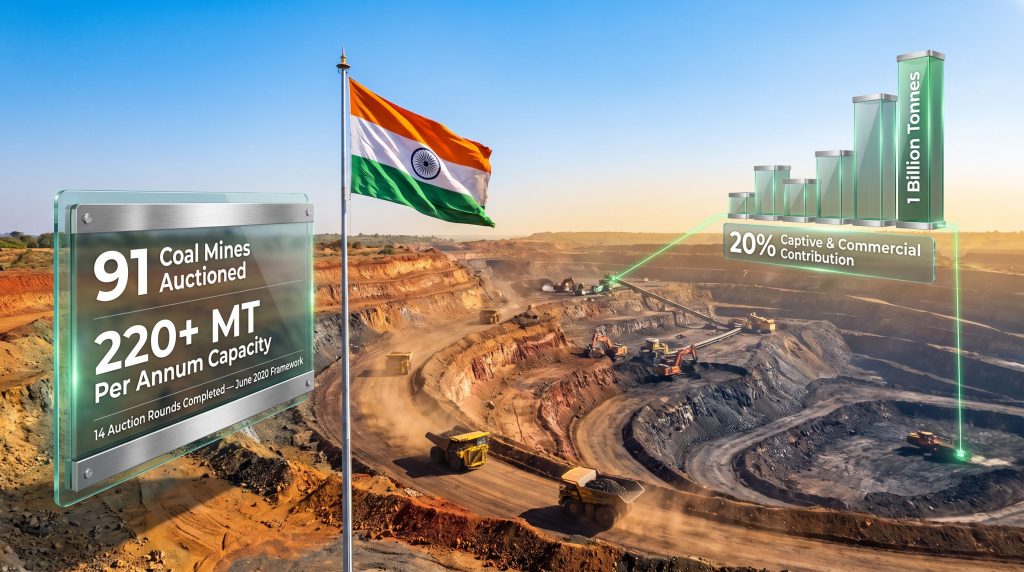
The institutional velocity of the auction programme has been notable. Since the framework launched in June 2020, India has completed 14 rounds of commercial coal mine auctions, with the 15th round underway as of mid-2026. The cumulative result is 91 coal mines successfully auctioned, representing a combined production capacity exceeding 220 million tonnes per annum.
| Milestone | Detail |
|---|---|
| Framework launch | June 2020 |
| Inaugural tranche blocks offered | 38 blocks |
| First allocation completed | November 2020, 19 blocks |
| Total auction rounds completed | 14 rounds (as of 2026) |
| 15th round status | Currently underway |
| Total mines successfully auctioned | 91 mines |
| Combined auctioned production capacity | 220+ MT per annum |
To sustain participation rates and awareness, the Ministry of Coal has been conducting roadshows and targeted stakeholder consultations with industry bodies and private companies. This outreach strategy is particularly relevant for partially explored blocks, where geological uncertainty represents a higher-risk proposition for private capital. Providing detailed technical briefings and engagement forums helps potential bidders make more informed participation decisions.
In addition, the proposed India coal trading exchange could further deepen market liquidity and price transparency as more auctioned mines reach operational status.
What Partially Explored Blocks Mean for Investors
The inclusion of partially explored blocks in the auctionable inventory is a dimension of the reforms that carries significant implications for both risk and opportunity. Fully explored blocks come with detailed geological surveys, defined seam profiles, and established resource estimates. Partially explored blocks, by contrast, carry geological uncertainty but are typically available at lower entry premiums.
For operators with in-house exploration capability or tolerance for geological risk, these blocks can represent substantial upside if exploration confirms productive seam continuity and quality.
Investors and operators evaluating partially explored blocks should treat the geological data gap as a primary due diligence risk variable rather than an afterthought. Seam thickness, coal rank (determining thermal versus metallurgical quality), ash content, and moisture levels can vary significantly across a block boundary, materially affecting mine economics.
How Private Mines Are Contributing to India's Billion-Tonne Achievement
India achieved over 1 billion tonnes of total coal production in each of the last two consecutive financial years, a milestone that reflects the cumulative effect of reforms across both the state and private sectors. Within that total, captive and commercial mines collectively accounted for approximately 20% of national coal output in the most recent financial year.
While Coal India Limited remains the dominant production entity, the 20% contribution from captive and commercial operations represents a structurally growing share. As more of the 91 auctioned mines reach full operational capacity in coming years, this percentage is widely expected to increase, gradually redistributing production responsibility toward the private sector.
Operationalisation Timelines: A Measurable Efficiency Dividend
One of the clearest indicators of regulatory improvement under the reform agenda is the reduction in mine operationalisation timelines. Continuous reforms have delivered the following efficiency gains:
- Fully explored blocks: Timeline reduced from 51 months to 40 months (a reduction of over 21%)
- Partially explored blocks: Timeline reduced from 66 months to 52 months (also representing approximately 21% improvement)
These are not marginal gains. In capital-intensive mining operations, every month of delayed production represents significant carrying costs on sunk capital expenditure. A 21% reduction in development timeline meaningfully improves project internal rates of return and de-risks investment cases, particularly for international operators evaluating India against competing jurisdictions. However, ongoing coal supply challenges remain an important consideration for operators planning production ramp-ups.
Coal Gasification and the Value-Added Processing Opportunity
One dimension of the commercial coal mining framework that receives less attention than the auction mechanics is the incentive architecture built around coal gasification and coal liquefaction. India has identified coal-to-gas conversion as a strategic priority, and the commercial mining reforms explicitly embed financial incentives for projects pursuing these pathways.
Coal gasification converts solid coal into syngas (a mixture of hydrogen, carbon monoxide, and carbon dioxide), which can then be used for power generation, fertiliser production, or further processing into liquid fuels. From an investment perspective, gasification projects carry higher capital costs but can deliver significantly better margins than raw coal sales, particularly when integrated with downstream chemical or energy operations.
The commercial mining reform framework's gasification incentives create an underappreciated optionality for operators who can combine extraction rights with downstream processing capability, effectively transforming a coal mining licence into a broader energy materials platform.
The next major ASX story will hit our subscribers first
The Policy Tensions That Will Define Long-Term Success
Parliamentary committee discussions around the commercial coal mining reforms have consistently surfaced a central tension: the pace of commercial expansion against the obligations of environmental stewardship and community welfare. Members of the Consultative Committee of Parliament attached to the Ministry of Coal have raised the importance of ensuring that the productivity gains from private sector participation do not come at the cost of ecological or social harm.
This tension is not unique to India. Every major coal-producing jurisdiction faces a version of the same challenge. What makes the Indian context distinctive is the scale: with 91 mines moving through various stages of development simultaneously, the aggregate environmental footprint of the commercial mining programme is substantial.
Land acquisition processes, water use, particulate emissions, and displacement of forest-adjacent communities all require active management frameworks that keep pace with the production ambitions embedded in the auction programme.
Coal in India's Energy Transition: A More Complex Story Than Headlines Suggest
Global narratives about energy transition often frame coal as a declining asset class. The reality within India's economic context is considerably more nuanced. With hundreds of millions of citizens still dependent on coal-fired power for basic electricity access, and with industrial demand from steel, cement, and aluminium sectors remaining structurally strong, coal is functioning as both a current necessity and a transition enabler in the Indian market.
Consequently, understanding coal's transition role in comparable large economies offers a useful lens through which to evaluate India's own trajectory. The question for long-term investors and policymakers is not whether coal will be phased out, but over what timeline and through what intermediate steps.
The commercial coal mining reforms essentially extend the productive lifespan of the sector's investment cycle by attracting private capital that would otherwise be withheld from a purely state-managed system. Furthermore, the reforms simultaneously build the production base that funds the fiscal resources India needs to invest in renewable infrastructure. However, green transition pressures will increasingly shape how investors and governments evaluate long-term coal asset commitments.
Frequently Asked Questions: Commercial Coal Mining Reforms in India
What Triggered India's Commercial Coal Mining Reforms?
The reforms responded to a structural contradiction: India held vast domestic coal reserves yet was importing significant volumes to meet demand, largely because the state-controlled model lacked the capital deployment efficiency and competitive incentives to accelerate domestic production. The framework launched in June 2020 aimed to close this gap by opening the sector to private and international operators.
Who Can Participate in India's Commercial Coal Mine Auctions?
Any qualified private domestic or foreign company may participate. The 100% FDI automatic route means international operators can enter without prior government approval, making India's coal auction process accessible to global mining capital on competitive terms. Brookings Institution analysis of reform recommendations highlights how open access models have functioned in comparable jurisdictions.
How Does the Revenue-Sharing Model Differ From the Old Royalty System?
Under the previous model, operators paid a fixed royalty irrespective of market conditions. The current revenue-sharing model ties payments to a percentage of gross revenue, creating a more dynamic relationship between production economics and government receipts, and embedding production incentives that reward early operationalisation.
How Many Auction Rounds Have Been Completed as of 2026?
Fourteen rounds have been completed, with the 15th currently underway. Across those rounds, 91 mines have been successfully auctioned with a combined production capacity exceeding 220 million tonnes per annum.
What Share of India's Coal Output Comes From Captive and Commercial Mines?
Approximately 20% of total national coal production in the most recent financial year originated from captive and commercial mines, within a total production environment where India exceeded 1 billion tonnes annually for two consecutive years.
What Are the Operationalisation Timeline Improvements Under the Reforms?
Fully explored block timelines have been reduced from 51 months to 40 months. Partially explored block timelines have fallen from 66 months to 52 months, each representing an improvement of over 21%.
Key Takeaways for Investors and Industry Analysts
- The June 2020 framework is the most consequential structural opening of India's coal sector since nationalisation in the early 1970s
- Fourteen completed auction rounds and 91 mines auctioned signal strong institutional execution behind the commercial coal mining reforms in India
- Operationalisation efficiency gains exceeding 21% for both block types translate directly into improved project economics for private operators
- The 20% production contribution from captive and commercial mines within a billion-tonne output environment indicates that the private sector's role is already material and growing
- Gasification and liquefaction incentives embedded in the framework create value-added processing pathways that extend beyond simple extraction economics
- Environmental and community management obligations represent the primary risk variable requiring active monitoring as commercial mining scale increases
- 100% FDI via the automatic route positions India as a genuinely competitive destination for global mining investment, particularly for operators with exploration and operational capabilities across both fully and partially explored block categories
- Broader considerations around Australia's resource and energy exports are also worth monitoring, given the competitive dynamics between major coal-exporting nations and India's expanding domestic production base
Readers seeking ongoing coverage of India's coal sector policy developments and production data can explore reporting available through ET EnergyWorld at energy.economictimes.indiatimes.com.
Disclaimer: This article contains forward-looking assessments regarding production trajectories, policy outcomes, and investment implications. These assessments are based on publicly available information and should not be construed as financial or investment advice. Readers should conduct independent due diligence before making investment decisions related to any sector discussed herein.
Want to Capitalise on Major Mineral Discoveries Before the Broader Market?
While India's coal reforms reshape global energy supply chains, commodity-driven market shifts create significant opportunities across the ASX — and Discovery Alert's proprietary Discovery IQ model delivers real-time alerts the moment significant mineral discoveries are announced, transforming complex data across 30+ commodities into clear, actionable insights. Explore historic discoveries and their remarkable returns on Discovery Alert's dedicated discoveries page, or begin your 14-day free trial today to position yourself ahead of the market.