August 7, 2026
When a Coal Giant Looks Beyond Coal: The Strategic Logic Behind India's Most Watched Mining Pivot
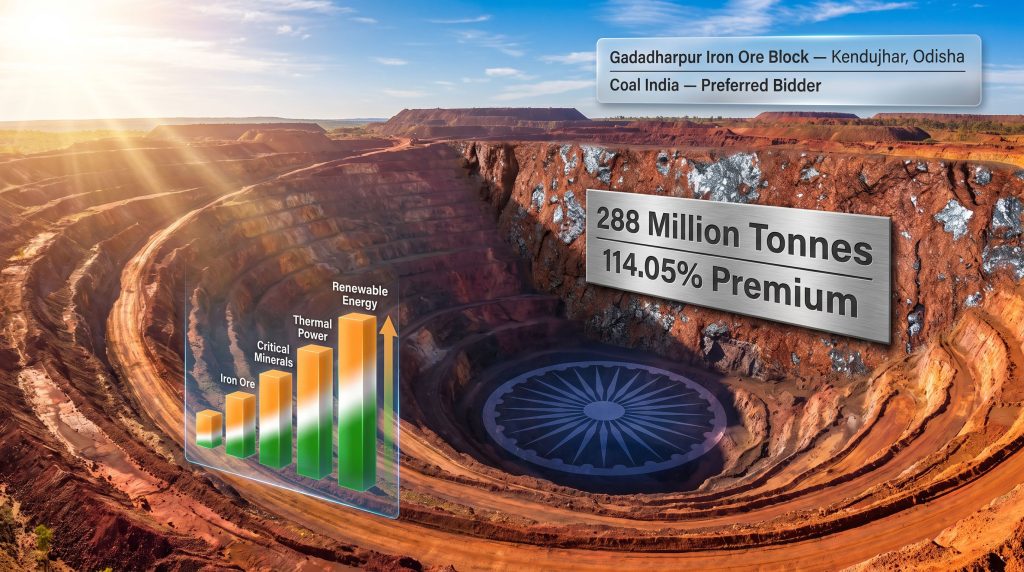
There is a quiet transformation underway inside India's largest state-owned mining enterprise, and it has nothing to do with coal. Across global resource markets, single-commodity dependency is increasingly viewed as a structural liability rather than an operational focus. For state-owned mining enterprises managing multi-billion dollar balance sheets, the question is no longer whether to diversify, but how quickly that diversification can be executed with credibility. Coal India preferred bidder for Odisha iron ore block Gadadharpur represents one of the clearest answers to that question yet delivered.
When big ASX news breaks, our subscribers know first
Why Coal India Is Reaching Beyond Its Core Commodity
India's coal sector is, by most long-range projections, entering a phase of demand moderation. While near-term consumption remains robust, driven by power generation needs and industrial use, the medium-to-long term trajectory reflects meaningful pressure from renewable energy capacity additions, efficiency improvements in power generation, and India's own decarbonisation commitments under its updated Nationally Determined Contributions.
For Coal India, which accounts for roughly 80% of India's total coal production, this structural horizon creates a revenue planning challenge that cannot be deferred indefinitely. The enterprise generates enormous cash flows today, but an institution of its scale must begin redeploying capital toward revenue streams that will remain resilient across the energy transition.
Iron ore is not an arbitrary diversification choice. It shares operational DNA with large-scale open-cut mining, involves similar logistics infrastructure, and connects directly to India's most capital-intensive industrial sector: steel. The logic of adjacency is compelling, even if execution will require meaningful capability development. Furthermore, understanding the iron ore market and deposit types is essential context for evaluating why this particular block attracted such competitive bidding.
Coal India's broader non-coal expansion now spans several verticals simultaneously:
| Business Vertical | Current Status |
|---|---|
| Iron Ore Mining (Gadadharpur) | Preferred Bidder – August 2026 |
| Critical Minerals Exploration | Active acquisition underway |
| Thermal Power Generation | Projects in development |
| Coal Gasification | Pilot and commercial-scale initiatives |
| Renewable Energy | Portfolio under active construction |
The sequencing of these bids matters. Iron ore offers scale and near-term strategic relevance to India's infrastructure cycle, while critical minerals offer longer-horizon upside tied to battery and energy transition demand. Coal India appears to be pursuing both tracks simultaneously rather than prioritising one over the other.
Understanding the Gadadharpur Block: Geology, Geography, and Scale
The Gadadharpur iron ore block sits within the Kendujhar district of Odisha, a region that geologists and mining professionals regard as one of the highest-density iron ore belts anywhere in India. Kendujhar, also referred to as Keonjhar, forms part of the Iron Ore Belt of the Eastern Ghats, a geological formation characterised by banded iron formations (BIFs) that have yielded some of India's most significant iron ore deposits over decades of extraction.
The block's reported resource base of 288 million tonnes is a substantial figure, though it must be understood in context. At the G3 exploration stage, this number represents an early-phase resource estimate derived from preliminary geological assessment and prospecting-level data. It is not a bankable resource, and it has not been delineated to the confidence levels required for a feasibility study.
What G3 Classification Actually Means in Practice
India's mineral exploration classification system runs from G4 through to G1, with G4 representing the earliest reconnaissance-stage work and G1 representing fully delineated, production-ready resources. Understanding where G3 sits in this hierarchy is critical for interpreting the Gadadharpur opportunity accurately. In addition, careful geological logging codes underpin the reliability of any resource estimate at this stage of exploration:
- G4: Regional reconnaissance, broad geological mapping
- G3: Prospecting stage, preliminary resource estimation with limited drill spacing
- G2: General exploration, resource estimation with greater geological confidence
- G1: Detailed exploration, feasibility-grade resource delineation
A G3 block has undergone enough work to justify a resource estimate, but the drill hole spacing is typically too wide to classify resources with high confidence under international reporting standards such as JORC or NI 43-101. This means the 288-million-tonne figure carries meaningful uncertainty, and actual resource tonnes confirmed at advanced stages could be materially higher or lower.
For Coal India, this is both a risk and an opportunity. If advanced exploration confirms or upgrades the resource, the acquisition at this early stage will be viewed as highly value-accretive. If the resource is revised downward, the 114.05% auction premium will look increasingly difficult to justify against project economics. A definitive feasibility study will ultimately be required before production decisions can be made with confidence.
The Strategic Value of Kendujhar's Iron Ore Geography
Beyond the block itself, location matters enormously in iron ore mining. Kendujhar's proximity to existing rail corridors connecting to Paradip Port and Vizag Port makes it logistically viable for both domestic supply and potential export. The district is already home to established mining operations by major players including NMDC and private steel majors, meaning infrastructure precedent exists even if Gadadharpur itself requires new investment.
Odisha accounts for approximately 55% of India's total iron ore reserves and contributes the largest share of annual national production output. For any institutional player seeking long-term iron ore supply security, Odisha is not merely one option among many — it is the primary arena. According to Mining Weekly, Coal India's entry into iron ore mining marks a significant strategic pivot for the state-owned enterprise.
Decoding the Auction: What a 114.05% Premium Really Signals
India's mineral block auction framework operates on a revenue-sharing model. When Coal India quoted a premium of 114.05% of the value of mineral dispatched, it committed to paying the Odisha state government that percentage above the baseline mineral value as an ongoing revenue share from future production. This is not a one-time payment — it is a structural cost embedded into every tonne of iron ore eventually extracted.
To contextualise this premium, iron ore block auctions in Odisha have historically attracted aggressive bidding from steel companies seeking captive supply security. Premiums above 100% have been recorded in competitive auctions where strategic motivation outweighs pure financial discipline. Coal India's 114.05% figure sits within this elevated range, suggesting the bid was driven by strategic positioning rather than conservative financial modelling.
A premium at this level is not irrational when viewed through the lens of long-term resource security. For a company with Coal India's production scale, locking in a 288-million-tonne iron ore resource at any reasonable cost today may prove far cheaper than attempting to acquire equivalent exposure in a more contested future market.
The financial implication is that project breakeven economics become more sensitive to iron ore price assumptions. If prices retreat from current levels during the production ramp-up phase, the high auction premium reduces the margin for error considerably. Consequently, monitoring the broader steel and iron ore market will be essential throughout Coal India's development timeline.
The Path from Preferred Bidder to Mining Lease: A Four-Stage Process
Coal India's current preferred bidder status is an important milestone, but it is not the finish line. India's mineral auction process involves distinct stages between initial bid award and actual mining commencement:
- Preferred Bidder Declaration: The highest qualifying bidder is identified (current stage as of August 2026)
- Conditions Fulfilment Window: The preferred bidder has 12 months to satisfy regulatory, financial, and technical conditions to convert to successful bidder status
- Mining Lease Deed Execution: The lease must be formally executed within three years of successful bidder confirmation
- Exploration Advancement and Production Development: Given the G3 stage, this phase involves significant capital commitment before first ore is produced
The 12-month conditions window is a genuine risk checkpoint. Preferred bidder status can lapse if conditions are not met within the stipulated timeframe. Under India's Mines and Minerals (Development and Regulation) Act, the regulatory requirements typically include environmental compliance submissions, state government approvals, and financial capability demonstrations. For a public sector undertaking of Coal India's scale, most of these conditions are procedural rather than substantive obstacles, but execution timelines in Indian regulatory processes are rarely perfectly linear.
Competitive Dynamics and What Coal India's Entry Changes
The participation of Coal India in iron ore block auctions introduces a qualitatively different competitive dynamic to a sector that has historically been contested between private steel producers seeking captive raw material supply and dedicated iron ore miners like NMDC. Jindal Steel has similarly emerged as a preferred bidder for another Odisha iron ore block, highlighting the intensifying competition for high-quality resources in the region.
A public sector undertaking with Coal India's financial depth can absorb high auction premiums more comfortably than a private player with shareholder return obligations and tighter capital allocation constraints. This creates an asymmetric competitive environment in future auctions, where Coal India's presence alone may elevate bidding floors in Odisha's mineral auction pipeline.
There is also a downstream integration question worth examining. If Coal India's iron ore production eventually feeds into state-linked steel producers, it could create a vertically integrated public sector supply chain spanning raw material extraction through to steel manufacture. This would represent a meaningful structural shift in how India's government-owned industrial base is organised, though any such integration would require deliberate policy coordination well beyond the scope of this single acquisition. India's broader critical minerals strategy further reinforces why institutions of this scale are prioritising long-term resource security.
The next major ASX story will hit our subscribers first
Key Risks Investors and Analysts Should Monitor
Several risk dimensions warrant careful tracking as this acquisition progresses:
- Resource risk: G3-stage estimates carry wide confidence intervals; advanced drilling could reveal the 288-million-tonne figure to be optimistic or conservative
- Premium sustainability: The 114.05% revenue share creates a structurally high cost base that narrows economic margins across iron ore price cycles
- Regulatory timeline risk: Environmental clearances and forest land approvals in Odisha have historically extended development timelines for new mining projects
- Capability gap risk: Open-cut hard rock iron ore mining differs technically from Coal India's core competency in coal extraction, potentially requiring external technical partnerships
- Capital allocation risk: Simultaneous expansion across iron ore, critical minerals, thermal power, and renewables creates execution bandwidth constraints for management
However, a well-executed critical minerals strategy running in parallel suggests Coal India is approaching diversification with deliberate intent rather than opportunistic deal-making.
Disclaimer: This article contains forward-looking analysis and speculative assessments regarding exploration outcomes, project economics, and corporate strategy. These do not constitute financial advice. Investors should conduct independent due diligence before making investment decisions.
What This Acquisition Signals for India's Broader Mining Landscape
The Gadadharpur bid is best understood not as a single transaction but as a directional signal about how India's largest public sector miners are repositioning themselves for the next two decades. The combination of a high-conviction auction premium, a resource-rich but early-stage block, and a 288-million-tonne resource estimate in one of India's premier iron ore districts reveals an institution that is willing to accept development-stage risk in exchange for long-term resource optionality.
For India's mining sector more broadly, the entry of Coal India preferred bidder for Odisha iron ore block status may catalyse further institutional participation in block auctions, potentially bringing additional financial depth and competitive intensity to a market that has occasionally struggled to attract qualified bidders for early-stage blocks. Whether that outcome benefits the sector's development efficiency or simply raises acquisition costs for private players will depend significantly on how Coal India executes its transition from preferred bidder to active iron ore producer over the years ahead.
The clock on that 12-month conditions window is already running.
Ready to Capitalise on the Next Major Resource Discovery?
Discovery Alert's proprietary Discovery IQ model delivers real-time alerts on significant ASX mineral discoveries — transforming complex geological and market data into actionable investment insights the moment they hit the exchange. Explore Discovery Alert's discoveries page to see how historic mineral discoveries have generated substantial returns, and begin your 14-day free trial today to position yourself ahead of the broader market.