August 7, 2026
The Invisible Mineral Holding Modern Industry Together
Most industrial supply chains have a single, underappreciated input that everything else depends on. For aluminium smelting, lithium battery electrolytes, semiconductor etching, refrigerant manufacturing, and pharmaceutical intermediates, that input is hydrofluoric acid. And hydrofluoric acid begins with one thing: acid-grade fluorspar.
Unlike its lower-value cousin, metallurgical-grade fluorite, acid-grade fluorspar (often called acidspar) must contain a minimum calcium fluoride (CaF₂) purity of 97% to be processed into anhydrous hydrogen fluoride and ultimately hydrofluoric acid. That purity threshold is non-negotiable for industrial applications, and it commands a substantial price premium over metallurgical-grade product. The distinction matters enormously to project economics, and it matters even more to the nations that depend on it.
The structural problem is one of geography. According to the United States Geological Survey, China accounts for roughly 60% of global fluorite mine production and controls an even larger share of downstream processing capacity. This concentration has prompted Australia, the United States, and the European Union to each classify fluorspar as a critical mineral, citing its irreplaceable role in clean energy manufacturing and its dangerously narrow supply base.
Against this backdrop, the Tivan Speewah fluorite project funding story is not simply a corporate finance update. It is one piece of a much larger puzzle about whether Western-aligned nations can build credible, independent supply chains for the inputs that advanced manufacturing cannot function without.
When big ASX news breaks, our subscribers know first
What Makes Acid-Grade Fluorspar So Strategically Significant?
The Downstream Chain Most Investors Overlook
The journey from fluorite ore to finished industrial product involves several value-adding steps that are rarely discussed outside specialist circles. Raw fluorite is first upgraded to acidspar concentrate, which is then reacted with sulphuric acid to produce hydrofluoric acid (HF). From HF, the industrial world derives:
- Aluminium fluoride, essential for aluminium smelting
- Refrigerants (including next-generation HFC and HFO compounds)
- Lithium hexafluorophosphate (LiPF₆), the dominant electrolyte salt in lithium-ion batteries
- Semiconductor etching chemicals, used in chip fabrication
- Pharmaceutical fluorination intermediates, enabling the production of many widely used drugs
What makes this chain particularly sensitive from a supply security perspective is that substitution options at the acidspar stage are extremely limited. There is no commercially viable alternative raw material for producing hydrofluoric acid at scale. This is precisely why the critical minerals demand surge carries real weight, rather than being a bureaucratic classification.
China's Processing Dominance: A Risk With Few Analogues
The fluorite supply concentration problem is arguably more acute than equivalent concerns about lithium or cobalt. With those commodities, new mine supply from diverse geographies is actively entering the market. With fluorite, the processing infrastructure required to produce battery-grade or semiconductor-grade HF derivatives is overwhelmingly located in China, meaning even ore from non-Chinese mines frequently travels through Chinese refineries.
Japan, South Korea, and Taiwan have experienced firsthand how rapidly this dependency can translate into industrial disruption when geopolitical tensions affect export flows. For Japan specifically, which has virtually no domestic fluorite production, securing a reliable allied-nation supply source has shifted from a commercial preference to a national industrial security priority. Furthermore, the intersection of critical minerals and energy security has never been more relevant to this debate.
The Speewah Project: Scale, Location, and Strategic Intent
A Globally Significant Deposit in Western Australia's East Kimberley
The Speewah vanadium-fluorite project is located in the East Kimberley region of Western Australia, a jurisdiction with established mining infrastructure and a track record of large-scale resource development. The deposit has been characterised as globally significant in scale, which is a meaningful designation given that genuinely large, high-purity fluorite deposits capable of supporting acid-grade production are uncommon outside of China and Mexico.
The project's central ambition is straightforward but historically unachieved in Australia: to become the country's first dedicated mining and processing operation producing acid-grade fluorspar. Australia currently exports raw mineral commodities across dozens of categories, but it has never operated a domestic acidspar production facility. Speewah represents a genuine step up the processing value chain, not merely another bulk mineral export operation.
The Joint Venture Architecture: Why Three Partners Were Needed
The incorporated joint venture structure underpinning the Speewah project reflects the complexity of what is being attempted. Three parties bring distinct and complementary capabilities:
| Joint Venture Partner | Role | Strategic Motivation |
|---|---|---|
| Tivan Limited | Project operator and JV lead | Develop Australia's first acidspar producer |
| Sumitomo Corporation | Equity investor and offtake partner | Secure fluorite supply for Japanese industrial clients |
| JOGMEC | Strategic co-investor | Advance Japan's critical mineral supply security |
Japan Australia Fluorite Associates (JAFA) serves as the vehicle through which the Japanese consortium engages with the project's financing activities. The fact that it was JAFA, rather than Tivan directly, that appointed the debt finance adviser ICA Natural Resources is telling. It signals that the Japanese partners are not passive equity contributors waiting for an Australian operator to deliver results. They are actively driving the financing process, which reflects the depth of Japan's strategic interest in seeing Speewah reach production.
Strategic context: Japan's near-total dependence on imported fluorite, predominantly sourced from China, has created an industrial vulnerability that JOGMEC's participation in Speewah is specifically designed to address. The Japan Organization for Metals and Energy Security exists precisely to deploy capital into foreign resource projects that serve Japan's long-term supply chain security objectives.
Breaking Down the Tivan Speewah Fluorite Project Funding Architecture
A Multi-Source Capital Stack Designed for Resilience
One of the less-discussed aspects of large-scale critical mineral project financing is that no single funding source can typically provide the capital required without creating unacceptable concentration risk for the project or the lender. The Speewah capital stack has been deliberately constructed across four distinct layers, each serving a different risk-return function.
Equity Layer 1: Japan Fluorite Corporation / Sumitomo
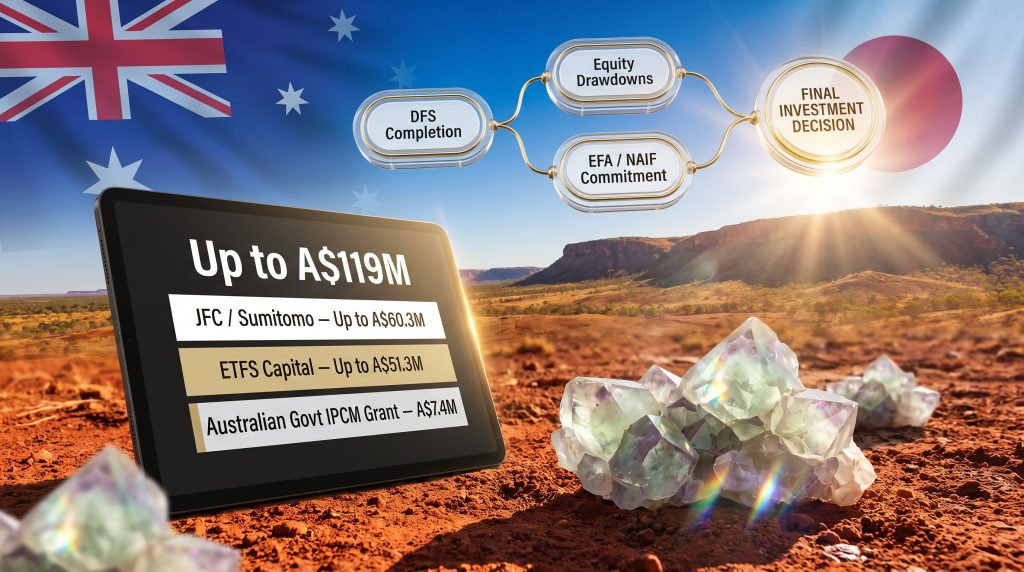
Japan Fluorite Corporation (JFC), the Sumitomo-backed investment vehicle, has binding agreements to invest up to A$60.3 million across three tranches in exchange for up to 22.5% of the Fluorite SPV. Two tranches have been completed: Tranche 1 of A$5.3 million and Tranche 2 of A$5.0 million, bringing total JFC investment to A$10.3 million and securing a 15% interest in the SPV. Remaining tranches are subject to milestone conditions aligned with project development progress.
Equity Layer 2: ETFS Capital
ETFS Capital has entered binding agreements to invest up to A$51.3 million across two tranches for up to 22.58% of the Fluorite Holding SPV. The first tranche of A$11.3 million was completed in January 2026. A second tranche of A$40.0 million remains outstanding, subject to agreed conditions.
Grant Layer: Australian Government IPCM Program
The Australian Government awarded the project a A$7.4 million grant under the International Partnerships in Critical Minerals (IPCM) program. As of March 2026, A$3.4 million had been received, with the balance of approximately A$4.0 million scheduled for disbursement later in 2026.
Debt Layer: Planned Project Finance
The debt financing layer is yet to be finalised, but two government financing bodies are in active engagement discussions. The appointment of ICA Natural Resources by JAFA formally initiates the structuring and execution phase for this component.
| Funding Source | Total Commitment | Amount Received/Completed | Remaining |
|---|---|---|---|
| JFC / Sumitomo (Equity) | Up to A$60.3M | A$10.3M | Up to A$50.0M |
| ETFS Capital (Equity) | Up to A$51.3M | A$11.3M | A$40.0M |
| Australian Govt (IPCM Grant) | A$7.4M | A$3.4M | ~A$4.0M |
| Debt Finance (Planned) | TBD | — | TBD |
| Total Identified Equity + Grant | Up to ~A$119M | ~A$25M | ~A$94M |
The Debt Financing Phase: What the ICA Natural Resources Appointment Actually Means
Decoding the Adviser Role in Project Finance
In project finance, the appointment of a financial adviser is not a ceremonial step. It marks the transition from informal lender conversations to a structured, documented transaction process. ICA Natural Resources will be responsible for transaction structuring, lender engagement, debt instrument selection, and execution management on behalf of JAFA.
The selection process spanned approximately two months and was described as highly competitive, indicating that multiple firms were assessed against defined criteria. This is standard practice for significant infrastructure transactions, where adviser capability directly influences the quality of lender engagement and ultimately the cost of debt capital. For further context on the broader Speewah fluorite strategy, the project's positioning within Australia's critical minerals pipeline adds considerable weight to lender assessments.
Export Finance Australia: The Letter of Support and What It Signals
Export Finance Australia (EFA) is Australia's export credit agency, providing financing solutions that support Australian exporters and projects with strategic national interest dimensions. EFA has issued a non-binding, conditional Letter of Support for the Speewah project.
In project finance terminology, a Letter of Support from an export credit agency occupies a specific and meaningful position. It is not a funding commitment, but it signals that the institution has reviewed the project at a sufficient level of detail to indicate conditional interest. For private lenders evaluating whether to participate in a project finance syndicate, export credit agency involvement typically serves as a risk-reduction signal, given the institutional due diligence process required to issue even a non-binding letter.
NAIF Due Diligence: A More Advanced Stage Than It Appears
The Northern Australia Infrastructure Facility (NAIF) provides concessional loans for infrastructure projects in Northern Australia that generate measurable public benefit. The Speewah project has advanced to NAIF's due diligence phase, which represents a materially more advanced stage of engagement than a preliminary expression of interest.
NAIF's assessment process is structured and sequential. Reaching due diligence means the project has passed initial eligibility screening, strategic fit assessment, and preliminary financial review. Active due diligence involves detailed examination of the project's technical, financial, legal, and environmental parameters.
Blended debt structure logic: The simultaneous engagement of both EFA and NAIF, alongside a newly appointed debt adviser, suggests the financing team is pursuing a structure that combines export credit agency support with concessional infrastructure lending. This blended approach can meaningfully reduce the project's overall cost of capital compared to relying solely on commercial bank debt.
The Critical Path to Final Investment Decision
Four Workstreams That Must Converge
A Final Investment Decision (FID) is the formal commitment by project owners to deploy full construction capital. It is the threshold between a development-stage asset and an operating one. For Speewah, FID requires the convergence of four parallel workstreams:
-
Definitive Feasibility Study (DFS) completion – Scheduled for later in 2026, the definitive feasibility study establishes the bankable cost estimate, production profile, and capital expenditure requirements that all financing parties rely upon. No lender will commit to project finance debt without a completed, independently verified DFS.
-
Remaining equity tranche drawdowns – ETFS Capital's A$40.0 million second tranche and JFC's remaining tranches are milestone-conditional and must be sequenced with the DFS completion timeline.
-
Debt finance structuring and execution – ICA Natural Resources will lead this process on behalf of JAFA, covering lender due diligence, term sheet negotiation, and financial close.
-
Government financing body binding commitments – Both EFA and NAIF must progress from their current engagement stages to binding commitment positions before the overall financing package can support an FID declaration.
What makes this critical path challenging is that each workstream has dependencies on the others. The DFS underpins debt structuring. Debt structuring influences equity drawdown conditions. Government financing body timelines are not directly controlled by the project proponents. Managing these interdependencies is where specialist project finance advisers earn their fees.
The next major ASX story will hit our subscribers first
Scenario Analysis: How the Funding Outcome Could Unfold
Four Plausible Pathways
Investors and industry observers assessing the Tivan Speewah fluorite project funding trajectory should consider multiple scenarios rather than a single linear outcome:
Base Case: The DFS delivers bankable outcomes within 2026, debt structuring proceeds efficiently with EFA and NAIF reaching binding commitments, and all equity tranches are drawn in sequence. FID is declared within the 2026-2027 window and construction commences.
Delayed DFS Scenario: If the DFS reveals capital cost pressures or processing yield outcomes that require additional optimisation work, the timeline to FID extends into 2027-2028. Lender appetite moderates pending revised project economics, and milestone conditions for equity tranches may require renegotiation.
Geopolitical Acceleration Scenario: Escalating supply chain tensions between China and Western industrial nations increase the urgency of alternative fluorite supply development. Government financing institutions accelerate their assessment timelines and potentially increase commitment levels. Japanese government deepens its participation through expanded JOGMEC engagement.
Market Pricing Headwind Scenario: A softening in global acid-grade fluorspar pricing reduces projected project revenues. Debt service coverage ratios tighten, potentially requiring additional equity contributions or project scope adjustments. FID is deferred pending improved market conditions.
Risk architecture note: The multi-source funding structure, blending private equity, government grants, export credit agency support, and concessional infrastructure lending, is specifically engineered to distribute risk across multiple stakeholders. This reduces the project's vulnerability to any single funding source withdrawal, which is a meaningful structural advantage compared to projects reliant on a single capital provider.
Australia-Japan Critical Minerals Partnership: A Replicable Template
Why the Speewah Structure Matters Beyond the Project Itself
The joint venture architecture underpinning the Tivan Speewah fluorite project funding model deserves analysis as a potential template for future allied-nation critical mineral supply chains, not just as a single project finance story.
The structure combines three elements that bilateral resource diplomacy increasingly requires: an Australian operator with project-level technical expertise, Japanese industrial capital seeking reliable offtake, and Japanese government-backed investment through JOGMEC providing strategic co-investment that de-risks the transaction for private equity participants. This tripartite model mirrors the structural logic of the Minerals Security Partnership (MSP) and the Quad critical minerals working group, which seek to create diversified supply chains across allied nations.
For Australia specifically, Speewah represents something genuinely new. Australia has historically excelled at extracting and exporting raw commodities, but the domestic production of a refined industrial chemical precursor like acid-grade fluorspar requires a different capability set and a different financing architecture. Consequently, Tivan's project overview illustrates how the company has positioned Speewah as a nationally significant asset capable of anchoring a new processing industry. If the project reaches production, it will demonstrate that Australia can successfully commercialise critical mineral projects through blended public-private financing structures, a proof of concept with implications well beyond fluorite.
Frequently Asked Questions: Speewah Fluorite Project Funding
What is the total equity commitment secured for Speewah to date?
Binding equity commitments total up to approximately A$111.6 million from JFC/Sumitomo (up to A$60.3M) and ETFS Capital (up to A$51.3M), plus a A$7.4 million Australian Government IPCM grant. Of this combined total, approximately A$25 million has been received or completed, with the balance subject to milestone conditions and ongoing financing processes.
What is the difference between acid-grade and metallurgical-grade fluorspar?
Acid-grade fluorspar requires a minimum 97% CaF₂ purity and serves as the feedstock for hydrofluoric acid production. Metallurgical-grade fluorite typically contains 60-85% CaF₂ and is used primarily as a flux agent in steel manufacturing. The purity gap between the two grades reflects a substantial difference in processing complexity, market pricing, and strategic value.
Why is Japan a cornerstone investor in an Australian fluorite project?
Japan has virtually no domestic fluorite production and has historically sourced the majority of its industrial fluorite requirements from China. Securing a reliable supply from an allied nation reduces Japan's strategic exposure to supply chain disruption, which is a priority explicitly pursued through JOGMEC's participation in projects like Speewah. The feasibility study and approval process has further reinforced Japanese confidence in the project's commercial viability.
What does a Letter of Support from Export Finance Australia actually mean?
A Letter of Support indicates that EFA has conducted sufficient preliminary review to signal conditional interest in potential debt participation. It is not a funding commitment, but it carries significant signal value for private lenders assessing whether to participate in a project finance syndicate alongside an export credit agency.
When is the Definitive Feasibility Study expected to be completed?
The DFS for the Speewah project is scheduled for completion later in 2026. Its outcomes will be the single most important near-term catalyst for the project's financing trajectory, as all debt structuring and remaining equity drawdown conditions are anchored to the bankable cost estimates and production profile it will establish.
This article contains forward-looking statements and scenario analysis based on publicly available information. It does not constitute financial advice. Readers should conduct their own due diligence and seek independent financial guidance before making investment decisions. Project timelines, financing outcomes, and market conditions are subject to change.
For ongoing coverage of Australia's critical minerals development pipeline, Australian Mining provides regular reporting on project development across Western Australia and Northern Australia.
Want to Stay Ahead of the Next Major ASX Critical Minerals Discovery?
Discovery Alert's proprietary Discovery IQ model delivers real-time alerts on significant ASX mineral discoveries across critical commodities like fluorspar, vanadium, and lithium — instantly transforming complex exploration data into actionable investment insights for both short-term traders and long-term investors. Explore how major mineral discoveries have historically generated substantial returns on Discovery Alert's dedicated discoveries page, and begin your 14-day free trial today to position yourself ahead of the broader market.