July 31, 2026
The mining industry faces unprecedented cost pressures as traditional extraction methods become increasingly expensive. However, Cerro de Pasco's Quiulacocha tailings reprocessing project offers a revolutionary approach that eliminates the costly processes of drilling, blasting, and hauling that have characterised mining industry evolution for decades. This innovative operation demonstrates how legacy mining districts can unlock substantial value through advanced metallurgical techniques.
Hydraulic Extraction Systems in Tailings Operations
Legacy mining districts worldwide contain substantial residual metal content trapped within historic tailings deposits. These accumulations result from metallurgical limitations and economic optimisation strategies employed during the early-to-mid 20th century. Furthermore, processing operations prioritised throughput velocity over maximum recovery efficiency during this period.
Submerged Material Handling Technology
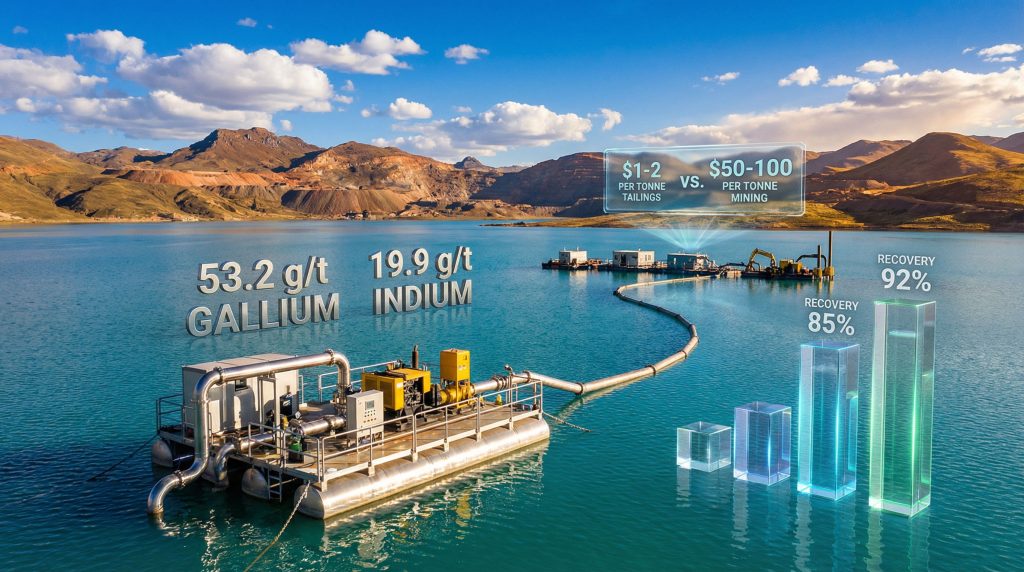
The Quiulacocha tailings deposit presents unique extraction parameters due to its location within a former lake bed environment. Consequently, the material remains fully saturated, creating specific engineering requirements for recovery operations. Pontoon-mounted slurry systems utilise submersible pumps to create a water-solid mixture that can be transported continuously through pipeline infrastructure.
Critical operational specifications include:
- Solids concentration maintenance between 65-75% by weight
- Continuous pumping capacity without material settling
- Pipeline flow optimisation to prevent blockages
- Particle size classification for processing efficiency
- Environmental containment during extraction operations
The elimination of conventional material handling equipment reduces operational complexity significantly. Traditional mining requires extensive fleet management, maintenance scheduling, and fuel consumption for mobile equipment. In contrast, slurry-based systems operate as stationary installations with substantially lower operational overhead.
Historic Processing Efficiency and Residual Value
Early flotation circuits achieved approximately 60% metal recovery within 24-hour processing cycles. Extended processing to 72 hours could increase recovery rates to 85-87%, but economic conditions favoured rapid throughput over extended residence time. This operational choice created substantial residual metal content within the tailings material.
At Quiulacocha, Phase 1 drilling across 40 locations confirmed average grades of 5.5 ounces per tonne silver-equivalent. The material composition includes silver at 1.66 oz/t, zinc at 1.47%, lead at 0.89%, and critically, gallium at 53.2 g/t. These concentrations reflect the unrecovered metals from historic operations spanning from 1906 to 1992.
Historic processing data reveals:
- Copper era (1906-1965): 16,369 thousand tonnes processed at 4.0% copper head grade
- Polymetallic era (1952-1992): 58,299 thousand tonnes processed with 3.3% lead, 8.6% zinc
- Average flotation recovery: 60% across most metals
- Economic rationale: Rapid turnover prioritised over extended recovery time
When big ASX news breaks, our subscribers know first
Financial Structure Analysis for Tailings Reprocessing
The cost differential between conventional mining and Cerro de Pasco's Quiulacocha tailings reprocessing creates a fundamental competitive advantage. Traditional operations carry substantial fixed expenses related to drilling, blasting, fleet operations, and waste management that are entirely absent from slurry-based extraction.
Comparative Cost Framework
| Operation Type | Cost Range (per tonne) | Primary Expenses | Capital Requirements |
|---|---|---|---|
| Open Pit Operations | $2-15 | Fleet, blasting, haulage | Heavy machinery, waste systems |
| Underground Mining | $30-200 | Ventilation, support, access | Shaft development, safety infrastructure |
| Tailings Processing | $1-2 | Slurry pumping, dewatering | Pipeline, pontoon systems |
This cost structure advantage remains consistent across varying commodity price environments. While metal prices fluctuate, the elimination of conventional mining expenses provides margin protection during market downturns and enhanced profitability during favourable price cycles.
Economic Modelling Parameters
Internal economic projections suggest significant profit potential based on different operational scenarios. However, these figures represent management estimates and require formal feasibility study validation.
Base Case Scenario (10,000 tonnes/day):
- Annual material processing: 3.6 million tonnes
- Metal recovery assumption: 40%
- Total operating cost: $10 per tonne
- Net smelter return: $52 per tonne
- Projected annual profit: $151 million
Optimised Scenario (20,000 tonnes/day):
- Annual material processing: 7.2 million tonnes
- Enhanced recovery including critical minerals: 70%
- Operating cost: $15 per tonne
- Projected annual profit: $650 million
The substantial difference between scenarios reflects the impact of scale and recovery optimisation rather than fundamental changes to the cost structure. Moreover, higher throughput enables fixed cost absorption across larger tonnage volumes while advanced metallurgical techniques can capture previously unrecovered metals.
Infrastructure Investment Considerations
Processing facility development presents strategic choices between third-party arrangements and purpose-built infrastructure. Third-party processing reduces initial capital requirements and accelerates production timelines but limits operational control and imposes toll processing fees.
Purpose-built facilities require higher upfront investment but enable customised metallurgical optimisation for the specific tailings composition. This approach provides long-term cost advantages through specialised equipment selection and process flow design tailored to maximise recovery of the multi-metal assemblage.
Slurry handling systems offer operational benefits:
- Continuous 24/7 processing capability
- Reduced environmental emissions compared to truck haulage
- Lower labour requirements for material movement
- Scalable capacity through pump system expansion
- Minimal dust generation in populated areas
Advanced Metallurgy and Critical Minerals Recovery
Modern processing techniques can target the 25-40% of metals remaining in historic tailings through enhanced flotation chemistry and optimised circuit design. The Quiulacocha deposit contains not only traditional precious and base metals but also critical minerals with strategic importance to technology supply chains.
Critical Minerals Strategic Value
The gallium content of 53.2 g/t positions Quiulacocha within strategically relevant categories for supply chain security. The United States maintains 100% import dependence for gallium, while China controls approximately 98% of global primary production. In addition, indium concentrations of 19.9 g/t provide additional strategic value for display technology and photovoltaic applications.
Technology sector applications include:
- Gallium: Semiconductor manufacturing, LED technology
- Indium: Flat panel displays, solar cell production
- Silver: Industrial electronics, antimicrobial applications
- Base metals: Construction, infrastructure development
These materials command premium pricing due to their technological importance and concentrated supply chains. Furthermore, recovery of critical minerals alongside traditional metals creates multiple revenue streams within a single processing operation.
Metallurgical Recovery Optimisation
Historic flotation operations prioritised speed over comprehensive metal extraction. Modern techniques can extend residence time, optimise reagent chemistry, and implement multi-stage separation processes to capture previously lost value.
The fundamental challenge in historic processing was economic rather than technical. Extended processing cycles could achieve 85-87% recovery rates, but rapid 24-hour cycles generating 60% recovery provided better cash flow characteristics for the operational context of that era.
Current processing approaches can implement:
- Advanced collector and frother chemistry for improved selectivity
- Extended flotation residence time for fine particle recovery
- Multi-stage cleaning circuits to upgrade concentrate quality
- Specialised critical mineral separation techniques
- Optimised pH control for selective mineral separation
Process Engineering Specifications
The tailings material characteristics determine optimal processing parameters. Particle size distribution affects flotation kinetics, while mineral assemblage composition influences reagent selection and circuit design. The saturated nature of the material requires dewatering considerations for concentrate handling and water recycling.
Key processing parameters:
- Optimal grinding requirements for liberation
- Flotation residence time for maximum recovery
- Concentrate grade specifications for smelter acceptance
- Tailings disposal and water management
- Critical mineral separation methodology
Laboratory metallurgical testing will establish definitive recovery rates and process flow sheets for the Quiulacocha material. These results will validate economic projections and support feasibility study development.
Strategic Supply Chain Positioning
The intersection of abundant historic tailings and critical mineral content creates unique strategic value beyond traditional mining economics. Geographic proximity to existing infrastructure and experienced workforce provides additional competitive advantages for development timeline and operational efficiency.
US Government Strategic Interest
The US International Development Finance Corporation's evaluation of up to $300 million in construction financing reflects strategic considerations beyond conventional project economics. Critical mineral supply chain security has become a priority for US energy and technology sectors.
Supply chain vulnerabilities include:
- 100% import dependence for gallium requirements
- Chinese market dominance in critical mineral production
- Limited alternative supply sources for technology manufacturing
- Geopolitical risks in concentrated supply chains
Projects that can provide alternative critical mineral sources receive enhanced institutional support and financing availability. Consequently, the combination of established mining district infrastructure and strategic mineral content supports this positioning.
Environmental Remediation Value Creation
Tailings reprocessing addresses multiple environmental objectives that support regulatory approval and community acceptance. The removal of sulphide-bearing materials can reduce acid mine drainage generation while surface area restoration enables alternative land use options.
Environmental benefits encompass:
- Acid drainage reduction through sulphide material removal
- Air quality improvement via dust control
- Water quality enhancement in surrounding watersheds
- Surface restoration for community development
- Noise reduction compared to conventional mining operations
These environmental improvements align with regulatory priorities and community interests, supporting permitting timelines and operational acceptance. The proximity of 67,000 residents to the deposit makes environmental considerations particularly significant.
Development Timeline and Risk Assessment
Cerro de Pasco's Quiulacocha tailings reprocessing projects follow different development pathways compared to conventional mining operations. Resource definition, metallurgical testing, and environmental assessment remain critical milestones, but mine reclamation innovation and infrastructure requirements are substantially reduced.
Technical Milestone Framework
The progression from exploration through production involves specific technical deliverables that reduce project risk incrementally. Each milestone validates assumptions and supports financing decisions for subsequent development phases.
Critical development stages:
- Resource definition expansion: Phase 2 drilling across additional tailings areas
- Metallurgical optimisation: Recovery rate confirmation and process design
- Feasibility study completion: Economic validation and financing preparation
- Environmental impact assessment: Regulatory compliance and permitting
- Processing facility construction: Infrastructure development for production
The US$5 million in milestone-based development funding from the DFC supports advancement through these technical stages with matching company contributions. This structured approach reduces development risk while maintaining project momentum.
Operational Risk Factors
Despite the cost structure advantages, tailings reprocessing operations face specific risk considerations that require management attention and mitigation strategies.
Primary risk categories include:
- Metallurgical performance: Actual recovery rates versus laboratory projections
- Commodity price exposure: Multi-metal revenue sensitivity to market conditions
- Regulatory compliance: Environmental standards evolution and compliance costs
- Processing facility optimisation: Third-party versus purpose-built facility trade-offs
- Infrastructure development: Capital cost escalation in remote locations
The multi-commodity nature of the deposit provides revenue diversification benefits but creates complexity in marketing and price risk management. Silver, zinc, lead, and critical minerals each follow different market cycles and pricing mechanisms.
Investment Framework and Market Positioning
The combination of low extraction costs, strategic mineral content, and established infrastructure creates multiple value drivers for investment evaluation. The elimination of conventional mining expenses represents a structural competitive advantage that persists across commodity price cycles.
Competitive Differentiation Factors
The project differentiates from conventional mining development through several key characteristics that reduce both development risk and operational costs.
Structural advantages include:
- Known resource base: Elimination of exploration risk through historic data
- Established metallurgy: Processing characteristics from historic operations
- Infrastructure leverage: Existing district power, roads, and water access
- Skilled workforce: Local mining expertise and operational experience
- Regulatory familiarity: Known permitting environment and stakeholder relationships
These factors combine to reduce development timelines and capital raising methods requirements compared to greenfield mining projects. The established mining district provides operational infrastructure and regulatory frameworks that support project advancement.
Financing Structure Optimisation
The DFC agreement structure demonstrates institutional validation of the project economics and strategic relevance before feasibility study completion. Milestone-based funding with repayment provisions upon qualifying financing events provides development capital without dilution during technical advancement phases.
Financing pathway elements:
- Development funding through technical milestones
- Construction financing evaluation for large-scale development
- Strategic value recognition for critical mineral content
- Environmental remediation benefits supporting regulatory approval
- Multi-commodity revenue diversification reducing single-metal exposure
The potential for up to $300 million in construction financing indicates institutional confidence in the project's technical and economic viability. This scale of financing would support substantial processing infrastructure development and working capital requirements.
Market Catalyst Identification
Several upcoming technical and regulatory milestones will provide investment catalysts and project advancement signals. These developments will validate key assumptions and support financing decisions for subsequent development phases.
Near-term catalysts encompass:
- Phase 2 drilling results across copper, silver, and gold tailings areas
- Metallurgical test work completion and recovery rate validation
- Feasibility study delivery and economic optimisation
- Environmental impact assessment progress and regulatory engagement
- Quiulacocha tailings project updates and DFC construction financing formalisation
Each catalyst addresses specific project risks while advancing toward production readiness. The combination of technical validation and institutional support creates multiple value inflection points during development progression.
The next major ASX story will hit our subscribers first
What Are The Long-Term Implications for Mining?
The success of Cerro de Pasco's Quiulacocha tailings reprocessing could reshape how the industry approaches legacy mining districts worldwide. Furthermore, this approach aligns with sustainable mining practices and critical minerals strategy objectives that governments are increasingly prioritising.
The combination of environmental remediation and resource recovery presents a compelling model for addressing historic mining impacts while generating economic value. This dual benefit structure could influence regulatory frameworks and financing availability for similar projects globally.
Investment decisions should consider the speculative nature of mineral development projects and the potential for actual results to differ materially from projected outcomes. Technical and economic projections require validation through formal feasibility studies and regulatory approvals before implementation.
Are You Ready to Capitalise on Revolutionary Mining Technologies?
Discovery Alert's proprietary Discovery IQ model delivers instant notifications on breakthrough mining innovations and technological advances across ASX-listed companies, ensuring you never miss the next transformative development in extraction methods or processing technologies. Begin your 14-day free trial today to position yourself ahead of the market and gain access to real-time insights that turn complex mining developments into actionable investment opportunities.