August 8, 2026
The Geology of Scarcity: Why Cesium Sits at the Intersection of Rarity and Rising Industrial Demand
Most critical minerals discussions centre on lithium, copper, or rare earths. Billions of dollars in exploration capital chase these commodities across dozens of jurisdictions each year. Cesium receives almost none of that attention, not because it lacks strategic importance, but because its geological occurrence is so restricted that the conventional frameworks investors use to evaluate mineral projects barely apply. Understanding cesium starts with understanding just how unusual its supply picture really is.
Pollucite, the primary cesium-bearing mineral, forms in highly evolved granitic pegmatites under very specific geochemical conditions. It is a caesium-aluminium silicate that can carry Cs₂O concentrations exceeding 30% in high-grade zones, making it by far the most economically viable host mineral for downstream cesium chemical production. Yet for all its chemical richness, pollucite deposits of meaningful scale are extraordinarily rare.
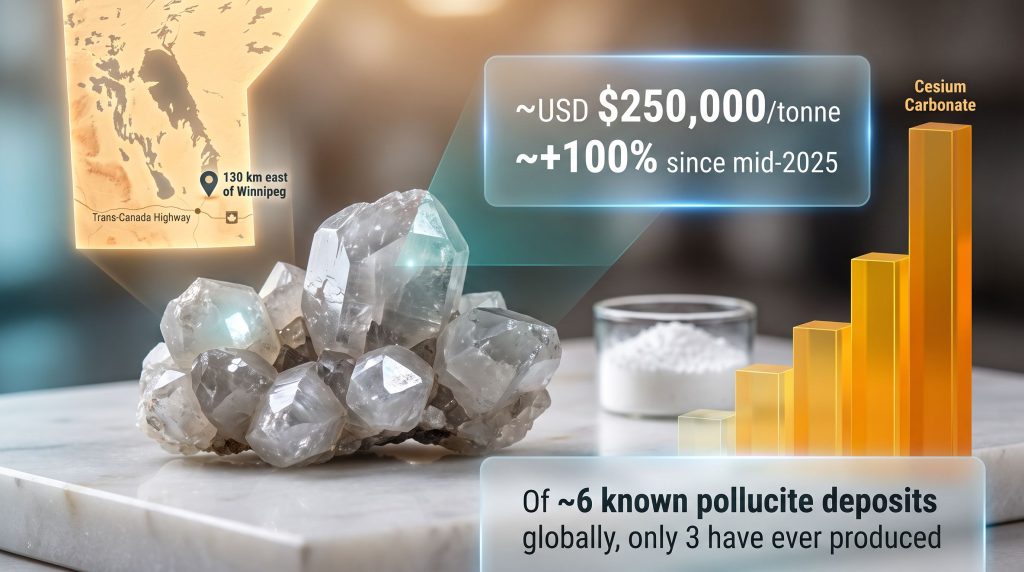
Of the approximately six known deposits worldwide, only three have ever transitioned from exploration into active ore production: Tanco in Manitoba, Bikita in Zimbabwe, and Sinclair in Western Australia. Today, Sinomine's Tanco operation in southeastern Manitoba is understood to be the only facility globally still producing cesium concentrate, making it one of the most concentrated single-source supply chains in the entire commodities universe.
This is the geological and commercial context that frames everything happening at the Grid Metals Falcon West cesium resource project in Manitoba. Furthermore, understanding the broader critical minerals strategy context helps illustrate why deposits like this attract increasing institutional attention.
When big ASX news breaks, our subscribers know first
Lucy South: Defining the Deposit at Falcon West
The Lucy South pegmatite sits within the Falcon West property, located approximately 130 kilometres east of Winnipeg with direct access via the Trans-Canada Highway. These are not minor logistical details. Infrastructure access is one of the most underappreciated cost variables in junior mining, and the combination of paved highway access and proximity to existing services materially reduces both the capital and timeline requirements associated with early-stage development.
What Does the Mineralisation Look Like?
Mineralisation at Lucy South is characteristically shallow. The cesium-rich core zone begins at less than two metres below surface in some areas and extends to approximately 40 metres depth, with the primary footprint delineated across a zone of roughly 120 by 50 metres. This near-surface geometry is significant because it directly informs the processing model.
Following a systematic multi-phase drill programme, Grid Metals completed 67 holes totalling 3,075 metres at the Lucy South target during Phase 2 alone. Consequently, interpreting drill results from this programme has been central to delineating the deposit's economic potential. The assay results speak to the deposit's quality:
| Drill Hole | Interval | Cs₂O Grade | Additional Detail |
|---|---|---|---|
| LU26-60 | 2.75 m | 5.44% Cs₂O | Includes 1.55 m at 8.49% Cs₂O |
| LU26-57 | 0.88 m | 2.53% Cs₂O | Phase 2 final assays |
| Earlier Phase | 3.5 m | 16.8% Cs₂O | Historical drilling |
| Earlier Phase | 3.35 m | 20.45% Cs₂O | Historical drilling |
| Earlier Phase | 3.0 m | 14.0% Cs₂O | Historical drilling |
It is important to distinguish the Lucy South cesium zone from the older, non-compliant historical estimate associated with the broader Lucy Pegmatite, which carried 226,000 tonnes at 1.75% Li₂O with no verified cesium grade and no NI 43-101 compliance. Grid Metals does not treat this figure as a current resource.
The forthcoming maiden NI 43-101 mineral resource estimate, commissioned through SGS Canada Inc. and expected in fall 2026, will be the first properly compliant resource figure for cesium at the property. That distinction matters considerably for institutional investors evaluating the project's technical credibility, and the associated mining study milestones will be closely watched by the market.
Why the Processing Model Changes the Economic Conversation Entirely
Conventional hard-rock mining carries a predictable suite of capital and operational burdens: flotation circuits, tailings storage facilities, water supply infrastructure, leaching systems. Each adds cost, complexity, and permitting exposure. The Lucy South deposit, however, sidesteps most of these requirements entirely.
How Does X-Ray Sorting Work Here?
Because the mineralisation is near-surface and the target mineral is physically distinguishable at the fragment scale, the proposed extraction flow sheet relies on crushing followed by X-ray ore sorting. Here is how the process works in practice:
- Run-of-mine rock is crushed to a manageable fragment size
- Individual fragments pass through an X-ray transmission sensor array
- The system identifies cesium-rich pollucite fragments based on their atomic density contrast with surrounding waste rock
- Compressed air jets physically separate high-grade material from low-grade waste
- The output is a cesium-enriched concentrate pile and a rejected waste stream, with both potentially carrying residual value
The critical implication: no tailings storage facility is required, no water-intensive circuit is needed, and the entire operation more closely resembles a quarry than a conventional mine. Total estimated project capital expenditure sits under CAD $10 million, a figure that is almost anomalously low relative to the commodity value of the target mineral.
For comparison, Power Metals Corp's Case Lake cesium operation in Ontario has been cited as a similarly scaled reference point for this type of quarry-style processing economics. The absence of water-intensive infrastructure is also expected to compress the environmental permitting timeline relative to a conventional mining operation, though Manitoba's regulatory process will ultimately set the pace.
The Avenir Minerals Joint Venture: Staged Capital With Institutional Weight
The deal structure underpinning Falcon West's near-term funding runway is, in many respects, as analytically interesting as the geology itself. Avenir Minerals, a wholly-owned subsidiary of Agnico Eagle Mines Limited, acquired an initial 15% interest in the Falcon West property for C$3.75 million in cash. TSX Venture Exchange approval for the transaction has been confirmed, and Grid Metals retains an 85% project interest along with operatorship.
What Are the Key Milestone Triggers?
What makes this agreement structurally compelling is its milestone-linked escalation mechanism:
- Stage 1 (Complete): C$3.75 million cash for 15% project interest, TSXV-approved
- Stage 2 (MRE trigger): Upon publication of the Lucy South NI 43-101 mineral resource estimate, Avenir gains the right to subscribe for up to 19.99% of Grid's issued and outstanding common shares at a 10% premium to the 30-day volume-weighted average price
- Stage 3 (PEA trigger): Upon completion of a Preliminary Economic Assessment or formal adoption of a mine plan, Avenir may acquire a further 15% project interest (reaching 30% total) at a price of 40% of project NPV at an 8% discount rate, calculated on a 100% project basis and applied to the 15% tranche
This structure does something unusual: it ties the acquisition price for the Phase Two Option to demonstrated project value rather than a fixed negotiated figure. If the Lucy South PEA generates a strong NPV8%, Avenir pays more for the next tranche. If the economics disappoint, the pricing adjusts accordingly. It is a structure that aligns both parties' incentives around delivering genuine project value rather than simply completing transactions.
The involvement of an Agnico Eagle subsidiary also introduces institutional technical oversight capacity alongside the capital, a dynamic that carries meaningful signalling value for a project at this stage.
Cesium Market Dynamics: Pricing, Demand, and the Albemarle Signal
Cesium carbonate currently trades at approximately USD $250,000 per tonne, a figure that has roughly doubled since mid-2025 and sits at approximately ten times the per-tonne price of lithium carbonate. This pricing level reflects both the mineral's genuine scarcity and the opacity of a market where the dominant processing entities, Sinomine and Albemarle, exert considerable influence over available supply.
At the ore level, the pricing benchmark that has emerged from discussions with the industry's primary operator suggests approximately $300 per tonne for every 1% of cesium content in direct ore. Analysts who have examined this figure closely consider it conservative relative to broader chemical market pricing, which implies significant upside sensitivity for deposits carrying grades materially above 1% Cs₂O.
Global annual demand is estimated at approximately 15,000 tonnes of 20% Cs₂O concentrate. In commodity terms, this is an extremely thin market, one where a single new producing deposit can meaningfully alter the supply-demand balance.
| End-Use Sector | Application | Demand Outlook |
|---|---|---|
| Energy technology | Perovskite solar cells (emerging) | High growth potential |
| Medical imaging | Caesium iodide scintillator detectors | Stable, established |
| Defence and aerospace | Atomic frequency standards, navigation systems | Strategically sensitive |
| Industrial chemistry | Cesium formate drilling fluids | Mature, price-sensitive |
| Research and telecom | Atomic clocks, frequency references | Niche but consistent |
Why Does the Albemarle Move Matter?
The most significant recent demand signal came in December 2025, when Albemarle, one of the world's largest specialty chemical companies, moved to secure all offtake from Power Metals' Case Lake cesium project in Ontario. This is a materially important data point. Albemarle's willingness to lock up pre-production supply from a junior explorer signals genuine buyer-side urgency that goes beyond routine procurement.
It establishes a precedent for offtake agreements at the pre-production stage in Western-jurisdiction cesium projects, a dynamic that could directly benefit Falcon West as it approaches its own resource and economic study milestones. The cesium discovery advantages seen at other comparable projects further reinforce why this category is attracting intensifying commercial interest.
Both the United States and Canada have designated cesium as a critical mineral. Despite this status, exploration capital directed at cesium remains a fraction of what flows toward lithium, copper, or rare earths. That disconnect between strategic classification and exploration investment creates the conditions in which early-movers with compliant resources can attract disproportionate institutional interest.
Manitoba Portfolio Depth: Diversification Beyond the Cesium Thesis
The Grid Metals Falcon West cesium resource story does not exist in isolation. Grid Metals holds a multi-commodity Manitoba land package where several other projects are being advanced substantially at partner expense:
| Project | Commodity | Grid Interest | Partner | Earn-In Structure |
|---|---|---|---|---|
| Falcon West (Lucy South) | Cesium / Lithium | 85% | Avenir (Agnico Eagle sub.) | C$3.75M for 15%; options to 30% |
| Makwa | Nickel-Copper-PGM | Minority | Teck Resources | Up to 70% via C$15.7M + C$1.6M cash |
| Mayville | Copper | 100% Grid | None | 32 Mt at 0.61% CuEq (M&I resource) |
| Donner | Lithium | 75% Grid | Tanco MOU | 6.8 Mt at 1.39% Li₂O (inferred) |
| Thompson East | Ni-Cu-PGM | Minority | Boliden | 80% earn-in via C$9.6M over 4 years |
The Teck Resources earn-in at Makwa and Boliden's option over Thompson East mean that Grid's nickel and platinum group metals targets are being explored at minimal direct cost to Grid's treasury. Furthermore, Donner's toll-milling memorandum of understanding with the nearby Tanco plant provides a potential low-capital processing pathway for lithium mineralisation that leverages existing regional infrastructure.
Mayville's measured-and-indicated copper resource provides a tangible asset backstop that exists independently of the cesium narrative. The multi-commodity logic here is deliberate: when one commodity cycle turns down, a portfolio exposed to several distinct end markets provides a degree of insulation that single-commodity juniors lack.
The next major ASX story will hit our subscribers first
The Development Roadmap: Milestones Through Late 2026 and Into 2027
Grid Metals' near-term calendar contains several events that compound on each other:
- Fall 2026: Maiden NI 43-101 MRE published for Lucy South (cesium and lithium combined)
- Concurrent with MRE: Avenir's equity subscription option becomes exercisable at a 10% premium to the 30-day VWAP
- Late 2026 to early 2027: Network engineering and mine planning work commences, with permitting discussions running in parallel
- Target by mid-2027: Preliminary Economic Assessment or formal mine plan completion, triggering Avenir's Phase Two Option at NPV8%-linked pricing
The permitting pathway is considered by management to be more comparable to a quarry-style regulatory process than a conventional mine approval, given the absence of tailings infrastructure and water-dependent processing. However, it is important to note that Manitoba's regulatory timelines will ultimately determine the actual pace of this pathway, and no permitting outcome should be assumed.
The maiden MRE functions simultaneously as a geological validation event and a balance sheet catalyst. Its publication triggers Avenir's option to increase its equity stake in Grid directly, meaning the resource announcement carries both technical and financial implications for shareholders. How the MRE grades and tonnage compare to what Phase 2 drilling has suggested will determine whether the downstream catalysts are accelerated or delayed. For investors, interpreting drill results accurately against the eventual resource model will be a key analytical exercise.
| MRE Outcome Scenario | Implied Signal | Effect on Downstream Options |
|---|---|---|
| High-grade, well-defined resource | Strong re-rating catalyst | Avenir likely exercises equity subscription promptly |
| Moderate grade, broader tonnage | Resource valid; PEA economics become the decisive test | Conditional on PEA outcome |
| Grade or continuity shortfall | Delays downstream milestones | Option exercise timing pushed out or renegotiated |
For a company carrying a market capitalisation of approximately C$31 million at the time of the Avenir deal, the asymmetry between current valuation and the potential re-rating from a well-graded maiden resource in one of the world's rarest mineral categories is the central investment consideration. According to Grid Metals' corporate disclosures, the commissioning of the MRE marks a pivotal transition from an exploration-stage to a resource-definition-stage project. That asymmetry, however, is equally a risk as a reward.
Resource estimates do not always confirm what drilling intercepts suggest, and investors should treat all forward-looking timelines and economic projections as inherently uncertain. As recent industry reporting confirms, high-grade cesium intercepts at the Grid Metals Falcon West cesium resource are generating growing attention from analysts tracking the Western supply deficit in this category.
This article is intended for informational purposes only and does not constitute financial advice. Resource estimates, price forecasts, and development timelines discussed herein involve forward-looking assumptions that may not be realised. Readers should conduct their own due diligence before making investment decisions.
Want to Be First When the Next Major Mineral Discovery Hits the ASX?
Discovery Alert's proprietary Discovery IQ model delivers real-time alerts on significant ASX mineral discoveries across more than 30 commodities — including critical minerals like cesium — turning complex geological data into actionable investment insights the moment they are announced. Explore historic discoveries and the substantial returns they have generated, then begin your 14-day free trial to position yourself ahead of the broader market.