
August 8, 2026
The Battery Metal Supply Gap That Is Reshaping Global Investment Strategy
Across the global mining sector, a structural tension has been building for years between the accelerating pace of electric vehicle adoption and the painfully slow pipeline of committed battery-grade nickel projects. Unlike copper or lithium, where supply responses have been relatively elastic, high-quality nickel sulfide deposits are geologically rare, concentrated in a handful of jurisdictions, and technically demanding to bring into production. The result is a widening gap between what the energy transition demands and what the mine supply pipeline can actually deliver through 2035.
It is within this context that the Tanzania Kabanga nickel project investment story has taken on outsized significance. What was once viewed as a promising but remote African development asset has evolved into a focal point for sovereign-backed capital from multiple continents, reflecting how fundamentally the competitive landscape for battery mineral supply has shifted. The broader battery metals investment landscape has rarely seen a single undeveloped asset attract this level of geopolitical attention.
When big ASX news breaks, our subscribers know first
Why Nickel Sulfide Chemistry Changes the Investment Calculus
Not all nickel is equal in the eyes of battery manufacturers, and understanding this distinction is central to appreciating why Kabanga commands so much attention. The global nickel supply is broadly split between two ore types: laterites and sulfides. Laterite deposits are far more abundant and account for the majority of global nickel reserves, but they require energy-intensive processing methods, typically through high-pressure acid leaching or rotary kiln electric furnace operations, to produce battery-suitable material.
Sulfide deposits, by contrast, produce a concentrate that is far more amenable to downstream refining into Class 1 nickel, the purity grade required for lithium-ion battery cathodes. The processing pathway is shorter, the energy consumption is lower, and critically, the carbon intensity per tonne of finished product is substantially reduced. For battery manufacturers navigating tightening environmental, social and governance requirements across their supply chains, these distinctions are no longer theoretical.
Indonesian nickel supply growth has dominated global output over the past decade through laterite-based processing, much of it reliant on Chinese capital and technology. While Indonesian production has suppressed benchmark nickel prices in the short term, it has simultaneously created a parallel premium market for traceable, low-carbon, sulfide-derived nickel. This bifurcation in the nickel market is quietly reshaping investment priorities across the sector.
Understanding the Kabanga Deposit: Geology, Scale, and Commercial Fundamentals
How Does the Geology Shape the Investment Case?
Located in the Kagera region of northwestern Tanzania, the Kabanga deposit sits within the East African Rift system, a geological corridor that has historically produced some of the world's highest-grade magmatic nickel deposits. The deposit's classification as a large, high-grade nickel sulfide system is not marketing language; it reflects a genuinely rare intersection of grade, scale, and mineralogical quality.
Kabanga's ore body carries not only nickel but meaningful concentrations of copper and cobalt, creating a co-product revenue structure that materially improves project economics and provides partial insulation against nickel price weakness. This polymetallic profile is particularly attractive to investors and offtake partners because it mirrors the battery material bundle that EV supply chains actually require, rather than a single-commodity exposure.
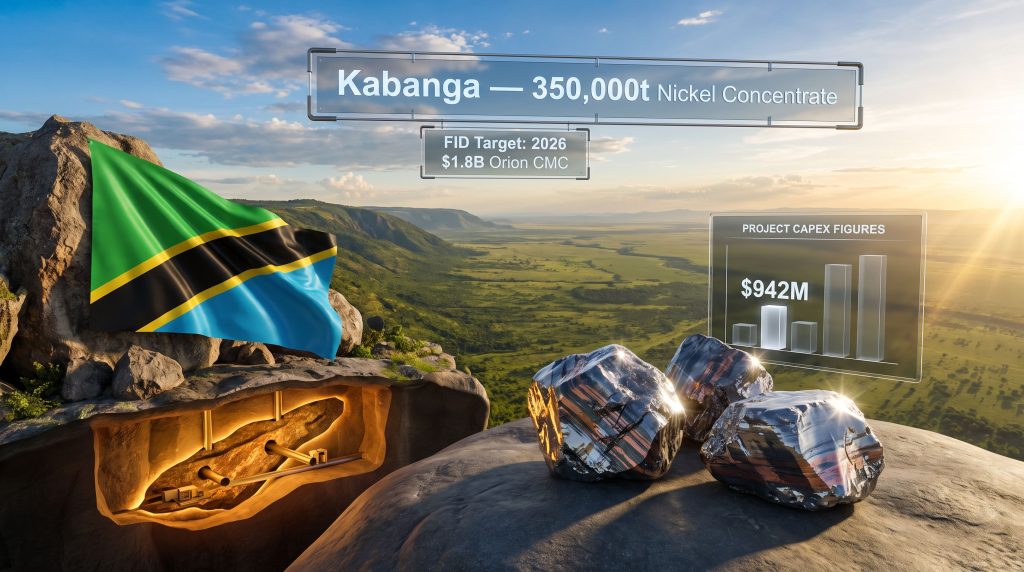
According to Lifezone Metals' feasibility study, the pre-production capital requirement for Kabanga stands at approximately $942 million, revised downward from an earlier estimate of around $991 million. This cost reduction reflects design optimisation and represents a meaningful improvement in capital efficiency. The project is expected to produce approximately 350,000 tonnes of nickel concentrate annually, alongside copper and cobalt co-products.
Kabanga's combination of sulfide mineralogy, polymetallic co-product streams, and a feasibility-confirmed capital cost below $1 billion positions it among the most capital-efficient large-scale undeveloped nickel projects in the world.
The Ownership Structure and How BHP's Exit Reshaped the Capital Stack
What Does the Current Stakeholder Structure Look Like?
The Tanzania Kabanga nickel project investment structure has undergone significant evolution. Lifezone Metals currently holds 100% of Kabanga Nickel Limited following BHP's exit from its 17% stake in 2025. BHP had previously backed up to $100 million committed to the project, comprising $40 million directed into Kabanga Nickel and $10 million into Lifezone's proprietary hydrometallurgical technology platform, with the remainder contingent on milestone achievement.
The Government of Tanzania retains a 16% sovereign equity stake in the project, a position established under Tanzania's mining framework for large-scale resource development. This stake is structurally non-negotiable but has introduced complexity into the financing timeline, as sovereign negotiation processes rarely move at the same pace as commercial transaction timelines.
| Stakeholder | Role | Ownership / Interest |
|---|---|---|
| Lifezone Metals | Project developer and operator | 100% of Kabanga Nickel Ltd (post-BHP exit) |
| Government of Tanzania | Sovereign equity partner | 16% project stake |
| BHP (historical) | Former strategic investor | Exited 17% stake in 2025 |
| Orion CMC (reported) | Preferred strategic equity investor | Undisclosed commitment size |
Standard Chartered was mandated to run the competitive strategic equity investor selection process, whilst Société Générale was appointed as debt arranger. Separating these two mandates across institutions is an intentional structural choice that reduces concentration risk and allows each financing stream to be optimised independently.
Who Is Orion CMC and What Does Its Emergence Signal?
Orion CMC was established in October 2025 with $1.8 billion in initial funding, drawing co-investment from the US International Development Finance Corporation and Abu Dhabi's L'imad Holding. This pairing represents a novel template in critical mineral finance: a vehicle that blends US government development capital with Gulf sovereign wealth, structured to compete directly with state-backed Chinese investment vehicles that have dominated African resource acquisition for two decades.
The consortium's most significant prior activity was a February 2026 preliminary agreement to acquire a 40% stake in Glencore's interests in two Congolese copper-cobalt mining operations. That transaction had not formally closed as of August 2026, which is worth noting when evaluating Orion CMC's execution track record at this stage of its development.
Reports citing people familiar with the deal indicate that Orion CMC has emerged as the preferred candidate for the Kabanga strategic equity investment, selected through Standard Chartered's competitive process from among multiple bidders. Lifezone's CEO confirmed publicly that a preferred partner had been identified and that negotiations were in their final phase, though the company declined to publicly confirm Orion CMC's identity or the size of the proposed commitment.
The structure of Orion CMC reflects a broader shift in how Western governments are engaging with African resource development, moving from policy advocacy toward direct capital deployment as a competitive tool.
Furthermore, this matters because sovereign-backed vehicles operate with fundamentally different risk tolerance and return expectations than traditional private equity. They can absorb longer payback periods, accept political and jurisdictional risk premiums that commercial investors would price prohibitively, and bring diplomatic leverage that can accelerate sovereign negotiation timelines.
Comparing Kabanga Against Global Nickel Development Peers
To appreciate the Tanzania Kabanga nickel project investment opportunity in context, it helps to benchmark it against comparable development-stage sulfide assets globally.
| Project | Country | Deposit Type | Estimated CapEx | Annual Output Target | Development Stage |
|---|---|---|---|---|---|
| Kabanga (Lifezone) | Tanzania | Nickel sulfide | ~$942 million | ~350,000t concentrate | Pre-FID, 2026 target |
| Turnagain (Giga Metals) | Canada | Nickel sulfide | ~$3.4 billion | TBC | Feasibility stage |
| Dumont (Waterton) | Canada | Nickel sulfide | ~$1.7 billion | ~33,000t Ni | Development stage |
| Tamarack (Talon Metals) | USA | Nickel sulfide | TBC | TBC | Advanced exploration |
Kabanga's capital efficiency relative to its output target compares favourably against peer projects. At under $1 billion of pre-production capital for 350,000 tonnes of annual concentrate output, the project's cost-per-tonne-of-output metric is competitive by global standards, particularly given its high-grade ore body and the processing advantages delivered by Lifezone's hydrometallurgical technology.
The next major ASX story will hit our subscribers first
The Hydrometallurgical Technology Advantage: A Differentiated Processing Approach
One of the less discussed but strategically significant aspects of the Kabanga investment case is Lifezone's proprietary hydrometallurgical refining technology. Conventional nickel sulfide projects have historically relied on pyrometallurgical smelting, a high-temperature process that produces significant sulphur dioxide emissions, consumes substantial energy, and generates processing by-products that require careful environmental management.
Hydrometallurgical processing uses aqueous chemistry rather than heat as the primary extraction mechanism. For nickel sulfide concentrates, this pathway can produce battery-grade nickel sulfate directly, bypassing the smelting step entirely and dramatically reducing the carbon intensity of the finished product. BHP's decision to invest $10 million specifically into Lifezone's technology platform, separate from its Kabanga project equity, was an important signal that major mining capital viewed the processing approach as commercially credible, not merely aspirational.
The downstream commercial implication is significant. Battery manufacturers and cathode active material producers increasingly require traceability and low-carbon certification for their supply chains, driven by regulatory requirements in the European Union and voluntary commitments from major automotive OEMs. Hydrometallurgically processed nickel from a sulfide source like Kabanga sits at the premium end of this traceability hierarchy.
The Path to Final Investment Decision: Milestones, Risks, and Scenarios
Lifezone has targeted a Final Investment Decision in 2026, though reporting indicates that Tanzania's sovereign negotiation pace has introduced some uncertainty around whether FID lands in late 2026 or drifts into early 2027.
Key factors that could accelerate the FID timeline:
- Formal announcement and closure of the Orion CMC strategic equity commitment
- Resolution of Tanzania's outstanding sovereign framework terms with Lifezone
- Completion of the debt financing package with Société Générale as arranger
- Stable or improving nickel price environment strengthening project economics
Key factors that could delay the FID:
- Protracted sovereign negotiation timelines with the Tanzanian government
- Failure to formally close the Orion CMC transaction after preferred partner designation
- Macro deterioration in nickel prices reducing project returns to below threshold levels
- Geopolitical risk reassessment by DFC or Abu Dhabi co-investors in response to regional developments
The gap between preferred partner designation and formal transaction close is a genuine risk factor. Orion CMC's Glencore Congo copper-cobalt deal, announced in February 2026, remained unclosed as of the latest available reporting. Investors should note that in large-scale mining finance, the distance between a signed letter of intent and a funded transaction can be substantial.
Risk Framework: What Investors Must Evaluate
Sovereign and Regulatory Risk
Tanzania's 16% stake introduces a negotiating counterparty with timeline imperatives that do not always align with commercial urgency. East African mining jurisdictions have generally maintained more stable regulatory frameworks than their Central African counterparts, but sovereign negotiations at this scale involve complex fiscal, employment, and infrastructure commitments that take time to conclude.
Commodity Price Risk
Nickel has faced sustained price pressure from Indonesian laterite supply growth. However, Kabanga's co-product revenue from copper and cobalt provides a natural partial hedge. The project's economics at various nickel price scenarios should be a core component of any investment analysis, given the sensitivity of a $942 million capital commitment to commodity cycle timing. Consequently, the broader nickel market recovery trajectory will directly influence how compelling these economics appear to prospective investors.
Execution Risk
Underground mine development in a greenfield East African context carries inherent complexity. Infrastructure requirements including power supply, water management, and logistics corridors for a remote large-scale operation are material considerations that are not always fully reflected in headline CapEx figures.
Financing Closure Risk
The sequencing of debt and equity financing closure is critical. A delay in either stream can create a funding gap that pushes construction commencement and, ultimately, first production scheduling.
What Kabanga Signals for African Critical Mineral Investment More Broadly
If the Orion CMC transaction closes and Lifezone achieves FID in the 2026-to-2027 window, Kabanga would represent one of the most consequential Western-backed critical mineral investments in Sub-Saharan Africa this decade. Tanzania would join the Democratic Republic of Congo, Zambia, and Zimbabwe as a recognised tier-one battery metal jurisdiction, with demonstrated capacity to attract sovereign-scale capital.
The competitive dynamic now emerging between US, European, and Gulf sovereign capital for African battery metal assets represents a structural shift that goes well beyond any single project. For decades, Chinese state-backed financing dominated African resource development by offering speed, scale, and minimal conditionality. The emergence of vehicles like Orion CMC suggests that Western governments have concluded that passive policy frameworks are insufficient and that direct capital participation is necessary to compete. In addition, the intersection of critical minerals and energy security concerns is accelerating this shift in ways that would have seemed unlikely just five years ago.
If Kabanga delivers on its development timeline, it could serve as a replicable model for sovereign co-investment in frontier nickel and battery metal projects across Africa, reshaping how Western capital engages with the continent's resource base through the 2030s.
For investors monitoring the Tanzania Kabanga nickel project investment thesis, the near-term focus should be on two triggers: formal confirmation of the Orion CMC equity commitment and resolution of Tanzania's sovereign framework negotiations. Both milestones are prerequisites for FID, and together they will determine whether Kabanga enters construction in the late 2020s or faces further delays.
This article is intended for informational purposes only and does not constitute financial or investment advice. Forecasts, timelines, and financial projections referenced herein are subject to material risks and uncertainties. Readers should conduct independent due diligence before making any investment decisions.
Ready to Identify the Next Major Battery Metal Discovery Before the Market Does?
Discovery Alert's proprietary Discovery IQ model delivers real-time alerts on significant ASX mineral discoveries — cutting through complex data across 30+ commodities to surface actionable opportunities in battery metals and beyond. Explore how historic discoveries have generated substantial returns on Discovery Alert's dedicated discoveries page, and begin your 14-day free trial today to position yourself ahead of the broader market.